
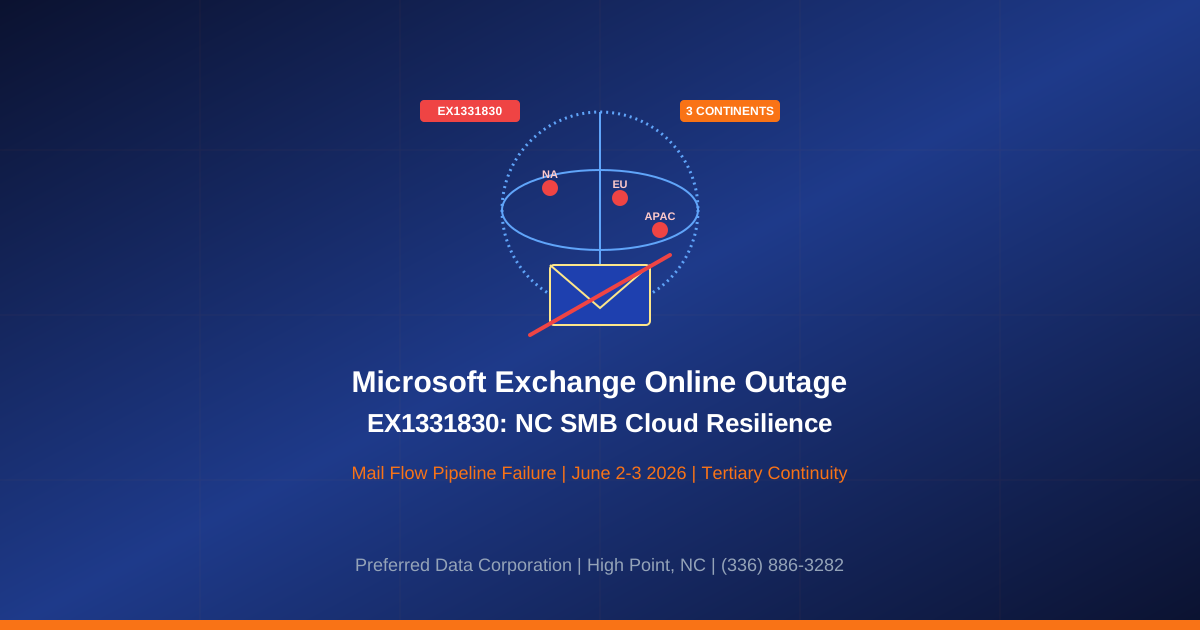
TL;DR: Beginning June 2, 2026, Microsoft Exchange Online incident EX1331830 delayed email delivery across North America, Asia-Pacific, and Europe. The failure hit the mail-flow pipeline directly, causing delivery delays and failures for enterprise and small-business Microsoft 365 tenants on three continents. For NC small businesses that built their entire email continuity story on Microsoft's published 99.9% SLA, this is a forcing function for a real resilience plan.
Critical takeaway: Microsoft 365's SLA pays back service credits, not the cost of a missed customer quote, a delayed invoice, or a stranded sales contract. NC small businesses must own their resilience: tertiary mail-flow paths, documented runbooks, communication failovers, and managed incident response. Cloud is not a substitute for a plan.
Need a real cloud resilience plan? Contact Preferred Data Corporation at (336) 886-3282. Protecting NC small businesses since 1987.
What is Exchange Online EX1331830?
EX1331830 is the Microsoft service health advisory tag for a June 2, 2026 Exchange Online incident that delayed email delivery across the mail-flow pipeline in North America, Asia-Pacific, and Europe. Per BleepingComputer's coverage, Microsoft said the issue caused extensive delays or failures for Exchange Online users trying to send or access their email.
Three facts NC SMB owners need to internalize about EX1331830:
- It was a mail-flow pipeline failure, not a regional Azure outage. Per BleepingComputer, the affected component was the mail-flow pipeline itself, and the failure cut across continents. Because of that, geographic failover or alternate Azure regions would not have helped affected tenants.
- It followed another Microsoft 365 incident the day before. Per BleepingComputer's reporting, a separate June 1 incident (MO1329446) left some users unable to open files in Office for the web or Microsoft Teams. Two outages in 48 hours is a pattern, not a fluke.
- Microsoft's SLA pays out service credits, not business losses. Per Microsoft's Service Level Agreement for Online Services, the recourse for downtime is service credit toward your subscription fee. It does not cover the missed customer quote, the delayed payroll batch, or the stranded contract.
The practical question for an NC SMB is "If Microsoft 365 email goes dark for 6 hours mid-week, can my business still take orders, close deals, and pay people?" If the answer is "we wait it out," that is the gap to close.
Why does EX1331830 matter so much for NC small businesses?
Because most NC SMBs have collapsed their entire customer-facing and internal-comms stack onto Microsoft 365 - so an Exchange Online outage cuts the company's nervous system at the very moment it most needs to function.
- Email is still the system of record for B2B commerce. Email is the dominant channel for quote-to-cash, customer service, and vendor coordination in SMB B2B. An outage isn't an inconvenience - it's a revenue interruption.
- Manufacturing scheduling lives in email. NC manufacturers run shop-floor scheduling, supplier confirmations, and shipping arrangements over email. An Exchange Online outage drops everything that has not already been scheduled into limbo.
- Construction firms run jobsite coordination on email and Teams. A six-hour outage during a normal jobsite week is a multi-thousand-dollar productivity loss across a typical 25-person crew.
Quotable definition: EX1331830 is the Microsoft service health advisory tag for a June 2, 2026 Exchange Online mail-flow pipeline failure that disrupted email delivery for Microsoft 365 customers across North America, Asia-Pacific, and Europe. The incident was not regional - making it a forcing function for NC small businesses to invest in cloud resilience beyond a single vendor SLA.
How can an NC small business build resilience against Exchange Online outages?
Layered resilience is the only durable answer. The goal is not "uptime equal to Microsoft" but "business that can keep running when Microsoft is down."
- Stand up a tertiary mail-flow path. Define a secondary mail-relay or third-party email continuity service that can queue inbound mail when Microsoft 365 is unreachable. Cloud-native services like Mimecast, Proofpoint Essentials, and Barracuda Email Continuity replay queued mail back into the tenant once service is restored.
- Subscribe to and route Microsoft service health alerts. Critical incidents (EX, TM, MO advisories) should be routed to the on-call IT contact via SMS and an internal status page - not just an admin email account that may itself be unreachable during the incident.
- Document and rehearse a 24-hour outage runbook. The runbook must cover: switching customer-facing comms to a backup channel (phone tree, web chat, social), invoking the tertiary mail path, communicating internally over Slack/Teams/SMS, and capturing inbound revenue that would otherwise be lost.
- Diversify communication channels deliberately. Pair Microsoft Teams with a second channel for incident response (phone tree, SMS broadcast, or a non-Microsoft chat). Avoid stacking every communication path on the same vendor.
- Buy real incident response, not just a phone number. A managed incident response retainer ensures the runbook gets executed and Microsoft service health updates are interpreted into business action - not a one-line "Microsoft is down" message at 7 AM.
The defensive principle is straightforward: a single-vendor cloud is a single point of failure. Build at least one out-of-band path for the comms that drive revenue.
What does layered cloud resilience cost an NC SMB?
For a typical 25-100 employee NC SMB on Microsoft 365 Business Premium, layered resilience can be added for a fraction of the revenue lost to a single multi-hour outage.
| Control | Typical NC SMB monthly cost | What it addresses |
|---|---|---|
| Tertiary email continuity (Mimecast/Proofpoint/Barracuda) | $3-$6 per user | Queues and replays mail during Exchange Online failures |
| Microsoft service health alerting to SMS/on-call | Bundled with managed IT | Awareness on minute 1, not hour 6 |
| Documented 24-hour outage runbook with rehearsals | Bundled with managed IT | Coordinated response, not improvisation |
| Secondary communication channel (SMS/phone tree/non-MSFT chat) | $50-$500/month | Keeps incident-response comms moving |
| Backup productivity stack (offline doc access, edge-cached) | Bundled with managed IT | Lets revenue work continue during outage |
| Incident response retainer | $500-$2,000/month | Executes runbook, manages comms, advises business |
The resilience stack above costs a fraction of a multi-hour outage.
Why is this an NC-specific concern?
Because NC's small business mix is heavily B2B - manufacturing, construction, professional services, healthcare - and B2B revenue runs on time-sensitive email and Teams collaboration.
- NC construction firms coordinate jobsites by email and Teams. A multi-hour outage during a project phase change can stall a $5M project by hours of crew time.
- NC professional services and healthcare firms have customer-notification obligations. Per North Carolina General Statute Chapter 75, regulated NC businesses must be able to reach affected customers within statutory windows - which a one-vendor email outage compromises.
Where do you stand? Take our free cybersecurity assessment or call (336) 886-3282 for a cloud resilience review.
How is Preferred Data helping NC SMBs build cloud resilience?
Preferred Data Corporation has been protecting NC small businesses since 1987. Our managed IT services build the layered resilience EX1331830 demands: tertiary email continuity, Microsoft service health alerting to SMS/on-call, documented 24-hour outage runbooks with rehearsals, backup productivity stacks, and managed incident response retainers. Our managed cybersecurity services extend the same discipline to identity, endpoint, and data resilience.
For NC manufacturers, construction firms, and regulated mid-market organizations across High Point, Greensboro, Charlotte, Raleigh, Winston-Salem, and the Piedmont Triad, we bring 200-mile on-site response, BBB A+ accreditation, and an average client tenure of more than 20 years.
Ready for a resilience plan that survives the next Microsoft outage? Contact Preferred Data at (336) 886-3282 or visit our contact page to schedule a cloud resilience review.
Frequently Asked Questions
What is EX1331830?
EX1331830 is the Microsoft service health advisory tag for a June 2, 2026 Exchange Online mail-flow pipeline failure that disrupted email delivery for Microsoft 365 customers across North America, Asia-Pacific, and Europe. Per BleepingComputer, Microsoft said users were experiencing "significant delays in sending and receiving email messages, with some email messages remaining undelivered for over an hour."
How is EX1331830 different from a regional Azure outage?
EX1331830 affected the mail-flow pipeline directly, not a specific Azure region. Per BleepingComputer, the failure cut across three continents. Because of that, geographic failover and alternate-region strategies would not have protected affected tenants.
Does Microsoft's SLA compensate NC SMBs for business losses during an outage?
No. Per Microsoft's Online Services SLA, Microsoft's recourse for downtime is a service credit toward the affected subscription. It does not compensate for lost revenue, missed quotes, delayed shipments, or contractual penalties.
What is "tertiary mail-flow" and how does it help?
A tertiary mail-flow path is a third-party email continuity service - common providers include Mimecast, Proofpoint Essentials, and Barracuda - that queues inbound mail when the primary Microsoft 365 tenant is unreachable and replays it once service is restored.
How fast can a NC SMB stand up email continuity?
For most NC SMBs within 200 miles of High Point, a managed email continuity service can be deployed and tested within 5-10 business days. Call (336) 886-3282 to start the engagement.
Should NC small businesses move off Microsoft 365 because of these outages?
No. Microsoft 365 remains the most cost-effective and feature-complete productivity platform for most NC SMBs. The right response is not to leave - it is to add tertiary resilience so a single-vendor outage does not become a single-business outage.
Does Preferred Data manage Microsoft 365 for NC SMBs?
Yes. Preferred Data Corporation manages Microsoft 365 tenants across NC manufacturers, construction firms, professional services, and healthcare-adjacent SMBs. We layer email continuity, identity protection, conditional access, and managed incident response on top of Microsoft 365. Call (336) 886-3282.
Related Resources
- Managed IT Services - Microsoft 365 management, email continuity, runbook design
- Managed Cybersecurity Services - Identity, endpoint, data resilience
- Manufacturing Industry Solutions - Just-in-time supply chain comms resilience
- Microsoft 365 January 2026 Outage - Earlier outage context
- AWS May 2026 Outage Cloud Resilience - Cross-cloud lessons
- Free Cybersecurity Assessment - Cloud resilience gap analysis
- Contact Preferred Data Corporation - Cloud resilience review