
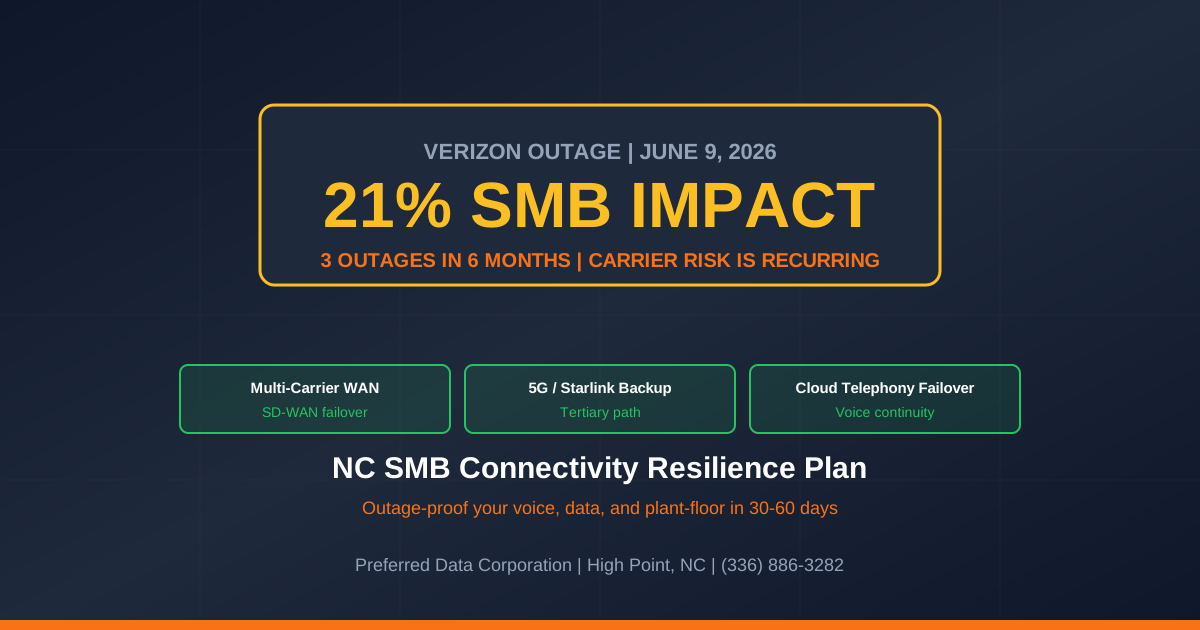
TL;DR: On June 9, 2026, fiber cuts disrupted Verizon wireless service for customers in the West Texas area, according to a Verizon statement reported by KTXS. It followed the January 14, 2026 outage, which the FCC says affected millions of customers. In the January outage, 21% of small businesses reported being affected. NC small businesses still running single-carrier internet, phone, and field-services connectivity are absorbing real revenue loss every time a carrier has a bad afternoon.
Key takeaway: Carrier outages are not anomalies in 2026; they are a recurring business cost. SMBs that lose phone, email, point-of-sale, plant-floor SCADA, or field-services dispatch during a four-hour outage absorb measurable revenue loss every quarter. The fix is multi-carrier WAN failover + cellular / Starlink backup + cloud telephony failover - not waiting for the next outage credit.
Need your connectivity made outage-proof before the next Verizon / Spectrum / AT&T disruption? Preferred Data Corporation runs managed network services for NC small businesses since 1987. Call (336) 886-3282 or book a connectivity resilience review.
What happened on June 9, 2026 and why does it matter to NC SMBs?
Verizon said fiber cuts caused a disruption in wireless service for customers in the West Texas area on June 9, 2026, per KOSA's coverage, and that service was fully restored by 5 a.m. CT on June 10, per KTXS. Unlike the January 14, 2026 outage, the June 9 event was confined to one region - which makes it easier to dismiss. That dismissal is exactly the trap NC SMBs need to avoid.
Three facts an NC SMB owner should write down:
- At least two Verizon disruptions in six months. January 14 (SOS mode) and June 9 (West Texas fiber cuts). The frequency is the story.
- 21% of small businesses reported direct impact from the January outage, per a Recon Analytics survey published by Light Reading. That is a one-in-five hit rate from a single ISP event.
- NC SMBs absorb the cost in revenue, not in outage credits. Verizon itself said its January credit "isn't meant to make up for what happened".
For an NC manufacturer in High Point with plant-floor SCADA on a single ISP, a distributor in Greensboro with VoIP routing through a single carrier, or a professional services firm in Charlotte with M365 / Teams traffic over a single fiber drop, every carrier event is a revenue event - whether or not the SMB notices the cause.
What does a carrier outage actually cost an NC small business?
It depends on the workload, but the realistic answer is "more than the outage credit." The practical impact on a 25-500 employee NC SMB during a 2-4 hour outage breaks down as follows:
| SMB Workload | Outage Impact | Realistic Loss |
|---|---|---|
| VoIP / cloud telephony | Inbound and outbound calls fail | Lost sales, lost service appointments, lost callbacks |
| M365 / Google Workspace email | Workforce idle on email-dependent tasks | Idle labor hours + missed customer responses |
| Point-of-sale + payment processing | Card not present, manual entry only | Lost transactions or fraud risk |
| Plant-floor SCADA + MES | Production line slows or halts | Direct manufacturing throughput loss |
| Field-services dispatch | Truck rolls without routing | Re-work and missed SLA windows |
| ERP / cloud apps | Order entry, invoicing, shipping stalled | Order-cycle delays and customer escalations |
| Remote workforce | Home connectivity intact but office VPN dark | Productivity loss for hybrid staff |
The carrier outage credit is modest by comparison: after the January 2026 outage, Verizon offered affected customers a $20 account credit, which it said covers multiple days of service on average. For an NC manufacturer, that is a small offset against potentially tens of thousands in lost throughput.
Why is multi-carrier WAN failover the only durable answer?
Because single-carrier connectivity in 2026 is statistically equivalent to single-server architecture in 2010 - the carrier will fail, and the only question is whether the SMB has a failover. The durable answer combines three resilience tiers:
- Multi-carrier WAN with SD-WAN failover. Two independent ISPs (fiber + cable, or fiber + fixed wireless) terminated on an SD-WAN appliance that fails over inside seconds, not minutes. The two carriers must use different last-mile infrastructure - two fiber providers in the same conduit fail together.
- Cellular or Starlink backup tier. A third connectivity option that does not depend on terrestrial fiber for the same SMB site. Modern SD-WAN appliances ship with embedded 5G / LTE modems; Starlink provides a satellite alternative that has survived terrestrial outage scenarios.
- Cloud telephony failover. Cloud-hosted VoIP (Microsoft Teams Phone, RingCentral, 8x8) that fails inbound calls to mobile devices or auto-attendant during an outage, instead of going to a dead PBX.
Quotable definition: Multi-carrier WAN failover is the SMB equivalent of "don't put your only backup on the same drive as production." In 2026, the carrier is the drive. NC SMBs that keep one carrier per site are absorbing recurring revenue loss they treat as inevitable - because they have not seen the failover quote.
For NC manufacturers in the Piedmont Triad and distributors in Greensboro, multi-carrier WAN also protects plant-floor SCADA, MES, and shipping-label printing - workloads that have a direct production throughput cost when connectivity is down.
What should an NC SMB do this month to start the connectivity resilience plan?
Run a four-step plan inside 30 days. The next carrier event is not a question of "if" - it is a question of "is your SD-WAN already provisioned when it lands."
- Inventory carrier dependency by workload (this week). Map every business-critical workload (voice, email, POS, ERP, SCADA, dispatch, payment) to the specific ISP, circuit, and last-mile provider it depends on. Single-carrier workloads are the priority list.
- Get quotes for a second-carrier ISP with last-mile diversity (this week). Different fiber provider, different conduit, or fiber + fixed-wireless mix. NC SMBs in the Piedmont Triad have multiple fiber options (Spectrum Business, AT&T Business Fiber, Lumen / Brightspeed, Open Broadband, fixed-wireless WISPs) plus 5G FWA from T-Mobile and Verizon.
- Deploy SD-WAN with cellular / Starlink failover (this month). Fortinet SD-WAN, Cisco Meraki, or VeloCloud appliances that fail over between ISPs in seconds and use cellular / Starlink as a tertiary path. Pair the SD-WAN with a managed firewall service to keep the security posture aligned with the connectivity changes.
- Move VoIP / telephony to cloud failover (this month). Microsoft Teams Phone, RingCentral, or 8x8 with auto-attendant + mobile-failover so inbound calls reach a person or a queue even if the office circuit is dark. Stop running an on-prem PBX as a single point of failure.
Key takeaway: Connectivity resilience is the cheapest insurance an NC SMB buys against 2026 carrier reality. The combined cost of a second ISP + SD-WAN + cellular failover for a typical 50-employee NC SMB is less than the realistic revenue loss from two annual outages.
How does Preferred Data Corporation help NC SMBs build connectivity resilience?
PDC runs managed network and infrastructure for NC small businesses with SD-WAN design, multi-carrier procurement, and 24/7 monitoring. We bring three things to the June 9, 2026 Verizon event:
- Network and infrastructure services: Multi-carrier WAN design, SD-WAN deployment (Fortinet, Meraki, VeloCloud), cellular / Starlink failover provisioning, and managed firewall rules that survive carrier-path changes.
- Managed IT services: Cloud telephony migration (Teams Phone, RingCentral, 8x8), ISP procurement negotiation across multiple NC carriers, and BCP / DR runbooks that document failover behavior per workload.
- Managed cybersecurity services: Edge security policies that follow the workload across paths, identity-based access that is not tied to a single circuit, and Zero Trust remote access for hybrid workforces.
For NC manufacturers in High Point and the Piedmont Triad, NC distributors in Greensboro and Winston-Salem, NC professional services firms in Charlotte and Raleigh, and NC healthcare practices, the next Verizon / Spectrum / AT&T outage is a near-certainty. The work this month decides whether the next outage is a near-miss or a revenue event.
Need help making connectivity outage-proof before Q3 2026? Call (336) 886-3282 or book a connectivity resilience review.
Frequently Asked Questions
What happened with Verizon on June 9, 2026?
Verizon said fiber cuts on June 9, 2026 caused a disruption in wireless service for customers in the West Texas area, and that service was fully restored by 5 a.m. CT on June 10, per KTXS. It followed the January 14, 2026 outage.
How many small businesses were affected by Verizon's January 2026 outage?
Per a Recon Analytics survey published by Light Reading, 21% of small businesses reported that the January 14, 2026 outage directly affected their company.
What does multi-carrier WAN failover mean for an NC SMB?
Multi-carrier WAN failover is an architecture that uses two or more independent ISPs (with last-mile diversity) plus an SD-WAN appliance that fails over between paths in seconds. A typical NC SMB design uses a primary fiber ISP, a secondary fiber or fixed-wireless ISP from a different provider, and a cellular or Starlink tertiary path. The result is sub-second failover with no manual intervention during an outage.
Is Starlink a real backup option for NC small businesses?
Yes. Starlink Business plans are available across North Carolina and provide a satellite-based backup that does not depend on terrestrial fiber. NC manufacturers in the Piedmont Triad and distributors in Greensboro use Starlink as a tertiary failover for plant-floor SCADA and warehouse / shipping connectivity when both primary and secondary fiber drops are affected by the same regional event.
Does cloud telephony solve carrier-outage risk on its own?
Partially. Cloud telephony (Teams Phone, RingCentral, 8x8) decouples voice from the on-prem PBX and lets inbound calls fail to mobile devices or auto-attendants during an outage. But cloud telephony still depends on connectivity to reach the SMB office. Pairing cloud telephony with multi-carrier WAN + cellular failover delivers the full outage-resilient design.
How fast can an NC SMB stand up multi-carrier WAN failover?
Realistic timeline is 30-60 days for a typical 25-100 employee NC SMB. The longest path is the second-carrier ISP install (often 14-45 days depending on existing conduit). SD-WAN appliance shipping and configuration is 5-10 business days. Cellular and Starlink failover can be activated inside 5 business days. PDC handles end-to-end procurement and design for NC SMBs.
Related Resources
- Network and Infrastructure Services for NC Businesses - Multi-carrier WAN and SD-WAN design
- Managed IT Services for NC Businesses - Cloud telephony and BCP / DR
- Managed Cybersecurity Services - Edge security across multi-carrier paths
- Microsoft Exchange Online Outage EX1331830: NC SMB Cloud Resilience - Companion cloud-resilience post
- Comcast SecurityEdge Preferred Launch: NC SMB MSP Reality - Companion ISP-bundled-security analysis
- Contact Preferred Data Corporation - Connectivity resilience review for NC SMBs