
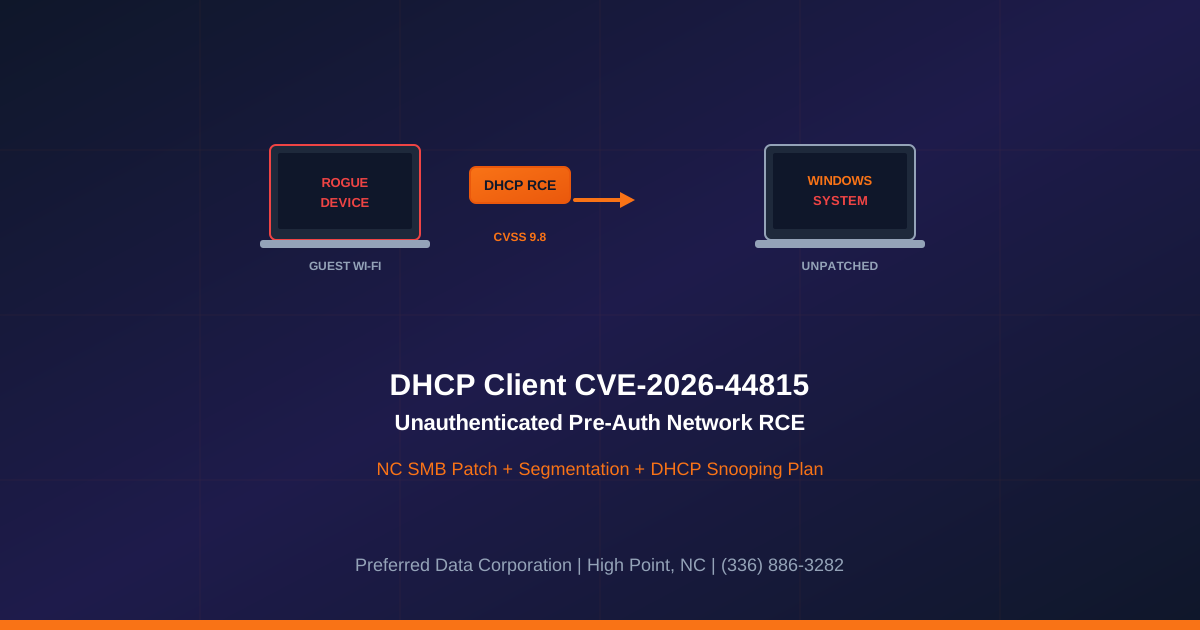
TL;DR: Microsoft's June 9, 2026 Patch Tuesday includes a fix for CVE-2026-44815, a stack-based buffer overflow in the Windows DHCP Client service (CVSS 9.8). The flaw lets a network-adjacent attacker compromise any unpatched Windows 10, 11, or Server 2012-2025 device by sending a single crafted DHCP response — no credentials, no clicks, no user interaction. For NC small businesses with flat office LANs, open guest Wi-Fi, manufacturing floors, and field-service laptops that roam onto untrusted networks, every unpatched endpoint is a one-packet-away takeover.
Key takeaway: DHCP is the most-trusted service on your network — every device asks for an address the moment it powers on. CVE-2026-44815 turns that trust into a free SYSTEM-level shell on every unpatched Windows endpoint. Patch in 14 days, segment guest and IoT traffic off the corporate VLAN, and turn on DHCP snooping at the switch.
Worried that one rogue device on your office Wi-Fi can compromise the whole fleet? Preferred Data Corporation runs managed patch deployment, network segmentation, and DHCP snooping policy for NC small businesses. Call (336) 886-3282 or request a network defense review.
What is CVE-2026-44815 and why is it dangerous for NC SMBs?
It is an unauthenticated remote-code-execution flaw in the Windows DHCP Client service, scored CVSS 9.8 with no user interaction required. Per the Microsoft Security Update Guide entry and The Hacker News' coverage of the June 2026 Patch Tuesday release, the exploit chain is:
- Attacker connects to the same broadcast domain as the victim — a guest Wi-Fi, a conference-room Ethernet drop, a vending-machine VLAN, a plant-floor switch.
- Attacker sends a crafted DHCP response to the victim machine when it requests an IP lease (every boot, every reconnect, every lease renewal).
- The malformed DHCP option triggers a stack-based buffer overflow inside the DHCP Client service.
- Code executes in the context of the DHCP Client — which runs as SYSTEM on Windows.
Three reasons NC small businesses are uniquely exposed:
- Flat LANs are still the SMB default. Per the 2026 Verizon DBIR, inadequate network segmentation remains a top initial-access enabler in SMB breach investigations. A single VLAN where laptops, IoT thermostats, printers, plant-floor PLCs, and guest devices share broadcast traffic is one rogue device away from CVE-2026-44815 exploitation.
- DHCP touches every Windows device. Per Zero Day Initiative's June 2026 review, every supported Windows client and server requests DHCP leases by default. There is no opt-out short of static IP across the entire fleet — which is operationally untenable.
- Public proof-of-concept is likely soon. Per The Hacker News and BleepingComputer's June 2026 patch summary, wormable network-level RCE flaws historically attract proof-of-concept code within weeks. Microsoft's "exploitation more likely" tagging is a near-term forecast.
For a Charlotte distributor with sales-rep laptops, a High Point manufacturer with field-service vans, or a Greensboro professional services firm with hybrid hot-desking, CVE-2026-44815 is the kind of flaw where one infected guest device or one unmanaged contractor laptop can pivot through DHCP to SYSTEM on a corporate workstation.
Why is a DHCP flaw worse than a typical RCE for small businesses?
Because DHCP is the protocol that runs before any other defense engages. Per the CISA Known Exploited Vulnerabilities Catalog guidance and Microsoft's MaxRequestBytes mitigation pattern documented in the June 2026 advisories, the structural reasons DHCP bugs hit harder than HTTP or SMB bugs are:
- DHCP runs before login, AV, and EDR. When a laptop boots, the DHCP Client service handshakes for an IP before the user types a password and before most EDR agents are fully loaded. A DHCP-stage exploit lands in SYSTEM context before any user-mode defense engages.
- DHCP traffic is broadcast. Anyone on the same Layer-2 segment can answer. There is no client-side server validation by default — Windows accepts the first DHCP response that arrives, which is why DHCP snooping at the switch is the standard mitigation for rogue DHCP servers.
- DHCP touches every endpoint, every lease cycle. Default lease durations are typically 8 hours to 7 days. Every renewal is another exploitation window for every unpatched device.
| Risk dimension | Unpatched + flat LAN | Patched + segmented + DHCP snooping |
|---|---|---|
| Network-adjacent attacker compromises endpoint | One DHCP response | Patch blocks the buffer overflow |
| Rogue DHCP server on guest VLAN | Indistinguishable from legitimate | DHCP snooping drops untrusted DHCP frames |
| Spread to other endpoints | Wormable potential via SYSTEM context | Contained to the compromised VLAN |
| EDR / AV detects exploitation | Pre-user-mode — often misses | Patched code path eliminates the overflow |
| CMMC / cyber insurance posture | Documented control gap | Defensible patch + segmentation evidence |
| Time-to-compromise from rogue device | Seconds | Not exploitable |
What does CVE-2026-44815 mean for NC SMB networks in practice?
It means that any network where untrusted devices can broadcast on the same VLAN as corporate Windows endpoints is a one-rogue-device-away breach event until the June 9, 2026 cumulative update lands fleet-wide. Per Help Net Security's coverage of the June 2026 Patch Tuesday and the Microsoft Security Update Guide, the realistic NC SMB attack scenarios are:
- Open guest Wi-Fi on the corporate switch. A coffee-shop laptop, a vendor's tablet, a customer's phone running an attacker's payload sends a malicious DHCP response to a corporate workstation that bridges the same VLAN.
- Plant-floor IoT on the office VLAN. A compromised vending machine, badge reader, IP camera, or sensor — anything internet-connected and rarely patched — becomes the launch point.
- Field-service laptop on a customer's network. A traveling tech connects to a customer Wi-Fi, picks up a crafted DHCP response, and brings the compromised laptop back into the corporate VPN.
- Contractor or BYOD device. A short-term contractor's personal laptop plugs into a conference-room Ethernet jack and pivots through DHCP.
Quotable definition: CVE-2026-44815 is a stack-based buffer overflow in the Windows DHCP Client service that lets a network-adjacent attacker execute code as SYSTEM by sending a single crafted DHCP response. There is no authentication, no user click, and no warning — it lands before login.
Need a fleet-wide patch deployment and a segmented LAN by Friday? Call (336) 886-3282 or book a network review.
What should an NC small business do in the next 14 days?
Run a four-step plan that patches every Windows endpoint and reduces the network blast radius. The plan:
- Inventory and prioritize (day 1-2). Pull a complete Windows 10 / 11 / Server inventory from Intune, your RMM, or Active Directory. Tag every device by exposure: public-facing servers, travel laptops, branch-office endpoints, plant-floor PCs, in-office desktops.
- Land the June 9, 2026 cumulative update (day 1-7). Push the patch fleet-wide using Intune, WSUS, or your RMM. Verify build numbers against Microsoft's Patch Tuesday release notes. Prioritize travel laptops and branch-office endpoints because they hit untrusted networks first.
- Enable DHCP snooping on access switches (day 5-14). Configure DHCP snooping to permit DHCP responses only from your authorized DHCP server interfaces. Drop rogue DHCP frames on guest and IoT VLANs. Per Cisco's DHCP snooping guidance and equivalent docs from Aruba, Juniper, and Ubiquiti, this is a one-command-per-VLAN baseline that catches rogue DHCP servers regardless of the underlying vulnerability.
- Segment guest, IoT, and BYOD onto their own VLANs (day 7-14). Put guest Wi-Fi, conference-room jacks, vending machines, badge readers, IP cameras, and contractor laptops on VLANs that cannot route to corporate workstations. Enforce inter-VLAN firewall rules — explicit deny by default.
Key takeaway: Patch + DHCP snooping + segmentation + a managed-detection feedback loop = a defensible answer to CVE-2026-44815. Any one of those four missing leaves the SMB exposed to the next wormable network-RCE flaw too.
How does Preferred Data Corporation help close CVE-2026-44815 for NC SMBs?
PDC has run managed patching, network segmentation, and switch-level policy for NC small businesses since 1987. We bring four things to the CVE-2026-44815 response:
- Managed cybersecurity services: Push the June 9, 2026 cumulative update fleet-wide, verify build numbers, document evidence for CMMC and cyber insurance.
- Network infrastructure design and management: Audit existing VLAN topology, configure DHCP snooping on access switches, isolate guest / IoT / BYOD onto dedicated VLANs, write explicit inter-VLAN firewall policy.
- Managed IT services: Day-to-day Intune, RMM, and Active Directory administration, lost-device response playbooks, hybrid-workforce baseline.
- Cybersecurity assessments: CMMC and NIST SP 800-171 control mapping, gap analysis against patching cadence and network segmentation requirements, evidence preparation for assessors and cyber insurance renewal.
For NC manufacturers in High Point and the Piedmont Triad with plant-floor networks, NC distributors in Greensboro and Winston-Salem with mobile sales fleets, and NC professional services firms in Charlotte and Raleigh with consultant laptops on customer networks, the CVE-2026-44815 response is a managed-program task, not a one-time patch.
Ready to lock down your NC network against CVE-2026-44815? Call (336) 886-3282 or book a network defense review.
Frequently Asked Questions
Is CVE-2026-44815 actively exploited in the wild?
As of the June 9, 2026 Patch Tuesday release, Microsoft has tagged CVE-2026-44815 on its "exploitation more likely" list but has not confirmed in-the-wild attacks yet. Per The Hacker News' coverage of the June 2026 Patch Tuesday, wormable network-level RCE flaws historically see PoC code published within weeks of the patch.
Which Windows versions are affected?
Per the Microsoft Security Update Guide entry for CVE-2026-44815 and the Zero Day Initiative June 2026 review, the bug affects Windows 10 (1607 and later), Windows 11 (all supported builds), and Windows Server 2012 through 2025. The June 9, 2026 cumulative updates ship the official fix.
Can we mitigate without patching?
Only partially. Restricting DHCP to a trusted DHCP server using DHCP snooping at the switch reduces the attack surface to attackers who can spoof or own that server's interface, but does not address the underlying buffer overflow. A patched endpoint is the only durable fix. Per the CISA Known Exploited Vulnerabilities Catalog guidance, defense-in-depth combines patching with switch-level policy.
Will this affect our CMMC or cyber insurance posture?
Yes. Per NIST SP 800-171 r2 control 3.14.1 (flaw remediation), CMMC contractors must remediate flaws in a timely manner. A CVSS 9.8 unauthenticated network-RCE that is on Microsoft's "exploitation more likely" list is the kind of finding assessors flag if it is unpatched at audit time, and cyber insurers increasingly require evidence of 14-day critical-patch cadence at renewal.
Does DHCPv6 carry the same risk?
The advisory covers the Windows DHCP Client service, which handles both DHCPv4 and DHCPv6 lease requests on most modern Windows builds. Per the Microsoft Security Update Guide, the June 9, 2026 patch covers both protocol paths.
Should we move to static IP addressing to avoid this class of bug?
For most NC SMBs, no. Static IP across a roaming-laptop, IoT-heavy, hybrid-workforce fleet creates more operational burden than security benefit. The right answer is patch + DHCP snooping + segmentation, not abandoning DHCP.
Related Resources
- Managed Cybersecurity Services for NC Businesses - Patch deployment, segmentation policy, KEV-rate response
- Network Infrastructure Design and Management - VLAN segmentation, DHCP snooping, switch policy for SMBs
- Managed IT Services for NC Businesses - Day-to-day Intune, RMM, and Active Directory administration
- Microsoft June 2026 Patch Tuesday: 200 CVEs and 3 Zero-Days - Companion overview of the full release
- YellowKey BitLocker CVE-2026-50507: NC SMB Laptop Defense - Companion June 2026 zero-day write-up
- Contact Preferred Data Corporation - Network defense review for NC SMBs