
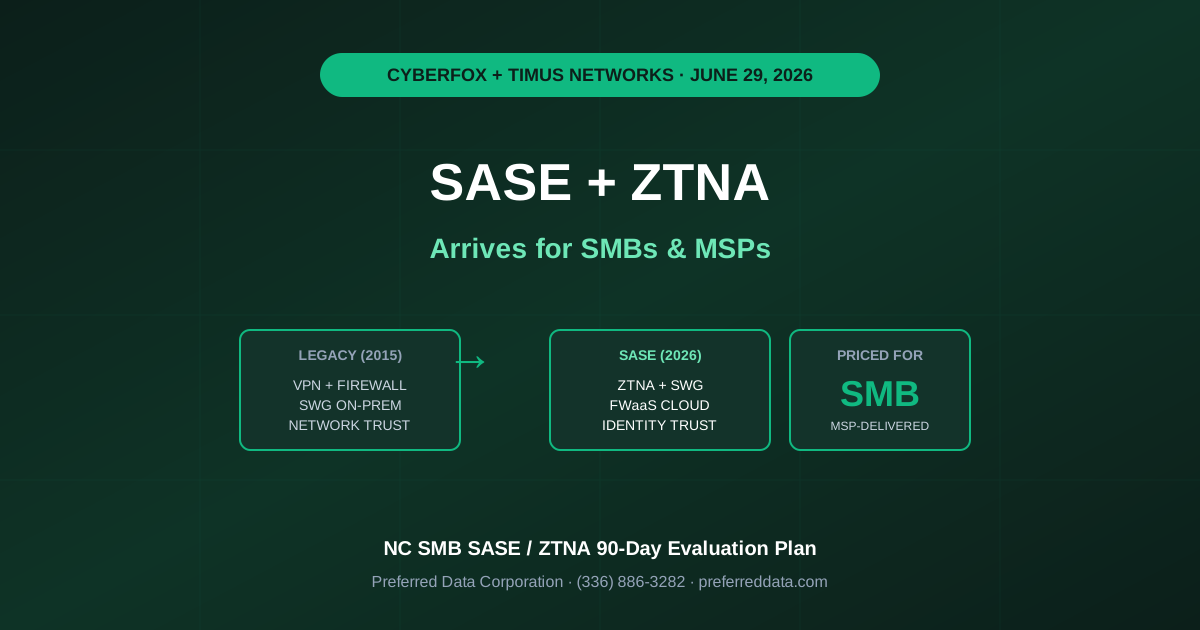
TL;DR: On June 29, 2026, CyberFOX announced its acquisition of Timus Networks to add 100% cloud-native Secure Access Service Edge (SASE) with Zero Trust Network Access (ZTNA) to its MSP-focused cybersecurity platform (CyberFOX press release, ChannelE2E coverage). The deal continues the MSP-security consolidation trend and signals that SASE — which used to be enterprise-priced — is now SMB-priced and MSP-deliverable. For NC small businesses still running legacy IPsec VPN, SonicWall/Meraki firewalls as the only perimeter, or "trust anyone on the LAN" network architecture, this is the moment to build a SASE/ZTNA evaluation plan rather than rip-and-replace whatever you have.
Key takeaway: SASE consolidation is not a vendor story for owners — it's a buying-window story. The vendors are merging, the price points are dropping into SMB range, and MSPs are productizing SASE rollouts. NC SMBs that ran "VPN forever" can now realistically replace VPN + secure web gateway + firewall + remote access policy with one cloud-delivered stack. The right move is not panic adoption — it's a structured 90-day evaluation against your actual remote workforce, manufacturing-floor, and compliance requirements.
Need help building a vendor-neutral SASE/ZTNA evaluation plan for your NC SMB? Preferred Data Corporation runs network modernization, remote-access design, and managed security for NC manufacturers, distributors, and professional services firms. Call (336) 886-3282 or request a SASE evaluation.
What happened on June 29, 2026 with CyberFOX and Timus Networks?
CyberFOX acquired Timus Networks to extend its MSP-targeted cybersecurity platform with SASE and ZTNA. Per the Bank Info Security coverage, the GlobeNewswire press release, and the CIO Influence summary:
- What CyberFOX added: Cloud-delivered SASE platform with ZTNA, secure web gateway (SWG), always-on VPN replacement, device posture checks, and policy controls — all targeted at MSPs serving SMBs.
- What stays the same near-term: Timus continues to operate under its own brand within the CyberFOX portfolio for the next several quarters. Existing Timus partners and customers see no immediate disruption.
- Strategic context: CyberFOX completed a growth-financing round earlier in 2026 explicitly to fund acquisitions, AI feature development, and international expansion.
- Industry signal: Per ChannelE2E, this is the latest in a wave of MSP-security platform consolidation moves — vendors are bundling EDR, identity, SASE, and email security into single-pane platforms for MSPs.
For NC SMB owners, the takeaway is not "switch to CyberFOX." It is "the market just told you SASE for SMBs is now real, productized, and MSP-deliverable."
What is SASE and how is it different from a VPN + firewall?
SASE — Secure Access Service Edge — is a cloud-delivered networking-and-security stack that combines firewall-as-a-service, secure web gateway, ZTNA, CASB, and SD-WAN into one platform. Per the Timus Networks platform documentation and the broader Gartner/MSP literature, the structural shift from a 2015-era network to a 2026 SASE network looks like this:
| Capability | Legacy stack (2015-2020) | SASE stack (2024-2026) |
|---|---|---|
| Remote access | IPsec VPN concentrator at HQ | Cloud-delivered ZTNA, identity-based |
| Firewall | On-prem hardware at each site | Firewall-as-a-service in the cloud |
| Web filtering | On-prem secure web gateway | Cloud SWG at the SASE edge |
| Trust model | Network-perimeter trust | Identity + device posture, per-resource |
| Branch + plant connectivity | Site-to-site VPN | SD-WAN with cloud orchestration |
| Application access | RDP, RemoteApp, full network on connect | Per-app ZTNA, no implicit network access |
| Policy management | Per-device firewall UI | Cloud console, role-based |
| Visibility | NetFlow, SIEM from each box | Unified telemetry to one platform |
The operational shift: stop thinking "is this device on the corporate LAN?" and start thinking "is this identity, on this device, at this posture, allowed to reach this resource?"
Quotable definition: SASE replaces the network as the trust boundary with identity + device posture as the trust boundary. For an NC small business with remote employees, a manufacturing floor on the same VLAN as the office, and a CEO who logs in from a personal device — that is the upgrade.
Why does the June 29, 2026 SASE consolidation matter to NC SMBs?
Because the price-and-deliverability gap that kept SASE in the enterprise has closed. Per the GlobeNewswire CyberFOX/Timus announcement and the broader MSP-security consolidation trend, three structural changes have happened:
- SMB-priced SASE. Per-user pricing has dropped into a range an NC SMB IT budget can absorb. Per our SBA 7(a) NC SMB technology financing playbook, SASE belongs in opex — predictable monthly cost, not financed capex.
- MSP-delivered SASE. Vendors like Timus, Todyl, Coro, and others now ship SASE with MSP-multi-tenant management, billing, and onboarding workflows. An NC SMB does not buy SASE from a hyperscaler — they buy it from a local MSP that operates the platform.
- Replacement, not stack-on-top. SASE replaces the IPsec VPN concentrator, the on-prem secure web gateway, and pieces of the firewall — so the net IT spend does not necessarily go up. It rebalances.
For NC manufacturers in High Point dealing with remote-access exposures like the recent Citrix NetScaler CVE-2026-3055, NC distributors in Greensboro replacing aging SonicWall fleets, and NC defense contractors in Charlotte and Raleigh scoping CMMC controls, SASE is now a realistic line item in the 2026-2027 roadmap.
When does SASE actually make sense for an NC SMB?
Five conditions, any one of which justifies a serious SASE evaluation:
- Mostly-remote or hybrid workforce with VPN as the only remote-access mechanism today.
- Multi-site footprint — branch, plant, or remote office that today connects via site-to-site VPN.
- Compliance pressure — CMMC, HIPAA, FTC Safeguards Rule, or insurance-driven controls that require identity-based access and access logging beyond what a basic firewall offers.
- Legacy VPN vulnerability exposure — running an edge appliance that has been the subject of multiple actively exploited CVEs in 2024-2026 (NetScaler, SonicWall, Fortinet, Ivanti, Citrix, etc.).
- Vendor sprawl — separate vendors for firewall, VPN, web filtering, secure browsing, MFA, and EDR with no single console.
If three or more of those apply to an NC SMB today, SASE is on the next 12-month roadmap. If five apply, it should be on the next 90-day roadmap.
| SMB signal | SASE urgency |
|---|---|
| Remote workforce + VPN-only access | High |
| Multi-site with site-to-site VPN | High |
| CMMC / HIPAA / FTC Safeguards pressure | High |
| Edge appliance with active CVE history | Very high |
| Vendor sprawl | Medium |
| Single-site, on-prem, low compliance | Low — modernize incrementally |
Need to score your NC SMB against these signals? Call (336) 886-3282 or book a SASE/ZTNA readiness review.
What should an NC SMB look for in a SASE / ZTNA vendor in 2026?
Eight evaluation criteria that survive the marketing slick. Per the Timus Networks platform site, the CyberFOX press materials, and the broader MSP-security buyer guidance:
- True cloud-native control plane — not a virtualized hardware appliance bolted into the cloud.
- ZTNA with per-application access policy — not "VPN with a new name."
- Device posture checks at access time — patch level, EDR status, encryption status.
- Identity provider integration — Microsoft Entra ID (formerly Azure AD), Okta, Google Workspace as first-class IdPs.
- Secure web gateway with category and URL filtering at the SASE edge.
- Branch / plant connectivity — SD-WAN or lightweight edge connector for sites you can't fully VPN-out.
- Unified telemetry / logging for the SIEM, MDR, or qualified-individual reporting required under regimes like the FTC Safeguards Rule.
- MSP multi-tenancy if delivered through a partner — billing, onboarding, and per-customer policy isolation.
Key takeaway: A SASE platform that does ZTNA + SWG + FWaaS + identity + device posture + logging in one console, delivered by an MSP that knows your environment, will outperform a stack of best-of-breed point products for any NC SMB under ~500 users.
What should an NC SMB do in the next 90 days?
Run a vendor-neutral SASE/ZTNA evaluation that turns the consolidation news into a procurement plan. The 90-day plan:
- Map current remote access and edge stack (week 1-2). Document every VPN concentrator, firewall, secure web gateway, RDP gateway, and remote-access exception in use. Note vendor, version, last CVE, support status.
- Score against the five SASE-urgency signals (week 2-3). Decide whether SASE is on the 12-month, 6-month, or 90-day roadmap.
- Run an RFP-light evaluation of 2-3 SASE vendors (week 3-8). Include at least one MSP-delivered platform (e.g., Timus/CyberFOX, Todyl, Coro) and one vendor-direct option (e.g., Cato, Cisco Meraki, Cloudflare One, Zscaler ZIA + ZPA).
- Pilot one user-cohort for 30 days (week 8-12). Pick a low-risk group — sales reps, remote office workers, or contractors — and run the SASE stack alongside the legacy VPN. Measure user friction, IT support tickets, and policy gaps.
- Build the cutover plan (week 12+). If the pilot succeeds, plan a phased cutover by user group or site. Decommission the legacy VPN concentrator only after the cutover is fully verified — not before.
Ready to put SASE into your NC SMB's 2026 roadmap? Call (336) 886-3282 or book a SASE/ZTNA evaluation.
How does Preferred Data Corporation help NC SMBs evaluate SASE?
PDC has been an NC small business's IT partner since 1987 and has run network modernization, remote-access migration, and managed security across NC manufacturers, distributors, defense contractors, and professional services firms. We bring four things to the SASE conversation:
- Network infrastructure services: Vendor-neutral design and migration from legacy VPN + firewall to SASE/ZTNA, with SD-WAN coverage for multi-site and plant-floor connectivity.
- Managed cybersecurity services: Identity, MFA, EDR, MDR, and SIEM integration into the SASE control plane — so logging, alerting, and incident response are coherent across the whole stack.
- Managed IT services: Help desk, device posture management, and end-user onboarding for SASE rollouts.
- Cloud solutions: Identity provider (Entra ID / Google Workspace) hygiene and conditional-access policy design as the foundation for ZTNA.
For NC manufacturers in High Point and the Piedmont Triad replacing aging VPN concentrators, NC distributors in Greensboro and Winston-Salem scoping multi-site SASE, and NC defense contractors in Charlotte and Raleigh aligning to CMMC controls, the June 29, 2026 CyberFOX/Timus deal is a market signal — not an action item. The action item is a vendor-neutral 90-day evaluation.
Ready to make sure your NC SMB has a SASE plan that survives the next consolidation cycle? Call (336) 886-3282 or book a SASE/ZTNA evaluation.
Frequently Asked Questions
Is SASE the same as ZTNA?
SASE is the broader platform. ZTNA is one component of SASE — the remote-access piece. Per the Bank Info Security coverage of the CyberFOX/Timus deal, a full SASE stack also includes secure web gateway, firewall-as-a-service, CASB, and often SD-WAN.
Do I have to rip and replace my existing firewall to adopt SASE?
No. Most SASE rollouts start with ZTNA replacing VPN, then move web filtering to the cloud SWG, then absorb the firewall function over time. Per the broader MSP-security migration literature, an NC SMB can run SASE alongside the existing firewall for 6-12 months and decommission the legacy gear only when fully comfortable.
What about the manufacturing floor / OT network?
OT is typically segmented behind the SASE stack rather than running on it directly. Per our OT/IT integration writeups, the right pattern is SASE for IT users + a separate OT segmentation strategy with explicit east-west controls. SASE is not a substitute for plant-floor segmentation.
How does SASE affect CMMC compliance for NC defense contractors?
Favorably, generally. Per the CISA Zero Trust Maturity Model guidance and DoD CMMC 2.0 control families, ZTNA + identity-based access + device posture + central logging map directly onto CMMC L2/L3 access-control, audit-and-accountability, and identification-and-authentication families. A properly scoped SASE rollout simplifies the CMMC evidence package.
Will SASE break my LOB applications?
A well-run pilot finds the breakers before cutover. Per the standard SASE migration playbook, the typical breakers are: legacy thick-client apps that assume LAN connectivity, hardcoded internal hostnames, and IP-allowlist integrations with cloud SaaS vendors. PDC's 30-day pilot stage specifically hunts for these.
What's a realistic SASE budget for a 50-100 person NC SMB?
Depends on user count, sites, and whether you fold in EDR/MDR. A typical NC SMB in this band runs $10-$25 per user per month all-in for a fully managed SASE/EDR/MDR stack. Per our SBA 7(a) NC SMB technology financing playbook, this is opex — predictable monthly cost — not a financed capex.
Related Resources
- Network Infrastructure Services - SASE / ZTNA design and migration
- Managed Cybersecurity Services - Identity, MFA, MDR integrated into SASE
- Managed IT Services - Help desk, device posture, end-user onboarding
- Cloud Solutions - Identity provider and conditional-access foundations
- Citrix NetScaler CVE-2026-3055 SAML IdP Defense - Companion remote-access threat update
- SBA 7(a) at 9% June 2026: NC SMB Tech Financing Playbook - Companion opex-vs-capex framing
- Contact Preferred Data Corporation - SASE/ZTNA evaluation for NC SMBs