
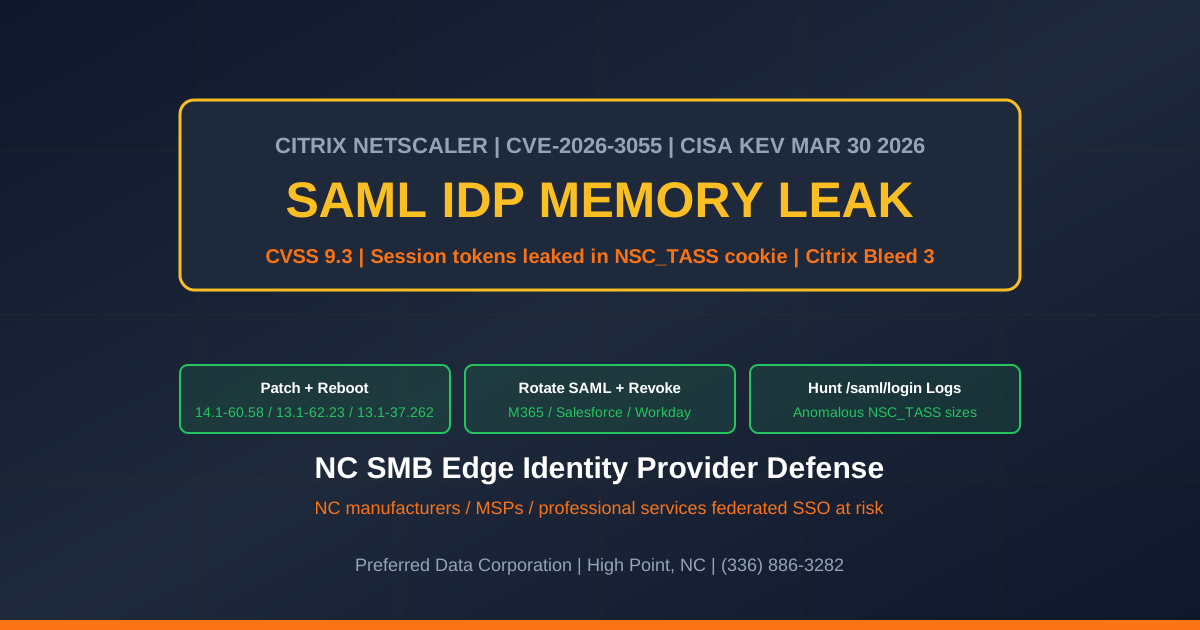
TL;DR: Citrix NetScaler ADC and NetScaler Gateway carry CVE-2026-3055, a CVSS 9.3 out-of-bounds memory read in the SAML Identity Provider path, with large-scale active exploitation confirmed by Fortinet and CISA, per Threat-Modeling.com. An unauthenticated attacker sends a crafted SAMLRequest to /saml/login with the AssertionConsumerServiceURL field omitted; the appliance dereferences a null pointer and returns memory contents inside the NSC_TASS HTTP cookie, leaking session tokens and authentication material, per Rapid7. CISA added it to the KEV catalog on March 30, 2026, and exploitation has continued. NC SMBs that run NetScaler as a SAML IDP for Microsoft 365, Salesforce, Workday, or in-house apps have hours to patch and rotate.
Key takeaway: Edge appliances configured as Identity Providers fail loudest. A memory leak that returns session tokens through a normal-looking HTTP cookie is an authentication bypass dressed as a routine response. If your NC SMB's NetScaler is SAML-IDP for any SaaS, treat this as a credential incident.
Need help patching NetScaler, rotating SAML signing keys, and tightening edge SSO? Preferred Data Corporation runs managed cybersecurity for NC SMBs since 1987. Call (336) 886-3282 or request an emergency edge appliance review.
What is CVE-2026-3055 and why is it different from prior Citrix bugs?
CVE-2026-3055 is an out-of-bounds read in NetScaler ADC and NetScaler Gateway when operating as a SAML Identity Provider, disclosed March 23, 2026, with a CVSS v4.0 score of 9.3, per NVD. Active exploitation was confirmed by watchTowr on March 27, and Fortinet's threat-intel team reported large-scale exploitation against internet-facing NetScalers configured as SAML IDPs, per Threat-Modeling.com.
| Attribute | CVE-2026-3055 detail |
|---|---|
| CVSS v4.0 score | 9.3 (critical) |
| Authentication required | None |
| Affected role | NetScaler ADC / Gateway configured as SAML IDP |
| Attack vector | Crafted SAMLRequest to /saml/login |
| Leak vector | Memory contents returned in NSC_TASS HTTP cookie |
| Outcome | Session token theft, SSO bypass, potential appliance takeover |
| Active exploitation | Confirmed large-scale (Fortinet, watchTowr) |
| CISA KEV add date | March 30, 2026 |
| Fixed versions | 14.1-60.58, 13.1-62.23, 13.1-37.262 |
The defect is in input validation: when a SAMLRequest arrives without an AssertionConsumerServiceURL, the NetScaler dereferences an invalid pointer and reads memory beyond the intended buffer, returning that memory in the NSC_TASS cookie of its HTTP response, per Penligent's analysis. The leaked memory varies request-to-request but routinely includes SAML assertion fragments, session tokens, configuration material, and authentication cookies for other users mid-flight.
Quotable definition: A Citrix Bleed-class flaw lets a remote attacker harvest authentication material from an edge appliance's memory by repeatedly hitting an unauthenticated endpoint. The "session" the attacker steals belongs to a real user, so post-exploitation looks like normal authenticated traffic to downstream SaaS.
Three facts an NC SMB's IT lead should write down today:
- The default config is safe; the IDP config is not. Per Hard2Bit and Citrix's advisory, only NetScalers configured as SAML Identity Providers are vulnerable. NetScalers configured as SAML Service Providers (the much more common SMB role) are unaffected by this specific CVE. The IDP role is dominant in enterprises with their own identity stack and in MSPs federating customer tenants.
- Patching alone is not the whole answer. The leaked memory is not recoverable post-incident. Any session token harvested before patching can be replayed against downstream SaaS until the user's session naturally expires - which on Microsoft 365 default policy can be 24 hours.
- The exploit pattern is detectable in logs. A spike in unauthenticated POSTs to
/saml/loginwith anomalous SAMLRequest parameters, paired with elevated outboundNSC_TASScookie sizes, is the signature. NC SMBs without full HTTP request/response logging on the NetScaler are operating blind.
Why does CVE-2026-3055 matter to NC SMBs in 2026?
Because the NetScaler-as-IDP role is concentrated in two NC SMB segments that are exactly the kind of targets ransomware affiliates and access brokers prefer: NC MSPs federating customer tenants, and NC mid-sized manufacturers / professional-services firms that built a private identity stack a decade ago and never moved off it.
The NC SMB victim profile maps cleanly:
- A High Point manufacturer running NetScaler ADC as the SAML IDP for an in-house ERP plus federated access to Microsoft 365, Salesforce, and a customer-collaboration portal. The NetScaler is the single point of authentication for the entire engineering, sales, and finance workforce.
- A Greensboro MSP running NetScaler as a multi-tenant SAML IDP for its own staff and several customer tenants. A session-token leak here is a cross-tenant breach amplifier - one MSP appliance, many customer environments downstream.
- A Piedmont Triad professional-services firm (accounting, legal, engineering) running NetScaler Gateway for VPN + SAML IDP for client portal access. The session tokens cover both employee access to client data and client access to deliverables.
- A Charlotte healthcare SMB running NetScaler as the SSO front end for a PACS / EMR. HIPAA notification clocks start the moment compromise of patient-record access is suspected.
Per Fortinet's threat-intel reporting, large-scale opportunistic scans for vulnerable NetScalers have been ongoing since late March 2026. The longer a NC SMB ran an unpatched SAML IDP after March 30, the higher the probability of session-token harvest by an automated scanner - regardless of whether the SMB was specifically targeted.
Key takeaway: This is the third Citrix Bleed pattern (CVE-2023-4966 / Citrix Bleed; CVE-2025-5777 / Citrix Bleed 2; CVE-2026-3055). The pattern - memory leak via crafted request returning authentication material in a normal-looking response - is the dominant edge-appliance failure mode of the 2020s. NC SMBs should treat the SAML IDP role on any edge appliance as in-scope for the same quarterly hardening review as the firewall.
How does an NC SMB respond to CVE-2026-3055 in 7 days?
Run a six-step sequence inside one week. The sequence is sized for an SMB IT team or an MSP-supported environment, not an enterprise SOC.
- Confirm the NetScaler role (Day 0). Check whether your NetScaler is configured as a SAML IDP (vulnerable) or only as a SAML SP / load balancer (not directly vulnerable to this CVE). The IDP role shows
add authentication samlIdPProfilein the running config. - Patch to the fixed version (Day 0-1). Update to NetScaler ADC 14.1-60.58, 13.1-62.23, or 13.1-37.262 per Citrix's advisory. Reboot the appliance after patching - the in-memory tokens leaked by prior requests are not invalidated until the process restarts.
- Rotate SAML signing certificates and session tokens (Day 1-2). Per Penligent, the conservative assumption is that any SAML signing material that touched the appliance memory was harvested. Rotate the IDP signing certificate, update relying-party trust on every downstream SaaS, and force a global session reset.
- Force user re-authentication across federated SaaS (Day 1-3). Microsoft 365:
Revoke-MgUserSignInSessionfor all users. Salesforce: revoke all sessions in Setup > Session Management. Workday: tenant-wide session terminate. The goal is to make any pre-patch stolen token useless. - Hunt logs for the exploit signature (Day 2-5). Search NetScaler HTTP logs (and any upstream WAF / load balancer) for unauthenticated POSTs to
/saml/loginwith an empty or missing AssertionConsumerServiceURL field, and for anomalousNSC_TASScookie sizes in responses. Per the GitHub probe l0lsec/check-cve-2026-3055-netscaler, the request pattern is straightforward to detect in logs once you know the shape. - Add edge-appliance hardening on top of the patch (Day 3-7). Restrict
/saml/loginaccess to known IDP-federation partner IPs where possible, enable detailed HTTP logging on the NetScaler, configure log forwarding to a 90-day retention SIEM, and put a quarterly NetScaler CVE review on the operations calendar.
| Day-7 control | Target outcome | Why it matters |
|---|---|---|
| NetScaler patched to fixed version | All instances | Closes the unauthenticated memory leak |
| Appliance rebooted post-patch | All instances | Invalidates in-memory tokens leaked pre-patch |
| SAML IDP signing certificate rotated | New cert + trust updated downstream | Invalidates any harvested signing material |
| All federated SaaS sessions revoked | M365, Salesforce, Workday, in-house | Invalidates harvested session tokens |
| HTTP logs hunted for exploit pattern | NetScaler + WAF logs since March 23, 2026 | Detects pre-patch session-token theft |
Key takeaway: Patching the NetScaler without rotating credentials and revoking sessions leaves the attacker holding tokens that still work. The patch closes the leak; the rotation closes the use.
How does Preferred Data Corporation help NC SMBs defend against CVE-2026-3055?
PDC has run managed cybersecurity, managed IT, and network infrastructure services for NC SMBs since 1987. For the March - June 2026 NetScaler exploitation window, PDC brings three things:
- Emergency edge appliance patching + reboot SLA: PDC patches NetScaler ADC / Gateway across the federal compliance window, schedules the post-patch reboot to invalidate in-memory tokens, and validates the fixed version is in production.
- SAML IDP rotation playbook: PDC rotates the IDP signing certificate, updates downstream relying-party trust on Microsoft 365, Salesforce, Workday, and in-house apps, and forces a global session revoke - the only durable answer to a pre-patch memory leak.
- Edge appliance log hunt and quarterly hardening: PDC pulls NetScaler and WAF HTTP logs back to the disclosure date, searches for the CVE-2026-3055 exploit signature, and stands up a quarterly hardening review covering NetScaler, FortiGate, SonicWall, and Palo Alto edges.
For NC manufacturers in High Point running a NetScaler-fronted ERP, NC MSPs in the Triad federating customer SaaS, NC professional-services firms in Greensboro and Raleigh running client portals, and NC healthcare SMBs in Charlotte with NetScaler-fronted PACS / EMR - this is the patch-rotate-revoke sequence that prevents a credential leak from turning into a downstream SaaS breach.
Need help responding to CVE-2026-3055 inside 7 days? Call (336) 886-3282 or book an emergency edge appliance review.
Frequently Asked Questions
What is CVE-2026-3055?
CVE-2026-3055 is a CVSS 9.3 out-of-bounds memory read in Citrix NetScaler ADC and NetScaler Gateway when configured as a SAML Identity Provider, disclosed March 23, 2026. Per Rapid7, an unauthenticated attacker sends a crafted SAMLRequest and receives leaked memory contents in the NSC_TASS cookie of the HTTP response.
Is my NetScaler vulnerable if I'm not using SAML?
No. Per Citrix's advisory and Security Arsenal, the vulnerability requires the appliance to be configured as a SAML Identity Provider. NetScalers used purely as load balancers, application delivery controllers, or SAML Service Providers are not directly vulnerable to this CVE - though prior Citrix Bleed variants (CVE-2023-4966, CVE-2025-5777) affected broader configurations and should be patched independently.
What versions fix CVE-2026-3055?
Per Citrix and Cybersecurity News, upgrade to NetScaler ADC 14.1-60.58, 13.1-62.23, or 13.1-37.262 (or later). Reboot the appliance after upgrade to invalidate any tokens leaked in memory before the patch.
What does post-exploitation look like?
Per Fortinet and Threat-Modeling.com, an attacker holding a stolen session token logs into downstream SaaS as the legitimate user with no MFA prompt - because the SAML assertion was already issued. The SaaS sees normal authenticated traffic. Detection downstream requires anomaly detection on user behavior (impossible travel, atypical hours, unusual data export volumes) rather than authentication failure alerts.
Do we need to revoke sessions, or is patching enough?
Both are needed. Patching closes the leak. Revoking sessions invalidates any token that was leaked before the patch landed. The Microsoft 365 default session lifetime is 24 hours, which means tokens harvested in the days before the patch can still be replayed for up to a day after patching unless you force a global session reset.
How do I detect the exploit signature in logs?
Search NetScaler HTTP logs (and any front-end WAF / load balancer logs) for unauthenticated POSTs to /saml/login with a malformed or missing AssertionConsumerServiceURL parameter. Watch for response sizes with anomalously large NSC_TASS cookies. Per the public probe at l0lsec/check-cve-2026-3055-netscaler, the exploit request shape is well-documented and can be turned into a SIEM rule.
How does this relate to Citrix Bleed and Citrix Bleed 2?
CVE-2026-3055 is the third in the Citrix Bleed family - all three are unauthenticated memory leaks from internet-facing NetScaler endpoints that return authentication material in normal HTTP responses. Per Penligent's analysis, the pattern is "Citrix Bleed 3." NC SMBs should put the NetScaler edge appliance on a quarterly hardening review alongside the firewall - the failure mode is recurrent and the patch SLA needs to match.
Related Resources
- Managed Cybersecurity for NC Businesses - Edge appliance patch SLA + SOC monitoring
- Network Infrastructure Services - NetScaler, firewall, and edge hardening
- Managed IT for NC Businesses - Patch management and identity hardening
- PTC Windchill CVE-2026-12569 KEV Defense - Companion June 2026 KEV disclosure
- DirtyClone Linux Kernel CVE-2026-43503 LPE Defense
- Ubiquiti UniFi OS CVE-2026-34908 KEV Defense
- Contact Preferred Data Corporation - Emergency NetScaler response for NC SMBs