
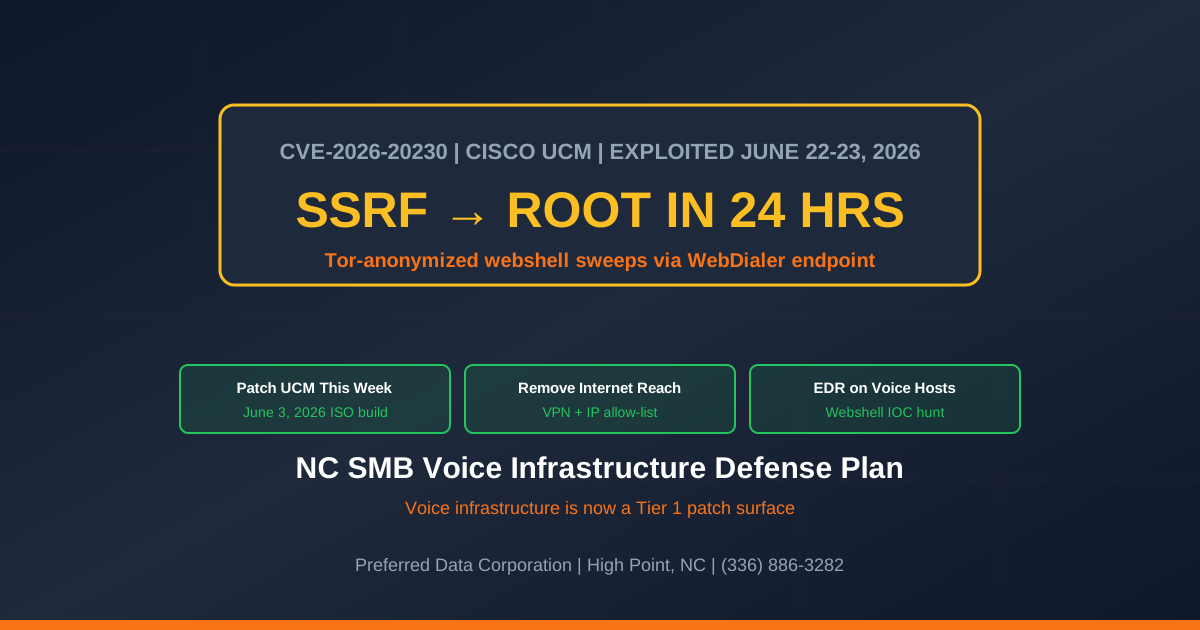
TL;DR: On June 3, 2026 Cisco patched CVE-2026-20230, a critical unauthenticated server-side request forgery (SSRF) vulnerability in Cisco Unified Communications Manager (Unified CM) and Unified CM Session Management Edition (Unified CM SME), per Cisco's advisory. On June 22 - 23, 2026 - within roughly 24 hours of SSD Secure Disclosure publishing PoC code - threat intelligence firm Defused observed Tor-anonymized mass sweeps deploying webshells via the WebDialer SSRF path. The exploit chain abuses SSRF to deploy a rogue Apache Axis service and write a first-stage JSP file-writer, ultimately enabling privilege escalation to root, per Help Net Security. For NC SMBs running Cisco Unified Communications Manager on-prem or in a hosted-on-prem model, the patching window has effectively closed - the question is whether your Cisco voice infrastructure is patched, network-isolated, and behind a 24/7 SOC.
Key takeaway: The PoC-to-weaponization gap is now measured in hours, not weeks. Any NC SMB still treating "monthly patch cadence" as adequate for internet-reachable Cisco voice infrastructure is operating against the 2022 threat model. The patch shipped June 3. The sweeps started June 22.
Need a same-week Cisco UCM patch and isolation plan? Preferred Data Corporation runs managed IT, voice infrastructure, and patch-SLA services for NC SMBs since 1987. Call (336) 886-3282 or request a voice-infrastructure review.
What is CVE-2026-20230 and how is it being exploited?
CVE-2026-20230 is an unauthenticated SSRF flaw in Cisco Unified Communications Manager (Unified CM) and Unified CM Session Management Edition (Unified CM SME) caused by improper input validation in specific HTTP requests, per Cisco's advisory and Threat-Modeling.com's analysis. An unauthenticated remote attacker sends a crafted HTTP request to the WebDialer endpoint, abuses the SSRF to reach internal services, and chains into arbitrary file write and ultimately root privilege.
| Exploit step | Defender visibility |
|---|---|
| Unauthenticated HTTP request to WebDialer endpoint | Visible in HTTP access logs if logging is configured |
| SSRF reaches internal Apache Axis admin endpoint | Mostly invisible to network monitoring |
| Rogue Apache Axis service deployed | Visible to host-based EDR with file-integrity monitoring |
| First-stage JSP file-writer dropped | Visible to JSP/webroot file monitoring |
| Webshell persistent on disk | Visible to outbound C2 monitoring + EDR |
| Privilege escalation to root | Full host takeover |
Per Dark Reading, automated Tor-anonymized scans deploying webshells via this chain began roughly 24 hours after the public PoC drop. Per Defused, the observed chain "abuses the WebDialer SSRF to deploy a rogue Apache Axis service and write a first-stage JSP file-writer."
Quotable definition: Server-side request forgery (SSRF) is a vulnerability class where a server can be tricked into making outbound HTTP requests to URLs the attacker controls - which often includes internal endpoints behind the perimeter. When SSRF chains to file write and code execution, an unauthenticated remote request becomes a root shell on the voice infrastructure.
Three facts an NC SMB owner should write down:
- The patch shipped June 3; exploitation arrived June 22 - 23. That is a 19-day window in which NC SMBs running unpatched Cisco UCM were operating under the assumption that they had patch time. Per Help Net Security, the actual safe window collapsed to less than 24 hours after the PoC release.
- The exploit is unauthenticated. No phished credential, no help-desk vishing, no MFA fatigue required. A crafted HTTP request to an internet-reachable WebDialer endpoint is sufficient. Internet exposure of Cisco UCM is the single highest-leverage control failure.
- The artifact is a webshell with root escalation. Once successful, the attacker has remote command execution at the highest privilege on the voice infrastructure - the same host stack that proxies call audio, holds call detail records, often participates in Active Directory authentication for voicemail, and bridges to other production systems.
Why does this matter to NC SMBs running Cisco voice?
Because Cisco Unified CM is the most-deployed on-prem voice platform across NC professional services, NC healthcare practices, NC manufacturers, and NC distributors - particularly mid-size SMBs with 50 - 500 endpoints who have not yet migrated to a Microsoft Teams Phone or RingCentral cloud model. The systems were typically deployed by a partner integrator several years ago and quietly continue running with monthly maintenance windows scheduled during business-low hours.
Realistic NC SMB exposure profiles:
- NC mid-size manufacturer with 100 - 250 plant-floor / office handsets on Cisco UCM. The system was deployed in 2018 - 2020, runs UCM 12.5 or 14.0 today, and has a maintenance window once a quarter. The June 3 patch was scheduled for the July maintenance window.
- NC professional-services firm (legal, accounting, engineering) with Cisco UCM + Webex Calling hybrid. The system runs in a colocation facility with a partner-managed posture, but the partner's patch SLA is "monthly with notification." The webshell sweeps don't respect monthly SLAs.
- NC healthcare clinic group with Cisco UCM serving multiple sites. Call audio crosses the same infrastructure that holds patient appointment records and bridges to the EHR. Root on the UCM is a HIPAA event in addition to a voice outage.
- NC distributor or logistics firm with Cisco UCM SME at the central data center proxying remote-site Unified CM clusters. SME compromise propagates across every connected site.
Per Security Affairs, the exploit code is now public and the sweeps are automated. The realistic NC SMB question is not "will we be scanned?" - we will - it is "does the scanner find a patched UCM, a network-isolated admin interface, and an EDR-monitored host? Or does it find an internet-reachable WebDialer endpoint running 12.5SU3?"
Key takeaway: Voice infrastructure has been the patch-SLA stepchild of NC SMB IT for a decade because it "just works." June 23, 2026 ended that mode of operation. Cisco voice is now in the same patch-cadence tier as the firewall and the EDR console.
What should an NC SMB do this week?
Run a six-control plan inside seven days. The PoC is public, automated sweeps are running, and the cost of compensating controls is far below the cost of a root-shell incident on the voice host.
- Patch Cisco Unified CM and Unified CM SME to the June 3, 2026 release (this week). Apply the patched ISO build to every UCM publisher and subscriber. Per Cisco's advisory, this is the only complete fix. Schedule the maintenance window inside seven days, not 30.
- Remove internet reachability for WebDialer and admin interfaces (this week). Cisco UCM administrative and WebDialer endpoints should not be reachable from the public internet under any operational mode. Place them behind an internal VPN or a reverse proxy with strict IP allow-listing.
- Hunt for webshell IOCs on UCM hosts now (this week). Search for unexpected JSP files in the Tomcat webroots, anomalous Apache Axis service registrations, and outbound HTTPS connections from the UCM host to known Tor exit nodes. Engage your MSP / managed cybersecurity provider if no in-house capability.
- Deploy host-based EDR on UCM hosts. Most NC SMB Cisco UCM hosts are unmonitored from a behavior-based EDR perspective. The June 23, 2026 sweeps are visible to EDR with file-integrity monitoring on Tomcat webroots and JSP write detection.
- Move Cisco UCM to the same patch-SLA tier as the firewall. Voice infrastructure is now a Tier 1 patch surface. Adopt a 7-day maximum patch window for Critical CVEs, a 14-day window for High CVEs, and a 30-day window for Medium - regardless of monthly maintenance scheduling.
- Tabletop the voice-outage-as-breach scenario. Walk the question: "If our voice infrastructure was compromised today, what does the call quality desk think, what does HR / compliance think (because voicemails contain regulated data), and what does counsel say about call-recording exposure?"
Key takeaway: Patch and isolate inside seven days. Hunt for IOCs inside seven days. The CVE-2026-20230 sweeps are running today, and the marginal cost of acting now versus next month is the entire incident.
How does Preferred Data Corporation help NC SMBs respond to CVE-2026-20230?
PDC runs managed IT, voice infrastructure services, and patch-SLA programs for NC SMBs with Cisco UCM, Microsoft Teams Phone, and hybrid voice architectures since 1987. We bring three things to the June 23, 2026 active-exploitation news:
- Managed IT services: Same-week Cisco UCM and UCM SME patch deployment, maintenance-window coordination, configuration backup, and post-patch validation testing.
- Managed cybersecurity services: Webshell IOC hunt on UCM hosts, host-based EDR deployment on voice infrastructure, network isolation review for WebDialer and admin interfaces, and ongoing KEV-rate patch SLA for Tier 1 voice surfaces.
- Network and infrastructure services: Network segmentation between voice and production tiers, internet-edge firewall rules removing public reachability to UCM management interfaces, and reverse-proxy-and-VPN architecture for remote voice administration.
For NC manufacturers in High Point and the Piedmont Triad running plant-floor Cisco voice, NC professional services firms in Charlotte and Raleigh with hybrid Cisco UCM + Webex deployments, NC healthcare clinics with UCM bridging to the EHR, and NC distributors with multi-site SME architectures - the June 23, 2026 sweeps are the alarm that voice infrastructure is a Tier 1 patch surface.
Need help patching UCM and hunting for webshells this week? Call (336) 886-3282 or book a voice-infrastructure review.
Frequently Asked Questions
What is CVE-2026-20230?
CVE-2026-20230 is a critical unauthenticated server-side request forgery (SSRF) vulnerability in Cisco Unified Communications Manager (Unified CM) and Unified CM Session Management Edition (Unified CM SME), patched by Cisco on June 3, 2026. Per SecurityWeek, the flaw is caused by improper input validation for specific HTTP requests; a successful attacker can write arbitrary files to the underlying OS and escalate to root.
How quickly was CVE-2026-20230 weaponized?
Roughly 24 hours. Per Dark Reading and Defused's reporting via Help Net Security, SSD Secure Disclosure released PoC code on or around June 22, 2026, and Tor-anonymized automated sweeps deploying webshells via the WebDialer SSRF began within a day.
How does an NC SMB patch CVE-2026-20230?
Apply the June 3, 2026 patched build of Cisco Unified Communications Manager and Unified CM SME per Cisco's official advisory. NC SMBs should compress the normal monthly maintenance window into a same-week emergency window: snapshot the UCM publisher and subscribers, apply the ISO, restart services, validate registrations, validate call routing, and confirm the WebDialer endpoint is no longer reachable from the public internet.
How do I tell if my Cisco UCM has been compromised?
Search for unexpected JSP files in the Tomcat webroots, anomalous Apache Axis service registrations, and outbound network connections from the UCM host to Tor exit nodes or unfamiliar HTTPS endpoints. Per Help Net Security, the observed attacker chain "abuses the WebDialer SSRF to deploy a rogue Apache Axis service and write a first-stage JSP file-writer." If your NC SMB does not have host-based EDR on the UCM, engage a managed cybersecurity provider for a one-time IOC hunt this week.
Why is Cisco UCM more dangerous if compromised than people assume?
Because the voice infrastructure participates in more of the production stack than the operations team typically diagrams. UCM holds call detail records, often integrates with Active Directory for voicemail authentication, frequently has SIP trunks reaching public PSTN gateways, and sometimes bridges to the EHR / ERP for click-to-dial. A root shell on UCM is not just a phone outage - it is a credential-harvesting platform sitting inside the production network with the highest privilege.
Does this CVE affect Webex Calling cloud users?
The disclosed vulnerability targets Cisco Unified Communications Manager and Unified CM SME, which are on-prem (or hosted-on-prem) platforms. Pure Webex Calling cloud users are not directly exposed to CVE-2026-20230, but NC SMBs in hybrid Webex Calling + on-prem UCM architectures still have a vulnerable UCM in the perimeter. Confirm your deployment topology with your integrator and patch every on-prem UCM regardless.
Related Resources
- Managed IT Services for NC Businesses - Same-week Cisco UCM patch deployment
- Managed Cybersecurity Services - Webshell hunting and EDR for voice hosts
- Network and Infrastructure Services - Voice / production network segmentation
- Cisco Catalyst SD-WAN CVE-2026-20245 Actively Exploited - Companion Cisco active-exploit context
- Cisco ISE / Webex CVE-2026-20147 RCE - Companion Cisco patch-cadence context
- Verizon DBIR 2026: Vulnerability Exploitation Now #1 Vector - Companion patch SLA data
- Contact Preferred Data Corporation - Voice infrastructure review for NC SMBs