
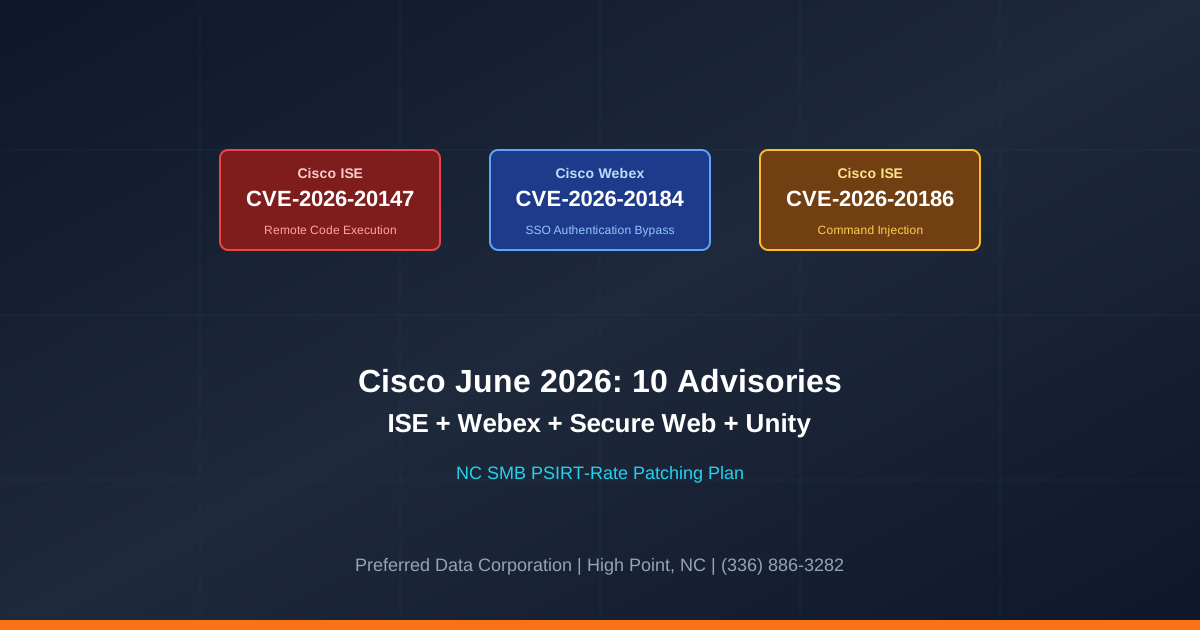
TL;DR: Cisco published 10 security advisories in June 2026 addressing critical and high-severity vulnerabilities across Webex Services, Webex Contact Center, Secure Web Appliance, Identity Services Engine (ISE), Unity Connection, and ThousandEyes Enterprise Agent. The highest-impact entries for SMBs are CVE-2026-20184 (Webex SSO bypass via Control Hub), CVE-2026-20147 (remote code execution in Cisco ISE), CVE-2026-20180 (path traversal in Cisco ISE), and CVE-2026-20186 (command injection in Cisco ISE). NC small businesses using Cisco for network access control, video conferencing, or web filtering need to patch inside 14-30 days and segment management interfaces off the production network.
Key takeaway: Cisco ISE is the network's identity gate. A pre-auth RCE in the gate is a board-level patch. SMBs that depend on Cisco for NAC, web filtering, or unified communications need a managed patching cadence aligned with vendor PSIRT releases, not a calendar.
Worried your Cisco patching cadence cannot match vendor PSIRT releases? Preferred Data Corporation runs managed patching, network segmentation, and 24/7 monitoring for NC small businesses. Call (336) 886-3282 or request a Cisco posture review.
What did Cisco actually patch in June 2026?
Cisco shipped 10 advisories covering critical and high-severity vulnerabilities across multiple product lines. Per the Cisco Security Advisories portal and SANS NewsBites coverage, the headline entries include:
- CVE-2026-20184 - SSO authentication bypass in Cisco Webex Services via Control Hub. Direct impact on SaaS-delivered video conferencing tenants.
- CVE-2026-20147 - Remote code execution in Cisco Identity Services Engine (ISE). ISE is the NAC, AAA, and policy gate for the corporate network. RCE here is catastrophic.
- CVE-2026-20180 - Path traversal in Cisco ISE. Can be chained for file disclosure on the policy server.
- CVE-2026-20186 - Command injection in Cisco ISE. Direct OS-level command execution on the appliance.
- Additional advisories covering Cisco Webex Contact Center, Cisco Secure Web Appliance, Cisco Unity Connection, and Cisco ThousandEyes Enterprise Agent. Each affects an SMB-relevant control plane.
Three things make this batch a top-priority issue for SMBs:
- ISE is the network's identity perimeter. It authenticates wired and wireless clients, enforces 802.1X, and brokers VPN access. A pre-auth RCE on ISE is equivalent to handing an attacker domain-level network control.
- Webex SSO bypass affects every Webex tenant. SaaS delivery means most customers cannot opt out of the update; the timing window between vendor patch and tenant patch is the exposure.
- Multiple advisories shipped together. Each requires its own change window. SMB teams without managed patching governance will miss at least one.
For an NC small business using Cisco for NAC, video conferencing, or web filtering, that is the exact stack that ships critical Cisco PSIRT advisories on a regular cadence.
Why are Cisco ISE vulnerabilities particularly dangerous for SMBs?
Because ISE sits between the user and every network resource, and SMBs typically expose its management surface more than they realize. Per Cisco's PSIRT documentation and standard NAC architecture, ISE provides:
- 802.1X authentication for wired and wireless endpoints.
- AAA brokering for VPN, switch admin, and firewall access.
- Posture assessment that gates network access by endpoint compliance.
- Profiling that fingerprints devices and assigns policy.
- TrustSec/SGT for east-west microsegmentation in larger deployments.
When ISE is compromised, the attacker can grant themselves access to any network segment, suppress posture failures, mint VPN sessions, and pivot laterally without tripping the controls that depended on ISE in the first place.
| Cisco product | What it does | Why the CVE matters |
|---|---|---|
| ISE (CVE-2026-20147 RCE) | Network access control, AAA | Pre-auth RCE = network admin equivalent |
| ISE (CVE-2026-20180 path traversal) | Same | Config and credential disclosure |
| ISE (CVE-2026-20186 cmd injection) | Same | OS-level shell on policy server |
| Webex (CVE-2026-20184) | SaaS conferencing | SSO bypass = tenant takeover |
| Webex Contact Center | Customer support | Call recording and CRM access |
| Secure Web Appliance | Outbound web filter | Bypass = data exfiltration channel |
| Unity Connection | Voicemail/UC | Voicemail data, SSO pivot |
| ThousandEyes Agent | Network visibility | Persistence on monitored endpoints |
The pattern matters because the answer is not "wait for the next maintenance window." It is to patch ISE inside the vendor-recommended deadline and segment the ISE management surface off the production network so a future RCE has nowhere to land.
What does this mean for NC small businesses in practice?
If you have Cisco ISE and you are not on the latest patched train, your network access control is also an attacker access control. Per the Verizon 2026 DBIR, vulnerability exploitation became the leading initial-access vector at 31% of breaches in 2026, with edge and identity appliances disproportionately represented. For Webex SaaS tenants, the SSO bypass class of issue is exactly the kind of CVE that drives multi-tenant breach activity quickly.
For a Piedmont Triad small business, the exposure stacks predictably:
- Manufacturing networks with ISE-gated plant-floor segmentation depend on ISE integrity for OT/IT separation.
- Multi-site businesses with Cisco VPN brokering through ISE/ASA/Firepower have a direct path from ISE compromise to remote-office takeover.
- Webex-standardized teams for sales and customer success face SSO-bypass risk that traditional MFA does not stop.
- Cyber insurance keys off edge-appliance patching. Per Help Net Security's 2026 coverage, missed CISA KEV entries or unpatched edge appliances are common denial triggers.
The defense pattern is managed patching aligned to vendor PSIRT, ISE management plane segmentation, EDR/MDR running on all internal endpoints, and a documented incident response plan.
Quotable definition: Cisco ISE CVE-2026-20147 is a 2026 remote code execution vulnerability in Cisco Identity Services Engine, the policy and authentication appliance that brokers network access for 802.1X, VPN, switch admin, and posture assessment; exploitation provides effective network-admin control of the corporate environment and demands KEV-rate patch cadence on internet-exposed and management interfaces.
What should an NC small business do this quarter?
Treat Cisco PSIRT releases like CISA KEV entries and align patching cadence to vendor deadlines, not internal calendars.
- Inventory every Cisco appliance and SaaS tenant. ISE versions and patch trains, Webex tenant configuration, Webex Contact Center, Secure Web Appliance, Unity Connection, ThousandEyes agents. You cannot patch what you do not know exists.
- Patch the June 2026 advisories inside the vendor-recommended deadline. ISE first (CVE-2026-20147, 20180, 20186 chain), Webex SSO second (CVE-2026-20184), then the rest. Test in a maintenance window; do not skip the test.
- Segment the ISE management plane off the production network. No production user, no production workload, and no internet path to the ISE admin interface. Out-of-band management VLAN only.
- Enforce phishing-resistant MFA on Cisco admin accounts. FIDO2 or certificate-based for everyone with ISE config rights, Webex Control Hub rights, or Secure Web Appliance admin rights.
- Deploy behavior-based EDR/MDR with tamper protection on every endpoint. Catch the post-exploitation movement that always slips through patching delays. The Huntress 2026 RMM abuse data shows endpoint detection is the catch-net.
- Subscribe to Cisco PSIRT and treat it like a KEV feed. Critical advisories get an emergency change window; high-severity advisories get the next maintenance window.
- Document the patching evidence for cyber insurance and CMMC. Patch tickets, vendor advisory IDs, closure timestamps, exception list with risk acceptance. Underwriters now expect this in writing.
Need this restructured for your business? Call (336) 886-3282 or contact Preferred Data Corporation for a Cisco posture review.
Why is this a managed problem, not a single-tool problem?
Because Cisco PSIRT ships multiple advisories per month and the patching cadence has to match. Per the Verizon 2026 DBIR, median patch time across organizations rose from 32 days to 43 days while attackers moved exploit development from weeks to hours. The defenders that hold up against edge-appliance and identity-appliance CVEs all run the same stack: vendor advisory monitoring + managed patching + segmented management plane + EDR/MDR + 24/7 SOC + documented evidence for insurance and compliance.
For a Piedmont Triad small business, the answer is clear. Pick a managed partner that runs KEV-rate and PSIRT-rate patching, segments management surfaces, monitors Cisco appliances 24/7, and evidences it for cyber insurance and CMMC. Preferred Data Corporation has delivered that managed protection to North Carolina small businesses since 1987, from our High Point headquarters and on-site across the Piedmont Triad, Charlotte, Greensboro, Raleigh, and Winston-Salem.
PDC supports this through managed cybersecurity, network and infrastructure services, and managed IT services.
Frequently Asked Questions
How critical is Cisco ISE CVE-2026-20147?
Critical. Per Cisco's PSIRT advisories, the ISE RCE class of issue allows pre-auth remote code execution on the policy and authentication server that brokers network access for the entire environment. ISE compromise is functionally equivalent to network-admin control. Patch inside the vendor-recommended deadline and segment the management plane.
Are SMBs even running Cisco ISE?
Many NC mid-market manufacturers, healthcare providers, professional services firms, and multi-site businesses do. ISE is common in any environment with 802.1X, VPN brokering, or BYOD policy enforcement. If your network engineer has ever said "we use ISE for NAC," this advisory applies to you.
What about businesses on Cisco Meraki or Catalyst without ISE?
Meraki and Catalyst-only environments are not directly affected by the ISE-specific CVEs, but the Webex SSO bypass (CVE-2026-20184), Secure Web Appliance, Unity Connection, and ThousandEyes Agent advisories may still apply depending on which Cisco services the business consumes.
How fast do we actually need to patch?
Inside the vendor-recommended deadline. For internet-exposed assets and identity-appliance CVEs of this severity, that typically means inside 14-21 days, faster if a workable exploit is public or a CISA KEV entry appears. For SaaS-delivered services like Webex, the patch is mostly vendor-managed; the SMB action is tenant configuration review and SSO settings audit.
Will cyber insurance underwriters care?
Yes. 2026 cyber insurance applications now ask explicitly about edge-appliance patching cadence, vendor PSIRT subscription, network segmentation, EDR/MDR coverage, MFA enforcement, and incident response readiness. Tenants without these controls face rate hikes, sublimits, or outright denial.
Related Resources
- Managed Cybersecurity Services for NC Businesses - PSIRT-rate patching, EDR/MDR, 24/7 SOC
- Network and Infrastructure Services - Cisco hardening, segmentation, management plane controls
- Managed IT Services for NC Businesses - Patching, monitoring, vCIO governance
- DBIR 2026 Remediation Paradox: NC SMB 43-Day Patch Gap - Patching context
- Palo Alto GlobalProtect CVE-2026-0257: NC SMB Defense Plan - Comparable edge-appliance CVE
- Contact Preferred Data Corporation - Cisco posture review for NC small businesses