
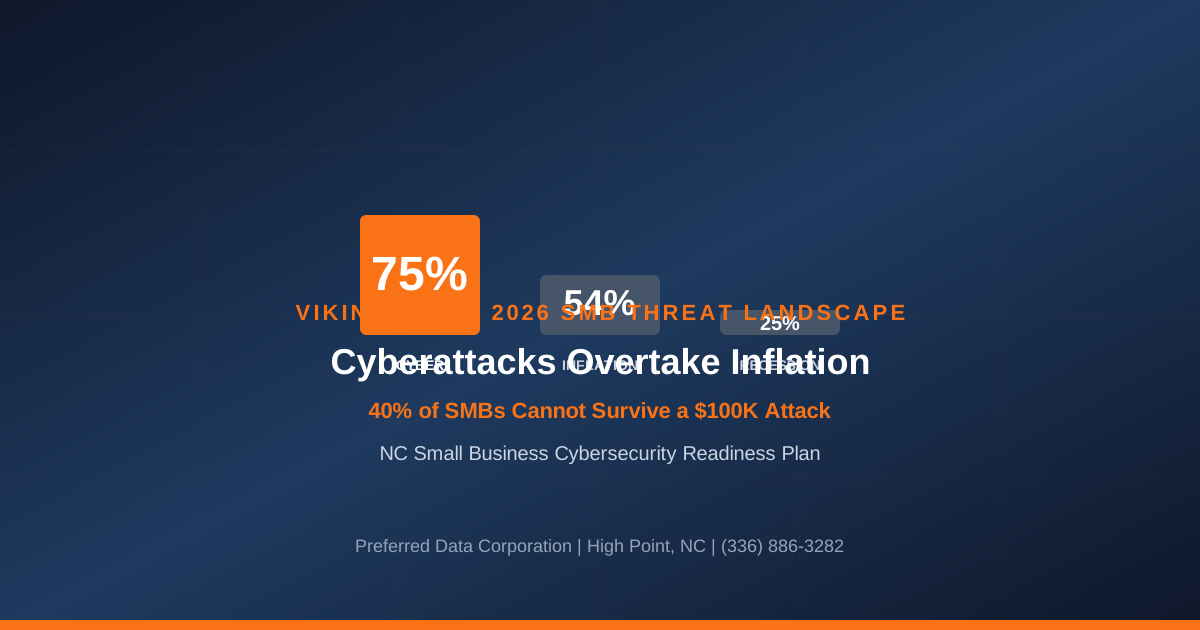
TL;DR: Per VikingCloud's 2026 SMB Threat Landscape Report, released February 2026, 3 in 4 SMBs now rank cyber incidents (data breaches, ransomware) as the most likely negative impact on their business this year - ahead of inflation (54%), recession (25%), and hiring shortages (25%). The same study found that 40% of SMBs say an attack of $100,000 or less could put them out of business, that 84% of SMB owners are still managing cybersecurity internally, and that AI-generated threats (phishing 46%, deepfake fraud 29%, customer data breaches 27%, ransomware 26%) are the most-cited attack vectors. For NC small businesses, the question is no longer "should we invest in cybersecurity?" - it is "how do we close the readiness gap before the next AI-generated phishing campaign lands?"
Key takeaway: Cyberattacks have moved from a back-burner IT concern to the #1 business risk facing NC small businesses in 2026. The financial floor on a serious incident now exceeds the survival threshold for two out of five SMBs. The question SMB leaders should be asking is not "what tool should we buy?" but "who is responsible for our cybersecurity outcome - and is that person actually qualified?"
Need a fractional CISO or managed cybersecurity partner? Preferred Data Corporation has provided managed IT and cybersecurity services to North Carolina small businesses since 1987. Call (336) 886-3282 or request a cybersecurity readiness review. Serving the Piedmont Triad, Charlotte, and Raleigh metros.
What is the VikingCloud 2026 SMB Threat Landscape Report?
Per VikingCloud's official announcement and the press release, the 2026 report surveys SMB owners and cyber leaders across the U.S. and U.K. on perceived threats, security budgets, AI-driven attack patterns, and organizational readiness. The headline numbers:
| Metric | Value | Source |
|---|---|---|
| SMBs ranking cyber as #1 business threat | 75% | VikingCloud 2026 SMB Threat Landscape Report |
| SMBs ranking inflation as top threat | 54% | VikingCloud 2026 SMB Threat Landscape Report |
| SMBs ranking recession as top threat | 25% | VikingCloud 2026 SMB Threat Landscape Report |
| SMBs that would lose customers after a breach | 50% | VikingCloud 2026 SMB Threat Landscape Report |
| SMBs that an attack <=$100K would close | 40% | VikingCloud 2026 SMB Threat Landscape Report |
| SMB owners managing security internally (DIY) | 84% | VikingCloud 2026 SMB Threat Landscape Report |
| Cyber leaders still DIY despite resources | 54% | VikingCloud 2026 SMB Threat Landscape Report |
| SMBs reporting AI-generated phishing attempts | 46% | VikingCloud 2026 SMB Threat Landscape Report |
| SMBs reporting deepfake-related fraud | 29% | VikingCloud 2026 SMB Threat Landscape Report |
| SMBs with outdated security tools | 34% | VikingCloud 2026 SMB Threat Landscape Report |
The "84% DIY" stat is the structural finding underneath the cyber-vs-inflation reversal: the threat has accelerated, but the operating model most SMBs use to defend has not.
Why did cyber surpass inflation as the #1 SMB threat?
Three forces are responsible, per VikingCloud's analysis and corroborated by the IDC 2026 SMB cybersecurity spending report:
- Frequency increase: SMBs are attacked more often. The Guardz 2026 MSP Threat Report found 89% of monitored SMBs had at least one compromised user. Per programs.com analysis, SMBs now account for over 70% of all data breaches globally.
- Severity increase: AI-driven attacks are harder to detect and faster to monetize. Ransomware costs (downtime + ransom + recovery + legal + notification) regularly exceed $250,000 for a 50-employee SMB.
- Inflation effect has compounded: A breach in 2020 might have been a $40,000 event for an SMB. In 2026, the same breach scope is a $150,000-$400,000 event because of higher ransom demands, longer downtime, and regulatory notification costs.
For NC small businesses, the practical effect is that cyber is now a board-level (or owner-level) risk that competes for the same attention historically reserved for cash-flow and customer concentration.
How does the 40% "can't survive $100K attack" stat translate to NC SMBs?
For a typical 25-100 employee NC manufacturer, construction firm, or professional services business:
| Attack type | Typical SMB cost floor | Cost ceiling |
|---|---|---|
| Business Email Compromise (BEC) wire fraud | $35,000 | $500,000+ |
| Ransomware (cloud + classic hybrid) | $120,000 | $2,000,000+ |
| Data breach with PII exfiltration | $80,000 | $750,000+ |
| AI-deepfake CEO fraud (vishing) | $50,000 | $1,000,000+ |
| Vendor breach with downstream impact | $25,000 | $400,000+ |
The 40% threshold ($100,000 attack puts the business at risk of closure) maps to most BEC and small ransomware events, and to the deductible-and-out-of-pocket portion of larger incidents under cyber insurance. The financial implication is that survival, not just security, is the budget conversation.
What is the practical NC small business cybersecurity readiness plan?
A 90-day readiness sprint for an NC SMB that is currently in the "DIY 84%" cohort:
| Days | Action | Owner |
|---|---|---|
| 1-15 | Cybersecurity baseline assessment: inventory assets, identities, data, SaaS, vendors | Managed security partner |
| 15-30 | MFA enforcement on all M365/Google accounts; conditional access policies | IT + managed partner |
| 30-45 | EDR deployment on all endpoints; baseline behavioral monitoring | Managed partner |
| 45-60 | Backup strategy: tested offsite + immutable copy; documented RTO/RPO | IT + managed partner |
| 60-75 | Security awareness training program; targeted high-risk role training (finance, executive) | Managed partner + HR |
| 75-85 | Tabletop exercise: ransomware, BEC, vendor breach scenarios with leadership | Managed partner + leadership |
| 85-90 | Cyber insurance policy review and updated application based on new controls | Insurance broker + managed partner |
For an SMB without a dedicated security lead, a fractional CISO arrangement (or "vCISO" through a managed security partner) typically runs $1,800-$6,000 per month and replaces the "owner does cybersecurity in their spare time" anti-pattern with documented, defensible practice.
Schedule a fractional CISO discovery call →
Why is "DIY cybersecurity" the structural problem?
Per VikingCloud's report, 84% of SMB owners and 54% of cyber leaders are still managing cybersecurity internally. The structural problems with DIY cybersecurity:
1. The threat landscape moves faster than internal teams can read
Patch Tuesdays, CISA KEV catalog additions, vendor breach disclosures, and AI attack pattern shifts arrive multiple times per week. A finance-or-operations-leader-also-doing-security cannot keep up while running the rest of the business.
2. The tools require operation, not just procurement
Buying an EDR license is not the same as operating EDR. The Guardz, VikingCloud, and IDC reports all surface the same gap: SMBs have tools but lack the operating discipline to make them effective.
3. The accountability is unclear
When the owner is "in charge of security" because no one else is, there is no real accountability. A managed partner with documented SLAs, defined scope, and quarterly reviews creates the missing accountability layer.
What is the budget conversation for NC small businesses?
Per the IDC 2026 SMB cybersecurity spending data, 60% of SMBs plan to increase cybersecurity spending in the next 12 months. Global SMB cybersecurity spending is projected at $175 billion in 2026, growing 16.3% year over year. Translating to NC SMB scale:
| Company size | Typical annual cybersecurity spend (managed services + tools) | Range |
|---|---|---|
| 10-25 employees | $18,000 - $42,000 | 6-10% of total IT budget |
| 25-75 employees | $45,000 - $120,000 | 6-10% of total IT budget |
| 75-250 employees | $120,000 - $400,000 | 6-12% of total IT budget |
| 250-500 employees | $400,000 - $1,000,000 | 8-14% of total IT budget |
These ranges include managed cybersecurity (24/7 monitoring, EDR operation, identity defense, incident response), security awareness training, cyber insurance premium, and tabletop / penetration test cadence. They do not include capital purchases of network gear or non-security IT services.
What is AI doing to the SMB attack equation?
Per VikingCloud's report:
- 46% of SMBs experienced AI-generated phishing attempts - emails crafted by LLMs with near-perfect grammar and context
- 29% reported deepfake-related fraud - typically voice-cloned CEO/CFO calls to finance staff requesting urgent wire transfers
- 27% reported customer data breaches
- 26% reported ransomware incidents
AI changes the defender requirements:
- Email security must include behavioral and brand-impersonation detection (not just URL and attachment scanning)
- Voice authentication for wire-transfer approvals (call-back to known number; no in-band confirmations)
- Security awareness training updated to cover deepfake voice and AI-personalized phishing patterns
- Vendor and customer communication channels with documented out-of-band verification protocols
Schedule an AI threat readiness assessment →
Why is "going it alone" no longer defensible for NC small businesses?
Per the report, 84% of SMB owners are still going it alone against AI-driven threats. The structural reasons this is no longer defensible in 2026:
- The attacker side is AI-augmented; the defender side cannot be DIY-augmented at SMB scale
- Cyber insurance carriers are explicitly requiring managed controls (24/7 monitoring, MFA, EDR, training cadence) at renewal
- Customer due diligence increasingly requires SOC 2 / NIST CSF self-attestation from SMB vendors - DIY operations cannot pass this bar
- State breach laws and federal reporting rules (CIRCIA, FTC) are tightening notification windows to 24-72 hours
For NC SMBs, a managed cybersecurity partner is no longer a luxury - it is the practical operating model that meets the threat, insurance, and customer-requirement reality.
How does Preferred Data Corporation help NC small businesses?
We provide fractional CISO and managed cybersecurity services scaled to NC SMBs. We start with a baseline assessment (assets, identities, vendors, data, SaaS, cyber insurance posture). We deploy and operate EDR, identity defense, and email security in your tenant - not just install, but monitor and respond. We run quarterly tabletops with leadership so the response runbook is rehearsed. We coordinate with cyber insurance brokers so your controls match policy requirements. And we serve as the documented accountability layer so "who is in charge of cybersecurity?" has a clear answer. Most NC SMBs do not need an in-house CISO; they need a partner who treats security outcomes - not security tickets - as the deliverable.
Frequently Asked Questions
Why did cyberattacks surpass inflation as the #1 SMB threat in 2026?
Per VikingCloud's 2026 report, 75% of SMBs now rank cyber incidents as the most likely negative impact on their business, ahead of inflation (54%) and recession (25%). The drivers are higher attack frequency (SMBs now account for over 70% of breaches globally), higher severity (ransomware floors exceed $100K), and AI-augmented attack tooling that scales personalization.
How much can a typical SMB cyberattack actually cost?
For a 25-100 employee NC SMB, attack cost floors typically run: BEC wire fraud $35K, ransomware $120K, data breach with PII $80K, AI deepfake fraud $50K, vendor breach $25K. Per VikingCloud, 40% of SMBs say an attack of $100K or less could close their business - and that figure intersects every category above.
What does "fractional CISO" or "vCISO" mean for an NC small business?
A fractional or virtual CISO is an outsourced senior security leader who provides strategy, oversight, board reporting, vendor risk management, incident command, and accountability for a defined portion of their time (typically 4-20 hours per month). For NC SMBs, vCISO arrangements typically run $1,800-$6,000 per month and replace the "owner-as-security-lead" anti-pattern with documented, qualified practice.
Is cyber insurance enough on its own?
No. Per the 2026 cyber insurance market analysis, carriers now require evidence of MFA, EDR, conditional access, employee training, and an incident response plan to issue or renew policies. Insurance is part of the financial cushion, not a substitute for prevention. Without the controls, the policy may not pay out.
How can SMBs defend against deepfake CEO fraud?
Three controls close most of the gap: a mandatory call-back protocol for wire transfers (call the CEO/CFO at their known number, not the number in the email), a second-approver requirement for any wire transfer above a threshold (e.g., $10,000), and security awareness training that includes deepfake voice samples and how to recognize them. Document the protocol in finance procedures - a deepfake call cannot route around a written policy.
What is the first thing an NC small business should do this month?
Run a cybersecurity baseline assessment with a qualified managed security partner. Inventory identities, assets, SaaS, data, and vendors. Force MFA on every Microsoft 365 / Google Workspace account. Subscribe to dark-web credential monitoring. Document an incident response runbook. These four actions close the highest-impact gaps for under $5,000 in initial spend and dramatically improve cyber insurance underwriting on the next renewal.
Does PDC offer managed cybersecurity for NC small businesses?
Yes. Preferred Data Corporation has provided managed IT and cybersecurity services to North Carolina small businesses since 1987, with on-site capability within 200 miles of High Point. Our managed cybersecurity includes EDR operation, identity defense, email security, security awareness training, fractional CISO/vCISO, and quarterly tabletop exercises. Call (336) 886-3282 or request a readiness review at preferreddata.com/contact.
Related Resources
- Guardz 2026 MSP threat report - 89% SMBs compromised users NC
- 2026 SMB breach economics NC small business survival budget
- Black Kite 2026 third-party breach report manufacturing pressure zone NC
- AI voice cloning CFO fraud small business defense NC
- Managed cybersecurity services for NC businesses
- Managed IT services for North Carolina businesses
About the author: Preferred Data Corporation has provided managed IT, AI transformation, and cybersecurity services to North Carolina small businesses since 1987. Based at 1208 Eastchester Drive, Suite 131, High Point, NC 27265, we serve manufacturers, construction firms, and professional services organizations across the Piedmont Triad, Charlotte, and Raleigh metros. Call (336) 886-3282 or request a cybersecurity readiness review.