
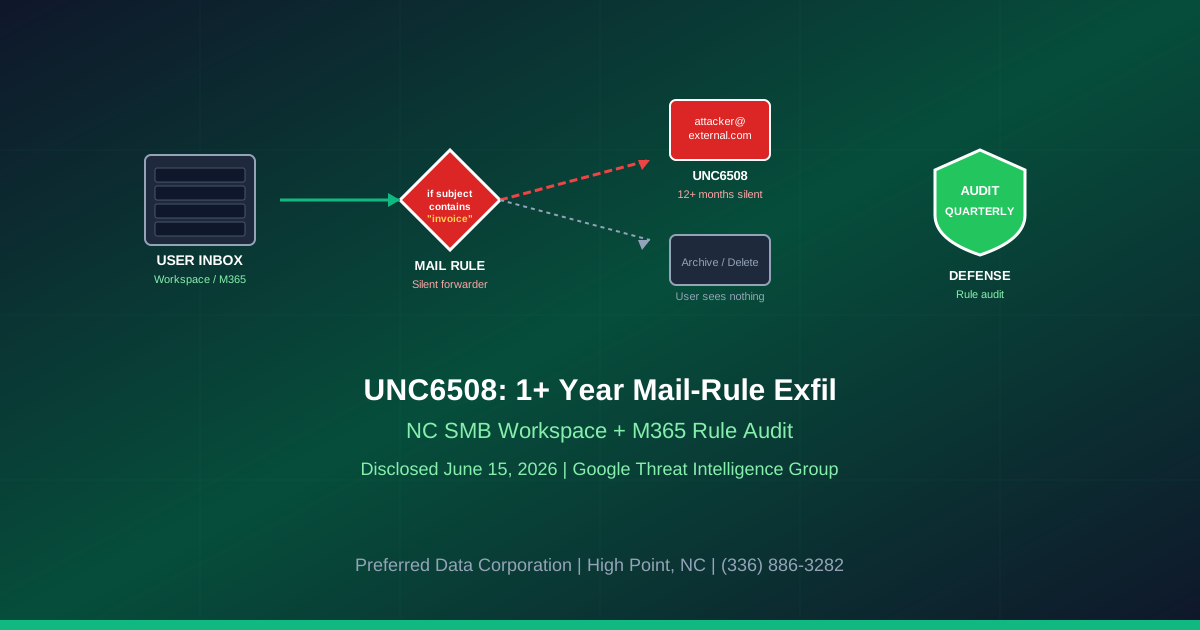
TL;DR: On June 15, 2026, Google's Threat Intelligence Group (GTIG) attributed a multi-year cyber espionage campaign to UNC6508, a People's Republic of China-linked threat actor that remained undetected in North American medical, academic, and military research networks for more than a year. Per Help Net Security's reporting, the way in was a backdoor on REDCap research servers; the way the data went out was something that should worry every NC SMB: the attackers rewired the victims' own Google Workspace mail rules to silently copy every message matching their keywords to attacker-controlled inboxes. The technique requires no new account, no malware on user endpoints, and no anomalous login - just one stolen admin password and a few well-placed filter rules.
Key takeaway: The most dangerous Workspace attack of 2026 is not malware - it is a few benign-looking mail forwarding rules in your Gmail filters. Quarterly mail rule audits are the single highest-leverage email control NC small businesses are not already running.
Need to verify your Google Workspace mail rules are clean? Preferred Data Corporation has supported NC small businesses since 1987 and can audit your tenant this week. Call (336) 886-3282 or request a Workspace rule audit.
What did UNC6508 do, and why is the SMB takeaway about mail rules?
UNC6508 is a Google-tracked threat cluster linked to the People's Republic of China that targeted North American clinical providers, academic centers, military health institutions, advocacy groups, and health regulators. Per Help Net Security's June 15 coverage, the activity began in September 2023 and continued through at least November 2025 - more than a year inside victim environments. The initial access vector was a backdoor planted on REDCap research servers; the persistence and exfiltration technique was the abuse of victims' own Google Workspace mail filtering rules.
Three reasons the SMB takeaway is the mail-rule technique, not the REDCap backdoor:
- Most NC SMBs do not run REDCap. The initial access vector is research-specific. The exfiltration technique generalizes to every Workspace tenant.
- Mail rules are invisible to traditional security tooling. Per Google's Workspace documentation, filter rules belong to the user and are not logged at the same fidelity as admin actions. EDR does not see them; SIEM rules typically do not catch them.
- The technique works for any motive. UNC6508 used it for espionage. BEC (business email compromise) crews already use the same trick for invoice fraud and wire-transfer redirection. The defense is the same regardless of motive.
How does the mail-rule exfiltration technique actually work?
The attacker gets one set of credentials - through phishing, an OAuth consent grant, infostealer malware, or a third-party app breach - and then never logs in again with anything anomalous. Instead, the attacker creates a few innocuous-looking Gmail filter rules that forward, copy, or label inbound messages matching specific keywords. Per The Next Web's reporting, UNC6508 rewired victims' own filter rules to copy any message matching their keywords to an inbox the attacker controlled, then exfiltrated data through that channel for months.
The four-step attack pattern:
- Initial access (any method). Phishing, OAuth consent grant, stolen credential, malicious browser extension, third-party app breach. The attacker needs one valid session.
- Create or modify mail filter rules. Filters can forward, copy, label, archive, or auto-respond. The attacker picks rules that look like personal organization, not security incidents.
- Continuous exfiltration. Every inbound mail matching the filter is silently routed to the attacker. No further logins. No anomalous activity.
- Persistence past credential rotation. If the user rotates their password but does not audit their own filter rules, the exfiltration continues uninterrupted. Per the BleepingComputer coverage, UNC6508 stayed inside for more than a year by exactly this mechanism.
Quotable definition: Mail-rule exfiltration is a post-credential-compromise persistence technique in which an attacker creates or modifies the victim's own email filter rules to silently forward inbound messages to an attacker-controlled inbox, surviving password rotation, MFA enrollment, and most traditional security tooling.
Why are NC small businesses uniquely exposed to mail-rule abuse?
Because mail rules sit at the user level, not the admin level, in both Google Workspace and Microsoft 365. NC SMBs typically run Workspace or M365 with a single admin account managed by an MSP and very limited end-user security awareness. Users create filter rules to organize their inbox - and attackers piggyback on the legitimate use of the feature.
| Control class | Stops phishing? | Stops mail-rule exfiltration? |
|---|---|---|
| MFA on user accounts | Yes for password reuse | No - rules persist past MFA enrollment |
| Conditional access policies | Partial | Partial - depends on rule creation event logging |
| EDR on endpoints | No | No - the attack is server-side |
| Email security gateway | Yes for inbound malware | No - the exfiltration is outbound forward |
| Workspace audit log alerts | If configured | Yes - if alerts on filter rule creation are turned on |
| Quarterly mail rule audit | N/A | Yes - direct detection |
Per the Cybersecurity and Infrastructure Security Agency (CISA), mail-rule manipulation has been used by both nation-state espionage actors and BEC criminal crews for years. The technique stays effective because audit is not part of most SMB Workspace or M365 baselines.
Which NC small businesses are most exposed to mail-rule attacks?
NC SMBs that have not run a mail-rule audit in the last 12 months, NC SMBs that allow users to forward business mail to personal addresses, and NC SMBs that grant third-party app OAuth consent without periodic review. The exposure is universal across Google Workspace and Microsoft 365 tenants - the technique works in both.
The highest-exposure NC SMB profiles:
- NC manufacturers in High Point, Winston-Salem, and Greensboro running Google Workspace with engineering teams and customer-service mailboxes. A single compromised engineering account can leak BOMs, supplier contracts, and customer pricing for months before anyone notices. See our Managed IT services page for Workspace hardening.
- NC distributors in Greensboro, Charlotte, and Raleigh with shared mailboxes for orders, AP, and AR. Shared mailboxes are the BEC attacker's favorite target; mail-rule rerouting of vendor invoices is a $10K-$100K-per-incident loss.
- NC professional services firms (law, accounting, engineering) in Raleigh, Charlotte, and Winston-Salem. Client communications are the target; the attacker can silently mirror every email between attorney and client for as long as the rule stays in place.
- NC SMBs that have ever connected a third-party app to Workspace or M365 via OAuth. A revoked third-party app token does not remove the mail rules it created. Audit the rules, not just the consent grants.
- NC defense contractors and CMMC-scoped firms. A persistent exfiltration of CUI through mail rules is a reportable cyber incident under DFARS 252.204-7012 and a finding in any C3PAO assessment.
Worried that a mail rule from six months ago is still siphoning your inbox? Call (336) 886-3282 or request a Workspace rule audit.
What governance steps should NC SMBs take this week?
Run a five-step plan over the next 14 days. None of these require new product purchases. Per Google's Workspace admin documentation and Microsoft's Defender for Office documentation, every step uses tooling NC SMBs already have.
- Audit user-created mail rules across the tenant (days 1-3). In Google Workspace, run a tenant-wide forwarding and filter audit; in M365, run a tenant-wide inbox rule audit via Get-InboxRule on every mailbox. Look for rules that forward externally, that route to obscure folders, or that target keywords like "invoice," "wire," "ACH," "MFA," or "verification."
- Disable external forwarding by policy where it is not a business need (days 2-5). In Workspace, restrict gateway routing to allow-listed domains; in M365, set the outbound spam policy to block automatic external forwarding. Per Microsoft's guidance, automatic external forwarding is the single most common BEC exfiltration channel.
- Configure admin alerts on filter rule creation (days 3-7). In Workspace, enable the "Email settings changed" alert in the Admin console; in M365, configure Defender for Office alert policies for new inbox rules. Alerting on the event lets you catch the next rule the day it is created, not 12 months later.
- Audit and prune OAuth app consent grants (days 7-10). In Workspace, run the third-party apps audit in Admin → Security; in M365, review enterprise applications and consented permissions. Per CISA's BEC guidance, abandoned OAuth grants are a major persistence channel.
- Run a quarterly cadence (day 14 forward). Put the rule audit on the quarterly compliance calendar. Document who runs it. Train the operator. Reference our Cybersecurity services for tenant baselines.
Key takeaway: The first action is the tenant-wide rule audit. NC SMBs cannot detect what they have not looked at; the rules that matter are usually the ones nobody has reviewed since the user created them on a Tuesday in 2024.
How does Preferred Data Corporation help NC SMBs harden Workspace and M365 against mail-rule attacks?
PDC has supported NC small businesses since 1987 and treats the tenant configuration baseline as the highest-leverage SMB security control. We bring three things to the UNC6508 conversation:
- Cybersecurity services: Tenant-wide mail rule audits, OAuth consent grant reviews, BEC-aware Workspace and M365 policy hardening, and incident-response runbooks for suspected mail-rule exfiltration events. We help NC SMBs treat the inbox as a tier-one asset.
- Managed IT services: Continuous Workspace and M365 baseline monitoring, automated admin alerting on filter and forwarding rule changes, identity and conditional access policy management, and the day-to-day operational work that keeps the tenant out of the headlines. For NC manufacturers in High Point, distributors in Greensboro, and professional services firms in Charlotte and Raleigh, the managed baseline is what makes mail-rule abuse a 24-hour incident rather than a 12-month one.
- Backup and recovery services: Tenant backup, retention, and legal-hold tooling so that even if a mail-rule attack runs for months, the data trail required for breach counsel and law enforcement is preserved.
For small business owners in High Point, the Piedmont Triad, Greensboro, Winston-Salem, Charlotte, and Raleigh, the UNC6508 disclosure is the cue to formalize quarterly Workspace and M365 rule audits. The CISA SMB resources frame this clearly: SMBs face enterprise-grade exposure with a fraction of the staff. A trusted local partner closes the gap.
Ready to audit every mail rule in your tenant this quarter? Call (336) 886-3282 or book a Workspace rule audit.
Frequently Asked Questions
Who is UNC6508?
UNC6508 is a Google-tracked threat cluster attributed to the People's Republic of China by Google's Threat Intelligence Group on June 15, 2026. The cluster targeted North American medical, academic, and military research networks using a backdoor on REDCap research servers and abuse of Google Workspace mail filter rules to exfiltrate data over more than a year of undetected access.
Why is the SMB lesson about mail rules, not REDCap?
Because most NC SMBs do not run REDCap, but every NC SMB runs an email tenant with user-creatable filter rules. Per BleepingComputer, the persistence and exfiltration technique - rewiring victim mail rules - is the technique that generalizes to every SMB tenant and is already used by BEC actors for invoice fraud.
Does MFA prevent mail-rule exfiltration?
No, not on its own. MFA prevents the initial credential compromise from being trivial, but once an attacker has any valid session (through phishing, OAuth consent abuse, or infostealer malware), the mail rules they create persist past password rotation and MFA enrollment. The defense is rule audit, not just authentication hardening.
What is the single most common forwarding rule pattern attackers use?
A forwarding rule that targets keywords like "invoice," "wire," "ACH," "verification," or "MFA," and forwards or copies matching messages to an external address. The rule typically also archives or deletes the original so the user does not see it. Per CISA's BEC advisories, the pattern has been consistent for years.
How often should NC SMBs audit mail rules?
Quarterly at minimum. Monthly is better if the tenant has more than 50 users or handles high-risk data classes. The audit takes 1-3 hours per quarter and is the highest-leverage email control NC SMBs typically are not already running.
What is the first thing an NC SMB should do this week?
Run a tenant-wide mail rule audit. In Google Workspace, check user forwarding and filter settings in the Admin console; in M365, run Get-InboxRule against every mailbox. Look for external forwards and keyword-targeted rules. Then disable automatic external forwarding by policy and enable admin alerts on filter rule creation.
Related Resources
- Cybersecurity Services for NC Small Businesses - Tenant audit, BEC hardening, incident response
- Managed IT Services for NC Businesses - Continuous tenant baseline monitoring
- Backup and Recovery Services - Backup, retention, and legal hold
- Google Workspace vs Microsoft 365 NC Small Business 2026 - Tenant choice guide
- Microsoft 365 Security Settings NC 2026 - Tenant baseline configuration
- Storm-2949 Entra ID Cloud Takeover: NC SMB Defense 2026 - Cloud identity defense
- Contact Preferred Data Corporation - Workspace rule audit for NC SMBs