
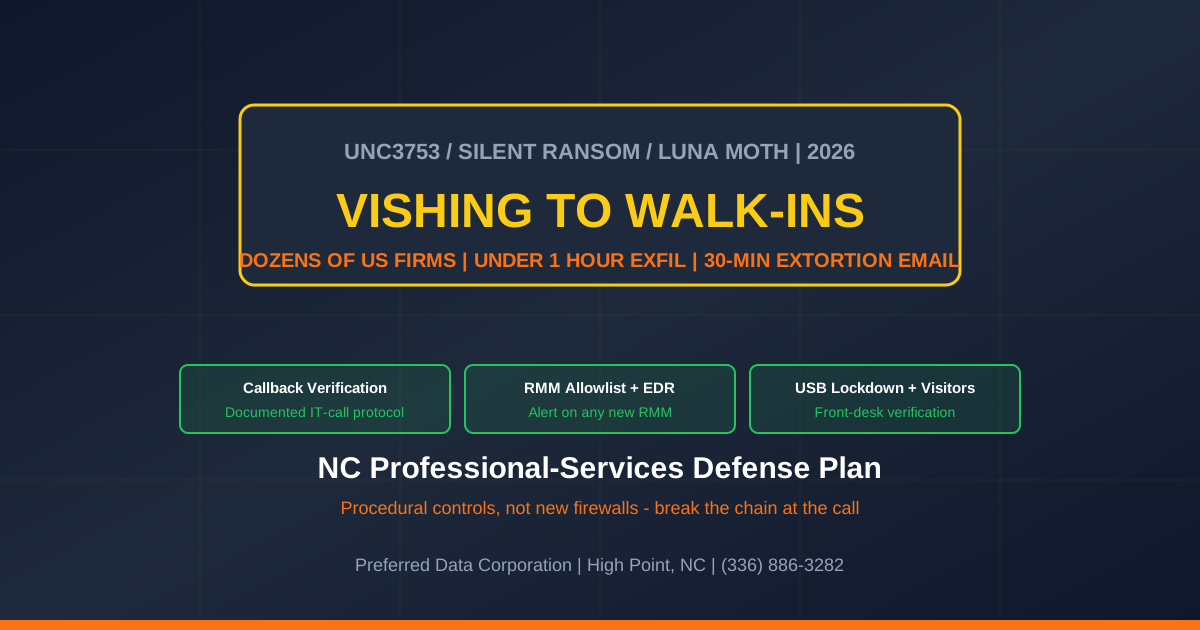
TL;DR: UNC3753 - tracked as Silent Ransom Group, Luna Moth, and Chatty Spider - has run a vishing-driven data-theft extortion campaign against US law firms and professional-services firms from January through May 2026. When the phone call fails to land remote access, the group sends individuals to victim offices in person to insert USB drives into employee computers, per The Register. The FBI published a TLP:Clear flash advisory in May 2026 and Google's Threat Intelligence Group published an updated analysis of the campaign in June 2026. For NC professional-services firms - law, accounting, financial advisory, healthcare administration, M&A - this is the moment to enforce a callback-verification policy, lock down RMM tools, and put a real visitor-verification process at the front desk.
Key takeaway: Silent Ransom Group has compressed the chain from first phone call to data theft into a single business day, with searching, staging, and exfiltration sometimes complete inside an hour. When the social-engineering call fails, the same operators escalate to in-person impersonation with USB drives. The defense is not a new firewall - it is a phone protocol, an RMM inventory, and a visitor policy.
Need a vishing + RMM + visitor-verification readiness review for your NC professional-services firm? Preferred Data Corporation has supported NC small businesses since 1987 from High Point. Call (336) 886-3282 or book a social-engineering readiness review.
Who is UNC3753 / Silent Ransom Group / Luna Moth?
UNC3753 is the cluster identifier used by Google's Threat Intelligence Group / Mandiant. The same threat actor is also tracked as Silent Ransom Group (SRG), Luna Moth, and Chatty Spider. Per The Hacker News and the Google Cloud Threat Intelligence post, the group has been active since at least March 2022 and traces back through prior overlaps to the now-defunct Conti ransomware ecosystem.
Three facts an NC SMB owner should write down:
- The 2026 campaign targets US law, financial, and professional-services firms. Per The Hacker News reporting and Cybersecurity News, UNC3753 hit dozens of US firms between January and May 2026. The targeting profile fits NC's Piedmont Triad professional-services base - law firms, accounting and tax practices, wealth and financial advisory, healthcare administration, M&A advisors, and high-end consulting practices.
- End-to-end intrusion sometimes completes in under an hour. Per Help Net Security and the Google Cloud post, the time from first phone call to data exfiltration is sometimes a single business day - and in some cases, search-stage-exfiltrate runs in under an hour. The defender's response window is short.
- Escalation to physical office intrusion with USB drives. Per The Register and Security Affairs, when the phone-based social engineering fails, the group sends operators to the victim's physical office. They pose as IT technicians, claim they need to image a device or run a backup, and insert a USB drive to install RMM software or copy data directly.
The FBI published a TLP:Clear flash advisory on May 26, 2026, warning specifically that SRG actors are impersonating IT personnel through social engineering. The advisory matters because it provides the formal IOC list and FBI-blessed playbook NC SMBs can hand directly to staff and counsel.
What does the Silent Ransom kill chain look like?
The chain has five stages and the defender has to break it at the call, not at the encryption.
| Stage | Attacker Action | NC SMB Failure Mode | Defense Layer |
|---|---|---|---|
| 1 | Vishing call posing as IT support | No callback verification policy | Documented IT-call protocol |
| 2 | Push RMM install via Privnote / self-destruct link | "We do not maintain an RMM inventory" | Allowlist + EDR detection |
| 3 | Establish persistence with AnyDesk / Bomgar / SuperOps RMM / Zoho Assist | EDR not configured to alert | EDR / MDR + RMM allowlist |
| 4 | Enumerate and exfiltrate to external drive or cloud | No DLP, no egress monitoring | DLP + egress controls |
| 5 | Extortion email within 30 minutes of exit | No IRP, no insurance carrier on speed dial | Tested IRP + retainer |
Two implications NC SMB owners should not skip:
- The threat actor uses legitimate RMM software. Per Cybersecurity News' UNC3753 deep dive, the RMM tools used (AnyDesk, Bomgar / BeyondTrust, SuperOps RMM, Zoho Assist, sometimes also Atera and ScreenConnect) are the same tools your real MSP might use. The EDR cannot rely on the tool name; the rule has to be "we allowlist exactly the RMM our MSP uses and alert on every other RMM install."
- Privnote / self-destruct messaging is a soft IOC. Per The Hacker News, instructions for installing the RMM are shared via privnote.com, which self-destructs after read. If an employee reports being asked to follow a "self-destructing" link from "IT support," treat it as a presumptive Silent Ransom indicator.
What does the physical-intrusion escalation look like?
Per the FBI flash advisory and Security Affairs' coverage of the escalation, the pattern is:
- The vishing call fails or is refused.
- A few days later, an individual appears at the office in business attire, claims to be "from IT" (sometimes naming the actual MSP), and says they need to image a device, run a backup, or address an "issue from the email earlier this week."
- They insert a USB drive into a workstation and either install RMM software or copy data directly.
For NC firms in older office buildings, mixed-tenant towers, or co-working space, the visitor-verification gap is real: the front desk is empty, the conference rooms are open, and the workstation in the second-row office is unattended at lunch. The defense has to be policy and process, not just technology.
What should an NC SMB do this week about Silent Ransom Group?
Run a six-step plan inside seven days. Every step is a policy and process change; none of them require a capital project.
- Day 1 - publish a callback-verification policy. No employee accepts any IT-support request that arrives by phone or email without independently calling back the documented IT or MSP number. The callback number is on the laminated card at every desk; the inbound number is never trusted. The policy is communicated by email and acknowledged by every employee.
- Day 1-2 - inventory every RMM and remote-access tool. Pull a list of every authorized remote-access tool: the MSP's preferred tool, any vendor-required tool for line-of-business apps, plus any tool used for executive home support. Anything not on the list is unauthorized. Configure EDR / MDR to alert on every install of any RMM that is not on the authorized list.
- Day 2 - lock down USB on the workstation fleet. Block USB mass-storage by default via Group Policy / Intune. Allow only signed, vetted devices for the small set of users who legitimately need USB. NC firms that need USB for closing documents, court filings, or financial deliverables can document the exception per user and audit it monthly.
- Day 3 - visitor-verification at the front desk. Anyone claiming to be IT or vendor support must (a) present photo ID, (b) be on the day's authorized visitor list, (c) be escorted to and from the desk by a named employee, and (d) sign in/out. The reception team is told explicitly: "no entry without a phone call to verify, even if the badge looks right."
- Day 4-5 - workforce training on vishing + walk-ins. Brief every employee in a 20-minute session: the call protocol, the visitor protocol, the privnote indicator, the "I'm from IT, I need to image your device" red flag. Record the training so new hires take it during onboarding. Test the training with a tabletop or a simulated vishing call within 30 days.
- Day 5-7 - verify IRP + insurance carrier alignment. Confirm the firm's IR retainer is in place, the insurance carrier is named on the IRP, and the cyber-insurance policy has the right SRG / Luna Moth coverage and no Conti-related exclusions. Per Dark Reading's coverage, the extortion playbook compresses the response window to days, and the email demanding payment arrives within 30 minutes of the operator exiting.
Key takeaway: Silent Ransom Group's defense is overwhelmingly procedural, not technological. Callback verification, RMM inventory, USB lockdown, visitor verification, and 20 minutes of staff training will break the chain at multiple stages. The technology defenses (EDR / MDR / DLP) are still required - but the procedural layer is where the chain actually breaks.
Want a procedural readiness sweep for your NC professional-services firm this week? Call (336) 886-3282 or book a social-engineering readiness review.
What sectors of NC's economy face the highest Silent Ransom Group risk?
Per the Google Cloud Threat Intelligence post and the SOC Prime analysis, the targeting profile is professional services firms with high-value client data and a structurally vulnerable IT support culture.
- Law firms. Client confidentiality, M&A deal data, litigation strategy, sealed records. Per Dark Reading, this is the primary 2026 target sector for SRG.
- CPA / accounting / tax firms. Per the Google Cloud post, the group enumerates folders related to tax filings, audits, and corporate client agreements - which is exactly the file set in a CPA firm.
- Financial advisory and wealth management. Social Security numbers, account statements, and client-PII at scale.
- Healthcare administration practices. HIPAA-regulated data, business associate exposures, vendor risk all stack together.
- M&A advisors / boutique investment banking. Per the documented enumeration patterns, corporate-client agreements and term-sheets are explicitly on the target list.
- High-end consulting practices. Client confidentiality + lean IT structure + high-value working files.
The common thread is "high-value data, lean IT support, vendor-heavy stack." NC has all of these clustered around Charlotte, the Research Triangle, Greensboro, Winston-Salem, and High Point. The threat is local in impact even when the actor is remote.
How does Preferred Data Corporation help NC professional-services firms harden against Silent Ransom?
PDC has supported NC small businesses since 1987 from High Point. Three concrete service lines align with the Silent Ransom defense playbook:
- Managed cybersecurity services: EDR / MDR with RMM allowlist content, vishing simulation training programs, security awareness for professional-services staff, DLP and egress controls for client-PII protection, and an Incident Response Plan with insurance-carrier alignment.
- Managed IT services: Documented IT-call protocol with a published callback number, USB lockdown via Intune / Group Policy, named RMM inventory, helpdesk authentication that explicitly does not rely on caller-trust, and the operational rhythm to make callback verification the default rather than an exception.
- Software development services: For NC firms with custom client-intake or matter-management systems, hardening the audit trail, adding session-binding and re-auth for sensitive actions, and integrating with EDR / MDR / SIEM so unauthorized RMM access is detectable at the application layer.
For NC law firms in Charlotte and Raleigh, CPA practices across the Piedmont Triad, financial advisory firms in Greensboro and Winston-Salem, healthcare administration practices in High Point, and M&A advisors and boutique consulting practices across the Research Triangle - Silent Ransom Group's playbook is sector-specific and local in impact. The procedural controls this week are the highest-leverage defense for the rest of 2026.
Need a Silent Ransom Group / Luna Moth readiness sweep scoped to your NC firm? Call (336) 886-3282 or book a social-engineering readiness review.
Frequently Asked Questions
Who is UNC3753 and what other names does it go by?
UNC3753 is the Google Threat Intelligence Group / Mandiant tracking name. The same threat actor is also tracked as Silent Ransom Group (SRG), Luna Moth, and Chatty Spider. Per The Hacker News, the group has been active since at least March 2022 and traces back through overlaps to the now-defunct Conti ransomware ecosystem.
What is the Silent Ransom Group's 2026 campaign focus?
Per The Register, Dark Reading, and the FBI flash advisory, the January through May 2026 campaign focused on US law firms and adjacent professional-services targets (accounting, financial advisory, healthcare administration). The group uses vishing to install RMM tools, exfiltrates data, and sends an extortion email within 30 minutes of exiting the environment.
How do attackers escalate from vishing to physical office intrusion?
Per Security Affairs and the FBI advisory, when the phone-based social engineering does not succeed, the same operators send an individual to the victim's office in business attire, claiming to be from IT and offering to image a device or run a backup. They insert a USB drive and either install RMM software or copy data directly. The escalation is documented in multiple confirmed incidents.
What RMM tools does Silent Ransom use?
Per Cybersecurity News' UNC3753 analysis, the documented tools include AnyDesk, BeyondTrust Bomgar, SuperOps RMM, Zoho Assist, and sometimes Atera and ConnectWise ScreenConnect. The defense is not to block these tools (your real MSP may legitimately use one or more) - it is to maintain an explicit allowlist of authorized RMM tools and alert on every install of any other RMM, even when the install looks normal.
What is the most important policy change for NC SMBs to make this week?
A documented callback-verification policy. No employee accepts any IT-support request - phone, email, chat, or SMS - without independently calling back the documented IT or MSP number from a separately known source. This single policy change breaks the Silent Ransom chain at stage one, before any RMM is installed. The cost is zero; the implementation is a memo, a 20-minute training session, and a laminated card at every desk.
How does cyber insurance treat Silent Ransom / Luna Moth incidents?
Cyber insurance underwriting in 2026 increasingly requires phishing-resistant MFA, EDR / MDR, immutable backups, vishing simulation training programs, and an IRP with a named IR provider on retainer. Silent Ransom incidents are covered under most policies, but coverage may be sub-limited if the carrier's pre-binding controls were not in place. The right time to verify alignment with your carrier is now, not after the extortion email lands.
Related Resources
- Cybersecurity Services - EDR / MDR, RMM allowlist, vishing training, IRP
- Managed IT Services - Documented IT-call protocol, USB lockdown, RMM inventory
- Software Development Services - Audit trail hardening for client-intake systems
- Conti Plea June 2026: NC SMB Ransomware Reporting Plan - Companion ransomware reporting analysis
- Gartner: 62% Hit by Deepfake Attacks - NC SMB AP Defense 2026 - Companion social-engineering defense post
- Contact Preferred Data Corporation - Social-engineering readiness review for NC firms