
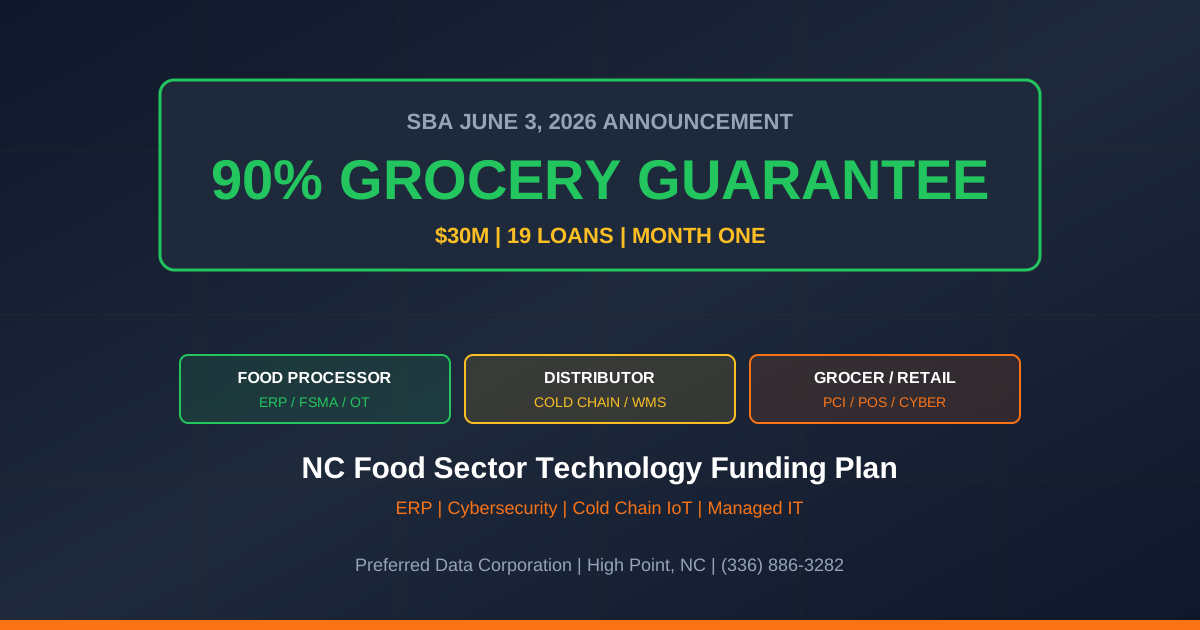
TL;DR: Per the SBA's June 3, 2026 announcement, the agency approved 19 loans totaling more than $30 million in one month under its new 90% Grocery Guarantee program. The program targets small businesses involved in food production, processing, distribution, and sales - exactly the NC food manufacturer, food distributor, food processor, and independent grocer footprint across the Piedmont Triad, Charlotte, Raleigh, and rural NC. SBA 7(a) loans are eligible to finance IT modernization, ERP migrations, cybersecurity stacks, cold-chain monitoring, traceability software, and managed IT contracts - which is where the 2026 food sector technology gap actually exists.
Key takeaway: The 90% Grocery Guarantee is not just a real-estate or working-capital tool. SBA 7(a) loans cover software, equipment, cybersecurity tooling, and managed-services contracts. NC food sector SMBs with a documented technology roadmap can now finance the modernization through SBA at a higher guarantee level than the standard 7(a) - improving lender approval rates and reducing cost of capital.
Need an SBA-eligible food sector technology roadmap before Q3 2026? Preferred Data Corporation has built IT and ERP roadmaps for NC food manufacturers and distributors since 1987. Call (336) 886-3282 or request a food sector technology session.
What is the SBA 90% Grocery Guarantee?
The 90% Grocery Guarantee is an SBA 7(a) program enhancement that raises the federal loan guarantee from the standard 75-85% to 90% for qualifying food sector small businesses. Per the SBA's June 3, 2026 press release, the program was launched as part of a federal initiative to expand access to capital for small businesses involved in food production, processing, distribution, and sales - with the first 19 loans totaling more than $30 million approved within the first month.
Three facts NC food sector owners should write down:
- Higher guarantee = higher approval probability. Per SBA 7(a) lender benchmarks, a 90% guarantee reduces the lender's risk exposure on the unguaranteed portion, which translates to higher approval rates and more competitive interest rates for the borrower.
- Tech and software are eligible uses. Per the SBA's 7(a) program overview and SBA SOP 50 10 7.1, eligible uses include working capital, equipment, machinery, IT infrastructure, software, cybersecurity tooling, and managed-services prepayment.
- Wide food sector definition. Per the SBA's June 3, 2026 announcement, the program covers food production (farms, processors, packagers), distribution (cold storage, logistics, wholesale), and sales (independent grocers, specialty food retailers, food service). Across the Piedmont Triad, this is hundreds of NC SMBs.
For NC food manufacturers in High Point, food distributors in Greensboro, and independent grocers across rural NC, the 90% Grocery Guarantee unlocks technology investments that were previously fragmented across cash flow, vendor financing, and lease-to-own.
What food sector technology gaps does the 2026 NC SMB face?
Per FDA Food Safety Modernization Act (FSMA) Section 204 traceability requirements and USDA Food Safety and Inspection Service guidance, NC food sector SMBs face six 2026 technology gaps that the 90% Grocery Guarantee can finance:
| Technology Gap | Why It Matters | SBA 7(a) Eligible? |
|---|---|---|
| FSMA Section 204 traceability software | Compliance deadline pressure, recall management | Yes - software / SaaS prepayment |
| ERP migration (legacy AS/400, on-prem to cloud) | Multi-warehouse visibility, sales tax automation | Yes - software + implementation |
| Cybersecurity stack (EDR, identity, backup) | Cyber-insurance underwriting, supply-chain mandates | Yes - SaaS + managed contract |
| Cold chain IoT monitoring | FSMA temp logs, insurance evidence | Yes - equipment + connectivity |
| PCI DSS payment terminals (retail / grocers) | Card-brand compliance, fraud protection | Yes - equipment |
| Managed IT contract (24/7 support) | Operational uptime, after-hours emergency | Yes - prepay 12-24 months |
For an NC food processor running a 20-year-old AS/400 ERP and an unsupported Windows Server domain, the 90% Grocery Guarantee can underwrite a roughly $500K - $1.5M modernization in one transaction.
Why is cybersecurity a food sector priority in 2026?
Because food and beverage manufacturers became a top-five ransomware target sector in 2025 - 2026. Per Verizon's 2026 Data Breach Investigations Report and BlackFog's 2026 State of Ransomware, manufacturing - including food manufacturing - sits in the top tier of ransomware impacts due to operational technology (OT) exposure, just-in-time supply chains, and traceability data sensitivity. Three NC-specific implications:
- OT shutdown = revenue stop. A food processor's bottling line, packaging line, or cold storage SCADA outage costs measured in dollars per minute, not per day.
- Recall consequences are amplified. Per FSMA traceability, a ransomware event that locks traceability records during a recall window creates a regulatory cascade beyond the cyber loss itself.
- Customer supply-chain mandates. Large NC food retailers (national grocery chains, large food service distributors) now require cybersecurity evidence from suppliers. Per The Hacker News 2026 supply chain coverage, supply-chain attestation has moved from "nice to have" to "contract gate."
Quotable definition: In 2026, an NC food sector SMB without an EDR-monitored, identity-hardened, immutable-backed stack is two things at once - a top-tier ransomware target and a supplier failing the largest customer's audit. The 90% Grocery Guarantee is the cleanest single financing instrument to close both gaps with one transaction.
What does a defensible 2026 food sector technology stack look like for an NC SMB?
Per CISA's Cybersecurity Performance Goals 2.0, NIST SP 800-82r3 OT security guidance, and FDA FSMA Section 204 traceability requirements, the 2026 NC food sector technology stack has six required components:
- Cloud ERP or modernized on-prem ERP with multi-warehouse visibility, lot tracking, and FSMA-compliant traceability data export.
- Managed cybersecurity stack - EDR on endpoints, MDR on the SOC, identity hardening on M365 / Entra ID, KEV-rate patching, and an incident response retainer.
- OT / IT segmentation between production SCADA and corporate IT, with firewall rules and named admin paths per NIST SP 800-82r3.
- Immutable backup tier - Veeam Hardened Repository, object-lock cloud, or offline tape - with quarterly recovery drills documented.
- Cold chain IoT with cloud telemetry, alerting, and signed audit trail for FSMA temperature logs.
- Vendor and supply-chain attestation program - documented evidence for the largest customer's cybersecurity questionnaire.
Per the SBA 7(a) program, all six components are eligible uses under the 90% Grocery Guarantee, financed as a single loan rather than fragmented across cash and vendor terms.
How does an NC food sector SMB structure the 90% Grocery Guarantee application?
A four-step plan, executed over 60 - 90 days:
- Document the technology roadmap (weeks 1 - 3). A signed multi-year roadmap covering ERP modernization, cybersecurity stack, cold chain IoT, and managed IT services. This is the document the lender and the SBA both review.
- Quantify the use of proceeds (weeks 2 - 4). Break the loan request into specific line items - software licensing, implementation services, equipment, managed-services prepayment - tied to vendor quotes.
- Pre-qualify with an SBA preferred lender (weeks 3 - 6). Per the SBA's preferred lender program, preferred lenders can issue conditional approval faster than standard 7(a) processing.
- Close and deploy (weeks 6 - 12). Phase the deployment to match cash flow, with managed IT and cybersecurity standing up first, then ERP migration, then cold chain IoT.
Ready to structure the 90% Grocery Guarantee around your actual modernization plan? Call (336) 886-3282 or book a food sector technology session.
How does Preferred Data Corporation support NC food sector SMBs?
PDC has built IT, ERP, and cybersecurity solutions for NC manufacturers and distributors since 1987 with 20+ year average client retention. We bring three things to the 2026 food sector SBA opportunity:
- Managed IT services: Eligible SBA 7(a) prepayment for 12-24 months of managed IT, RMM, and patch management for NC food manufacturers, distributors, and grocers.
- Managed cybersecurity services: Managed Microsoft Defender for Business, M365 / Entra ID hardening, KEV-rate patching, immutable backup tier design, and customer-attestation evidence for NC food sector supply chains.
- PDC Software and software development: ERP modernization, custom traceability tooling, cold chain IoT integration, and OT / IT segmentation engineering for NC food sector SMBs.
For NC food manufacturers in the Piedmont Triad, NC food distributors in Greensboro and Winston-Salem, and NC independent grocers and food retailers across rural NC, the 90% Grocery Guarantee is the cleanest single financing event in a decade. The work this quarter decides whether the modernization happens as a financed, planned program - or as a forced response to the next supply-chain customer mandate or ransomware event.
Need a food sector SBA-eligible technology roadmap before Q3 2026? Call (336) 886-3282 or request a roadmap session.
Frequently Asked Questions
What is the SBA 90% Grocery Guarantee program?
It is an SBA 7(a) program enhancement that raises the federal loan guarantee to 90% for small businesses involved in food production, processing, distribution, and sales. Per the SBA's June 3, 2026 announcement, the agency approved 19 loans totaling more than $30 million in the first month - signaling fast initial uptake by lenders and borrowers.
Can NC food SMBs use the Grocery Guarantee for technology investments?
Yes. Per SBA SOP 50 10 7.1 and the 7(a) program overview, eligible uses include working capital, equipment, software, IT infrastructure, cybersecurity tooling, and managed-services prepayment. NC food sector SMBs can finance ERP modernization, cybersecurity stacks, cold chain IoT, and managed IT contracts under the same loan.
What kinds of NC food sector SMBs qualify?
A wide range, including food manufacturers, food processors, beverage producers, cold storage and distribution operators, wholesale food distributors, independent grocers, specialty food retailers, and food service. Per the SBA announcement, the program defines the food sector broadly across production, processing, distribution, and sales.
How does FSMA Section 204 affect NC food sector SMBs?
FDA FSMA Section 204 requires additional traceability records for certain foods, with phased compliance milestones. NC food manufacturers, processors, and distributors handling foods on the Food Traceability List must maintain lot-tracking, supply-chain event records, and recall-ready data exports. ERP and traceability software are SBA 7(a) eligible to finance the compliance investment.
Is cybersecurity really a top issue for NC food sector SMBs?
Yes. Per Verizon's 2026 DBIR, manufacturing - including food manufacturing - sits at the top of ransomware-impacted sectors. NC food sector SMBs face three combined pressures: operational technology (OT) exposure that causes per-minute revenue loss during downtime, FSMA traceability data sensitivity, and large retailer / distributor cybersecurity questionnaires that gate the supplier relationship.
What is the typical timeline for an NC food sector SBA 7(a) under the Grocery Guarantee?
60 - 120 days end to end. Per SBA preferred lender benchmarks, pre-qualification takes 2 - 3 weeks once the technology roadmap and quotes are in hand, conditional approval typically lands within 30 - 45 days, and closing follows within 60 - 90 days. NC food sector SMBs starting in Q3 2026 can have funds deployed by Q4 2026 or Q1 2027.
Related Resources
- Managed IT Services for NC Businesses - Eligible SBA 7(a) prepayment for 12-24 months
- Managed Cybersecurity Services for NC Businesses - Customer-attestation evidence and IR retainers
- PDC Software and Custom Solutions - ERP modernization for NC food sector
- Software Development Services - Traceability and IoT integration
- SBA $10M Combined 7(a) + 504 July 4, 2026 - Companion SBA capacity expansion
- Contact Preferred Data Corporation - Food sector technology roadmap session