
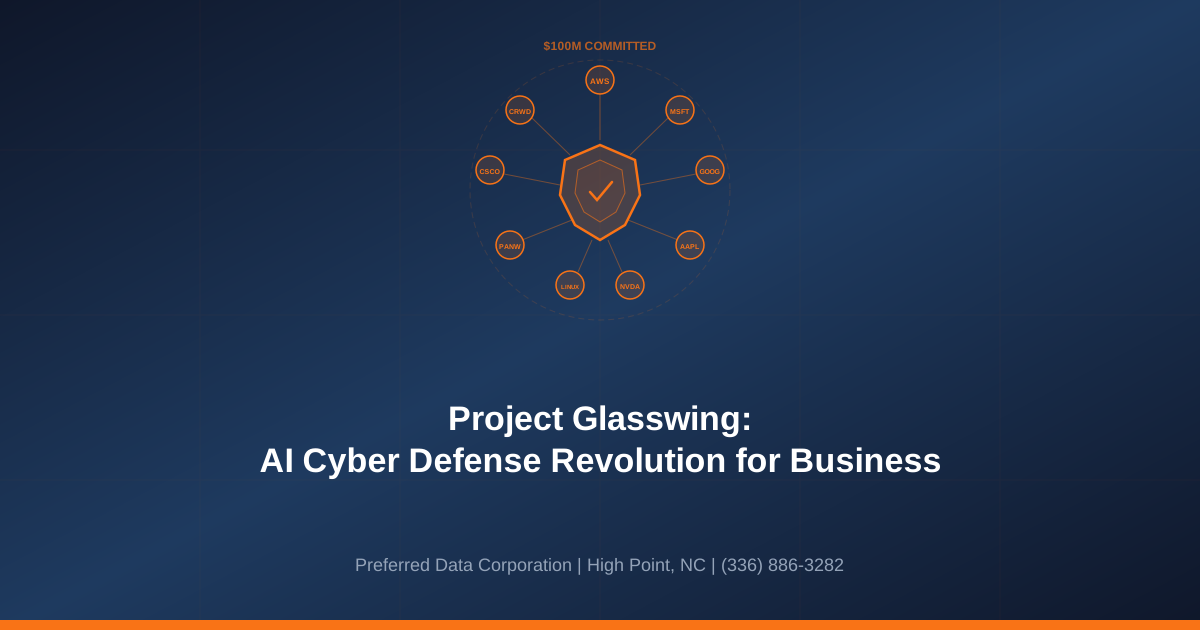
TL;DR: Project Glasswing is a $100 million defensive cybersecurity initiative backed by Amazon, Apple, Google, Microsoft, Nvidia, CrowdStrike, Cisco, and other tech giants. Using Anthropic's Claude Mythos AI to proactively discover and fix vulnerabilities before attackers find them, Glasswing represents the largest collaborative cybersecurity effort in history. For North Carolina small businesses, this initiative will produce faster security patches and better defensive tools, but only for organizations that keep their systems updated and properly managed.
Critical takeaway: Project Glasswing commits $100 million in Claude Mythos Preview usage credits to find and fix vulnerabilities across widely used software. With cybersecurity stocks dropping 5-11% on the Mythos announcement, the industry recognizes that AI-powered defense is now essential. Businesses that do not keep pace will be left exposed.
Learn how Project Glasswing protects your business. Contact Preferred Data Corporation at (336) 886-3282 for expert guidance. Serving High Point, Greensboro, Charlotte, Raleigh, and all of North Carolina since 1987.
What Is Project Glasswing and Who Is Involved?
Project Glasswing is the most ambitious collaborative cybersecurity initiative ever launched, bringing together the world's most influential technology companies to use AI for proactive cyber defense. Anthropic, the creator of Claude Mythos, organized this coalition to channel the AI's vulnerability-discovery capabilities toward defending software rather than exploiting it.
The partner list is extraordinary. Amazon, Apple, Google, Microsoft, Nvidia, CrowdStrike, Cisco, JPMorgan, Broadcom, the Linux Foundation, and Palo Alto Networks have all joined the initiative. Together, these organizations have committed $100 million in Claude Mythos Preview usage credits dedicated exclusively to finding and fixing security vulnerabilities.
For businesses in High Point, Greensboro, Charlotte, and across North Carolina, this coalition represents a fundamental shift in how the technology industry approaches cybersecurity. Instead of waiting for hackers to find vulnerabilities, the biggest names in technology are proactively hunting for flaws in their own products and fixing them before they can be exploited.
Why Did the Tech Industry Create This Coalition?
The urgency behind Project Glasswing stems directly from what Claude Mythos demonstrated it could do. The AI model discovered thousands of zero-day vulnerabilities across every major operating system and browser. It found a 27-year-old bug in OpenBSD, a 16-year-old flaw in FFmpeg, and a 17-year-old remote code execution vulnerability in FreeBSD (CVE-2026-4747).
When the technology industry saw that a single AI model could discover vulnerabilities that had evaded the global security community for decades, the response was immediate. Cybersecurity stocks dropped 5-11% following the announcement, reflecting market concern that existing security products might not be adequate.
The companies involved in Glasswing recognized a critical reality: if Mythos could find these vulnerabilities, other AI systems would eventually develop similar capabilities. The choice was simple. Either use this technology proactively for defense, or wait for attackers to develop similar tools and use them offensively. The industry chose defense.
For small businesses across the Piedmont Triad and Research Triangle, this decision has direct implications. The software you use every day, from Windows and macOS to Chrome and Office, will receive security patches for vulnerabilities that traditional methods never would have found.
How Does Project Glasswing Actually Protect Software?
Project Glasswing operates by systematically deploying Claude Mythos to analyze widely used software products for undiscovered vulnerabilities. When the AI finds a flaw, the finding is reported directly to the software vendor through a responsible disclosure process. The vendor develops and releases a patch, and businesses receive the fix through their normal update process.
The workflow follows established vulnerability disclosure practices but operates at a scale and speed never before possible. Mythos scored 83.1% on the CyberGym cybersecurity benchmark and 93.9% on SWE-bench Verified, meaning it can not only find vulnerabilities but also suggest fixes. This accelerates the entire patch development cycle.
| Glasswing Partner | Role in Initiative | Business Impact |
|---|---|---|
| Anthropic | Provides Claude Mythos AI | Core vulnerability discovery engine |
| Amazon (AWS) | Cloud infrastructure scanning | Faster patches for AWS services |
| Apple | macOS and iOS hardening | Improved Apple device security |
| Chrome and Android analysis | Browser and mobile security patches | |
| Microsoft | Windows and Office security | Critical updates for business software |
| CrowdStrike | Endpoint protection integration | Better threat detection tools |
| Palo Alto Networks | Network security enhancement | Improved firewall and network defense |
| Linux Foundation | Open source software review | Patches for server and infrastructure software |
| Nvidia | GPU and driver security | Safer computing hardware |
| Cisco | Network infrastructure | Router and switch vulnerability fixes |
| Broadcom | Hardware and firmware review | More secure business hardware |
For businesses in Winston-Salem, Durham, and across North Carolina, this means the foundational software your operations depend on is being scrutinized by the most capable AI security tool ever built, with fixes delivered through the vendors you already trust.
What Does $100 Million in AI Credits Mean in Practice?
The $100 million commitment in Claude Mythos Preview usage credits translates to an enormous amount of vulnerability scanning. To put this in perspective, Mythos found thousands of zero-days in its initial testing phase. With $100 million dedicated to systematic scanning, the number of vulnerabilities discovered and patched will be orders of magnitude greater.
Each participating company directs their credits toward their own products and the open source software they depend on. Microsoft focuses on Windows, Office, and Azure. Google scans Chrome, Android, and cloud services. The Linux Foundation examines critical open source projects that underpin much of the internet's infrastructure.
For North Carolina small businesses, this means the software ecosystem is getting safer at an unprecedented rate. However, and this is critical, these improvements only protect businesses that keep their software updated. Every patch that Glasswing produces requires businesses to actually install the update.
This is where the gap emerges for many small businesses in Charlotte, Greensboro, High Point, and the broader Piedmont Triad. Without automated patch management and professional IT management, the benefits of Glasswing never reach your systems. The vulnerability gets found and fixed, but your business continues running the unpatched version.
How Will Glasswing Findings Reach Small Businesses?
The path from Glasswing discovery to small business protection follows the standard software update pipeline, but with significantly more content flowing through it. When Mythos identifies a vulnerability in, say, Windows, Microsoft develops a patch and releases it through Windows Update. Similarly, Google pushes Chrome updates, Apple delivers macOS patches, and Linux distributions release security updates.
For businesses with professional IT management, these patches are tested and deployed systematically, usually within days of release. For businesses managing IT themselves, patches often go uninstalled for weeks or months, leaving systems exposed to vulnerabilities that have known fixes.
The statistics underscore this risk. Organizations with AI-powered defenses detect threats 80 days faster and save $1.9 million per breach. In 2026, 94% of SMBs use managed service providers, reflecting widespread recognition that professional IT management is essential.
For manufacturing companies along the I-40 and I-85 corridors, construction firms in the Piedmont Triad, and professional services companies in Raleigh and Durham, the question is not whether Glasswing will find vulnerabilities in your software. It will. The question is whether your business will apply the patches quickly enough to stay protected.
Is your patch management keeping pace? Contact Preferred Data at (336) 886-3282 for a free assessment of your update processes and security posture.
What Are the Limitations of Project Glasswing?
While Project Glasswing represents a major advance in proactive cybersecurity, it has important limitations that North Carolina business owners should understand.
First, Glasswing focuses on widely used commercial and open source software. Custom applications, proprietary business software, and legacy systems specific to your industry may not be covered. Manufacturing execution systems, custom ERP configurations, and industry-specific tools used by companies in High Point and Greensboro still require separate security evaluation.
Second, Glasswing discovers vulnerabilities and reports them to vendors, but it cannot force vendors to prioritize fixes. Some patches may take weeks or months to develop and release, leaving a window of exposure.
Third, Glasswing does not address the human element. AI-powered phishing achieves open rates of 54-78% compared to 12% for traditional methods, and no amount of software patching protects against an employee clicking a malicious link. Security awareness training remains essential.
Fourth, attackers can move from initial access to data theft in under 72 minutes. Even with Glasswing improving the overall security of software, businesses still need real-time threat detection and response capabilities to handle attacks that exploit the window between vulnerability discovery and patch deployment.
With 43% of cyberattacks targeting small businesses and the average AI-related breach costing $254,445, relying solely on Glasswing is not a complete security strategy. Businesses need layered defenses including endpoint protection, network security, data backup, and security awareness training.
How Should NC Businesses Leverage Glasswing for Maximum Protection?
To maximize the benefits of Project Glasswing, North Carolina businesses should take several concrete steps that ensure Glasswing's discoveries translate into actual protection for their systems.
Step 1: Automate patch management. Every Glasswing-discovered vulnerability that gets patched only helps if the patch reaches your systems. Automated patch management ensures updates deploy promptly, tested, and with minimal business disruption.
Step 2: Maintain a current software inventory. You need to know exactly what software is running across your organization. This includes not just desktop applications but server software, network device firmware, and operational technology platforms used in manufacturing and industrial settings.
Step 3: Implement defense-in-depth. Glasswing makes software safer, but it does not eliminate all risk. Layer your defenses with multi-factor authentication (which blocks 99.9% of automated attacks), endpoint detection and response, network segmentation, and regular backups.
Step 4: Monitor for emerging threats. Even with Glasswing, new vulnerabilities will be discovered faster than they can be patched. Real-time monitoring through a managed security provider gives your business the ability to detect and respond to threats before they cause damage.
Step 5: Plan for the gaps. Glasswing does not cover every piece of software your business uses. Engage a cybersecurity partner to assess your custom applications, legacy systems, and industry-specific tools that fall outside Glasswing's scope.
Preferred Data Corporation has been protecting businesses across North Carolina since 1987. With over 37 years of experience, BBB A+ accreditation, and an average client retention of 20+ years, we help businesses in High Point, Charlotte, Greensboro, Raleigh, Winston-Salem, and the entire Piedmont Triad maximize their cybersecurity posture.
Our managed IT services ensure your systems stay current with every security patch. Our cybersecurity services provide the layered defense that complements Glasswing's proactive approach. Contact us at (336) 886-3282 to learn how we can help your business take full advantage of this new era in AI-powered defense.
Frequently Asked Questions
Is Project Glasswing free for small businesses?
Project Glasswing does not charge small businesses directly. The benefits flow through software vendors, meaning when Microsoft, Google, Apple, or other participants patch vulnerabilities found by Mythos, those patches reach your business through normal software updates at no additional cost. However, you need proper IT management to ensure updates are applied.
Will Project Glasswing find vulnerabilities in my specific business software?
Glasswing focuses on widely used commercial and open source software. If your business runs Windows, macOS, Chrome, Office, or other major platforms, you will benefit from their scanning. Custom or industry-specific applications may not be covered, which is why a comprehensive cybersecurity assessment from a managed IT provider remains important.
How long until Glasswing patches reach my business?
The timeline varies by vendor and vulnerability severity. Critical fixes may be released within days, while less urgent patches may take weeks. With automated patch management through a managed service provider, patches deploy as soon as vendors release them, minimizing your exposure window.
Does Project Glasswing replace the need for cybersecurity services?
No. Glasswing improves the security of widely used software, but it does not protect against phishing, social engineering, insider threats, misconfigurations, or attacks on custom applications. Businesses still need comprehensive cybersecurity services including monitoring, incident response, employee training, and backup solutions.
Which companies are part of Project Glasswing?
The confirmed partners include Amazon, Apple, Google, Microsoft, Nvidia, CrowdStrike, Cisco, JPMorgan, Broadcom, the Linux Foundation, and Palo Alto Networks. These organizations have collectively committed $100 million in Claude Mythos Preview usage credits for proactive vulnerability discovery and patching.
How does Glasswing compare to traditional bug bounty programs?
Bug bounty programs rely on human researchers who find vulnerabilities one at a time. Glasswing uses Claude Mythos, which scored 83.1% on CyberGym and discovered thousands of zero-days simultaneously. The scale and speed of AI-powered discovery far exceeds what human researchers can achieve, though both approaches remain valuable.
What should my North Carolina business do right now?
Ensure your systems are set up for automatic updates, implement multi-factor authentication, and partner with a managed security provider. Preferred Data Corporation serves businesses across the Piedmont Triad, Charlotte, Raleigh, and all of NC. Call (336) 886-3282 to schedule a free security assessment.