
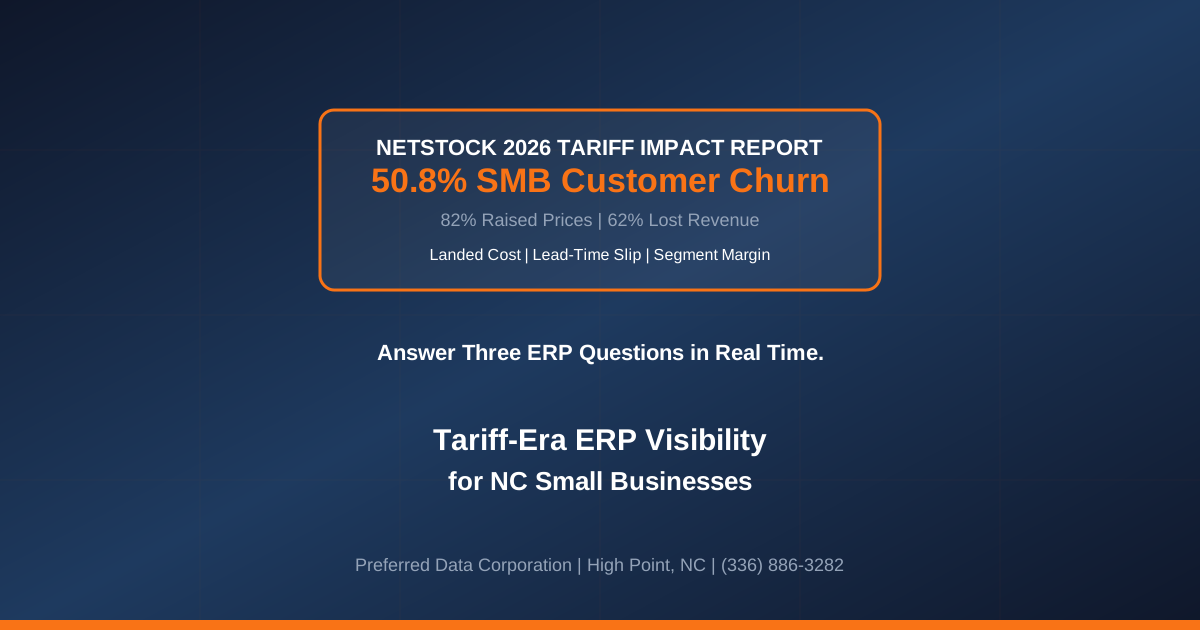
TL;DR: The April 2026 Netstock Tariff Impact Report surfaces a second-order effect most tariff coverage misses. 50.8% of SMBs reported customer dissatisfaction or churn as a direct result of supply chain disruptions in the last 12 months. 62% lost revenue or missed sales. 82% raised prices, of which 92% did so via direct price increases. The customer churn is the outcome the tariff-first-order-cost coverage does not capture: your customer, receiving a price increase from a supplier whose lead times just doubled, quietly switches suppliers. NC manufacturers, distributors, and construction supply firms who cannot answer three ERP questions in real time — landed cost by SKU, quoted lead time versus delivered lead time, and margin by customer segment — are the ones losing accounts to competitors who can.
Key takeaway: Tariffs are a margin story on the buy-side and a customer-retention story on the sell-side. Every NC SMB has both stories, but the sell-side story is the one with a compounding second-order effect. Retention lost this quarter is not recovered next quarter. Your ERP is the answer, but only if it exposes the three questions in real time.
Do you know your landed cost by SKU, your quoted-versus-delivered lead-time gap, and your margin by customer segment — this week, not last quarter? Contact Preferred Data Corporation for a same-week ERP visibility assessment. BBB A+ rated. On-site within 200 miles of High Point. Call (336) 886-3282.
What Did the Netstock 2026 Tariff Impact Report Actually Say?
Netstock's April 22, 2026 Tariff Impact Report is the largest 2026 dataset on how SMBs are actually experiencing the current tariff regime. It surveyed thousands of SMBs across manufacturing, distribution, and retail. Six numbers frame the whole picture.
Six defining numbers from the Netstock 2026 report:
- 73.4% of SMBs said tariffs were the top factor impacting their shipping, sourcing, or supply chain in the past year.
- 82% of SMBs raised prices due to tariffs (up from 44% in Netstock's 2025 benchmark — a near-doubling year over year).
- 92% of price-raising SMBs did so via direct price increases (not surcharges, not fees).
- 62% of SMBs reported lost revenue or missed sales due to supply chain problems.
- 50.8% of SMBs reported customer dissatisfaction or churn from supply chain disruptions.
- 72% of SMBs cited cost-related challenges, with increased landed costs the leading category at 56% and margin pressure the emerging category at 16%.
The 50.8% customer churn number is the one most tariff coverage misses. It is the second-order effect: customers get a price increase, feel bad about it, then quietly evaluate alternatives. In a B2B setting, that evaluation is nearly invisible to the incumbent supplier until the reorder does not arrive.
Key takeaway: Netstock's data shows the tariff story is not just "margins are down." It is "you are silently losing customers to competitors who managed the pass-through better." For an NC manufacturer or distributor, that is a survival issue disguised as a pricing conversation.
Why Is Customer Churn the Underappreciated Tariff Second-Order Effect?
Every tariff conversation gets to price. Very few get to what the customer does after the price letter. Netstock's data forces the second conversation.
Three specific dynamics behind the 50.8% churn number:
- Price increases without visibility feel arbitrary to the customer. When a customer receives a "we are raising prices 12% effective July 1" letter with no supporting detail, they experience it as opportunistic. When the same letter includes "your tariff-affected SKUs are increasing 9.4% and your non-tariff SKUs are unchanged," it feels defensible. Most SMBs cannot produce the second letter because they do not know their landed cost by SKU.
- Lead-time slip erodes trust faster than price does. A customer expecting a 4-week lead time who receives 8 weeks with no early warning switches suppliers on the next order. A customer who receives an early 6-week warning with a supplier-diversification explanation stays put. The trust preserved is a function of visibility, not price.
- Competitors invested in ERP visibility win the churn. In every category, some SMB has real-time landed-cost visibility and quote-to-deliver accuracy. That SMB wins the customer whose incumbent supplier just sent a vague price letter.
For NC SMBs — many of whom still run 20-year-old Actian Zen / Pervasive SQL ERPs with limited landed-cost visibility — the customer-churn risk is direct. The ERP is the answer to the visibility question, but only if it has been extended to answer 2026 tariff-era questions.
What Three Questions Must Your ERP Answer in Real Time?
The 50.8% churn problem is solvable but requires ERP visibility of a specific kind. Three questions distinguish an ERP that helps you from an ERP that watches you lose customers.
Question 1 — What is my true landed cost by SKU this week?
Landed cost is materials plus freight plus duty plus insurance plus broker plus warehousing plus adjustments. In a stable tariff environment, computing it monthly was fine. In 2026 tariffs shift on 30-day cycles, and a SKU whose landed cost was $47.20 in April is $53.10 in June. If your ERP shows $47.20, your quote is under-priced by 12% and you are absorbing tariff you should be passing through.
Question 2 — What is my quoted lead time versus delivered lead time by SKU?
Netstock's data documents lead-time slip as a top-three churn driver. If your ERP shows only the current quoted lead time, you cannot detect slip until the customer complains. The needed report: for every SKU shipped in the last 90 days, quoted lead time at order-take versus actual delivered lead time. A widening gap is the leading indicator of churn.
Question 3 — What is my margin by customer segment?
Not by SKU, not by product line — by customer segment. The customer who buys a broad basket of your SKUs may be tolerating an unprofitable mix because your salesperson prices SKU by SKU. When tariffs hit some SKUs harder than others, the customer's total margin can go negative while every individual SKU still shows positive margin. This is the customer you overserve, then lose, and never realize why.
Every NC manufacturer, distributor, and construction supply firm should be able to run all three reports in under 5 minutes. If it takes IT a week to pull the numbers, the ERP is not answering the tariff-era questions. It is answering the 2015-era questions.
Explore Preferred Data's PDC Software Suite for manufacturing
How Should NC SMBs Rebuild ERP Visibility for the Tariff Era?
The rebuild is a scoped four-stage engagement. Each stage delivers value on its own.
Stage 1 — Landed cost automation (weeks 1-3).
- Automate broker EDI ingestion so duty, freight, and insurance flow into the ERP without manual reentry.
- Recalculate landed cost weekly, not monthly, for tariff-affected SKUs.
- Surface the delta from prior-week landed cost on a sales-facing dashboard so quoting reflects current cost, not April cost.
Stage 2 — Lead-time slip detection (weeks 3-5).
- Capture quoted lead time at order-take.
- Capture actual delivered lead time on ship confirmation.
- Alert on any SKU where the 30-day rolling gap exceeds 25% or grows week-over-week.
Stage 3 — Customer-segment margin analytics (weeks 5-8).
- Roll up margin by customer, not just by SKU.
- Segment customers by industry, geography, and size.
- Identify customers whose total-basket margin has drifted negative and route to sales for renegotiation before they churn.
Stage 4 — Tariff refund automation (weeks 8-12).
- Netstock's separate 2026 tariff refund study documents a "gamechanger" opportunity for SMBs to claim refunds on tariff exclusions, drawback, and misclassification. Automating the eligibility check inside the ERP recovers material working capital.
- Refunds can average 4-8% of paid tariff on qualifying flows.
Stage 5 — Supplier diversification workflow (ongoing).
- Netstock reports 74% of SMBs are still China-exposed; firms diversifying into Europe, Southeast Asia, and Mexico face onboarding friction.
- ERP-native supplier onboarding, item mastering, and quality tracking reduces the diversification cycle from 6 months to 6 weeks.
| Investment | Payback | Customer retention impact |
|---|---|---|
| Landed-cost automation | 3-4 months | High — accurate pricing |
| Lead-time slip alerting | 2-3 months | High — early customer warning |
| Customer-segment margin | 4-6 months | Very high — churn prevention |
| Tariff refund automation | 6-9 months (net cash) | Medium — reinvest in service |
| Supplier onboarding | 6-9 months | High — resilience story |
| AI inventory planning | 9-12 months | Medium — service level |
Read Preferred Data's tariff strategy guide
What Are the Warning Signs You Are Losing the Churn Battle?
Post-tariff churn produces a consistent fingerprint in ERP data. NC SMBs should hunt these signals monthly through 2026.
High-confidence signals of active churn:
- Reorder gap widening. Customers whose average reorder cadence has extended by 30-50% without a corresponding annual-purchase drop typically re-evaluate suppliers. They will not tell you.
- Basket size shrinking. Same customer, same cadence, smaller basket — often means they moved specific SKUs to a competitor and left you the rest.
- Complaint frequency on lead time up. Your CSR queue and salespeople hear it before your dashboard shows it. Log it and correlate.
- New-account acquisition rate down. In a tariff-affected market, your competitors are also raising prices. If your new-account rate is dropping while your competitors' is not, your differentiation on visibility and reliability is losing.
Lower-confidence but worth reviewing:
- Customer visits to your public quote system without conversion.
- Increased "please expedite" requests from historically-patient customers.
- Sales team reporting they are being asked for "how do you calculate this price" more often.
How Does This Connect to Broader 2026 SMB Reality?
Tariff-driven customer churn is one of three compounding pressures NC SMBs face in 2026. Understanding the compound helps prioritize investment.
Three connected 2026 SMB pressures:
- Tariff cost passthrough. Netstock's 82% price-raising number captures the buy-side pressure. Every SMB is doing it. Every SMB's customer knows their SMB is doing it.
- Cybersecurity cost floor. The Verizon 2026 DBIR shows 88% of SMB breaches involve ransomware. Cyber insurance renewals, MSSP retainers, and MSP fees are up 15-25% year over year. This cost lands on the same P&L as tariffs.
- AI-driven productivity divergence. SMBs investing in AI-augmented operations are pulling ahead on service levels and cost. Those not investing are falling behind on both. The gap widens the tariff-driven churn effect.
For NC manufacturers, distributors, construction supply firms, and industrial suppliers in the Piedmont Triad, Charlotte, Raleigh, and Greensboro, the compound demands an ERP that is doing 2026 work, not 2015 work.
How Does Preferred Data Deliver Tariff-Era ERP Visibility?
Preferred Data Corporation delivers ERP-native landed cost automation, lead-time slip detection, customer-segment margin analytics, tariff refund automation, supplier diversification workflows, PDC Software Suite extensions for NC manufacturers, Actian Zen and Pervasive SQL upgrades and integrations, and managed IT services for NC manufacturers, construction firms, healthcare providers, professional-services offices, and financial institutions.
With 37+ years of North Carolina IT expertise, an average client retention of 20+ years, and deep experience with the exact Actian Zen / Pervasive SQL ERPs NC manufacturers run, our ERP extension program integrates with your existing customer service, sales, and finance workflows.
Our tariff-era ERP visibility package includes a landed-cost automation pilot on your top 100 SKUs, a lead-time slip dashboard, a customer-segment margin report, a tariff refund eligibility scan, and a documented ROI report to justify the investment to leadership.
For businesses within 200 miles of High Point, we deliver on-site engagement for the plant-floor systems, MFPs, and legacy ERP clients that make remote-only work impossible.
Contact Preferred Data Corporation — same-week ERP assessment engagement.
Frequently Asked Questions
What is the Netstock 2026 Tariff Impact Report?
An April 22, 2026 survey report from Netstock covering thousands of SMBs across manufacturing, distribution, and retail. Key findings: 73.4% of SMBs cite tariffs as their top supply chain factor, 82% have raised prices, 62% lost revenue, 50.8% reported customer churn.
Why is customer churn a bigger story than margin compression?
Because it compounds. Margin compression is recovered when tariff conditions change. A customer lost to a competitor with better ERP visibility rarely returns. Netstock's 50.8% churn number captures a persistent competitive loss, not a temporary margin loss.
How does ERP visibility prevent churn?
Three specific ways: accurate landed cost by SKU makes price letters defensible, quoted-versus-delivered lead-time detection triggers early customer communication, and customer-segment margin identifies unprofitable accounts for renegotiation before they churn to a competitor.
We run Actian Zen / Pervasive SQL. Can we still get modern visibility?
Yes. Actian Zen is a supported production database in 2026 and can absolutely serve a 2026-era visibility layer. Preferred Data has 20+ years of Actian Zen experience specifically extending legacy ERPs with modern dashboards, alerting, and AI-augmented analytics.
What is landed cost automation?
Ingesting broker EDI, freight bills, and duty statements into the ERP so that landed cost is recalculated weekly (or per-shipment) rather than monthly-manual. Result: quoted price reflects current cost, not last-month cost.
What is tariff refund automation?
Automating the eligibility check for tariff exclusion, drawback, and misclassification refunds inside the ERP. Netstock's separate 2026 tariff refund study documents this as a "gamechanger" for SMB working capital, with refunds averaging 4-8% of paid tariff on qualifying flows.
How long does a full tariff-era ERP visibility program take?
Preferred Data's stage-1 landed cost automation lands in 3 weeks. The full four-stage program is a 12-week engagement. Value is delivered per stage, so leadership can pace investment.
Can Preferred Data assess our ERP this month?
Yes. Our tariff-era ERP visibility assessment is a 5-day engagement and delivers a landed-cost gap analysis, lead-time slip audit, customer-segment margin baseline, and prioritized remediation plan. Call (336) 886-3282 to start.