
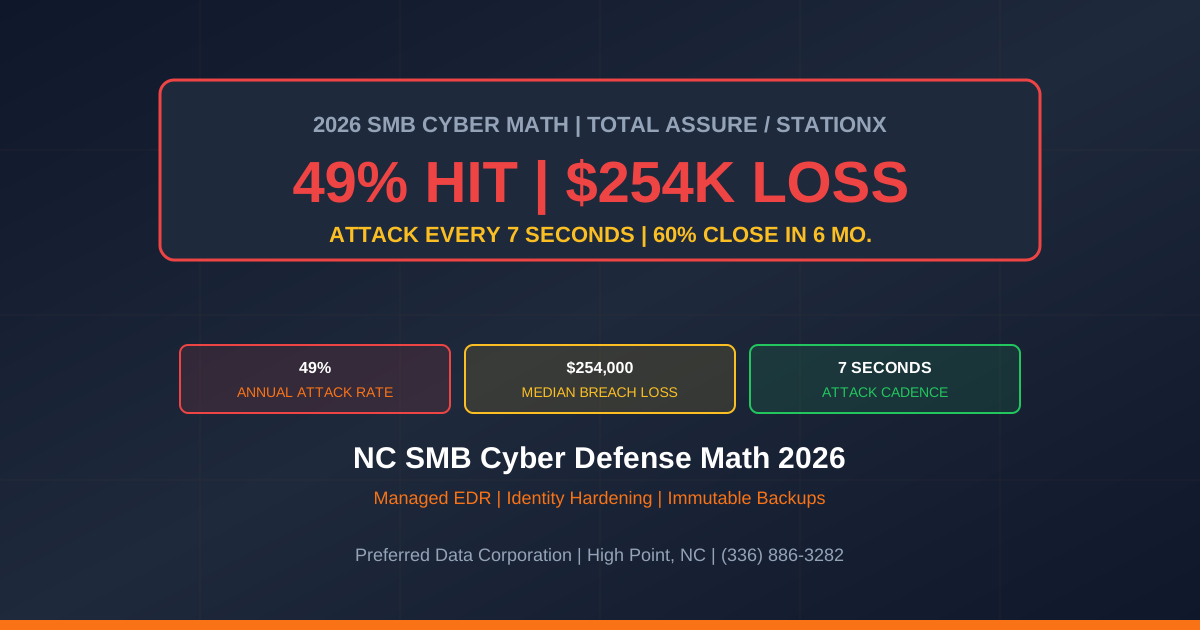
TL;DR: Total Assure's June 2026 analysis of 2,800 North American small businesses found a 49% annual cyberattack rate in 2026, with attacks happening every 7 seconds and average breach costs of $254,000. Per the U.S. Small Business Administration, 60% of small businesses that suffer a significant cyberattack close within six months. For NC manufacturers, distributors, and professional services firms, the math now points one direction: either pre-fund a 24/7 managed cybersecurity stack or pre-fund the business closure. There is no longer a third option.
Key takeaway: A 49% annual incident rate means a coin-flip outcome for every NC SMB without an EDR-monitored stack. The $254K loss is not the worst case; it is the median case. NC SMBs running break-fix or part-time IT in 2026 are statistically pre-committed to a six-figure event inside the next 12 months.
Need to size a defensible cybersecurity stack against the 2026 math? Preferred Data Corporation runs managed cybersecurity for NC small businesses since 1987. Call (336) 886-3282 or request a cybersecurity posture review.
What does the 49% SMB cyberattack rate mean for an NC small business?
In plain terms: a coin flip. Per Total Assure's 2026 statistics report drawing on a sample of roughly 2,800 small businesses across North America from January through April 2026, 49% reported at least one cyberattack in the prior 12 months. The same report puts the global attack cadence at one incident every 7 seconds and the average per-breach financial loss at $254,000.
Three facts an NC SMB owner should write down today:
- Half of NC peers will be hit this year. Per Total Assure, the 49% rate is an annual figure across all small business sectors. The Piedmont Triad's concentration of manufacturers, distributors, and professional services firms tracks the national base rate.
- $254K is the median, not the worst case. Per StationX's 2026 small business cybersecurity statistics, the worst-decile breach for an SMB exceeds $1.2M when ransomware, business interruption, and regulatory penalties stack.
- The 60% closure rate has not moved in a decade. Per long-standing SBA guidance, 60% of SMBs that take a significant cyberattack close within 6 months. The reason is not the encryption itself; it is the working-capital hole the recovery creates.
For an NC manufacturer in High Point, a distributor in Greensboro, or a professional services firm in Charlotte, the practical implication is that the cyber loss line item is no longer a "if" - it is a "when" the underwriter will price.
How much does an NC SMB lose in a 2026 cyber incident?
The 2026 baseline is $254,000 per incident, but the distribution skews heavily by attack type. Per the 2026 Verizon Data Breach Investigations Report and Total Assure's 2026 statistics, the cost components for an NC SMB look like this:
| Cost Component | Typical Range (NC SMB, 2026) | Notes |
|---|---|---|
| Incident response and forensics | $40,000 - $120,000 | DFIR retainer or emergency hourly |
| Business interruption (5-10 days median) | $80,000 - $200,000 | Per-day downtime times revenue exposure |
| Ransom (if paid, often discouraged) | $50,000 - $400,000+ | Trending up with double-extortion |
| Notification and credit monitoring | $15,000 - $60,000 | Per state breach notification law |
| Legal, regulatory, and cyber-attorney fees | $25,000 - $100,000 | NC AG notice plus federal exposure |
| Total median | $254,000 | Per Total Assure 2026 baseline |
NC manufacturers with CMMC or HIPAA scope add a layer: documentation gaps surfaced during the incident response can trigger contract suspension or recoupment, often a larger eventual cost than the breach itself.
Why is the 7-second attack cadence relevant to a 30-person NC SMB?
Because attack volume that high means automation, not human targeting. Per Total Assure, the 7-second figure represents the global cadence of confirmed SMB-targeted attacks - phishing landings, credential stuffing attempts, exposed-RDP probes, and SaaS token theft. The implication for a 30-person NC manufacturer is not "we are too small to notice"; it is "we are large enough to be scanned."
Quotable definition: The 2026 attack model is industrial. Automated tooling enumerates the public internet, scores exposed assets, sells access to ransomware affiliates, and moves on. A 30-person NC manufacturer is not chosen; it is matched against an exposure score. Reducing the exposure score is the only available defense - which is why managed EDR plus identity hardening, not size, decides outcomes.
For NC SMBs running on-prem ERPs, exposed Remote Desktop, unpatched VPN concentrators, or aging M365 tenants without MFA enforcement, the exposure score is high enough to be matched in days, not months.
What is the defensible 2026 cybersecurity stack for an NC small business?
Per CISA's Cybersecurity Performance Goals 2.0 and NIST's Small Business Cybersecurity Corner, the defensible 2026 stack for an NC SMB has six layers. None is optional any more.
- Identity hardening across M365 / Google Workspace. Phishing-resistant MFA (FIDO2 or platform passkeys), conditional access policies, dormant-account purge every 30 days, and session-token revocation on suspicious sign-in.
- Managed EDR on every endpoint. Microsoft Defender for Business, SentinelOne, or CrowdStrike Falcon Go, with 24/7 SOC monitoring. Per Verizon's 2026 DBIR, endpoint compromise remains the top initial access vector for SMBs.
- Immutable backups, weekly recovery drills. Veeam Hardened Repository, object-lock-protected S3 / Wasabi / Azure Blob, or offline tape. Recovery drills must happen quarterly with documented RTO / RPO.
- Patch SLAs (KEV in 72 hours, Critical in 7 days, all others in 30 days). Managed RMM with reporting, not "I think we patched it" - per CISA's Known Exploited Vulnerabilities Catalog, KEV-rate patching is what separates breached SMBs from intact ones.
- Vendor / SaaS access review every 90 days. OAuth token audit, dormant integrations purge, SaaS-to-SaaS connector inventory. Per the Verizon 2026 DBIR, third-party breaches doubled to 30% recently.
- Tabletop exercise + incident runbook annually. Documented, signed, tested. The runbook is the single document an underwriter and a board both ask for after an incident.
Key takeaway: The 2026 stack costs less in monthly fees than the $254K median incident costs in cash. An NC SMB paying $4,000 - $9,000 per month for managed cybersecurity is buying a roughly 80% reduction in the probability that the coin flip lands on a six-figure loss.
How does an NC small business budget the 2026 cyber stack?
Per Federal Reserve Bank of New York's April 2026 SMB AI adoption analysis and Verizon DBIR 2026 benchmarks, a defensible managed cybersecurity stack for an NC SMB in 2026 falls in three tiers:
| SMB Size | Monthly Managed Cybersecurity Budget | Stack Includes |
|---|---|---|
| Under 25 employees | $2,500 - $5,000 | EDR, M365 hardening, weekly backup, quarterly review |
| 25 - 100 employees | $5,000 - $12,000 | EDR + MDR, identity SOC, monthly testing, 24/7 IR retainer |
| 100 - 500 employees | $12,000 - $30,000 | Full SOC, segmentation, immutable backup tier, compliance program |
For an NC manufacturer at 60 employees, the math is roughly $8K/month, or $96K/year - well under one-third of the $254K median incident cost, and the underwriter will price the cyber premium 20-40% lower with the stack documented.
Ready to size the 2026 cybersecurity stack against your actual revenue? Call (336) 886-3282 or book a cybersecurity posture review.
How does Preferred Data Corporation help NC SMBs beat the 2026 math?
PDC has run managed IT and cybersecurity for NC small businesses since 1987 with 20+ year average client retention. We bring three things to the 2026 SMB cyber math:
- Managed cybersecurity services: Managed Microsoft Defender for Business, identity hardening across M365 and Entra ID, KEV-rate patching, 24/7 monitoring through partnered SOC providers, and incident response retainers.
- Managed IT services: RMM-driven patching, asset inventory, dormant-account purge, vendor / SaaS access review on a 90-day cadence, and quarterly business reviews tied to the underwriter's checklist.
- Backup and recovery: Veeam Hardened Repository design, immutable cloud tier, quarterly recovery drills, and documented RTO / RPO that survives a cyber-insurance audit and a CMMC assessment alike.
For NC manufacturers in High Point and the Piedmont Triad, NC distributors in Greensboro and Winston-Salem, and NC professional services firms in Charlotte and Raleigh, the 2026 math is unambiguous: 49% attack rate, $254K median loss, 60% closure rate. The work this quarter decides whether your business is one of the half that take the hit and survives, or one of the 60% that does not reopen.
Need a 12-month cybersecurity roadmap that prices below your cyber-insurance deductible? Call (336) 886-3282 or request a 2026 cybersecurity roadmap.
Frequently Asked Questions
What does the 49% SMB cyberattack rate mean in practice?
It means a coin-flip outcome over the next 12 months. Per Total Assure's 2026 report, 49% of small businesses surveyed across North America in the first four months of 2026 reported at least one cyberattack. For an NC SMB without a managed EDR stack, the rate trends higher; for one with the 2026 stack in place, the rate drops to roughly 10-15% by underwriting benchmarks.
What is the average cost of a cyberattack on a small business in 2026?
$254,000 per incident on average. Per Total Assure, the $254K figure represents the median total cost across forensics, business interruption, ransom (if paid), notification, legal, and regulatory components. NC SMBs in CMMC or HIPAA scope can add another $50K - $200K in compliance-driven costs.
Why do 60% of small businesses close after a cyberattack?
Working-capital exhaustion, not encryption. Per long-standing SBA guidance, 60% of SMBs that suffer a significant cyberattack close within 6 months. The cause is the cash drain across the 8-12 week recovery period - lost revenue, payroll continuing, vendor demands, and the cost of forensics - which most SMBs cannot survive without an incident-budget line and a working-capital buffer.
What does "an attack every 7 seconds" actually mean?
It is the global cadence of automated, confirmed SMB-targeted attacks. Per Total Assure's 2026 data, the 7-second cadence reflects industrialized attacker tooling - phishing landings, credential stuffing, exposed-service probes, and SaaS-token theft - not human attention. The implication for an NC SMB is that being small does not provide stealth.
Is managed cybersecurity worth it for a 30-person NC manufacturer?
Yes. A 30-person NC manufacturer paying roughly $4,000 - $6,000 per month for managed cybersecurity is buying an 80% reduction in incident probability. Per Verizon 2026 DBIR benchmarks and underwriter pricing data, the annual managed-cyber cost runs about 20-25% of the $254K median incident cost - a clear-cut return on investment before the insurance-premium reduction is counted.
Does PDC build a cybersecurity stack for NC SMBs under 50 employees?
Yes. Per PDC's managed cybersecurity service, the NC SMB stack scales from 5-employee professional services firms to 500-employee manufacturers. The under-50 tier centers on Microsoft Defender for Business, M365 / Entra ID hardening, RMM-driven patching, Veeam immutable backups, and a quarterly cybersecurity review tied to cyber-insurance underwriting criteria.
Related Resources
- Managed Cybersecurity Services for NC Businesses - 24/7 SOC and EDR for NC SMBs
- Managed IT Services for NC Businesses - RMM, patching, asset inventory
- Backup and Recovery Services - Immutable repositories and recovery drills
- 73% of SMBs Fail Cyber Insurance Audits - Underwriter requirements
- Verizon DBIR 2026: 88% SMB Ransomware Rate - Companion industry data
- Contact Preferred Data Corporation - 2026 cybersecurity roadmap for NC SMBs