
Say you keep the books at a 90-person distributor in Kernersville, and you read every line on an IT invoice before you approve it. This is the increase built to get past you anyway. It will not arrive labeled "price increase." It arrives as the same server-license renewal you have paid for years, five percent heavier, because of a billing setting nobody has looked at since the servers moved to a subscription. The trigger is invisible on the invoice, which is how careful people miss it. (That is an illustration, not a specific client, but the setup is common in the Piedmont Triad.)
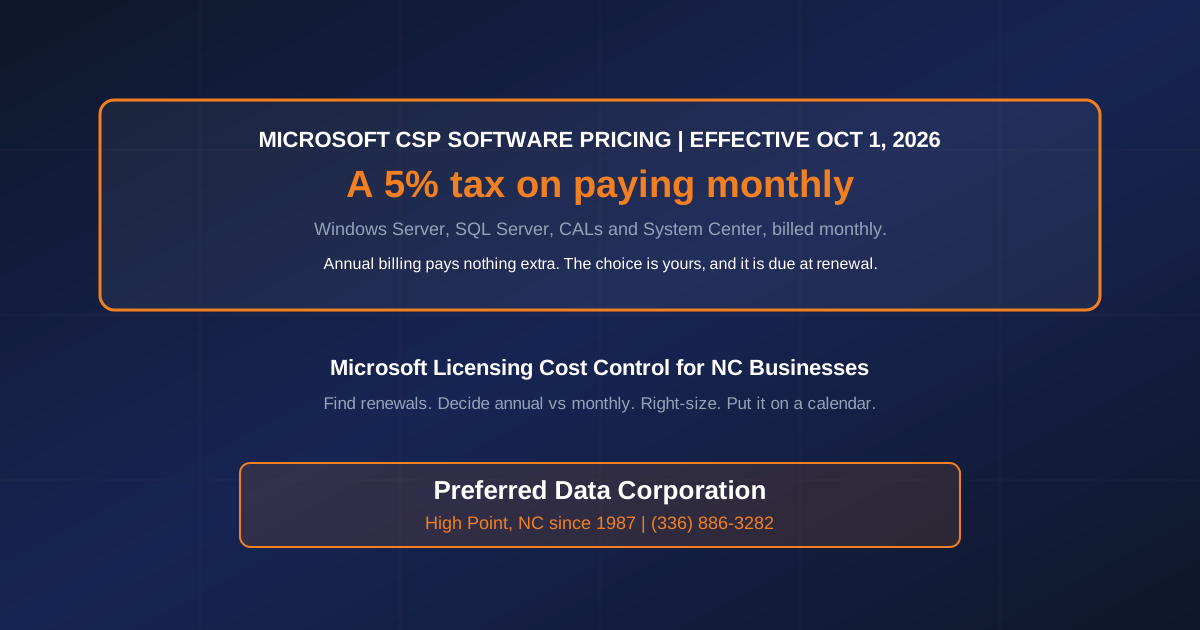
Starting October 1, 2026, Microsoft adds a 5% "cost of capital" uplift to annual-term Cloud Solution Provider (CSP) software subscriptions that are billed monthly, and for the first time that reaches the server software North Carolina businesses actually run: Windows Server, SQL Server, Client Access Licenses (CALs), and System Center. Per the Microsoft Partner Center announcement, it applies to each subscription at its first renewal on or after that date.
Here is the ten-second version of whether this is you: are your Microsoft server licenses billed to you monthly? If yes, and you will keep those servers for years, you are about to pay 5% for nothing. If you are not sure how you are billed, that is the single question to put to whoever renews your Microsoft licenses. This is not a price you negotiate. It is a billing choice you get to make.
Put a dollar figure on it with your own numbers. A shop running Windows Server, a SQL Server instance, and a stack of CALs might carry $20,000 to $40,000 a year in Microsoft server licensing. Five percent of that is $1,000 to $2,000 every year, for the convenience of a payment schedule you could change in an afternoon. Preferred Data Corporation has served Piedmont Triad companies since 1987, and today we handle the Microsoft licensing and renewals where a decision like this actually gets made. The fix here is a renewal-date review, not a migration.
Want to know which of your server licenses are exposed? Preferred Data Corporation reviews your Microsoft renewals and billing terms and tells you where switching to annual actually saves money. Call (336) 886-3282 or ask for a licensing review.
What exactly is Microsoft changing on October 1, 2026?
Microsoft is charging 5% for the convenience of paying monthly on an annual server-software commitment. The Microsoft announcement applies the uplift to CSP software subscriptions "with annual-term commitments billed monthly," names SQL Server, Windows Server, CALs, and System Center, and states plainly that "there's no change to annual billing or month-to-month subscriptions."
The whole thing turns on the renewal date. A subscription that renews September 30 gets almost another full year at today's price. One that renews October 2 takes the 5% on day one. Same license, same server, five percent apart over which week the calendar landed on. The distributor Pax8 confirmed the terms for the channel: the change "only affects annual commitment subscriptions with monthly billing," applied "upon renewal on or after October 1, 2026," per its August 2026 Microsoft update.
Key takeaway: The 5% is not a tax on running Windows Server or SQL Server. It is a tax on paying for them monthly, and that is the one thing here you control.
Who actually pays the 5%, and who does not?
You pay it only if you hold an annual-term Windows Server, SQL Server, CAL, or System Center subscription and settle it in monthly installments. Pay annually and nothing changes. Sit on a true month-to-month subscription and nothing changes. The uplift targets one arrangement: the twelve-month commitment paid in twelve installments.
Do not confuse this with the seat-based lever most owners half-remember. On the seat-based side of Microsoft's New Commerce Experience (think Microsoft 365 licenses), a genuinely flexible month-to-month subscription, the kind you can cancel any month, costs about 20% more than the annual commitment, a premium the software firm N-able describes as a flat "20% premium added to this mode of payment" in its New Commerce Experience breakdown. Server software is different: it is sold on annual terms, so that cancel-any-month escape hatch is not really on your menu. Your live decision is narrower, and it is the one this change is about, annual billing versus monthly billing on an annual commitment you are keeping either way.
For a North Carolina shop, the practical read is short. Look at your CSP server subscriptions. The ones on an annual term paid monthly are the exposed ones, and in a lot of small environments that is most of them, because monthly was the reflexive setup when the server moved to a subscription and no one has revisited it.
Why paying monthly stopped being the safe default
Because the flexibility you are paying for does not exist on the systems this hits. Nobody cancels their domain controller in March. Nobody rips out the SQL Server database under their ERP mid-quarter because cash got tight. Those are multi-year fixtures, and Microsoft's licensing complexity keeps them that way. The licensing advisory 2Data notes that on-premises "SQL Server deployments continue to represent a significant commercial commitment," complex enough that "the consequences of non-compliance are significant," in its 2026 SQL Server licensing guide. You will not churn that license, so paying a premium for the freedom to churn it buys an option you will never use.
Here is the part most managed providers will not say out loud, because monthly billing is easier for them to sell: for your core server stack, monthly billing is now the expensive habit. The "monthly keeps us flexible and protects cash flow" instinct made sense for seasonal seats or a short project SKU. It is wrong for the machine running your accounting database.
The counterpoint is fair. Monthly billing does smooth cash flow, and for a business watching every week of runway, spreading a Windows Server renewal across twelve payments has real value, 5% or not. That call belongs to your controller. Until October the choice was free; after October it costs 5% on the licenses least likely to ever move, which is reason enough to decide it on purpose.
Not sure how your server licenses bill? Most owners genuinely do not know, and the invoice rarely makes it obvious. Preferred Data Corporation maps your Microsoft subscriptions, renewal dates, and billing terms so the call gets made on purpose. Call (336) 886-3282 or explore our cloud solutions.
What should a North Carolina business do before its renewal date?
Do not overhaul anything. Before your next server renewal, make four checks. The whole exercise is an afternoon for most 20 to 250 person shops, and against a five-figure Microsoft footprint it pays for itself.
1. Ask one question, or pull one list
If someone else handles your Microsoft renewals, ask them one thing: which of our server licenses are annual-term billed monthly, and what would we save switching them to annual? If that someone is you, pull your CSP subscription list and write the renewal date and billing term next to each line. The subscriptions renewing October 1 or later are the ones where the 5% is now in play.
2. Decide annual versus monthly, line by line
For each server subscription you will obviously run for years, price annual billing against monthly and take the cheaper path unless cash flow argues otherwise. Keep monthly only where you genuinely value being able to change course. For the domain controller and the ERP database, this is not a hard call.
3. Catch the licenses you are already overpaying on
A renewal is the moment to find waste, and the 5% is small next to what a growing shop quietly loses to licenses it stopped using. You bought SQL Server Enterprise when a consultant spec'd your ERP years ago and have run Standard-sized workloads ever since. You added CALs for the second shift you ran in 2021 and never scaled them back. Flexera pegged data-center software waste at 34% in its 2022 State of ITAM research, and its 2026 State of ITAM Report finds wasted spend still rising in several categories, led by AI software. Right-sizing at renewal usually dwarfs the uplift.
4. Put it on a calendar, not in your memory
The uplift triggers at renewal, so the renewal date is the deadline. Note it, and bring the annual-versus-monthly and right-sizing questions back to that date every year. A renewal you review is a renewal you control; a renewal you forget is 5% plus whatever waste has piled up since last year.
How the two server-billing options compare after October 1
For server software on an annual term, there are two ways to pay, and after October 1 Microsoft prices them 5% apart. Here is the comparison to have in front of you at renewal.
| Billing on your annual term | Uplift vs annual-paid | Cash-flow shape | Best for |
|---|---|---|---|
| Paid annually, upfront | None | One yearly payment | The core stack you will run for years: domain controller, ERP database, file server |
| Paid monthly | 5% (new, from Oct 1, 2026) | Twelve smaller payments | Smoothing cash flow on a license you are keeping anyway |
The trap is paying that 5% for a payment schedule while you are locked into the annual term either way. If you are keeping the license regardless, the only real question is whether spreading the cost across twelve months is worth 5%, and for most of your server stack it is not.
What Preferred Data Corporation does about licensing cost
Preferred Data Corporation has run IT for North Carolina manufacturers, distributors, and industrial firms from High Point since 1987, 39 years, with a 20-plus year average client tenure and a BBB A+ rating. We handle Microsoft licensing and renewals for the businesses we support, so we meet the annual-versus-monthly question at the renewal, where it actually gets decided. For the exposure this change creates, our work includes:
- Licensing and renewal review: a mapped list of your Windows Server, SQL Server, CAL, and System Center subscriptions with renewal dates and billing terms, and a recommendation on each, part of our managed IT services
- Cost right-sizing: finding the unused CALs and oversized SQL editions a renewal is the moment to catch, through our cloud solutions
- Migration planning where it pays: when a server workload is genuinely better off on newer licensing or in the cloud, we say so, and when it is not, we say that too; see our manufacturing solutions
- Budget forecasting: renewal dates and known increases like this one built into an IT budget you can defend to ownership
Key takeaway: Monday, pull your CSP subscription list and write the renewal date next to each server license. The ones dated October 1 or later are what the 5% is waiting on, and they are the same ones worth thirty minutes of right-sizing while you are in there.
About Preferred Data Corporation
Preferred Data Corporation provides managed IT, cloud solutions, and cybersecurity for manufacturers, distributors, and industrial firms across the Piedmont Triad, the Research Triangle, and the wider North Carolina market. We are the partner NC owners call when a Microsoft invoice starts creeping and nobody can say why.
- Call (336) 886-3282
- Visit preferreddata.com/contact
- Email [email protected]
- Address: 1208 Eastchester Drive, Suite 131, High Point, NC 27265
What NC owners are asking about the Microsoft change
Is the 5% uplift a one-time charge or does it stick?
It sticks. Once a subscription renews on or after October 1, 2026 on the annual-term, monthly-billed path, the 5% is built into that subscription's pricing from then on. That is why switching to annual billing at renewal, where cash flow allows, is worth the few minutes it takes to decide.
Which products does this actually hit?
The October 1 change names server software: Windows Server, SQL Server, Client Access Licenses, and System Center, on annual-term subscriptions billed monthly. Microsoft's own wording is "such as," so treat that as the main list rather than a complete one, and confirm your specific subscriptions at renewal.
We are a 50-person shop in Greensboro. Is this worth our time?
Yes, because the review that dodges the 5% is the same one that catches licenses you are already wasting money on. On a five-figure Microsoft server footprint, an hour spent on renewal dates, annual-versus-monthly, and right-sizing typically returns far more than the uplift itself. The 5% is just the reason to finally do it.
Should we switch everything to annual billing to avoid it?
Not everything, and not blindly. Annual billing avoids the 5% but locks your cash for the term, so keep monthly billing where the flexibility is genuinely worth it and your cash flow needs it. For a domain controller or an ERP database you will run for years, annual is usually the easy call. An experienced managed IT partner can make the call line by line.
Does Preferred Data Corporation serve businesses outside High Point?
Yes. We are based in High Point and provide on-site and remote IT coverage within 200 miles, reaching companies across Greensboro, Winston-Salem, Charlotte, Raleigh, and the broader Piedmont Triad and Research Triangle.
Related Resources
- Managed IT Services for NC Businesses
- Cloud Solutions
- Cybersecurity Services
- Manufacturing IT Solutions
- Microsoft 365 July 2026 Price Increases: NC Small Business Guide
- Windows Server 2016 End of Support: NC SMB Migration Playbook
- IT Budget Planning Template for NC Small Business
- IT Services in Greensboro
- IT Services in Charlotte