
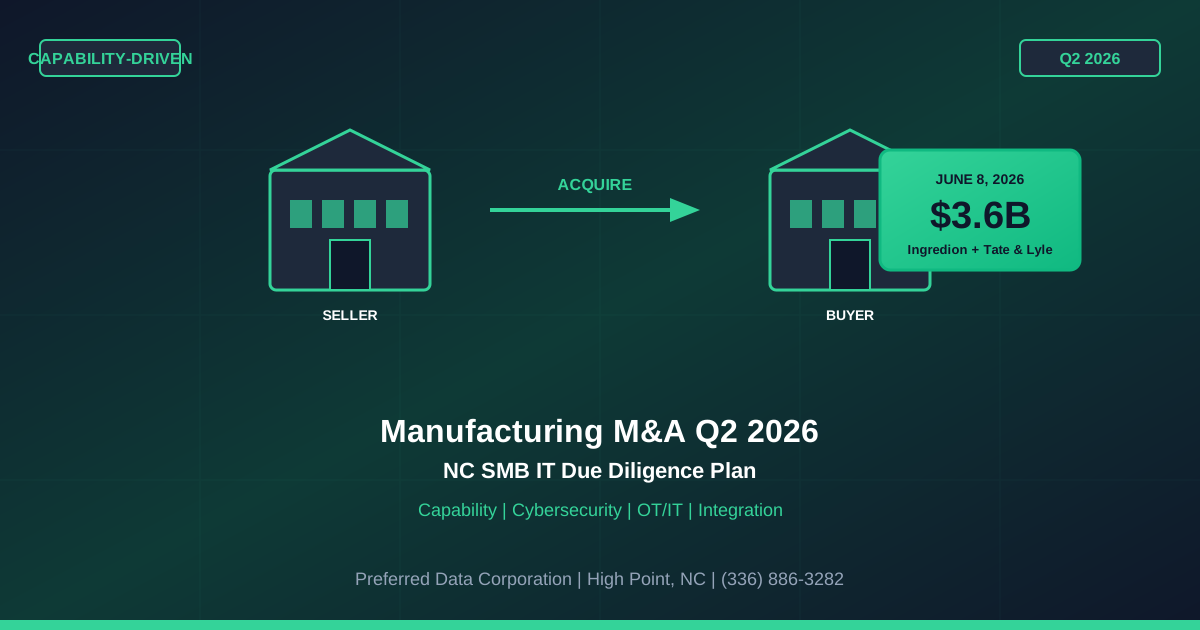
TL;DR: Q2 2026 manufacturing M&A has decisively shifted from pure scale consolidation to capability-driven acquisitions. On June 9, 2026, Wesco International purchased Newark Engineering Group, adding Singapore-based data center cooling and lifecycle services. One day earlier, on June 8, 2026, Ingredion agreed to acquire Tate & Lyle in a $3.6 billion transaction, one of the largest manufacturing-related deals of the quarter. Private equity sponsors are rolling up aerospace components, defense supply chains, and industrial services platforms, and acquirers are buying existing facilities instead of building new ones. For NC manufacturers in High Point, Greensboro, Charlotte, Raleigh, and Winston-Salem, both as sellers and as buyers, the consequence is that technology readiness, cybersecurity posture, and IT integration capacity now sit squarely inside the deal valuation and close timeline.
Key takeaway: Capability-driven M&A means the technology is the asset. NC SMB sellers with a clean, documented, well-governed IT environment get higher multiples and faster closes. NC SMB buyers without a disciplined IT due diligence plan inherit cyber risk, integration debt, and post-close surprises that erode the deal thesis.
Buying or selling an NC manufacturer in 2026? Preferred Data Corporation has built IT due diligence and post-merger integration playbooks for NC manufacturers since 1987. Call (336) 886-3282 or request an M&A technology readiness session.
What is happening with manufacturing M&A in Q2 2026?
Q2 2026 manufacturing M&A is running hot, but the pattern has shifted from scale-only deals to capability-driven acquisitions. Per the Rich Group Q2 2026 manufacturing M&A trend report, acquirers are paying premiums for specific technical capabilities, geographic coverage, and existing production facilities rather than simply consolidating revenue.
Three forces are driving Q2 2026 deal flow:
- Capability-driven theses dominate. Per the Rich Group US Manufacturing M&A 2026 deals and trends analysis, buyers are paying premiums for engineered systems, lifecycle services, specialty materials, and embedded software inside manufactured products rather than commodity production capacity.
- Existing facilities over greenfield. Acquirers are buying operating plants rather than building new ones, which accelerates production timelines, locks in regional coverage, and reduces capex and permitting risk per Dealroom's recent M&A coverage.
- Family-owned firms are coming to market. Per The Middle Market coverage of 2026 deal flow, founder retirements and succession events are pushing more family-owned manufacturers, distributors, and industrial-services firms into a buyer's pipeline, especially in the middle market.
For NC manufacturers in the Piedmont Triad and across the state, this means the next deal conversation, inbound or outbound, will be about what the business uniquely does, not just what it produces.
Why are capability-driven acquisitions replacing pure scale consolidation?
Because the highest-margin capacity in 2026 manufacturing is technical, not volumetric. Per the Rich Group Q2 2026 trend analysis, acquirers are looking for engineered IP, specialty processes, software-enabled products, regulatory certifications, and lifecycle service revenue streams that would take years to build internally.
Quotable definition: Capability-driven M&A is the acquisition of a target whose primary value lies in a specific technical capability, engineered process, software platform, regulatory certification, or lifecycle service stream, rather than in the target's raw revenue, headcount, or production capacity.
Three structural reasons capability-driven deals are winning in Q2 2026:
- Greenfield is slow and expensive. New facilities take 18-36 months and capex commitments to bring online. Buying a working facility from a NC manufacturer in High Point or Greensboro collapses that timeline into 60-120 days, per Dealroom's recent deal commentary.
- Talent and certifications come with the company. Engineered capability is embedded in people, documented processes, audited quality systems, and qualified customer relationships. Acquirers cannot replicate that with a hiring plan.
- Software and OT/IT integration matter more. Per the federal NIST Manufacturing Extension Partnership program, manufacturers with mature plant-floor IT integration, MES, ERP, and cybersecurity controls command higher acquisition premiums because they shorten the post-close integration runway.
What do Wesco-Newark and Ingredion-Tate & Lyle tell NC manufacturers?
The two largest June 2026 deals are textbook examples of capability-driven and scale-plus-capability theses, respectively, and both have direct read-throughs for NC SMB owners. Per the Rich Group Q2 2026 trend analysis, Wesco International purchased Newark Engineering Group on June 9, 2026 specifically for its Singapore-based data center cooling and lifecycle services capability.
Per Dealroom's recent M&A deals coverage, on June 8, 2026, Ingredion agreed to acquire Tate & Lyle in a $3.6 billion transaction, blending scale with adjacent capability in specialty ingredients.
Three read-throughs for NC manufacturers:
- Specialty capability is the deal magnet. Wesco did not buy Newark for revenue alone; it bought lifecycle services and engineering depth in a thermal-management niche. NC manufacturers with specialty capability, niche tooling, certified processes, or proprietary software should document that capability in deal-ready form.
- Adjacency premium is real. Ingredion's $3.6 billion bet on Tate & Lyle reflects the premium acquirers pay for adjacent specialty capability that extends the platform without cannibalizing it. NC family-owned manufacturers with adjacent product or process strength sit in a strong negotiating position.
- Cross-border and cross-region capability is on the table. Per The Middle Market coverage, 2026 acquirers are increasingly comfortable buying cross-border capability. NC manufacturers serving regulated industries, including defense, aerospace, and medical, are direct beneficiaries of this trend.
Considering inbound interest from a strategic or PE buyer? Call Preferred Data Corporation at (336) 886-3282 for an M&A technology readiness review before you respond.
Why are PE sponsors rolling up aerospace, defense, and industrial services in 2026?
Because fragmented supplier bases plus rising defense, aerospace, and industrial-services budgets create textbook conditions for platform building. Per the Rich Group US Manufacturing M&A 2026 deals and trends analysis, private equity sponsors are running multi-acquisition roll-up strategies in three sectors that are heavily represented in NC: aerospace components, defense supply chains, and industrial services.
Three reasons PE is concentrating on these sectors right now:
- Aerospace and defense supply chains are fragmented and under-modernized. PE buyers acquire a platform manufacturer, then bolt on five to ten regional suppliers, standardize ERP, cybersecurity, and quality systems, and sell the combined platform at a higher multiple per Dealroom's recent deal commentary.
- Industrial services has recurring revenue. Lifecycle services, predictive maintenance, calibration, and managed industrial IT all have recurring revenue characteristics that PE values at 2-3x the multiple of pure project revenue.
- NC's manufacturing base is squarely in the target population. Per the North Carolina Department of Commerce, manufacturing is one of the state's largest employment sectors, with deep aerospace, defense, automotive, and industrial-services concentrations in the Piedmont Triad, Charlotte, and along the I-85 and I-40 corridors.
For NC family-owned manufacturers in High Point, Winston-Salem, and Greensboro, this means the next inbound call is statistically more likely to come from a PE-backed platform than from a strategic competitor.
What IT due diligence stakes do NC SMB sellers and buyers face right now?
The stakes are valuation, deal certainty, and post-close risk. Per the Rich Group Q2 2026 trend report, capability-driven acquirers underwrite the IT environment, the cybersecurity posture, and the integration runway as part of the core deal thesis, not as an afterthought.
For NC SMB sellers, weak IT documentation, unpatched systems, undocumented OT networks, missing cyber insurance, or unresolved compliance gaps directly compress the offer price and extend the close timeline. For NC SMB buyers, skipping or shortcutting IT due diligence means inheriting ransomware exposure, integration debt, and customer-contract risk that surfaces in the first 90 days post-close.
| Diligence priority | NC SMB seller view | NC SMB buyer view |
|---|---|---|
| IT asset inventory and licensing | Defend valuation; show clean records | Validate cost basis; flag unlicensed software |
| Cybersecurity posture and recent incidents | Disclose, remediate, document | Quantify residual risk; price into deal |
| OT/IT integration and plant-floor IT | Show production continuity | Plan integration runway and capex |
| ERP, MES, CRM, and core systems | Demonstrate process maturity | Estimate integration and rationalization cost |
| Compliance, including CMMC for defense | Pass audit; close compliance gaps | Confirm contracts will survive change of control |
| Cyber insurance and vendor contracts | Carry adequate, current coverage | Inherit, replace, or repurpose existing policies |
For sellers, a documented, defensible IT environment is worth real money. For buyers, a disciplined diligence playbook prevents the deal thesis from collapsing in the first year.
| Indicator | Capability-driven deal | Scale-driven deal |
|---|---|---|
| Premium driver | Engineered IP, software, lifecycle services | Revenue, headcount, geographic coverage |
| Diligence focus | Technology, IP, OT/IT, cyber, key talent | Customer concentration, working capital, EBITDA bridge |
| Post-close integration | Preserve capability; protect engineering team | Standardize systems; capture cost synergies |
| Typical buyer | Strategic with platform gap; PE add-on | Strategic with scale thesis; consolidator |
| NC SMB seller posture | Document capability, IT, cyber, IP | Document financials, contracts, customer base |
What is the 60-day IT due diligence plan for an NC SMB seller (or buyer)?
A disciplined 60-day plan covers asset inventory, cybersecurity baseline, OT/IT documentation, compliance posture, and a deal-ready data room. For sellers, this is value protection. For buyers, this is risk underwriting.
- Week 1 - Scope and assemble the diligence team. Identify the engagement lead, the technology advisor or M&A advisory partner, and the responsible party for each functional area: IT, OT, cybersecurity, ERP, and compliance. Define the data room structure.
- Week 2 - Build the technology asset inventory. Servers, switches, endpoints, cloud tenants, SaaS contracts, software licenses, ERP and MES modules, plant-floor controllers, network diagrams, vendor and MSP contracts, and renewal calendars.
- Week 3 - Run the cybersecurity baseline assessment. Vulnerability scan, identity and access review, EDR coverage, backup and restore validation, incident history, cyber insurance review, and where applicable, CMMC or sector-specific framework gap analysis.
- Week 4 - Document OT/IT integration and plant-floor IT. Network segmentation, OT vendor management, remote access controls, MES and SCADA integration with ERP, and the OT data flow per NIST MEP guidance for manufacturers.
- Week 5 - Map compliance and contractual risk. Customer contracts with cybersecurity clauses, change of control provisions, defense or aerospace compliance posture, data privacy obligations, and intercompany IP licenses.
- Week 6 - Quality of Technology report. Synthesize the work into a single deal-ready Quality of Technology report covering current state, risks, integration plan, and remediation cost estimates. Sellers add this to the data room. Buyers use it as the underwriting basis for IT integration capex.
- Week 7-8 - Remediation sprint and data room finalization. Close the highest-risk gaps, document compensating controls, and finalize the data room. Sellers go to market with a defensible posture; buyers go to LOI with a quantified risk profile.
Key takeaway: Sixty days of disciplined IT due diligence work converts a soft, defensive technology posture into a quantified, deal-ready asset. Sellers protect valuation; buyers protect the deal thesis. Either way, the work pays for itself many times over.
How does Preferred Data Corporation help NC SMBs navigate M&A technology risk?
Preferred Data Corporation has been the technology partner for NC manufacturers, distributors, and industrial-services firms since 1987, with 37+ years of experience in the Piedmont Triad and across the state. PDC's M&A Advisory practice brings three things to the deal table:
- M&A Advisory and Quality of Technology reporting. IT due diligence for sellers preparing for market and for buyers underwriting a transaction. PDC builds defensible asset inventories, cybersecurity baselines, OT/IT documentation, and the deal-ready Quality of Technology report that closes the loop with corporate development teams and lender underwriting.
- Managed IT services and integration runway. Post-close, PDC builds the integration roadmap, consolidates ERP and managed-services contracts, and stands up the unified IT environment that delivers the synergies the deal thesis promised.
- Cybersecurity services and CMMC-relevant readiness. For NC defense and aerospace suppliers, PDC provides cybersecurity diligence, gap closure, and post-close program continuity so customer contracts and CMMC posture survive the change of control intact.
- AI Transformation for the post-close 12 months. Once the IT environment is stable, PDC builds the AI roadmap that captures the productivity gains and margin expansion that underwrote the deal valuation.
For NC family-owned manufacturers in High Point, Winston-Salem, and Greensboro evaluating an inbound offer, for NC distributors in Charlotte and Raleigh considering a bolt-on acquisition, and for PE-backed platforms running roll-up strategies across the Piedmont Triad, PDC is the local technology partner that translates the deal thesis into operating reality.
Ready to put your IT environment on a deal-ready footing? Call (336) 886-3282 or book an M&A technology readiness session.
Frequently Asked Questions
What is capability-driven M&A and why does it dominate Q2 2026?
Capability-driven M&A is the acquisition of a target whose primary value is a specific technical capability, engineered process, software platform, certification, or lifecycle service stream, rather than raw revenue or production capacity. Per the Rich Group Q2 2026 trend report, acquirers pay premiums for engineered IP because it cannot be replicated by hiring or greenfield investment in a relevant timeline.
What are the largest manufacturing-related M&A deals of June 2026?
Per Dealroom's recent M&A deals coverage, Ingredion agreed to acquire Tate & Lyle in a $3.6 billion transaction announced June 8, 2026. Per the Rich Group Q2 2026 trend analysis, Wesco International purchased Newark Engineering Group for its Singapore data center cooling and lifecycle services capability on June 9, 2026.
Why are private equity sponsors building platforms in aerospace, defense, and industrial services?
Because supplier bases in these sectors are fragmented, end-customer budgets are rising, and recurring lifecycle-services revenue is highly valued. Per the Rich Group US Manufacturing M&A 2026 deals and trends analysis, PE platforms acquire an anchor manufacturer and then bolt on regional suppliers, standardize systems, and exit at a higher multiple. NC's aerospace, defense, and industrial-services concentration in the Piedmont Triad makes the state a natural target population.
Why are acquirers buying existing facilities rather than building new ones?
Because greenfield construction takes 18-36 months and significant capex, while acquiring an operating facility from an NC manufacturer can close in 60-120 days with the workforce, certifications, and customer relationships intact. Per Dealroom's recent deal commentary, this is a meaningful share of 2026 manufacturing deal flow.
What is a Quality of Technology report and why does it matter for NC SMB deals?
A Quality of Technology report is a deal-ready synthesis of the target's IT environment, cybersecurity posture, OT/IT integration, compliance status, and integration risk, with remediation cost estimates. For NC SMB sellers, it protects valuation by replacing buyer guesswork with documented evidence. For NC SMB buyers, it converts a soft risk into a quantified line item in the deal model.
Should an NC family-owned manufacturer engage an IT advisor before going to market?
Yes. Per The Middle Market coverage of 2026 deal flow, founder-led sellers who arrive at market with a documented IT environment, cybersecurity baseline, and integration playbook close faster, defend valuation more effectively, and avoid the most common late-stage diligence surprises. Engaging a technology advisor like Preferred Data Corporation 90 to 180 days before a process is the standard recommendation.
Related Resources
- M&A Advisory Services for NC Businesses - IT due diligence and Quality of Technology reporting
- IT Due Diligence Checklist for SMB Acquisitions - Buyer-side diligence playbook
- Post-Merger IT Integration for NC Manufacturers 2026 - First 90 days after close
- Quality of Technology Report Due Diligence 2026 - Deal-ready technology assessment
- Technology Due Diligence Checklist Mergers Acquisitions 2026 - Full diligence framework
- Contact Preferred Data Corporation - M&A technology readiness session for NC SMBs