
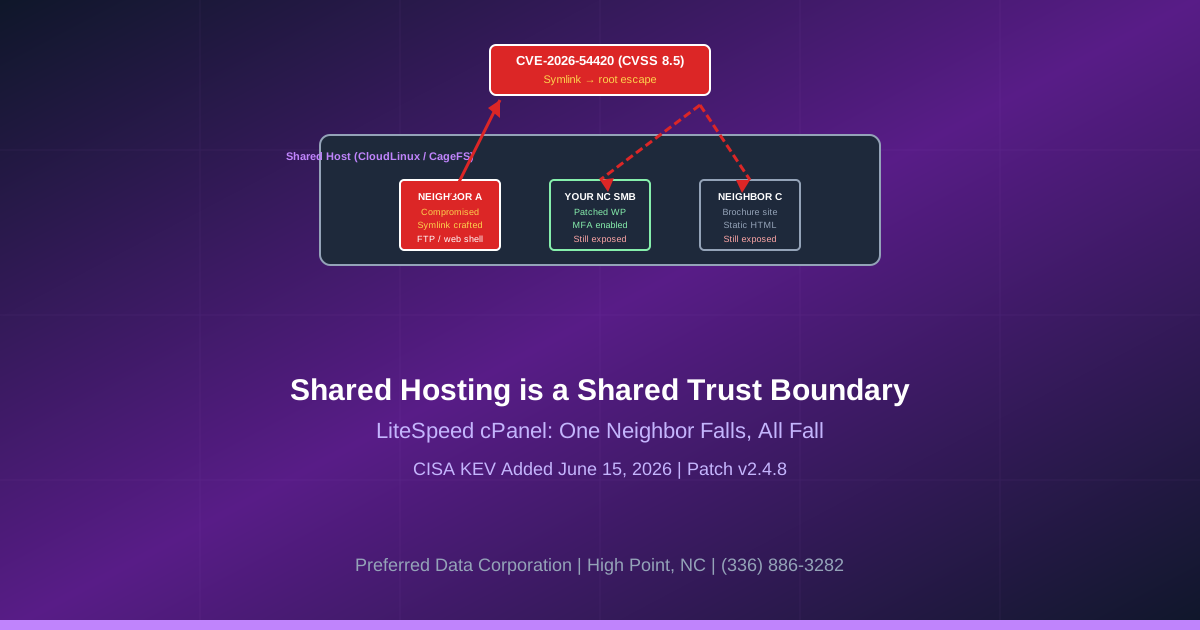
TL;DR: On June 15, 2026, CISA added CVE-2026-54420 to the Known Exploited Vulnerabilities catalog - a CVSS 8.5 symlink-handling flaw in the LiteSpeed cPanel plugin that lets any user with FTP or web shell access on a shared hosting server running CloudLinux or CageFS escalate to root. Per The Hacker News reporting, federal agencies were given a June 18 patch deadline. The fix is LiteSpeed WHM Plugin v5.3.2.1 (cPanel plugin v2.4.8). For NC small businesses on shared LiteSpeed hosting, the question is not "is my account safe" - it is "are any of my hosting neighbors compromised, and will the attacker pivot to my account?"
Key takeaway: Shared hosting is a shared trust boundary. A single CVSS-8.5 escalation flaw in a shared-hosting helper plugin turns every account on the host into a target the moment one neighbor falls. NC SMB owners on shared LiteSpeed hosting need a same-week patch confirmation in writing from their host.
Need to verify your hosting environment is patched? Preferred Data Corporation has supported NC small businesses since 1987 and can audit your hosting tier this week. Call (336) 886-3282 or request a hosting audit.
What is CVE-2026-54420?
CVE-2026-54420 is a CVSS 8.5 privilege escalation vulnerability in the LiteSpeed cPanel plugin, the helper plugin that bridges LiteSpeed web server with cPanel/WHM control panels on shared hosting infrastructure. Per BleepingComputer's coverage, the plugin mishandles symlinks (symbolic links) provided by a user with FTP or web shell access. The mishandling lets the attacker escalate from a low-privileged shared-hosting user to root on the host operating system.
The kicker is the operating environment. CloudLinux and CageFS exist specifically to isolate one shared-hosting user from another so a compromise of one account does not become a compromise of the whole server. CVE-2026-54420 breaks that isolation. Per Tech Jack Solutions' writeup, the exploit chain reads as "any user → root → all users on the same host."
CISA gave federal agencies a 48-hour patch window. Per Cybersecurity News reporting, the vulnerability is being actively exploited in the wild. The fix is LiteSpeed WHM Plugin v5.3.2.1 with cPanel plugin v2.4.8 or later.
Why does a shared-hosting bug matter for NC small businesses?
Because most NC SMB websites live on shared hosting, and most NC SMB owners do not know their host's patch posture, do not know what other tenants share the box, and do not have a contractual right to ask. Per Cisco's Global Hosting Market Report, shared hosting still represents over 60% of small business website hosting by account count, primarily driven by cost.
The downstream risk for NC SMBs is what security professionals call a "neighbor attack":
- One neighbor gets compromised through a vulnerable WordPress plugin, an exposed admin panel, or stolen FTP credentials.
- That neighbor's account is normally walled off from the rest of the server by CageFS.
- CVE-2026-54420 breaks the wall. The attacker uses the LiteSpeed plugin bug to escalate from neighbor to root.
- Once at root, every other account on the same host is exposed. That includes your account, your customer database, your form submissions, your email forwarders, your
.envfile with API keys.
Per the LiteSpeed advisory, the exploit does not require any vulnerability on your account. You can have a perfectly patched WordPress, perfect MFA, and rotated passwords. If a single neighbor on the same physical host is compromised and the host is not patched, you are still exposed.
Quotable definition: A neighbor attack on shared hosting is an attack in which the initial compromise lands on a different customer's account on the same physical server, and the attacker then uses a host-level flaw to break tenant isolation and reach other tenants' data. CVE-2026-54420 is the exact mechanism that makes neighbor attacks viable on CloudLinux/CageFS hosts in 2026.
How does the symlink exploit actually work?
A symbolic link in a filesystem is a file whose contents are a path to another file. Many programs that operate on user-provided paths need to handle symlinks carefully so a user cannot trick the program into following a link out of their sandbox into a privileged area. Per Vulert's writeup, the LiteSpeed cPanel plugin failed to enforce that path-handling for user-supplied data.
Three-step attack pattern:
- Initial foothold inside one user's account. Phishing the user's cPanel credentials, exploiting a vulnerable WordPress plugin to get a web shell, or buying FTP credentials on a stealer log marketplace. Any of these provides the low-privileged starting position.
- Craft a symlink that points out of the user's sandboxed home into a privileged area (commonly something LiteSpeed will read and act on with elevated privilege).
- Trigger the LiteSpeed plugin to operate on the symlinked file, which it does with root-level privilege. The attacker now controls a root-privileged write or read on the host operating system - enough to install a SUID binary, modify
/etc/passwd, plant a persistent backdoor, or read every other tenant's.env, database password, and session data.
The exploit is fast, mostly silent, and leaves only ordinary log entries on the host - which the SMB tenant cannot see because they do not have host-level log access.
Which NC small businesses are most exposed to CVE-2026-54420?
NC SMBs on shared cPanel + LiteSpeed hosting from any of the major mass-market hosts that bundle CloudLinux/CageFS. Per W3Techs, LiteSpeed has become the dominant web server in shared hosting environments specifically because of its performance with WordPress and WooCommerce - which is exactly the SMB stack.
Highest-exposure NC SMB profiles:
- NC professional services firms (law, accounting, real estate) in Charlotte and Raleigh running WordPress on shared cPanel hosting. Form submissions, client intake data, and client document downloads all live in the account; a neighbor attack compromises all of it.
- NC manufacturers and distributors in High Point, Greensboro, and Winston-Salem with brochure or product catalog sites on shared hosting. Sales pipeline data, vendor pricing references, and customer contact lists are the targets.
- NC SMBs with multiple sites under one cPanel reseller account. A single root-level compromise of the host exposes every reseller-managed tenant at once.
- NC SMBs whose website also hosts their
.envfile or stored API keys. The hosting compromise becomes an SaaS compromise the moment a.envwith Stripe, Mailgun, AWS, or OpenAI keys is read off disk. - NC SMBs whose hosting contract does not specify a 48-hour critical patch SLA. Most cheap shared hosting contracts do not. Read yours.
The risk profile is the same whether you run a 5-page brochure site or a full WooCommerce store. The differentiator is the host's patch posture, not your code.
Worried your hosting provider has not patched yet? Call (336) 886-3282 or request a hosting tier review.
What should NC small businesses do this week?
Run a five-step plan. Most of this is operator work, not engineering work.
- Identify your hosting provider and ask them for written confirmation of LiteSpeed cPanel plugin v2.4.8 deployment (today). A patch notice email from the host is enough. Silence is the answer that requires escalation. Per CISA's BOD 26-04, federal patch deadlines for this CVE landed on June 18; an SMB host that has not patched by today is behind schedule.
- Rotate every credential stored on the host (this week). cPanel password, FTP/SFTP passwords, database passwords, application admin passwords, and every API key in any
.envon disk. If the host was compromised before the patch landed, every credential on disk is potentially exfiltrated. - Audit your site for unfamiliar files (this week). Search the web root for new PHP files with recent mtime, unfamiliar admin users in
wp_users, and unexplained outbound connections from your account's logs. Reference our Cybersecurity services page for managed website incident response. - Move critical assets off shared hosting where the business case supports it (next 30-90 days). For NC SMBs with payment processing, sensitive client data, or compliance scope, the shared-hosting tier is the wrong long-term answer. Managed VPS, managed Kubernetes, or a managed CMS-as-a-service eliminates the neighbor-attack threat model entirely.
- Add a hosting-tier patch SLA to your next contract renewal (compliance calendar). Negotiate a 48-hour critical CVE patch commitment in writing. Many SMB hosting providers will agree if asked; most never get asked.
Key takeaway: You cannot patch a LiteSpeed cPanel plugin on a shared host - your host does. Your job this week is verification, credential rotation, and the long-term migration decision. The host's job is the actual patch.
How does the hosting tier landscape compare for NC small businesses?
The June 17 incident is a good reason to revisit hosting choices. Per Hosting Tribunal's 2026 SMB hosting survey, the hosting tier choice is one of the highest-leverage and least-revisited SMB IT decisions.
| Hosting tier | Cost per month | Neighbor-attack exposure | Patch responsibility | NC SMB best fit |
|---|---|---|---|---|
| Shared cPanel + LiteSpeed | $5-25 | High (this CVE) | Host (no SLA usually) | Brochure sites only |
| Managed WordPress (Kinsta, WP Engine, etc.) | $30-200 | Low | Host (strong SLA) | Most NC SMB marketing |
| Managed VPS | $40-200 | None (single tenant) | Shared with MSP | E-commerce, forms with data |
| Self-managed VPS | $5-50 | None | 100% SMB / MSP | Only with full IT staff |
| Managed Kubernetes / serverless | $50-500 | None | Cloud provider + SMB | NC SMBs scaling fast |
A managed WordPress or managed VPS tier costs more per month than shared hosting, but the cost per neighbor-attack incident is zero rather than catastrophic. The math has been favorable for years; CVE-2026-54420 is a reminder.
How does Preferred Data Corporation help NC SMBs harden hosting?
PDC has supported NC small businesses since 1987 and treats hosting tier choice as a security decision, not just a procurement one. We bring three things to the LiteSpeed conversation:
- Cybersecurity services: Hosting-tier review, post-CVE-2026-54420 incident hunting on your account, credential rotation runbooks, and managed WAF deployment. We help NC SMBs understand what their hosting contract actually covers.
- Managed IT services: Continuous hosting posture monitoring, automated patch confirmation tracking, and migration planning when the shared-tier risk no longer fits the business. For NC manufacturers in High Point, distributors in Greensboro, and professional services firms in Charlotte and Raleigh, the managed baseline is what makes CVE-2026-54420-class events a same-day confirmation phone call rather than a multi-week investigation.
- Cloud solutions: Migration of marketing sites, e-commerce, and customer portals from shared cPanel hosting to managed cloud or managed VPS tiers that eliminate the neighbor-attack threat model.
For small business owners in High Point, the Piedmont Triad, Greensboro, Winston-Salem, Charlotte, and Raleigh, the CVE-2026-54420 disclosure is the cue to revisit hosting tier decisions made a decade ago. The CISA SMB resources frame this clearly: SMBs face enterprise-grade exposure with a fraction of the staff. A trusted local partner closes the gap.
Ready to audit your hosting tier and patch posture this week? Call (336) 886-3282 or book a hosting review.
Frequently Asked Questions
What is CVE-2026-54420?
Per the CISA KEV catalog entry, CVE-2026-54420 is a CVSS 8.5 symlink mishandling vulnerability in the LiteSpeed cPanel plugin (versions before 2.4.8). A user with FTP or web shell access on a shared hosting server running CloudLinux or CageFS can escalate to root, bypassing the per-tenant isolation that CloudLinux is designed to enforce.
Is my NC small business affected?
If your website is on shared cPanel hosting that uses LiteSpeed web server, yes - your host is affected, and by extension you are. You cannot patch this yourself; you must confirm with your host that LiteSpeed WHM Plugin v5.3.2.1 (cPanel plugin v2.4.8) or later is deployed.
Does my own site need a patch?
No. The vulnerability is in the host's LiteSpeed cPanel plugin, not in your CMS or your account. Your job is to verify the host is patched and rotate every credential that ever lived on disk in your account.
What if my host has not patched?
Escalate the question to the host's security or support team in writing. If the answer is "we are patching" without a specific date, treat it as unpatched. Move critical sites to a patched host, a managed WordPress tier, or a managed VPS in the next 30 days.
Is this related to CVE-2026-48172 from earlier this year?
Both are LiteSpeed cPanel plugin flaws but distinct CVEs. Per Security Affairs, the pattern of repeated KEV additions on the same plugin is itself a signal: the codebase is under active scrutiny, more flaws are likely, and the SMB risk concentrates on hosts that are slow to patch.
Should NC small businesses move off shared hosting?
For brochure-only sites with no payment data and no compliance scope, shared hosting is still defensible if the host has a strong patch SLA. For NC SMBs with WooCommerce, customer portals, payment processing, or compliance scope (HIPAA, PCI, CMMC), the answer is increasingly no - managed WordPress or managed VPS pays for itself the first time a neighbor attack would have hit.
Related Resources
- Cybersecurity Services for NC Small Businesses - Hosting audit and incident response
- Managed IT Services for NC Businesses - Continuous hosting posture monitoring
- Cloud Solutions for NC Businesses - Managed hosting migration
- LiteSpeed cPanel CVE-2026-48172 Privilege Escalation NC 2026 - Sibling LiteSpeed cPanel flaw
- Joomla JCE CVE-2026-48907: NC SMB Web Defense 2026 - Same-week CMS plugin flaw
- Web Application Security for NC Small Business 2026 - General web hardening
- Contact Preferred Data Corporation - Hosting tier review for NC SMBs