
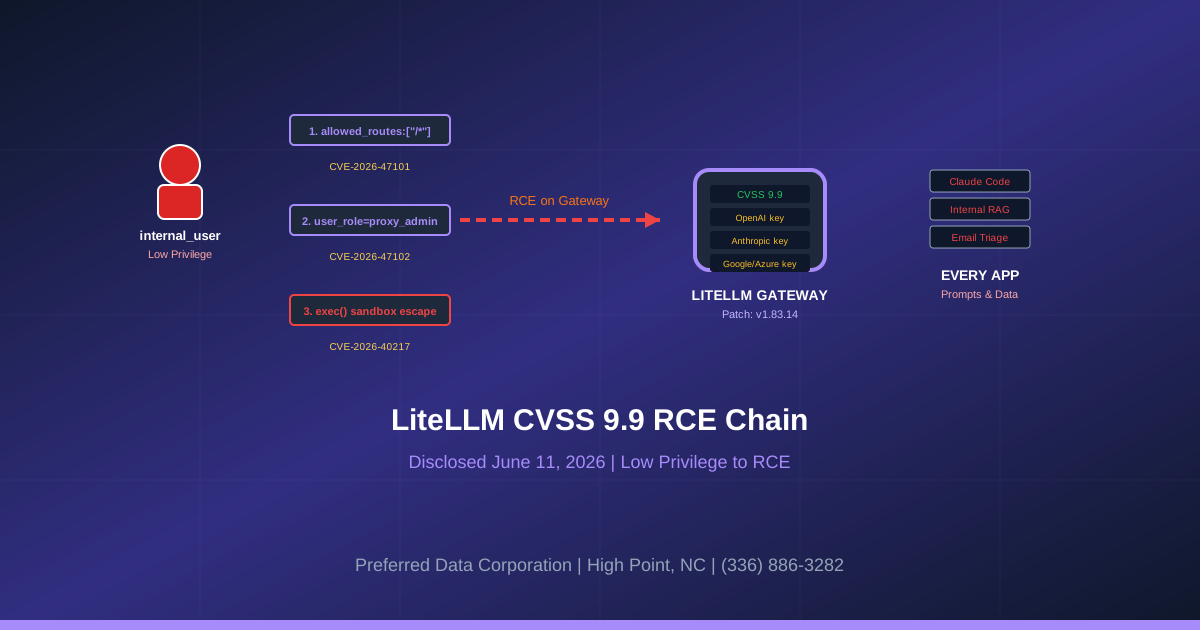
TL;DR: On June 11, 2026, Obsidian Security disclosed a CVSS 9.9 vulnerability chain in LiteLLM, the open-source AI gateway that proxies traffic to OpenAI, Anthropic, and other model providers. Per The Hacker News reporting, CVE-2026-47101, CVE-2026-47102, and CVE-2026-40217 chain together so that a default low-privilege user can mint a wildcard API key, elevate to proxy_admin, and execute arbitrary code on the LiteLLM server. The fix shipped in v1.83.14; SecurityWeek reports the bugs were exploited shortly after disclosure.
Key takeaway: AI gateways are the new "middleware tier" of SMB infrastructure: they hold API keys to every model provider, they see every prompt and response, and they are usually deployed by a single engineer. A CVSS 9.9 chain from low-privilege user to RCE means whoever has any account on your gateway can become its administrator and read every prompt that has ever transited it.
Running LiteLLM (or any AI gateway) for your NC business? Preferred Data Corporation has supported NC small businesses since 1987 and can audit your AI infrastructure this week. Call (336) 886-3282 or request an AI gateway exposure review.
What is LiteLLM and why are NC small businesses suddenly running one?
LiteLLM is an open-source AI gateway that proxies application traffic to multiple large language model providers - OpenAI, Anthropic, Google, Azure OpenAI, AWS Bedrock - through a single OpenAI-compatible interface. Per the LiteLLM project, the gateway centralizes API keys, enforces per-team usage quotas, routes prompts to the cheapest model that meets quality requirements, and exposes a unified observability surface. NC small businesses adopted LiteLLM (or competing AI gateways) over the last 18 months for one reason: it is the single fastest way to give multiple internal applications access to AI models without spreading API keys across every codebase.
Three reasons NC SMBs are exposed even if they did not deploy LiteLLM intentionally:
- Shadow AI infrastructure. Per industry reporting on AI tool sprawl, a developer in High Point, Greensboro, or Charlotte may have deployed LiteLLM on a single VM to support an internal Claude Code or Cursor integration without any change-management or security review.
- API key concentration. LiteLLM holds the master OpenAI, Anthropic, and Google API keys for every team it serves. Server compromise leaks every key at once and exposes every prompt that ever transited the gateway.
- Default low-privilege user accounts. Per Obsidian Security's writeup, the chain starts with any low-privilege user account on the gateway - including the default internal_user role.
How does the CVSS 9.9 LiteLLM vulnerability chain actually work?
The chain combines three independent bugs into a path from "any internal user" to "remote code execution as root on the gateway." Per Obsidian Security's technical writeup, every step in the chain is silent and requires only an authenticated low-privilege account.
The three-step attack chain:
- CVE-2026-47101 - Authorization bypass via unchecked allowed_routes. When an internal_user generates a virtual API key, LiteLLM stores the caller-supplied
allowed_routesfield without checking it against the user's role. A non-admin user can mint a key withallowed_routes: ["/*"], a wildcard that reaches every route, including admin-only routes. - CVE-2026-47102 - Privilege escalation via missing field-level authorization. The
/user/updateand/user/bulk_updateendpoints do not protect theuser_rolefield from caller-controlled updates. Per The Hacker News, the now-wildcard key can call these endpoints and setuser_role: "proxy_admin", granting full admin in the gateway. - CVE-2026-40217 - Sandbox escape in Custom Code Guardrail. Production endpoints ran admin-supplied Python through
exec()with no source-level filtering. Per Obsidian Security, whenexec()receives a globals dict without__builtins__, Python silently injects the full builtins module - the sandbox is illusory. The now-admin attacker uploads guardrail Python that callsos.system()and gains RCE on the LiteLLM server.
Quotable definition: The LiteLLM CVSS 9.9 vulnerability chain (CVE-2026-47101, CVE-2026-47102, CVE-2026-40217) lets a default low-privilege user mint a wildcard API key, elevate to proxy_admin, and execute arbitrary code on the LiteLLM server through a sandbox escape in the Custom Code Guardrail feature. The fix is LiteLLM v1.83.14.
Why does an AI gateway compromise have outsized impact for NC SMBs?
Because the gateway sees everything: every prompt, every response, every API key. NC SMBs running LiteLLM in front of Claude Code, Cursor, or internal RAG applications have effectively given the gateway the same data-classification scope as their entire codebase, customer-support inbox, and product documentation - whatever the AI tools were called against. Per SecurityWeek, exploitation began shortly after disclosure, which means unpatched gateways are now actively at risk.
| Compromise target | Data exposed | Lateral reach | Patch urgency |
|---|---|---|---|
| Single application API key | One app's calls | Limited to that app | 7 days |
| Developer endpoint | Local code, local creds | Lateral movement required | 7 days |
| AI gateway (LiteLLM RCE) | Every prompt, every API key, every app | All gateway-served applications at once | 72 hours |
| Domain admin | Domain-joined data | Every domain host | 24 hours |
| Cloud root account | Tenant-wide data | Entire cloud account | 24 hours |
The reason the patch urgency for an AI gateway sits at 72 hours rather than 7 days: the gateway is the join point between developer tools, AI providers, and the data the AI is asked to summarize. Per Obsidian Security, this chain specifically allows hijacking Claude Code responses - which means the attacker can make the AI return content of their choosing to your developers, who then trust it. That is a software supply chain attack delivered through an AI side channel.
Which NC small businesses are most exposed to AI gateway risk?
NC SMBs that have a developer or internal data team running LiteLLM, Helicone, OpenRouter-self-hosted, or any other AI gateway as part of internal tooling. The exposure does not require a public AI product. It requires a self-hosted AI proxy and any developer or analyst with an account on it.
The highest-exposure NC SMB profiles:
- NC manufacturers in High Point, Winston-Salem, and Greensboro running LiteLLM to centralize AI calls from shop-floor analytics and PLC log summarization tools. The gateway holds the API keys; a compromise leaks every prompt against operational data. See our Managed IT services page for endpoint and infrastructure hardening.
- NC distributors in Greensboro and Charlotte routing customer-service email summarization or invoice OCR through a LiteLLM proxy. Customer PII, invoice imagery, and EDI content are all touched by prompts that pass through the gateway.
- NC professional services firms (legal, accounting, consulting) in Raleigh, Charlotte, and Winston-Salem with internal RAG over client work product. The gateway sees every retrieved chunk and every model response - effectively the firm's entire client memory.
- NC SaaS startups and consultancies serving multi-tenant AI features through LiteLLM. One gateway compromise leaks every customer's prompts; the breach notification scope is the entire customer book.
- NC defense contractors with AI in CMMC scope. A LiteLLM RCE on a gateway that touches CUI is a reportable event under DFARS 252.204-7012 and a high-risk finding in any C3PAO assessment.
Not sure if your team runs LiteLLM or any other AI gateway? Call (336) 886-3282 or request an AI infrastructure inventory.
What governance steps should NC SMBs take this week?
Run a five-step plan over the next 14 days. The patch (v1.83.14) closes the specific bugs; the governance steps close the next set of bugs that have not been disclosed yet. Per The Hacker News, the bugs were exploited shortly after disclosure, so step 1 is non-negotiable.
- Inventory AI gateways (days 1-2). Ask every developer, data scientist, and AI engineer: "Do you run LiteLLM, Helicone, OpenRouter, or any other AI proxy?" Capture host name, version, and which API keys it holds.
- Patch LiteLLM to v1.83.14 or later (days 1-3). Per Obsidian Security, this version closes the three CVEs. Patch before doing anything else; LiteLLM versions before this release are actively exploitable.
- Remove the gateway from the public internet (days 2-4). Put LiteLLM behind a VPN, a Cloudflare Zero Trust tunnel, or a firewall rule that only allows the internal applications that need it. AI gateways do not belong on a public IP.
- Audit user accounts and rotate API keys (days 4-7). Delete every account you do not recognize. Rotate every upstream API key the gateway holds (OpenAI, Anthropic, Google, Azure). Assume keys leaked while the gateway was unpatched.
- Publish an AI infrastructure acceptable-use policy (days 7-14). Document which AI gateways are sanctioned, which applications may call them, what prompt content is forbidden, what data classifications may be summarized, and who reviews new AI tool deployments. Reference our Cybersecurity services for policy templates.
Key takeaway: The first action is inventory. NC SMBs cannot patch a gateway they did not know was running. A 30-minute conversation with every developer is the highest-ROI security step of the next 72 hours.
How does Preferred Data Corporation help NC SMBs govern AI gateways?
PDC has supported NC small businesses since 1987 and treats AI infrastructure as a tier-one asset. We bring three things to the LiteLLM conversation:
- AI Transformation services: AI gateway inventory, version posture, acceptable-use policy authoring, and architecture reviews for NC SMBs deploying LiteLLM, Helicone, custom RAG proxies, or commercial AI gateways. Governance is part of the rollout, not an afterthought.
- Cybersecurity services: API key rotation playbooks, network egress controls for AI gateway hosts, incident-response runbooks for suspected gateway compromise, and CMMC-aligned policy for NC defense contractors running AI in scope.
- Managed IT services: Patch management for self-hosted AI infrastructure, identity and access governance for gateway accounts, monitored network configuration baselines, and the operational discipline that keeps AI proxies out of headlines. For NC manufacturers in High Point, distributors in Greensboro, and professional services firms in Charlotte and Raleigh, the managed baseline is what makes AI infrastructure survive contact with reality.
For small business owners in High Point, the Piedmont Triad, Greensboro, Winston-Salem, Charlotte, and Raleigh, the LiteLLM disclosure is the cue to bring AI infrastructure into the same governance regime as the rest of the stack. The CISA SMB resources say the same: SMBs face enterprise-grade exposure with a fraction of the staff. A trusted local partner closes the gap.
Ready to inventory and govern the AI gateways already running on your network? Call (336) 886-3282 or book an AI infrastructure review.
Frequently Asked Questions
What is the LiteLLM CVSS 9.9 vulnerability chain?
The chain combines CVE-2026-47101, CVE-2026-47102, and CVE-2026-40217, disclosed by Obsidian Security on June 11, 2026. A default low-privilege user can mint an API key with a wildcard allowed_routes value, use it to set their own role to proxy_admin, and then upload Custom Code Guardrail Python that escapes the sandbox via exec() and executes arbitrary code on the gateway.
Is the chain patched?
Yes - in LiteLLM v1.83.14. Per The Hacker News, versions prior to the patch are actively exploited shortly after disclosure. NC SMBs should patch within 72 hours and assume keys leaked if the gateway was internet-reachable.
What is an AI gateway?
An AI gateway is a server that proxies application traffic to one or more LLM providers (OpenAI, Anthropic, Google, Azure OpenAI, AWS Bedrock) through a unified API. Per the LiteLLM project, the gateway centralizes API keys, enforces usage quotas, routes requests across models, and provides observability. LiteLLM is the most popular open-source option; Helicone, Portkey, and OpenRouter-self-hosted serve the same role.
Does my NC SMB run an AI gateway?
If you have a developer or data engineer who has deployed Claude Code, Cursor, internal RAG, or any AI-powered SaaS feature in the last 18 months, the answer is "probably." Ask them directly: "Do you run LiteLLM, Helicone, OpenRouter, or any other AI proxy?" The inventory question is the highest-ROI starting point.
Why is the patch urgency 72 hours and not 7 days?
Because the gateway holds API keys to every model provider it proxies and sees every prompt. A compromise is data exfiltration at the prompt level plus credential theft at the API key level - a worst-of-both-worlds outcome. Per SecurityWeek, exploitation began shortly after disclosure.
What is the first thing an NC SMB should do this week?
Inventory every AI gateway in the environment. Patch LiteLLM to v1.83.14 or later. Remove the gateway from the public internet. Rotate every upstream API key. Then publish an AI infrastructure acceptable-use policy that documents which gateways are sanctioned and who reviews new ones.
Related Resources
- AI Transformation Services for NC Businesses - AI gateway inventory, governance, and architecture review
- Cybersecurity Services for NC Small Businesses - Network egress controls and incident response
- Managed IT Services for NC Businesses - Patch management and access governance
- AI Agent Security Risks: Prompt Injection NC 2026 - Adjacent AI risk class
- Agentjacking MCP Attack: NC SMB AI Coding Agent Defense - Developer endpoint AI risk
- AI Agents Inside the Perimeter: Shadow AI Governance NC 2026 - Shadow AI risk for NC SMBs
- Contact Preferred Data Corporation - AI gateway exposure review for NC SMBs