
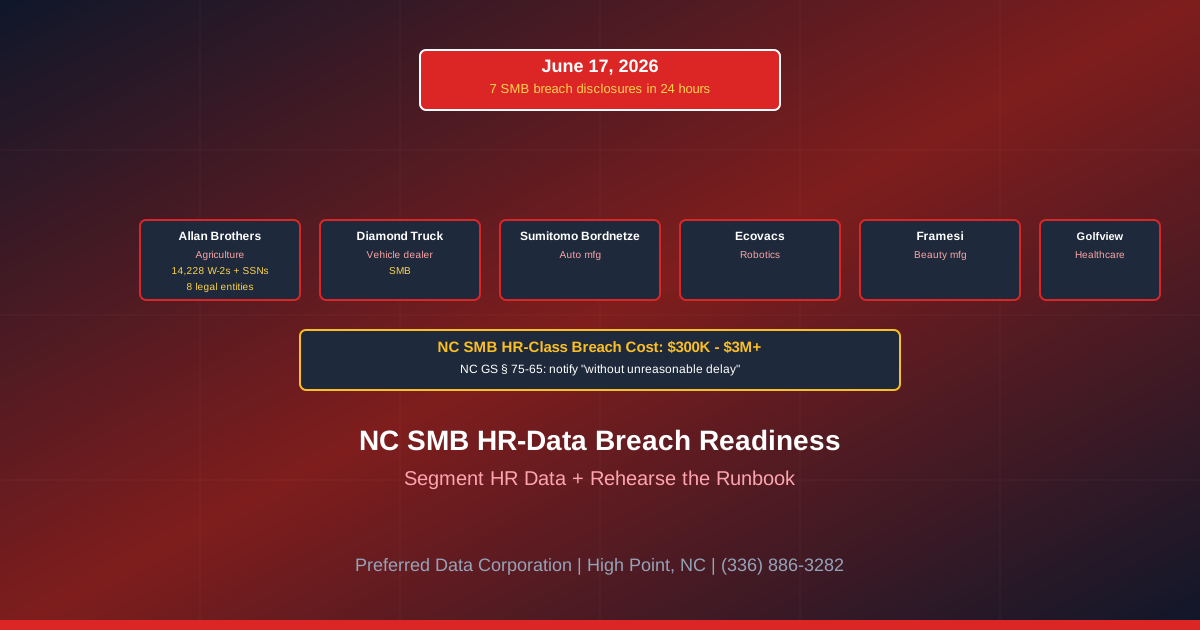
TL;DR: On June 17, 2026, at least seven small and mid-sized businesses were publicly listed on ransomware leak sites and breach trackers - including Allan Brothers, Inc., a Washington-based agricultural employer whose 14,228 employee records (including names, dates of birth, phone numbers, employment history, and full W-2s with Social Security Numbers across eight legal entities) were exfiltrated by the Aurora ransomware crew. Per Kaseya's Week in Breach roundup, the disclosures span agriculture, automotive dealership, robotics, beauty, healthcare, and manufacturing - the exact NC SMB segment mix. The lesson is not the individual breach; it is the cadence. SMBs are now being listed at a pace where the NC owner who is "too small to be a target" is the owner with the worst data the attacker found this week.
Key takeaway: When the W-2s and SSNs of every employee land on a ransomware leak site, the cost is not the ransom decision - it is the multi-state breach notification, the identity protection enrollment, the wage-and-hour lawsuit risk, and the years of erosion in employee trust. NC small businesses need a tested HR-data incident-response runbook, not an ad-hoc reaction.
Need to test your HR-data breach runbook before you need it? Preferred Data Corporation has supported NC small businesses since 1987 and can run a tabletop exercise this month. Call (336) 886-3282 or request a breach readiness review.
What happened on June 17, 2026?
Per BreachSense's incident tracker, at least seven organizations had data postings or breach disclosures appear on June 17, 2026. The publicly known list includes:
- Allan Brothers, Inc. - Washington agricultural employer; 14,228 employee records and full W-2 tax filings with SSNs across eight legal entities exfiltrated by Aurora ransomware. 1.3GB total leak. Per Ransomware.live.
- Diamond Truck Centres - Commercial vehicle dealership.
- Sumitomo Electric Bordnetze - Automotive manufacturing.
- Ecovacs Robotics - Consumer robotics.
- Framesi - Professional beauty products manufacturer.
- Golfview Developmental Center - Healthcare and developmental services.
- SUNASS - Peruvian government regulatory agency (non-SMB, included by trackers).
The common thread across the SMB victims is HR and operational data. Names, dates of birth, phone numbers, gender, employment history, employee photos, and SSNs on W-2s are the highest-value commodity in the underground market because they translate directly to tax fraud, employment fraud, and synthetic identity creation. Per the FBI IC3 2025 Annual Report, business email compromise and synthetic identity fraud are the two fastest-growing categories of cybercrime loss, and HR data theft is the supply chain that feeds both.
Why is this an NC small business story?
Because the victim profile matches the NC SMB profile. Agricultural employers with 50-500 seasonal workers and 8 legal entities exist across NC's High Point/Piedmont Triad and eastern North Carolina farm belt. Commercial vehicle dealerships, manufacturing operations, healthcare services, and beauty distribution all map directly onto NC's SMB economy. Per the North Carolina Department of Commerce, SMBs (under 500 employees) employ over 1.8 million North Carolinians - and the W-2 dataset for those firms is the exact data class an Aurora-style leak monetizes.
The downstream cost picture for an NC SMB that loses a W-2 dataset is not just the ransom decision:
| Cost category | Typical SMB cost range | Trigger event |
|---|---|---|
| Breach counsel retainer | $25K-$100K | First disclosure call |
| Multi-state breach notification | $5K-$50K | Affected employees in multiple states |
| Identity theft protection (2 years) | $100-$300 per employee | Statutory requirement in most states |
| Forensic investigation | $50K-$250K | Required for cyber insurance claim |
| Cyber insurance deductible | $25K-$100K | Per policy |
| Wage-and-hour lawsuit defense | $50K-$500K | Class action risk on disclosed PII |
| Employee turnover from trust loss | Hard to quantify | Multi-year erosion |
| Ransom payment (if paid) | $100K-$2M | Negotiation outcome |
| Total realistic range | $300K-$3M+ | For a 100-500 employee SMB |
Per the 2026 IBM Cost of a Data Breach Report, the average SMB breach cost crossed $3.31M for organizations under 500 employees - and the HR-data class is at the high end of that range because of the per-employee statutory cost driver.
What does NC law require when SSNs are exposed?
North Carolina General Statute § 75-65 (Identity Theft Protection Act) requires NC businesses to notify affected NC residents "without unreasonable delay" when their unencrypted personal information - which explicitly includes the combination of name and SSN - is reasonably believed to have been acquired by an unauthorized person.
For an NC SMB whose W-2 dataset is exfiltrated:
- Notification to affected NC employees is mandatory. Even employees who left years ago.
- Notification to the NC Attorney General's office is mandatory when more than 1,000 NC residents are affected. The AG operates a public breach notification log that becomes part of the SMB's public record.
- Notification timing pressure. "Without unreasonable delay" is not defined in days, but NC AG enforcement actions have consistently treated 30-60 days as the outer boundary. Per the NC DOJ Identity Theft Protection guidance, delays past 60 days draw enforcement scrutiny.
- Out-of-state employee triggers. Most NC SMBs employ at least some non-NC residents - particularly in agriculture, transportation, and seasonal industries. Per the IAPP US State Breach Notification Tracker, every state now has a notification statute, and the SMB must comply with each one for affected residents of that state. The compliance multiplier on multi-state SMBs is real.
Quotable definition: An "HR-class breach" is a data breach in which the exfiltrated dataset includes employee records containing the combination of name and SSN (or other state-defined PII triggers), making statutory breach notification mandatory and creating per-employee costs for identity protection, credit monitoring, and dispute support that scale directly with headcount.
Which NC small businesses are most exposed to an HR-class breach?
NC SMBs with high seasonal headcount, multiple legal entities, and HR data sitting on the same network as production workloads - the exact profile Allan Brothers maps to. Per the FBI IC3 small business advisories, the targeting pattern is:
- NC agricultural employers in eastern North Carolina and the Piedmont with H-2A seasonal workers, multiple farm LLCs, and consolidated payroll on a single small server.
- NC manufacturers in High Point, Winston-Salem, and Greensboro with 50-500 production employees and payroll consolidated with the ERP. See our Managed IT services page for HR-data segmentation.
- NC distributors in Greensboro and Charlotte with mixed W-2 and 1099 worker populations and benefit administration data on a shared file server.
- NC professional services firms in Charlotte and Raleigh with attorney, accountant, or consultant W-2s and high partner SSN exposure - lawsuits target partner records first.
- NC healthcare and developmental services organizations (matching the Golfview profile) with both employee W-2s and patient PHI in scope.
- NC SMBs with mature operational technology but immature data segmentation. Old NAS shares, "everyone read" folders, and unstructured backups are the leak source for most HR-class breaches.
Worried that an HR-class breach would shut your business down? Call (336) 886-3282 or request a data segmentation review.
What should NC small businesses do this quarter?
Run a five-step plan. The work is policy, segmentation, and rehearsal. No new product purchases required.
- Inventory every place HR data lives (weeks 1-2). HRIS, payroll system, file shares, email attachments, accounting system, backup tapes, and the office manager's laptop. Build a one-page diagram of the HR data flow. The diagram is the artifact you give your breach counsel on day one of an incident.
- Segment HR data from production workloads (weeks 2-6). Move HR data to a separate file share with strict ACLs. Encrypt at rest. Limit access to named individuals with logged access. Per NIST SP 800-171 Rev. 3, data segmentation is the highest-leverage control for limiting blast radius - which is exactly the SMB risk class on the June 17 list.
- Stand up a tested incident response runbook (weeks 4-8). First call to MSP. Second call to breach counsel. Third call to cyber insurance. Fourth call to forensics. Fifth call to communications. Each call has a name, a phone number, and a written charter. Reference our Cybersecurity services page for managed incident response retainers.
- Run a tabletop exercise (weeks 8-10). Simulate an Allan Brothers-style W-2 disclosure. Walk through the calls. Time the steps. Find the gaps. The first time the runbook runs should never be the real incident.
- Subscribe to ransomware leak-site monitoring (month 3 forward). Add the SMB's name, key supplier names, and key customer names to a leak-site watch list. Per Comparitech's ransomware tracker and ransomware.live, the leak site listing is usually the SMB's first notice that its data is gone - and free monitoring is widely available now.
Key takeaway: The breach-readiness gap is operational, not technical. NC SMBs do not lack tools; they lack runbooks, contact lists, and the muscle memory of a tabletop they ran six months ago.
How does Preferred Data Corporation help NC SMBs prepare for HR-class breaches?
PDC has supported NC small businesses since 1987 and treats HR-data segmentation and breach readiness as a board-level concern, not an IT-only task. We bring three things to the June 17 conversation:
- Cybersecurity services: HR-data segmentation review, incident response runbook authoring, tabletop exercise facilitation, leak-site monitoring, and managed breach-counsel intake. We help NC SMBs face the W-2 breach decision before they have to.
- Managed IT services: Continuous HR-data access monitoring, automated alert on bulk reads of payroll datasets, file-share permission audits, and the day-to-day operational work that keeps the W-2 export from leaving the network in the first place. For NC manufacturers in High Point, distributors in Greensboro, and professional services firms in Charlotte and Raleigh, the managed baseline is what makes an Allan Brothers-class event a non-event.
- Backup and recovery services: Immutable HR-data backups, off-host retention, and tested restoration that supports both ransomware recovery and forensic evidence preservation.
For small business owners in High Point, the Piedmont Triad, Greensboro, Winston-Salem, Charlotte, and Raleigh, the June 17 breach wave is the cue to treat employee data with the same operational rigor as customer data. The CISA SMB resources frame this clearly: SMBs face enterprise-grade exposure with a fraction of the staff. A trusted local partner closes the gap.
Ready to run a breach-readiness tabletop with your leadership team this quarter? Call (336) 886-3282 or book a readiness review.
Frequently Asked Questions
What happened in the June 17, 2026 SMB breach wave?
Per BreachSense and Kaseya's Week in Breach, at least seven organizations had data breach disclosures appear on June 17, 2026 - including Allan Brothers Inc. (agriculture, 14,228 employee records with W-2s and SSNs), Diamond Truck Centres, Sumitomo Electric Bordnetze, Ecovacs Robotics, Framesi, Golfview Developmental Center, and SUNASS. The common thread among the SMB victims is HR and operational data.
Why is the Allan Brothers breach the lead example?
Because the dataset includes W-2 tax filings with full Social Security Numbers across eight legal entities - the highest-value HR data class. Per Ransomware.live, 1.3GB of records were exfiltrated by the Aurora ransomware group. The case is a textbook example of how SMB headcount + multiple legal entities + payroll consolidation creates the worst single-blob exposure.
What does NC law require when an NC SMB loses employee SSNs?
Per NC GS § 75-65, an NC business must notify affected NC residents "without unreasonable delay" when unencrypted personal information including name + SSN is reasonably believed to have been acquired by an unauthorized person. Notification to the NC AG is mandatory when more than 1,000 NC residents are affected.
What does an HR-class breach typically cost an SMB?
Per IBM's 2026 Cost of a Data Breach Report and observed SMB cases, $300K-$3M+ for an SMB of 100-500 employees - inclusive of breach counsel, multi-state notification, identity protection, forensics, insurance deductible, lawsuit defense, and (if paid) ransom. The per-employee cost driver is the reason HR data segmentation matters more than equivalent-volume customer data.
What is the single most important control NC SMBs can adopt this quarter?
HR-data segmentation. Move HR data to a separate file share with named-individual ACLs, encrypt at rest, log access, and alert on bulk reads. Per NIST SP 800-171 Rev. 3, this is the highest-leverage operational control for limiting blast radius in the exact SMB breach class on the June 17 list.
How often should NC SMBs run a breach tabletop?
Annually at minimum. Better: every six months, with a rotating scenario (HR data leak, ransomware on accounting server, BEC wire fraud, supply chain compromise). Per CISA's tabletop exercise guidance, the marginal cost of a tabletop is small relative to the marginal preparedness gain.
Related Resources
- Cybersecurity Services for NC Small Businesses - Breach readiness and incident response
- Managed IT Services for NC Businesses - HR-data segmentation and access monitoring
- Backup and Recovery Services - Immutable HR-data backups
- Spring 2026 Third-Party Breach Wave NC SMB Defense - Supply chain breach context
- 73% SMB Cyber Insurance Failure: Audit Defense NC 2026 - Cyber insurance posture
- FBI IC3 Cybercrime Losses $21B Small Business Defense NC 2026 - Federal threat context
- Contact Preferred Data Corporation - Breach readiness review for NC SMBs