
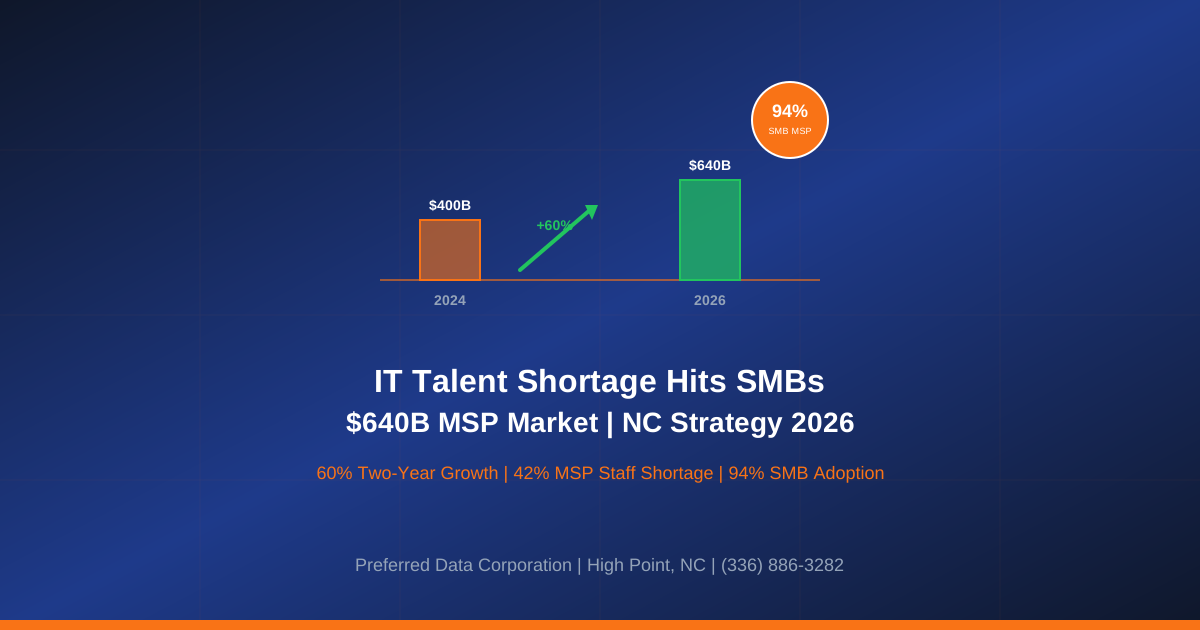
TL;DR: The global IT outsourcing market grew from roughly $400 billion in 2024 to nearly $640 billion in 2026 - a 60% surge in two years, per recent industry analysis. The driver is not vendor marketing; it is a structural shortage. 42% of MSPs report staffing shortages, 94% of SMBs now use an MSP, and 61% of SMBs say they need more tech expertise than they have internally. For North Carolina small businesses, attempting to compete with cloud providers and venture-funded SaaS companies for senior network and security engineers in 2026 is a losing economic position. The strategic answer is co-managed or fully managed IT - and the calculus has tightened sharply this year.
Key takeaway: In 2026, the question is not whether to use an MSP; it is which functions to keep internal and which to outsource. The 6% of SMBs still running fully in-house IT are paying a cybersecurity, uptime, and opportunity-cost premium that is no longer defensible against current attacker capability or current hiring economics.
Need a strategic MSP evaluation for your NC SMB? Preferred Data Corporation has run managed IT for NC businesses since 1987 - 39+ years, 20+ year average client retention. Call (336) 886-3282 or request a managed services assessment.
Why is the IT outsourcing market growing 60% in two years?
Three macro forces converged in 2025-2026. None of them is reversing in the next 24 months.
| Force | Evidence | Impact on NC SMB |
|---|---|---|
| Cybersecurity threat scaling | 88% of SMB breaches involved ransomware (Verizon 2025 DBIR) | Reactive in-house response is no longer fast enough |
| AI tooling complexity | 75% of SMBs investing in AI; 80% lack governance | Internal staff cannot keep up with safe-rollout practices |
| Senior IT/security talent scarcity | 42% of MSPs report unfilled positions | SMBs lose every recruiting fight against cloud and SaaS pay scales |
The result is a market in which 94% of SMB organizations now use an MSP, per Sagiss research, and SMBs are the fastest-growing client segment in the global managed services market.
What is the cost reality of hiring a senior IT or security engineer in NC?
Three benchmarks, drawn from the North Carolina BLS data for May 2025 and 2026 NC tech recruiting data:
- Mid-level sysadmin (4-6 yrs): $85,000-$110,000 base + benefits in the Piedmont Triad; $95,000-$125,000 in Charlotte/Raleigh.
- Senior security engineer (6-10 yrs): $135,000-$175,000 in Charlotte/Raleigh; $115,000-$150,000 in the Piedmont Triad.
- CISO or director of IT: $185,000-$275,000 in NC metro areas, with very thin supply.
To staff 24/7 coverage in-house requires 5-7 people (round-the-clock rotations including weekends). Two senior security engineers and one sysadmin alone is already $280,000-$435,000 fully loaded in NC, before tools, training, certifications, recruiting fees, or attrition replacement.
Per Micromenders' 2026 SMB analysis, most SMBs "cannot afford to match the six-figure salaries that massive tech companies pay for network engineers and cybersecurity experts." The pay gap is widest precisely at the experience level that small business cybersecurity actually needs.
Why is 94% MSP adoption not just a marketing statistic?
Because the SMBs that have made the switch report quantifiable improvements that the remaining 6% can no longer match in-house. Per Sagiss and Digacore 2026 SMB outsourcing data:
- 80%+ reduction in unplanned downtime for SMBs that move from break-fix to proactive managed IT.
- 30-50% lower total IT spend when the MSP can consolidate redundant tooling and renegotiate licensing.
- 24/7 incident response and patching that no 1-3 person internal team can sustain.
- Documented compliance evidence for cyber insurance renewals, SOC 2 attestations, CMMC self-assessments, HIPAA risk analysis.
The improvement is not the MSP being smarter than an internal admin. It is the MSP being a fractional team of 20-50 engineers backed by enterprise-grade tooling and a 24/7 SOC, distributed across hundreds of NC SMBs.
How should an NC SMB decide what to outsource?
Use this four-quadrant decision framework. Most NC SMBs end up outsourcing the bottom two quadrants and keeping the top two.
| Function | Recommended Model | Why |
|---|---|---|
| Business analyst, product/marketing analytics | Internal | Deeply context-specific to your customers |
| Application admin for line-of-business apps | Internal or co-managed | Workflow context matters more than IT depth |
| Server, network, identity, endpoint operations | Fully managed | Standardized, scale-leveraged, 24/7 needed |
| Security operations, EDR/MDR, SOC, incident response | Fully managed | Specialized talent, $640B market for a reason |
Per Techaisle's 2026 SMB top 10 priorities, 45% of SMBs rank tech integration as a top-three challenge, and the highest-yield way to solve integration debt is to consolidate operations under a single managed partner rather than try to coordinate 6-12 point vendors with a 1-2 person internal team.
Quotable definition: Co-managed IT is a model where an MSP handles 24/7 operations, security, and platform engineering while an internal IT manager remains responsible for business-facing priorities, vendor relationships, and project intake. It is the most common 2026 model for NC SMBs in the 50-250 employee range.
What is the right way to evaluate an MSP partner?
A six-question screen separates a strategic partner from a body shop:
- What is your average client retention? Industry average is 5-7 years; top decile MSPs report 15+ years. PDC averages 20+ year client tenure.
- What is your SOC coverage model? 8x5 with monitoring queue, 24x7 with on-call response, or 24x7 with active threat hunting?
- What is your incident response RPO and RTO? Documented in the MSA, not the marketing site.
- What is your cybersecurity tooling stack and do you own it? Some MSPs resell point tools; others run an integrated XDR/MDR platform.
- What is your local on-site response time? For NC SMBs, on-site presence within the Piedmont Triad or major NC metros matters for hardware events.
- What is your manufacturing, OT, or compliance specialty depth? Generic horizontal MSPs are rarely competent at CMMC, HIPAA, or OT/IT integration.
The cheapest MSP is rarely the best. Per BizTech Magazine's 2026 small business trend coverage, the best 2026 outcomes for SMBs come from "consolidation under fewer, better partners, not the lowest unit price."
When should an NC SMB switch from break-fix to managed services?
Three triggers, in order of urgency:
- Cyber insurance renewal denied or premium sharply higher. Your control environment is now an underwriting failure. Managed IT and managed cybersecurity can close the control gaps the questionnaire asks about.
- In-house IT person quit, retiring, or burned out. The cost of replacement at 2026 salaries plus 90-day onboarding is higher than 12 months of managed IT for most NC SMBs.
- Two or more security incidents in the trailing 12 months. Reactive break-fix has reached the limit of what one person can absorb. Managed services moves you to proactive.
What does a managed services engagement with PDC look like?
Three phases, predictable cost, no long lock-in:
- Weeks 1-3 - Assessment and stabilization. Network audit, identity audit, endpoint inventory, security posture review, documented gaps with priorities and costs.
- Weeks 4-8 - Foundation rollout. EDR/MDR deployment, MFA hardening, backup verification, patch SLA implementation, asset documentation refresh.
- Week 9+ - Operate and improve. 24/7 monitoring, monthly business reviews, quarterly cybersecurity reviews, annual tabletop exercise. Continuous improvement to the security and uptime floor.
The economic model is fixed monthly per user or per device, no surprise tickets, no nickel-and-diming on response time. The strategic model is one accountable partner with documented SLAs.
Need a strategic IT outsourcing decision this quarter? Call (336) 886-3282 or request a managed services scoping call.
How does Preferred Data Corporation help?
PDC supports NC small businesses with all three layers of the modern managed services stack:
- Managed IT services with 24/7 monitoring, fixed-price per user, EDR/MDR, MFA hardening, patch SLA, asset documentation, and quarterly business reviews.
- Managed cybersecurity with SOC coverage, identity threat detection, phishing-resistant MFA rollout, compliance evidence for cyber insurance, CMMC, and HIPAA renewals.
- Cloud Solutions for cloud platform engineering, migration, and ongoing operations including Microsoft 365, Azure, and AWS.
- Network services for switching, wireless, firewall, segmentation, and remote site connectivity.
PDC has served NC small businesses, manufacturers, and distributors for over 39 years - founded in 1987 - with on-site coverage within 200 miles of High Point and a 20+ year average client retention that is more than three times the industry norm. The combination of local presence, deep manufacturing and OT context, and national-grade tooling is what makes PDC the right partner in the $640 billion managed services market.
Frequently Asked Questions
Is the IT outsourcing market really at $640 billion in 2026?
Yes. Per Auxis's 2026 outsourcing trend analysis and the IT managed services market sizing data, the global IT outsourcing market expanded from approximately $400B in 2024 to nearly $640B in 2026, a 60% increase in two years driven by cybersecurity pressure, AI tooling complexity, and a structural senior IT talent shortage.
What percentage of SMBs use an MSP today?
Sagiss MSP industry trend data reports that 94% of SMB organizations now use an MSP for at least some portion of their IT and security operations. The remaining 6% are concentrated in micro-businesses (1-5 employees) and a small set of larger SMBs with mature in-house IT.
Is managed IT actually cheaper than in-house?
For most NC SMBs in the 25-250 employee range, yes. The in-house equivalent of 24/7 monitoring, security operations, patch management, EDR/MDR, backup, and end-user support requires 5-7 people fully loaded plus tooling, which typically runs $700,000-$1.4M annually. Managed IT for the same coverage scope is generally $200,000-$500,000 annually depending on user count and security tier.
What is co-managed IT, and is it right for my business?
Co-managed IT pairs an internal IT manager (handling vendor relationships, project intake, business-facing priorities) with an MSP that handles 24/7 operations, security, and platform engineering. It is the most common 2026 model for NC SMBs in the 50-250 employee range and balances strategic context with scale-leveraged execution.
How do I switch MSPs without disrupting operations?
A well-run MSP transition takes 6-10 weeks. Phase 1 is documentation handover and shadow operations (weeks 1-3). Phase 2 is parallel monitoring and credential transfer (weeks 4-6). Phase 3 is cutover and stabilization (weeks 7-10). PDC has run dozens of NC SMB transitions and uses a documented playbook to minimize risk.
Related Resources
- Managed IT Services for NC Businesses - 24/7 operations, fixed-price per user
- Managed Cybersecurity Services for NC Businesses - SOC, MDR, incident response
- Cloud Solutions for NC Businesses - Migration and ongoing platform operations
- 94% SMB MSP Adoption - In-House IT Unviable - Companion guide
- WatchGuard MSP-Led Security Shift - Security side of the MSP shift
- Contact Preferred Data Corporation - Schedule a managed services scoping call