
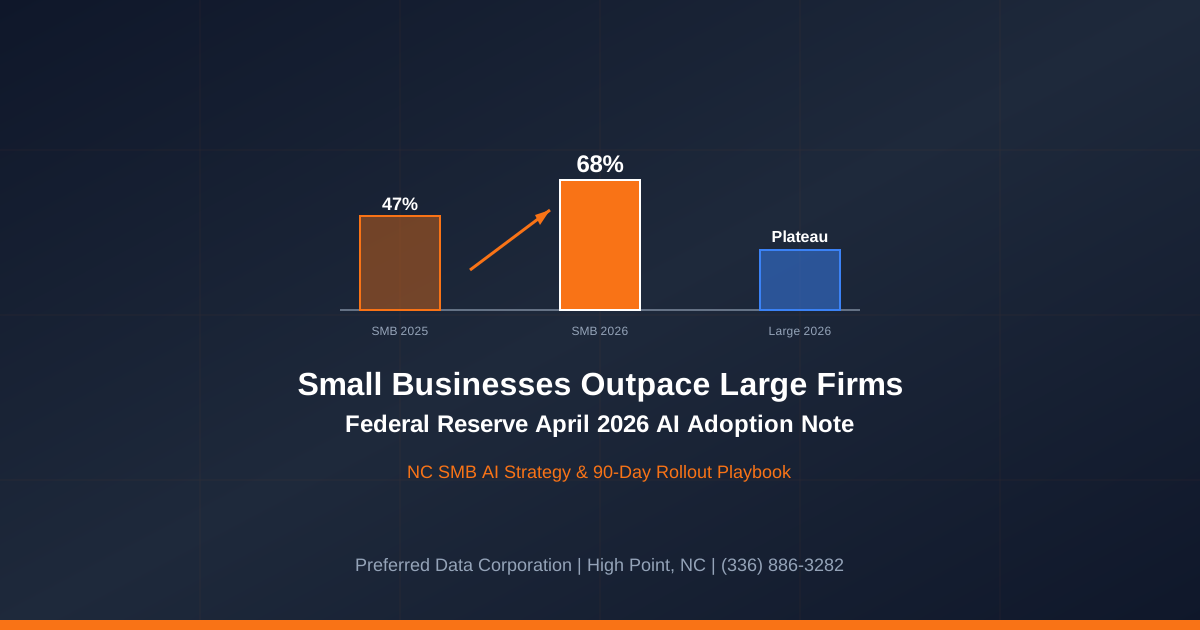
TL;DR: Per the Federal Reserve's April 2026 monitoring note, AI adoption among US firms with 10 to 100 employees jumped from 47% to 68% in a single year - a first-ever reversal in which small businesses now outpace large enterprises. About 20% of all US firms are using AI in production by early 2026, up from 18% at year-end 2025, and per Federal Reserve Bank of Minneapolis analysis, the SMB curve continues to steepen while enterprise adoption plateaus. For an NC SMB, the strategic question is no longer "should we adopt AI" - it is "are we in the 68% with governed AI or the 32% that is still planning while competitors deploy?"
Key takeaway: Small businesses are no longer the AI laggards. They are the AI leaders. In NC, that means an 80-person manufacturer that has not deployed managed AI by Q4 2026 is competing against peers that already have.
Need a managed AI strategy and rollout for your NC SMB? Preferred Data Corporation runs AI transformation, governance, and infrastructure for NC small businesses. Call (336) 886-3282 or request an AI readiness assessment.
What does the Federal Reserve April 2026 AI adoption note actually say?
Per the FEDS Note "Monitoring AI Adoption in the U.S. Economy" published April 3, 2026 and the accessible data version:
| Metric | Federal Reserve finding |
|---|---|
| US firms using AI in core production (year-end 2025) | 18% |
| US firms using AI in any business function (early 2026) | 20% |
| AI adoption among firms with 10-100 employees (year-over-year) | 47% to 68% |
| US labor force at firms with some AI adoption | 78% |
| Direction of the SMB curve | Continues to steepen |
| Direction of the large-enterprise curve | Plateauing |
The reversal is the news. For the entirety of the modern monitoring window, large firms led on AI adoption because they had the capital, the data, and the engineering. In the past year that gap closed, and per the San Francisco Fed Community Development analysis, the principal drivers were:
- Cost collapse on commercial AI APIs and packaged SaaS (M365 Copilot, ChatGPT Enterprise, Claude for Business).
- Speed of integration in SMBs with fewer change-management gates.
- Pressure from peer adoption - SMBs adopting because their competitors did.
Why are small businesses suddenly outpacing large firms?
Per the Atlanta Fed's working paper and the Minneapolis Fed's analysis, three structural reasons. Each is relevant for NC SMBs:
- Per-seat licensing is now SMB-friendly. M365 Copilot at SMB pricing, Claude for Business, ChatGPT Enterprise, and Google Workspace Gemini at $20-$60 per user per month has put governed AI in reach of any 25-person company.
- Use cases are concrete and short-cycle. SMBs deploy AI for quote generation, document summarization, customer email triage, RFP response, and invoice matching - all measurable, all under 90 days.
- Less change-management overhead. A 50-person NC manufacturer can pilot, evaluate, and roll out AI to 30 users in a quarter. A 50,000-person enterprise requires legal, compliance, vendor risk, works council, security review, and union notice before pilot one.
The result is the inverted curve. SMBs deploy. Large firms still plan.
What does the 32% non-adopter risk look like for NC SMBs?
Significant and growing. Per the Stealth Agents 2026 AI adoption statistics, BusinessNews coverage, and the Federal Reserve adoption curve, the cost of being a non-adopter in 2026 includes:
- Customer service response time gap. Sanctioned-AI competitors close tickets in minutes that take non-adopters hours.
- Quote / proposal turnaround gap. AI-assisted SMBs produce custom proposals in a single shift; non-adopters take days.
- Talent flight. Per the 2026 Small Business AI Outlook, employees increasingly weigh AI access in employer choice, especially for marketing, sales, and finance roles.
- Shadow AI fills the vacuum. Per BlackFog Q1 2026, 49% of employees use unsanctioned AI when their employer does not provide a managed option, creating data exfiltration risk. We covered the shadow AI exposure in detail in our 1-in-9 ransomware disclosure analysis.
What does a 68%-grade NC SMB AI rollout actually look like?
A four-layer playbook, deployable inside 90 days for a typical NC SMB:
- Sanctioned AI tool selection. Pick one or two governed platforms with enterprise privacy terms - M365 Copilot for Office-centric workflows, Claude for Business for long-document and code work, ChatGPT Enterprise for general use. Per Anthropic, commercial agreements explicitly exclude customer data from model training.
- Use case prioritization and pilot. Identify three concrete, time-boxed use cases (e.g., quote generation, RFP response, customer email triage), pilot with 5-10 users for 30 days, measure cycle-time improvement.
- AI infrastructure readiness. Per our AI-ready IT infrastructure post, this means an identity provider with conditional access, a data classification baseline, a DLP policy that covers AI domains, and an acceptable use policy.
- Workforce training and governance. Quarterly training on safe-data-handling, prompt practice, and AI-augmented workflow design. Per Acrisure's 2026 brief, only 58% of SMBs offer any cybersecurity training, and almost none yet train for AI tool use.
Quotable definition: Governed AI is the use of commercial AI tools under an enterprise agreement that excludes customer data from model training, supports SSO and audit logging, and is paired with an acceptable use policy and DLP coverage - in contrast to shadow AI, where employees use consumer AI tools outside IT visibility.
What is the AI infrastructure readiness gap for the average NC SMB?
Per the Federal Reserve's AI adoption monitoring, OECD's SME AI adoption report, and SMB customer reality:
- 61% cite cost as the primary barrier. Per-seat licensing has helped, but data-readiness costs are still real.
- 54% cite lack of expertise. SMBs cannot hire a chief AI officer; they need a managed services partner that delivers the same outcome.
- 41% cite data quality issues. AI on a broken CRM or a 1998 ERP gives broken answers. Data hygiene is the prerequisite.
The implication for an NC SMB is that AI adoption is not just a tool purchase. It is an infrastructure project that touches identity, data, DLP, and training. Per our AI-ready IT infrastructure briefing, the readiness work usually pays for itself inside the first AI productivity quarter.
Is the productivity gain real, or just hype?
The Federal Reserve thinks real. Per the Atlanta Fed's policy hub piece, executives expect AI to raise productivity by 2.25 percent on average over the next three years while lowering headcounts by 1.2 percent. Per Governor Barr's February 2026 speech, the productivity gain is unevenly distributed - high-skill, high-cognition work captures more of it than low-skill repetitive work.
For an NC manufacturer or professional services firm, the practical takeaway is that the productivity gain is real but it is not automatic. It requires use case selection, training, and integration into existing workflows. SMBs that deploy and measure capture the gain. SMBs that buy and walk away do not.
What is the right 90-day NC SMB rollout?
Sequence the steps so the highest-yield AI capabilities land first. PDC scopes this as a three-month sprint inside the AI transformation service:
| Month | Action | Outcome |
|---|---|---|
| 1 | Select sanctioned AI platform; baseline data and identity readiness | Governed AI footprint chosen; DLP and SSO ready |
| 2 | Pilot 3 use cases with 5-10 users; measure cycle-time impact | Quantified productivity baseline; identified expansion candidates |
| 3 | Roll out to all sanctioned roles; train; retire shadow AI usage | 68% adoption inside 90 days; shadow AI exfil risk closed |
Key takeaway: The Federal Reserve has confirmed it - small businesses are outpacing large firms on AI adoption. An NC SMB that defers governed AI into 2027 is not playing it safe; it is accepting structural disadvantage against peers that have already deployed.
Ready to deploy governed AI inside 90 days? Call (336) 886-3282 or request an AI readiness assessment.
How does Preferred Data Corporation help?
PDC supports NC small businesses with the three layers required for a governed AI rollout:
- AI Transformation services with use case selection, sanctioned platform deployment (M365 Copilot, Claude for Business, ChatGPT Enterprise), training, and quarterly review.
- Managed IT services with identity provider configuration, DLP rollout, data classification, and shadow AI inventory.
- Managed cybersecurity with AI domain DLP, acceptable use policy, and exfiltration monitoring so the AI rollout does not become a 96%-exfiltration ransomware incident.
PDC has served NC small businesses, manufacturers, and distributors for over 39 years with on-site coverage within 200 miles of High Point. The combination of local NC presence, 20+ year average client retention, and modern AI transformation experience is what gets a 90-day governed AI rollout landed and measurable.
Frequently Asked Questions
Why does the Federal Reserve say small businesses are now ahead of large firms on AI?
Per the FEDS Note from April 3, 2026, AI adoption among firms with 10-100 employees rose from 47% to 68% in a single year while enterprise adoption plateaued. The structural reasons are SMB-friendly per-seat licensing, concrete and short-cycle use cases, and lower change-management overhead in smaller organizations.
What sanctioned AI tools should an NC SMB consider?
For most NC SMBs, the practical choices are Microsoft 365 Copilot for Office-centric workflows, Claude for Business for long-document and code work, and ChatGPT Enterprise for general use. All three carry commercial terms that exclude customer data from model training, support SSO, and provide audit logging. PDC helps NC SMBs pick the right mix based on existing M365 / Google Workspace footprint and use cases.
What is "shadow AI" and why does it matter?
Shadow AI is employee use of unsanctioned consumer AI tools - ChatGPT, Claude, Gemini, Perplexity - outside IT visibility. Per BlackFog Q1 2026, 49% of employees use unsanctioned AI platforms, creating data exfiltration risk. The defense is to deploy sanctioned alternatives that meet user needs and pair them with DLP coverage and acceptable use policy.
How long does it take to roll out governed AI to a 25-person NC SMB?
A 90-day sprint inside PDC's AI transformation service. Month 1 is platform selection and infrastructure readiness, month 2 is pilot with measurement, month 3 is rollout, training, and shadow AI retirement. A 25-person SMB can be at 68%-grade adoption inside one quarter.
Will the productivity gain show up in the numbers?
Yes if you measure it. Per the Federal Reserve, executives expect AI to lift productivity by 2.25% over three years on average, but the gain is unevenly distributed. NC SMBs that select clear use cases, train, and measure cycle-time impact see meaningful productivity improvement inside the first quarter. SMBs that buy and walk away see little.
Related Resources
- AI Transformation Services for NC Businesses - Use case selection, sanctioned platform rollout, training
- Managed IT Services for NC Businesses - Identity, DLP, infrastructure readiness
- AI-Ready IT Infrastructure for NC Small Business 2026 - Companion infrastructure briefing
- AI Productivity Tools Small Business ROI - ROI measurement framework
- Microsoft 365 Copilot SMB Permanent Pricing - July 1 pricing deadline
- Contact Preferred Data Corporation - Schedule an AI readiness assessment