
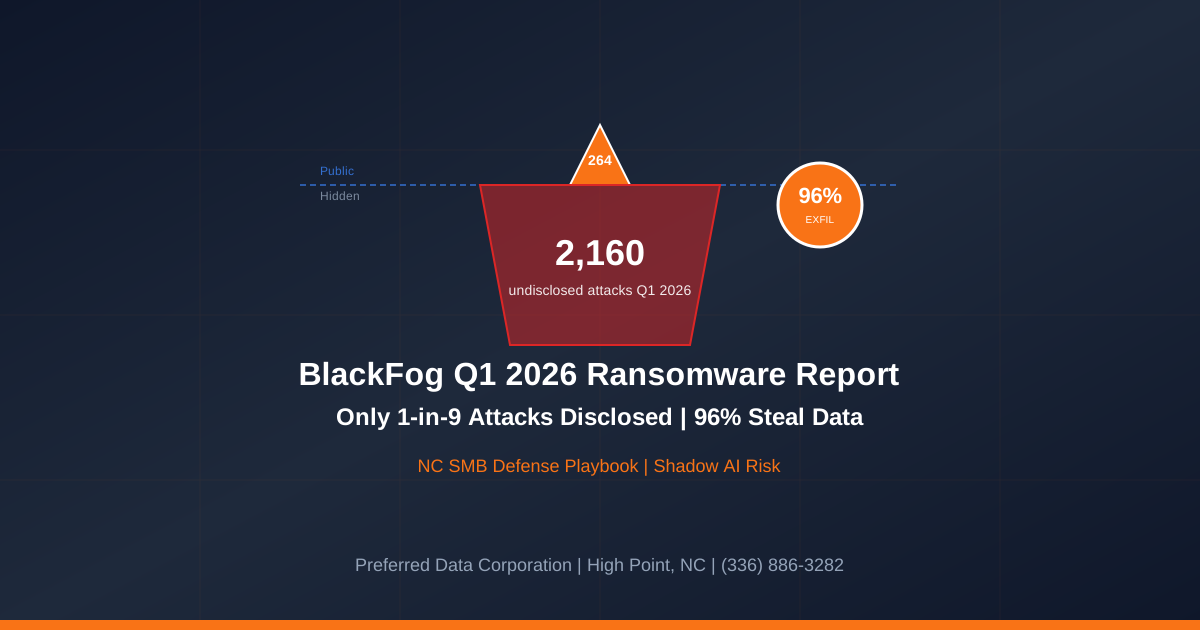
TL;DR: BlackFog's Q1 2026 State of Ransomware report documented 2,160 undisclosed ransomware attacks against 264 publicly disclosed attacks, meaning only 1 in 9 ransomware attacks are made public. Data exfiltration was confirmed in 96% of incidents, and the report highlights "shadow AI" as a new and rapidly growing exfiltration channel - with 86% of employees using AI tools weekly and 49% on unsanctioned platforms. For an NC SMB, the headline is the iceberg: public ransomware statistics massively understate the real attack volume, and any 2026 SMB risk budget that ignores data exfiltration and shadow AI is planning for a different decade.
Key takeaway: Most ransomware now ends with stolen data on a leak site, not just encrypted files. If your 2026 plan is "we have backups, we are fine", you have written a 2018 plan. Backups stop the encryption blast. They do not stop the disclosure.
Need a 2026-grade ransomware defense and shadow AI governance plan? Preferred Data Corporation runs managed cybersecurity for NC SMBs including EDR, MDR, immutable backups, and shadow AI inventory. Call (336) 886-3282 or request a ransomware readiness review.
What did the BlackFog Q1 2026 Ransomware Report actually find?
Per BlackFog's published Q1 2026 report PDF and the Industrial Cyber summary, the headline numbers are:
| Metric | Q1 2026 value | What it means for an SMB |
|---|---|---|
| Publicly disclosed ransomware attacks | 264 | Down 15% YoY, but only the visible iceberg tip |
| Undisclosed attacks tracked | 2,160 | Up 2% YoY - the real attack volume |
| Disclosure ratio | 1 in 9 | For every public story, eight invisible incidents |
| Data exfiltration rate | 96% | Almost every incident is now a data theft event |
| Countries affected | 97 | Geographic distribution is global |
| Employees using AI tools weekly | 86% | Shadow AI is the new exfiltration channel |
| Employees on unsanctioned AI platforms | 49% | Roughly half of workforce uses AI outside IT visibility |
| Employees integrating AI in workflows without IT approval | 51% | Most AI usage today is unmanaged |
The report frames ransomware as "structurally elevated" and "industrialised" - no longer episodic, no longer a problem you can outrun by being smaller than the next target.
Why does the 1-in-9 disclosure gap matter for SMB defense planning?
Because public ransomware statistics radically understate the true exposure for an NC SMB. Per Cybersecurity Dive's coverage and the BlackFog press release:
- The public ransomware leak site count understates real attacks by a factor of nine. A 50-person NC manufacturer planning around the "264 attacks in Q1" number is planning for the wrong threat volume.
- Most SMBs that get hit pay quietly. Per the Acrisure 2026 SMB cyber threat brief, 88% of SMB breaches involve ransomware, but only a fraction make news. The rest pay, restore, and move on - often without a formal incident response, without insurer notification, and without lessons learned reaching peer companies.
- Cyber insurance carriers see the real numbers. Underwriters have the full incident database from claims data and price accordingly. The premium environment for SMBs in 2026 reflects the 2,160 number, not the 264 number.
The practical implication: any NC SMB that says "we have not seen ransomware in our industry" is observing a public-disclosure sample, not the actual incident base rate.
Why is data exfiltration in 96% of incidents now the dominant risk?
Because the modern ransomware business model has shifted from encryption-only to double extortion to data-theft-only. Per the Industrial Cyber summary of BlackFog's report and the Cyble 2026 ransomware groups roundup:
- Encryption is operationally noisy. It triggers EDR, breaks production, and lights up monitoring. Many 2026 groups skip it.
- Exfiltration is quieter and equally monetizable. A 50-gigabyte exfil over weeks looks like normal cloud usage. The extortion lever is the threat of public release.
- Backups are no longer the answer. Per BlackFog, an SMB with perfect backups still has the disclosure obligation if the data was taken, plus the regulatory exposure if PII or PHI was involved.
The result: the 2026 NC SMB risk model is "data leaves my network" first, "files are encrypted" second.
What is "shadow AI" exfiltration and why is it spiking?
Shadow AI is employee use of AI tools - ChatGPT, Claude, Gemini, Perplexity, M365 Copilot personal, Cursor, dozens more - that the company has not sanctioned. Per the BlackFog Q1 report:
- 86% of employees use AI tools weekly.
- 49% use unsanctioned platforms.
- 51% integrate AI into workflows without IT approval.
The exfiltration risk is straightforward. An employee pastes a customer list, a contract, a price sheet, or a CAD bill of materials into a consumer AI to "summarize" or "rewrite", and the data has left the company's perimeter to a service whose retention, training, and breach posture are not under any DPA.
Per Acrisure's 2026 brief, only 58% of SMBs offer cybersecurity training, and almost none train specifically for AI tool data handling. The result is unmanaged exfil at scale, and a ransomware actor in 2026 does not have to break in if the data is already leaving on its own.
What does a 2026-grade SMB ransomware defense actually look like?
A layered defense across four controls, deployable inside 60 days for a typical NC SMB:
- EDR with detection-and-response (MDR) coverage 24x7. Per the Verizon 2026 DBIR coverage, median time from credential capture to lateral movement is under 30 minutes. EDR without 24x7 response is a security camera with no one watching.
- Immutable backups with offline / air-gapped copies. Per Acrisure's 2026 brief, modern ransomware groups specifically target backups before triggering encryption. Backups must be immutable, geographically separated, and routinely tested via restore drills.
- Data loss prevention (DLP) on cloud, email, and AI. A DLP policy that flags large file movements to consumer AI domains, outbound exfil patterns, and unsanctioned cloud storage is now standard. Per BlackFog, shadow AI exfil is the new attack vector and the policy has to follow.
- Shadow AI inventory, sanctioned alternatives, and training. Inventory AI tools in use, sanction managed alternatives (M365 Copilot, ChatGPT Enterprise, Claude for Business), and run quarterly training on what data is and is not safe to paste into AI.
Quotable definition: Double extortion ransomware is an attack that combines file encryption with data exfiltration, where the attacker threatens to publish stolen data publicly if the ransom is not paid - making the breach a disclosure event even if backups restore the environment.
Does cyber insurance still pay out on ransomware incidents?
Increasingly only on documented controls. Per the 2026 SMB cyber insurance environment, insurers want to see:
- Endpoint detection and response (EDR).
- Immutable backups with tested restores.
- MFA on privileged accounts.
Per the same guide, a business that cannot show these controls should expect higher premiums, coverage exclusions, or a declined application, and a policy that is issued may exclude ransomware payments.
What is the right 60-day NC SMB rollout?
Sequence the controls so the highest-yield protections land first. PDC scopes this as a two-month sprint inside the managed cybersecurity service:
| Week | Action | Outcome |
|---|---|---|
| 1-2 | Deploy EDR + 24x7 MDR across all endpoints | Lateral movement, credential theft, and pre-encryption staging caught in minutes |
| 3-4 | Move backups to immutable + offline copy; run restore drill | Encryption survivable; restore time tested |
| 5-6 | Roll out DLP on email + cloud + AI domains | Outbound exfil patterns and shadow AI uploads flagged |
| 7-8 | Inventory AI tools, deploy sanctioned alternatives, run training | Shadow AI usage measurable; safe-handling training in place |
Key takeaway: The 1-in-9 disclosure gap is the most important number an NC SMB CFO needs to internalize for 2026 risk budgeting. Public ransomware statistics undercount real attack volume by 9x. The corresponding defense budget undercount has to be corrected before the audit, not after the breach.
Ready to upgrade ransomware defense and govern shadow AI? Call (336) 886-3282 or request a ransomware readiness review.
How does Preferred Data Corporation help?
PDC supports NC small businesses with the three layers required to close the 2026 ransomware gap:
- Managed cybersecurity with 24x7 SOC/MDR, EDR coverage, DLP, immutable backup architecture, and incident response retainer that treats data exfiltration as a Tier 1 event.
- Managed IT services with shadow AI inventory, sanctioned AI rollout (M365 Copilot, Claude for Business, ChatGPT Enterprise), and quarterly tabletop exercises that include ransomware and AI exfiltration scenarios.
- AI Transformation services to give NC SMBs a governed AI path so employees do not have to default to consumer ChatGPT for daily work.
PDC has served NC small businesses, manufacturers, and distributors for over 39 years with on-site coverage within 200 miles of High Point. The combination of local NC presence, 20+ year average client retention, and modern detection tooling is what gets a 60-day ransomware defense and shadow AI program landed and verified before the next renewal.
Frequently Asked Questions
What is the 1-in-9 disclosure gap in the BlackFog Q1 2026 report?
Per BlackFog, Q1 2026 saw 264 publicly disclosed ransomware attacks but 2,160 undisclosed attacks tracked through other means. The ratio means only roughly 1 in 9 ransomware attacks ever become public, and public statistics radically understate actual attack volume. This is the most important number for SMB risk budgeting in 2026.
What is shadow AI and how is it different from regular AI use?
Shadow AI is employee use of AI tools - ChatGPT, Claude, Gemini, Copilot personal, Perplexity, Cursor, others - that the company has not sanctioned or governed. Per BlackFog Q1 2026, 49% of employees use unsanctioned AI platforms and 51% integrate AI into workflows without IT approval, creating a new data exfiltration channel.
Are immutable backups still enough to defend against ransomware?
Backups are necessary but not sufficient. Per BlackFog, 96% of modern ransomware incidents now involve data exfiltration in addition to or instead of encryption. Backups restore the files but do not stop the disclosure - the stolen data is already gone, and the regulatory and reputational exposure remains. The defense has to include DLP and exfiltration detection.
How much does a 2026-grade ransomware defense cost for an NC SMB?
For a 25-person NC SMB, expect $50-$120 per endpoint per month for EDR + 24x7 MDR, $5-$15 per user per month for DLP coverage, and $20-$60 per user per month for a sanctioned AI tool (M365 Copilot, Claude for Business, or ChatGPT Enterprise). PDC bundles these into the managed cybersecurity service for predictable per-seat pricing.
How quickly can PDC stand up this defense for an NC SMB?
A 60-day sprint inside the managed cybersecurity service. Weeks 1-2 deploy EDR + MDR, weeks 3-4 harden backups, weeks 5-6 roll out DLP, and weeks 7-8 inventory and replace shadow AI. A 25-person NC SMB can be fully covered within two billing cycles.
Related Resources
- Managed Cybersecurity Services for NC Businesses - 24x7 SOC, EDR + MDR, DLP, incident response
- Managed IT Services for NC Businesses - Backup architecture, immutable storage, restore drills
- AI Transformation Services - Sanctioned AI rollout, governance, training
- AI Ransomware $74 Billion Threat - Companion ransomware briefing
- AI Tool Sprawl Governance for SMBs - Shadow AI controls
- Contact Preferred Data Corporation - Schedule a ransomware readiness review