
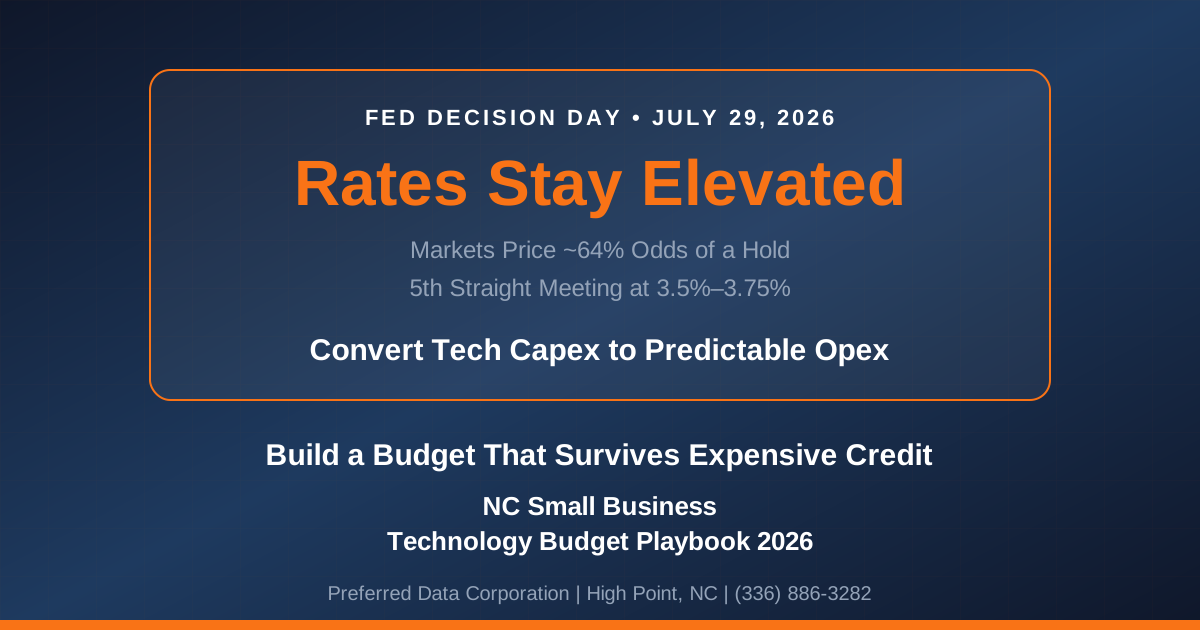
TL;DR: The Federal Reserve's FOMC meeting concludes today, July 29, 2026, with the rate decision announced at 2:00 pm ET. Economists polled by FactSet expect the Fed to hold its benchmark rate steady at the 3.5% to 3.75% target range, which would be the fifth consecutive meeting with no change, and CME Group fed funds futures assign roughly a 64% probability of a hold. Whatever the exact outcome, rates remain at a restrictive level, so the durable move for NC small businesses is to keep converting technology capital expense into predictable operating expense: managed IT, cloud, and financed or managed hardware procurement.
Key takeaway: Do not wait for the 2:00 pm ET headline to plan your technology budget. Under any realistic outcome, borrowing stays expensive and small business credit stays tight through 2026. The right posture is a decision framework: green-light fast-payback, risk-reducing opex (security, backup, managed IT), defer illiquid long-payback capex, and protect your cash and credit lines.
Planning your 2026-2027 technology budget against an expensive-credit environment? Contact Preferred Data Corporation at (336) 886-3282 for a right-sized capex-to-opex IT budget review. BBB A+ rated, serving High Point, Greensboro, Winston-Salem, Charlotte, Raleigh, and the Piedmont Triad since 1987.
What is the Fed expected to decide on July 29, 2026?
The decision comes today, and markets are positioned for no change. Economists polled by FactSet predict the Fed will hold its benchmark rate steady at the 3.5% to 3.75% target range, which would mark the fifth consecutive meeting without a move, and CME Group fed funds futures price roughly a 64% probability of a hold. The announcement is scheduled for 2:00 pm ET.
Three data points frame the meeting for a business owner in the Piedmont Triad.
- Base case is a hold. Per CBS News coverage of the July meeting, the consensus expectation is that the Fed leaves rates unchanged rather than cutting or hiking.
- The odds are firm but not certain. A ~64% futures-implied probability of a hold means roughly a one-in-three chance the outcome differs, so plan for a range rather than a single number. Earlier in 2026 the narrative briefly flipped toward expected hikes before the market settled back toward a hold going into this meeting.
- The backdrop is mixed. Oil prices have fallen and the labor market is holding steady, but inflation remains elevated. If inflation reignites, including from any geopolitical escalation, the probability of a rate hike later in 2026 rises.
The operational takeaway is that this is not a pivot to cheap money. Rates stay at a restrictive level either way, and your technology budget should be built for that reality.
Why does a still-restrictive rate environment matter for NC small business tech budgets?
Because borrowing stays expensive and small business credit stays tight, every large capital outlay costs more to finance and ties up cash you may need elsewhere. A restrictive rate means the cost of financing a server refresh, a network build-out, or an in-house hire is higher than it was in the low-rate years, and the opportunity cost of parking cash in depreciating hardware is higher too.
Small businesses feel this more sharply than large enterprises for structural reasons. Large firms tap public debt markets and syndicated bank lines; NC small and midsize employers in High Point, Greensboro, Winston-Salem, and Charlotte rely on regional-bank lines that reprice quickly and often tighten on availability, not just price. When the Fed's own June 2026 FOMC materials and market commentary point to sustained restrictive policy, the practical message for an owner-operator is to minimize rigid, illiquid overhead.
That is the core of the capex-to-opex thesis. Converting technology capital expense into predictable monthly operating expense does three things at once: it removes a large financed outlay from the balance sheet, it preserves borrowing capacity for revenue-generating needs, and it turns an unpredictable refresh cycle into a flat, forecastable line item. See our managed IT services and cloud solutions pages for how PDC structures that shift.
Capex vs opex technology approach: which wins when rates stay high?
In a restrictive-rate environment, the opex approach wins on the two factors that matter most: cash-flow impact and flexibility. Owning depreciating hardware and staffing in-house locks up capital and financing capacity at exactly the moment credit is expensive, while managed services and cloud spread cost into predictable monthly amounts you can scale up or down. The table below is illustrative and qualitative, not a quote, and the right mix depends on your specific workloads.
| Factor | Capex approach (own hardware, in-house build) | Opex approach (managed IT, cloud, financed procurement) |
|---|---|---|
| Upfront cost | Large lump sum, often debt-financed | Little to none, spread across months |
| Cash-flow impact | Ties up cash or a credit line at high rates | Predictable monthly expense, cash preserved |
| Flexibility | Fixed capacity, hard to resize | Scales up or down with demand |
| Risk in a high-rate environment | Financing cost and refinance risk compound | Cost is flat and forecastable regardless of rates |
| Obsolescence | You absorb depreciation and refresh timing | Refresh handled inside the service or lease |
| Balance-sheet effect | Adds financed assets and liabilities | Keeps borrowing capacity available |
The point is not that capex is always wrong. A high-return, short-payback investment can still make sense. The point is that when credit is expensive, the bar for illiquid, long-payback capex rises, and the case for predictable opex gets stronger. For NC manufacturers weighing plant-floor technology, our manufacturing IT page covers how OT and IT spending fits this framework.
Not sure which of your 2026 technology line items should be capex and which should be opex? Call Preferred Data Corporation at (336) 886-3282 for a no-pressure budget review built around your cash position.
Which technology spend should NC SMBs green-light right now?
Green-light the fast-payback, risk-reducing opex first, because it protects revenue and often lowers other costs. In a tight-credit environment, the spending that survives scrutiny is the spending that either prevents an expensive event or converts a lump sum into a predictable monthly cost. Three categories clear that bar.
- Managed IT as predictable opex. Instead of a large hardware or staffing capital outlay, managed IT delivers monitoring, help desk, patching, and refresh planning as a flat monthly expense. That removes both the financed outlay and the unpredictability of break-fix surprises.
- Security and backup that reduce downside risk. Cybersecurity controls and backup and disaster recovery are the definition of risk-reducing opex. A single ransomware or data-loss event compounds against an already-tight balance sheet, so this spend protects the exact cash cushion you are trying to preserve.
- Cloud on a pay-as-you-go basis. Cloud solutions replace owning depreciating servers with capacity you rent and resize. In a high-rate environment, not financing a server refresh is itself a cost saving.
What technology spend should NC SMBs defer or restructure?
Defer illiquid, long-payback capex, and restructure any large hardware purchase into financed or managed procurement. When borrowing is expensive, discretionary capital projects with slow, uncertain returns are the first candidates to push out, while necessary hardware can often be converted from a lump-sum purchase into a predictable payment.
- Defer discretionary, long-payback capex. Non-urgent workstation refreshes, printer fleet replacements, and speculative build-outs can usually wait 6 to 12 months if the current equipment is functional. Deferring avoids financing that outlay at today's restrictive rates.
- Restructure necessary hardware into managed procurement. When hardware genuinely must be replaced, managed hardware procurement lets you spread the cost rather than draw down cash or a credit line in a single hit.
- Preserve cash and credit lines. Treat your working-capital line as a scarce resource. Every dollar not committed to depreciating hardware is a dollar available for payroll, inventory, or a genuine growth opportunity if conditions shift.
- Pull forward only high-ROI, risk-reducing spend. The exception to deferral is security and backup. Those should be accelerated, not delayed, because the cost of the event they prevent compounds against a tightening balance sheet.
How should a High Point or Piedmont Triad business act on today's decision?
Run a simple three-bucket triage of every open technology line item before the quarter closes. This framework holds regardless of whether the 2:00 pm ET announcement is a hold or a surprise, because rates remain restrictive in every realistic scenario. Sort each planned expense into green-light, defer, or restructure.
- Green-light: fast-payback, risk-reducing opex. Managed IT, managed security, backup and disaster recovery, and pay-as-you-go cloud. These preserve cash and lower downside risk.
- Defer: illiquid, long-payback discretionary capex. Non-urgent refreshes and speculative build-outs pushed 6 to 12 months.
- Restructure: necessary hardware turned from a lump-sum purchase into financed or managed procurement so it lands as predictable monthly opex.
PDC has helped NC manufacturers and industrial businesses run exactly this kind of budget triage since 1987, with a 20-plus-year average client tenure. As a local Piedmont Triad provider, we plan technology budgets around your actual cash position and growth plans, not a national vendor's quota.
Ready to build a 2026-2027 technology budget that fits an expensive-credit environment? Contact Preferred Data Corporation or call (336) 886-3282. Serving High Point, Greensboro, Winston-Salem, Charlotte, Raleigh, and the Piedmont Triad.
Frequently Asked Questions
Is the Fed cutting rates on July 29, 2026?
No cut is expected. The decision comes today at 2:00 pm ET, and economists and futures markets expect a hold at the 3.5% to 3.75% target range, with CME Group fed funds futures pricing roughly a 64% probability of no change. That would be the fifth consecutive meeting with no move. A hold means rates stay at a restrictive level, so borrowing remains expensive for small businesses.
What does a Fed rate hold mean for my small business technology budget?
A hold at a restrictive level means the cost of financing large technology purchases stays high and small business credit stays tight. The practical response is to favor predictable operating expense (managed IT, cloud, managed hardware procurement) over large capital outlays that tie up cash or a credit line. This preserves borrowing capacity for revenue-generating needs.
What is capex-to-opex conversion in IT?
Capex-to-opex conversion means replacing large upfront technology purchases (capital expense) with predictable recurring service fees (operating expense). Instead of buying and financing servers, staff, and hardware, you subscribe to managed IT and cloud services. In a high-rate environment this keeps cash on the balance sheet and turns an unpredictable refresh cycle into a flat monthly line item.
Should NC manufacturers still invest in technology when rates are high?
Yes, but selectively. The question is not whether to invest but which spend delivers fast, risk-reducing returns versus which is illiquid and long-payback. Security, backup, and managed IT typically clear the bar because they prevent expensive events and convert lump sums into predictable costs. Discretionary hardware refreshes can often be deferred. See our manufacturing IT page for industry-specific guidance.
How does cloud save money when interest rates are elevated?
Cloud replaces owning depreciating servers with capacity you rent and resize on a pay-as-you-go basis. When rates are high, not financing a hardware refresh is itself a saving, because you avoid both the upfront outlay and the interest cost of carrying that asset. Cloud solutions also let you scale capacity down if demand softens, which fixed on-premise hardware cannot do.
Where can I get help planning my technology budget in the Piedmont Triad?
Preferred Data Corporation, founded in 1987 and headquartered in High Point, NC, provides managed IT, cybersecurity, cloud, backup, and hardware procurement for small and midsize businesses across High Point, Greensboro, Winston-Salem, Charlotte, Raleigh, and the wider Piedmont Triad. Call (336) 886-3282 or visit our contact page for a capex-to-opex budget review.
Related Resources
- CNBC: Fed interest rate decision, July 2026
- CBS News: Fed interest rate decision, July meeting
- Kiplinger: Fed meeting updates and commentary, July 2026
- PDC Managed IT Services
- PDC Cloud Solutions
- PDC: NFIB Optimism and BofA Small Business Checkpoint, NC SMB Tech Investment
- PDC: Fed July 29 Rate Decision and Hike Pivot, NC SMB Tech Budget Plan