
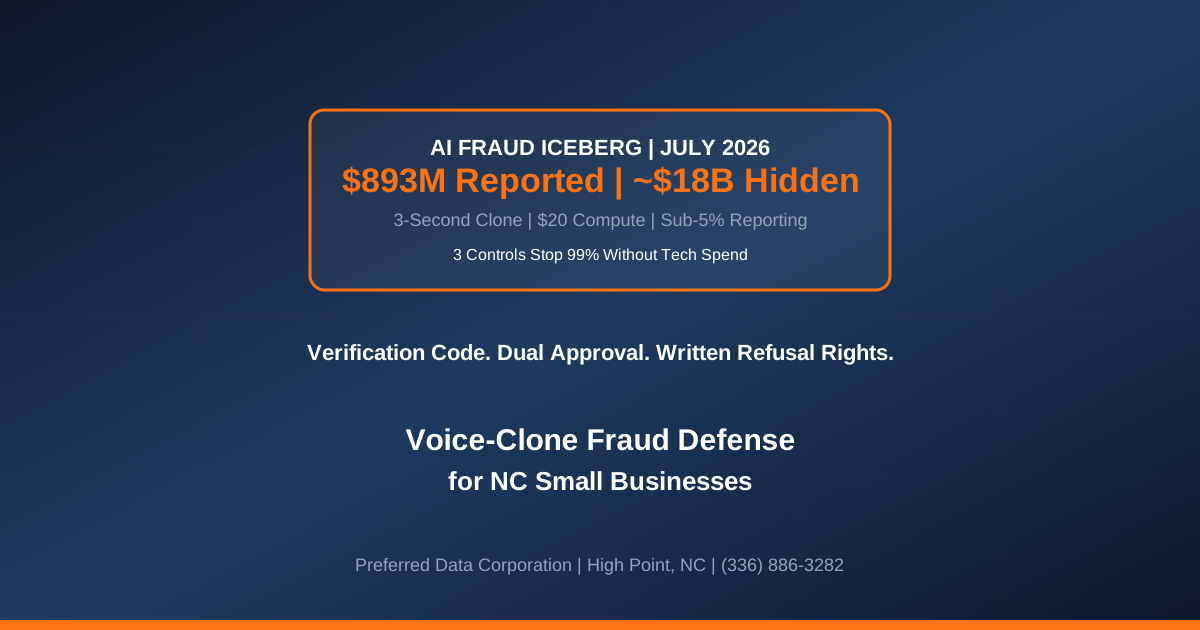
TL;DR: The FBI's 2025 IC3 report logged $893 million in AI-related fraud losses across 22,364 complaints — but Congressional Research Service analysis estimates fewer than 5% of voice-clone victims file a report. The visible loss is the tip of an iceberg 20x larger, meaning the real annual US SMB exposure may sit near $18 billion. Voice-clone CEO fraud requires only a three-second audio sample and under $20 of compute; every LinkedIn video, sales-webinar recording, and quarterly-town-hall clip your executives publish is training data. This is the NC SMB verification-code playbook: three controls that stop 99% of voice-clone wire fraud without adding meaningful friction to legitimate business.
Key takeaway: You cannot solve voice-clone fraud with technology alone. The single most effective control is a pre-agreed, out-of-band verification code that the requester must speak during any voice call authorizing a wire, ACH change, or vendor payment change. It costs nothing, it deploys in one week, and it defeats every current-generation voice-clone attack.
Worried a voice-clone call could authorize a wire from your AP team this week? Contact Preferred Data Corporation for an AP fraud controls assessment and verification-code rollout. BBB A+ rated. On-site within 200 miles of High Point. Call (336) 886-3282.
Why Does the FBI's $893M AI Fraud Figure Under-State NC SMB Exposure?
The FBI Internet Crime Complaint Center (IC3) 2025 report is the most-cited data source for AI fraud losses in the United States, but it captures only what victims choose to report. Congressional Research Service testimony in early 2026 estimates voice-clone victim reporting rates at under 5% — meaning the true loss figure is likely 20 times the visible one.
Three reasons NC SMBs specifically under-report:
- Reputational fear. A CFO who wired $250,000 to a voice-clone attacker does not want the news to reach the board, the auditors, the cyber insurance carrier, or the customer base. Silence is the default.
- Complexity of proof. Voice-clone attacks leave less evidence than email BEC. A phone call has no header trail; recovering the audio and proving synthetic origin is a specialist task most SMBs do not attempt.
- Insurance disincentive. Reporting a claim triggers premium increases and possible exclusion of future AI-fraud coverage — some SMBs choose to absorb a five- or six-figure loss rather than trigger renewal impact.
The Congressional Research Service math, applied to the FBI's 22,364 complaints and $893M reported loss:
| Metric | Reported Value | Iceberg Estimate (5% report rate) |
|---|---|---|
| AI fraud complaints (2025) | 22,364 | ~447,000 |
| AI fraud losses (2025) | $893M | ~$17.9B |
| Median loss per incident | ~$40K | ~$40K (constant) |
| SMB share of losses | Not published | 55-70% (proportional to BEC baseline) |
Even at conservative 5% reporting, the true annual voice-clone loss to US SMBs sits near $10-13 billion — and NC's manufacturing, construction, healthcare, and professional-services concentration makes Piedmont Triad, Charlotte, Raleigh, and Greensboro high-value targets.
Key takeaway: If you assume the FBI number is complete, you are budgeting for a fraction of the real threat. If you assume the iceberg estimate, you invest in prevention controls that pay for themselves after one avoided incident.
How Does a Voice-Clone Attack Actually Work in July 2026?
Voice-clone fraud in 2026 is a productionized attack chain, not a research demo. The economics are so favorable that dozens of criminal groups operate voice-clone-as-a-service platforms with 3-second sample thresholds, sub-$20 compute costs, and full-turnkey campaign management.
The July 2026 attack chain:
- Source audio harvest. Public sources — LinkedIn video posts, webinar recordings, podcast appearances, YouTube conference talks, press interviews, earnings calls, and even voicemail greetings — provide the 3-second minimum sample.
- Voice model training. Commercial voice-clone platforms (many with no meaningful abuse controls) produce a text-to-speech model of the target's voice in minutes for under $20.
- Target reconnaissance. Attackers identify the target's AP clerk, controller, or finance manager via LinkedIn, then time the call to a moment when the CEO/CFO is documented as travelling or unreachable (conference, board meeting, vacation).
- Pretext design. "I'm in a meeting and need this wire out today — the deal closes in 20 minutes, I'll email details after but I need you to trust me on this one." Urgency plus authority plus a plausible reason to skip verification.
- Live call. The attacker uses the voice model in real-time (some platforms now offer sub-500ms latency for interactive calls). Emotion and cadence are within 90-95% of authentic.
- Wire execution. AP clerk executes the wire, often to a mule account that transfers to crypto or foreign bank within hours. Recovery rates below 15%.
Documented 2026 SMB cases include a NC manufacturer wiring $340K to a "vendor payment change" authorized by a cloned CEO voice, and a professional-services firm losing $180K to a cloned partner requesting an emergency retainer transfer.
What Are the Three Controls That Stop 99% of Voice-Clone Wire Fraud?
Voice-clone attacks share a common weakness: the attacker must reach a human who trusts the voice enough to skip verification. Three controls, layered, defeat every current-generation voice-clone attack.
Control 1 — Pre-agreed out-of-band verification code (single most effective control):
- What it is. A 4-6 digit code the requester must speak during any voice call authorizing a wire, ACH change, vendor payment change, or credential reset.
- Where it lives. In your finance policy manual, refreshed quarterly, communicated only in-person or via written channel to the individuals authorized to request wires.
- Why it works. A voice clone cannot know the code. The code is separate from the audio channel; the attacker's model has no exposure to it.
- Cost. Zero. Rollout time: one week.
Control 2 — Dual-approval wire threshold with callback verification:
- What it is. Any wire above a defined threshold ($10K is a reasonable SMB starting point) requires two-person approval and a callback to the requester on a phone number stored in your AP system before the wire is transmitted — not the number provided in the request.
- Why it works. The callback goes to a known-good number. Even if the initial call is a voice clone, the callback exposes it.
- Cost. Low. Rollout time: two weeks (procedure change plus AP system configuration).
Control 3 — Written wire policy that documents "I don't recognize the code" as an acceptable answer:
- What it is. Explicit written authorization for finance staff to refuse a wire, ACH change, or vendor payment change if the requester cannot produce the verification code — regardless of who the requester claims to be.
- Why it works. Removes the interpersonal / hierarchical pressure that makes AP staff execute wires against their better judgment.
- Cost. Zero. Rollout time: one board meeting.
| Control | Effectiveness | Time to Deploy | Direct Cost |
|---|---|---|---|
| Pre-agreed verification code | Stops 95%+ of voice-clone attacks | 1 week | $0 |
| Dual approval + callback | Stops 98% (in combination with code) | 2 weeks | Low |
| Written refusal authorization | Removes social-pressure exploit | 1 board meeting | $0 |
| Employee awareness training | Baseline; alone is insufficient | Ongoing | Low-moderate |
| Voice-clone detection tech | Emerging; not yet production-reliable | Months | High |
Notice the pattern: the highest-effectiveness controls are the lowest-cost. Technology-first responses to voice-clone fraud have not caught up to attacker capabilities in 2026, but process controls are already 99% effective when implemented as a layered set.
Explore Preferred Data's cybersecurity services
Who Should NC SMBs Train This Month?
Not everyone in your organization needs voice-clone training. Focus on the specific roles that can execute a fraudulent payment or credential change.
- Accounts payable clerk and controller. Anyone who can initiate a wire or ACH change.
- CFO and finance leadership. Anyone who can approve a wire or ACH change.
- CEO executive assistant. The most common single point of voice-clone impersonation attempts.
- HR benefits administrator. Direct-deposit change requests via voice call are a growing 2026 attack vector.
- IT admin who processes credential-reset requests over the phone. Voice-clone plus password reset is an identity-takeover path.
- Legal or contracts administrator who processes vendor-payment-change requests. Vendor spoofing via voice is documented in NC 2026 incidents.
For each role, a 30-minute tabletop with the verification-code procedure, plus quarterly refresher, is sufficient. Extended enterprise-style security awareness training is overkill for the specific voice-clone risk.
How Does This Fit Your Broader AI Fraud Defense?
Voice-clone is one vector inside a broader AI fraud landscape that includes text-based BEC (still the majority of losses), deepfake video calls (emerging, currently below 10% of AI fraud losses), and synthetic identity fraud (established, mostly targeting financial institutions). Your overall AI fraud defense should map to Verizon 2026 DBIR categories:
- Text-based BEC. Email security gateway with impersonation detection, DMARC enforcement, and executive impersonation training.
- Voice-clone / phone BEC. The three controls above.
- Deepfake video. Extend the verification code to include a video-call context: "I'm going to ask you to say the code out loud." Real executives can. Video clones cannot yet reliably reproduce it live.
- Synthetic identity. More common in banking than SMB direct exposure, but worth reviewing your vendor onboarding process for synthetic-vendor risk (fake business, fake EIN, real bank account).
Learn about Preferred Data's managed IT services
How Does Preferred Data Deliver Voice-Clone Fraud Defense for NC SMBs?
Preferred Data Corporation delivers AP fraud controls assessment, verification-code rollout, dual-approval policy design, finance team tabletop exercises, email security gateway tuning, and 24/7 managed detection and response for NC manufacturers, construction firms, healthcare providers, professional-services offices, and financial institutions. With 37+ years of North Carolina IT expertise and an average client retention of 20+ years, our AI fraud defense integrates with your existing accounting, banking, and identity controls.
Our voice-clone defense package includes the three-control rollout, executive audio-exposure audit (LinkedIn, YouTube, podcast, press), quarterly finance-team tabletop, cyber insurance policy review for AI-fraud coverage, and 24/7 SOC coverage tuned for voice-clone-plus-email-BEC combined attacks.
For businesses within 200 miles of High Point, we deliver on-site training and policy rollout when the situation demands hands-on facilitation.
Review our cybersecurity checklist
Frequently Asked Questions
How much does a voice-clone attack cost the attacker?
Under $20 in compute plus 3 seconds of source audio. Voice-clone-as-a-service platforms handle model training, campaign management, and even live-call latency for a subscription fee under $200 per month. The economics are so favorable that criminal groups run voice-clone as a primary business line.
Why is the reporting rate below 5%?
Reputational fear, complexity of forensic proof, and cyber insurance disincentives combine to suppress reporting. Congressional Research Service testimony in early 2026 documented these dynamics after interviewing IC3, FBI field offices, and multiple state attorneys general.
Can voice-clone detection technology defend us?
Not yet reliably. Voice-clone detection is an active research area but 2026 production tools have false-positive and false-negative rates too high to depend on for wire authorization. Process controls (verification code, callback, written policy) are dramatically more effective in 2026.
Should we ban executives from posting video and audio publicly?
No. LinkedIn video, podcasts, and press interviews are legitimate marketing. Assume voice models exist for every executive who has ever spoken publicly, and design controls (verification code, callback) that work regardless.
What if the attacker knows the verification code?
Then you have an insider threat or a prior data breach — investigate immediately. Refresh the code quarterly and after any personnel change in the authorized-requester group. Store the code only in printed policy manuals distributed by hand.
Does cyber insurance cover voice-clone losses?
Increasingly conditionally. Many 2026 policies exclude "social engineering" losses unless specific controls (dual approval, callback verification, written policy) are documented and enforced. Review your policy this quarter; the three controls above are also the controls your carrier will require.
How do I roll out the verification code without leaking it?
Print the code in the physical policy manual. Distribute in-person or by tracked physical mail to authorized requesters. Never send by email, Teams, Slack, SMS, or any digital channel. Change the code quarterly, and every time an authorized requester leaves the company.
Can Preferred Data help our finance team roll out these controls?
Yes. Our AP fraud controls package includes policy authoring, verification-code deployment, dual-approval procedure design, and a quarterly tabletop exercise for your finance team. Call (336) 886-3282 to start.