
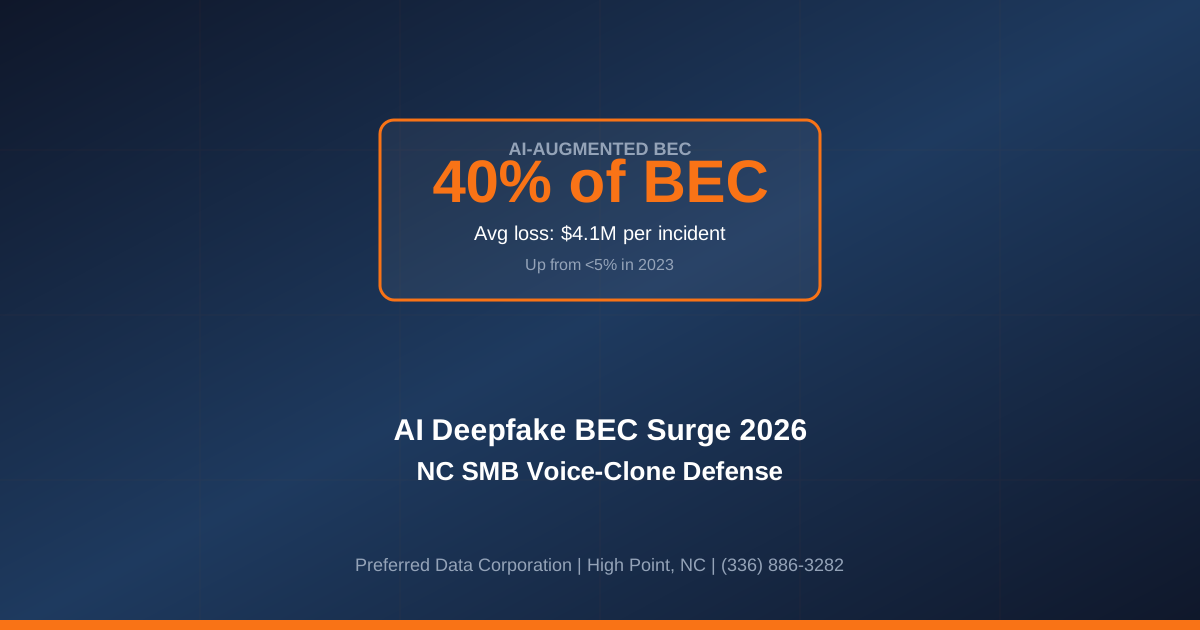
TL;DR: AI-generated deepfakes now drive 40% of business email compromise (BEC) attempts — up from less than 5% in 2023 — and average per-incident losses on AI-augmented BEC exceed $4.1 million versus $1.3 million for traditional BEC. A three-second voice sample scraped from a podcast, YouTube video, or conference recording is enough to clone an executive's voice, and dark-web tools priced under $20 have removed every barrier to entry. Only 31% of small and mid-sized enterprises have implemented AI-specific defensive controls. For NC SMBs — especially manufacturers, construction firms, and financial-services offices with public-facing executives — the defense is not detection tools. It is procedure: out-of-band callback verification, dual control on wire transfers, and phishing-resistant MFA on every executive.
Key takeaway: Deepfakes are a procedural attack, not a technical one. The right procedure defeats a perfect voice clone. The wrong procedure lets a mediocre voice clone drain $4.1M.
Do your wire transfer procedures assume the voice on the phone might not be who it sounds like? Contact Preferred Data Corporation for a BEC procedural review. Call (336) 886-3282.
What Is Driving the AI Deepfake BEC Surge in 2026?
Business email compromise has been the highest-loss cybercrime category by dollar amount for six consecutive FBI IC3 annual reports. What changed in 2025-2026 is the "email" part — attackers now attach voice calls, video meetings, and multimodal impersonation to the classic BEC pretext. The 40% figure reflects incidents where AI-generated media (voice, video, or text at LLM scale) is a material component of the attack.
Three structural drivers explain the surge:
- Voice cloning is trivially available. Commercial tools under $20 can clone a voice from a three-second audio sample.
- LLMs remove the language barrier. Non-native attackers now write flawless English at scale, and can tailor tone to match a specific executive's public writing.
- Public exposure of executive voices has exploded. Every podcast, LinkedIn video, industry-conference recording, and YouTube posting is training data for a voice clone of that executive.
For NC SMB executives who speak on Piedmont Triad industry panels, appear on regional news, or host video content — manufacturing owners, construction principals, community bank CEOs, dealer principals — the raw material for a voice clone of you is already public. The relevant question is not "will we be targeted" but "when we are, will our procedures hold."
Key takeaway: Every executive voice has been recorded. Assume every executive voice can be cloned. Design accordingly.
How Do AI-Augmented BEC Attacks Actually Unfold?
The 2026 AI-BEC playbook is a hybrid of email, voice, and often video, timed against a real business event that reduces suspicion.
Typical 2026 AI-BEC kill chain:
- Reconnaissance. Attacker harvests public LinkedIn, news, and social data about a target executive and their finance / AP staff.
- Voice sample collection. Podcast, webinar, conference recording, YouTube video, or even the executive's outbound voicemail.
- Voice model training. Commercial cloning tool trained on 3-30 seconds of audio; higher-quality clone from more audio.
- Pretext construction. Attacker times the attack against a real business event — pending acquisition, quarterly close, holiday period, vendor payment cycle.
- Initial email pretext. From a spoofed or lookalike domain, the "executive" instructs an AP staffer to expect a call.
- Voice call reinforcement. Cloned voice of the executive calls the AP staffer, references the pretext, and adds urgency.
- Optional deepfake video meeting. For higher-value targets, a Zoom / Teams / Google Meet with a live deepfake video of the executive.
- Wire instructions. Wire transfer to attacker-controlled account, often through a mule bank in a jurisdiction with slow clawback.
Observed 2026 targeting patterns:
- Manufacturing acquisition cycles. Attackers know quarterly acquisition activity — a "confidential earnest-money wire" pretext exploits genuine deal urgency.
- Construction draw schedules. General contractors expecting draw payments to subs are targeted for redirected payments.
- Payroll cycles. Attackers time BEC against known payroll processing dates.
- Year-end close. Q4 activity provides natural cover for last-minute wire instructions.
| Attack Component | 2023 Prevalence | 2026 Prevalence |
|---|---|---|
| Email-only BEC | 90%+ | ~60% |
| Voice-augmented BEC | <5% | ~25% |
| Full deepfake video BEC | Rare | ~10-15% |
| LLM-tailored language | Rare | Ubiquitous |
Do your AP and finance staff know that "the CFO called me and said" is not sufficient authorization? Request a BEC procedure review from Preferred Data. (336) 886-3282.
What Procedures Actually Defeat AI-Augmented BEC?
Detection tools have a role — email authentication (SPF / DKIM / DMARC), impersonation-detection filters, and deepfake-detection APIs are all worth deploying. But the primary defense is procedural. The following procedures survive perfect voice clones and near-perfect video clones.
Procedure 1: Out-of-band callback verification.
- Any wire transfer instruction — new or changed — triggers a callback to a phone number on file from the vendor master.
- The number on the incoming request is never used for the callback.
- Callback happens before the wire is released, not after.
Procedure 2: Dual control above threshold.
- Wires above a defined threshold (typically $10,000 for most NC SMBs; lower for tight-cash operations) require two-person approval.
- Both approvers see the full instruction and independently verify the destination.
- Neither approver can also initiate the transfer.
Procedure 3: Vendor bank change written trail.
- Any request to change a vendor's bank account or routing number requires written verification against pre-existing records.
- Any bank change from an "urgent" or "confidential" pretext is automatically escalated.
- Recent vendor bank changes trigger heightened monitoring on subsequent invoices.
Procedure 4: Executive-authorized wire pattern.
- Executives commit in writing to only initiate wire transfers through documented channels.
- Any "urgent, confidential, wire immediately" request is a red flag by definition.
- Finance staff are trained and empowered to slow down without executive retaliation.
Procedure 5: Fraud recovery playbook.
- Documented steps for the first 24 hours after a suspected fraudulent wire: bank contact, FBI IC3 report, cyber insurance carrier, counsel.
- Contact numbers current and reachable outside business hours.
- Bank relationship documented at treasury-management level, not branch level.
What Technical Controls Support the Procedural Defense?
Procedure is the primary defense, but technical controls reduce the volume of BEC attempts that reach humans in the first place.
Email-layer controls:
- SPF, DKIM, DMARC enforced with
p=rejectin DMARC — reduces basic domain spoofing. - Impersonation-detection filter in the email gateway — flags emails purporting to come from a named executive but originating outside company infrastructure.
- External-sender banners clearly marking any email from outside the organization.
- Lookalike-domain monitoring — alerts on newly registered domains with 1-2 character deltas from your primary domain.
Identity-layer controls:
- Phishing-resistant MFA on every executive, finance, and AP account. FIDO2 / passkeys defeat push-fatigue and token relay.
- Conditional access on privileged accounts limiting sign-in to known devices, known IPs.
- Sign-in log alerting on impossible-travel or first-time-in-country logins for finance and executive accounts.
Detection-layer controls:
- DLP on outbound wire instructions — alerts on wire-instruction PDFs / documents leaving the organization.
- SIEM correlation on suspicious inbound calls (from known VoIP-abuse ranges) coinciding with wire-pretext emails.
- Deepfake-detection API in critical meeting workflows — the technology is imperfect but rising quickly.
| Control Category | Cost Range | Effectiveness Against 2026 BEC |
|---|---|---|
| DMARC p=reject | Free | Reduces basic spoofing |
| Impersonation filter | Included with M365 E5 / Google Workspace Enterprise | Catches most email-only BEC |
| FIDO2 phishing-resistant MFA | $30-$50/user hardware key | Defeats credential phishing |
| Deepfake detection API | Emerging market | Partial defense; procedure still primary |
| Managed detection & response | $30-$80/endpoint/year | 24/7 detection uplift |
What Training Actually Changes AP Staff Behavior?
Annual phishing training has diminishing returns after year two. What changes behavior is short, frequent, scenario-based practice — plus explicit permission to slow down.
Effective training practices:
- Monthly 5-minute scenarios rather than annual 45-minute videos.
- Simulated voice-BEC calls — a proctored exercise where AP staff receive a mock deepfake call.
- Post-incident debriefs shared internally (with victim protection) so lessons compound.
- Executive explicit permission to slow down. Written: "Never release a wire because I sound urgent. If you slow down and it costs me an hour, I will not be upset. If you release incorrectly, we will lose $X." Reduces the psychological pressure attackers exploit.
Training pitfalls to avoid:
- Blame-culture reactions to failed simulations discourage reporting.
- Overly technical training that assumes AP staff will remember the difference between SPF and DKIM.
- One-and-done annual training measured by completion rate, not behavior change.
Need to design an AP-focused BEC training program? Contact Preferred Data — we run tabletop and simulation exercises for NC SMBs. (336) 886-3282.
How Does Cyber Insurance Respond to AI-Augmented BEC?
Cyber insurance BEC coverage has tightened in 2025-2026 in response to AI-augmented losses. Three specific policy considerations for NC SMBs:
- Social engineering sublimits. Many policies cap social-engineering-fraud coverage at $100K-$250K, even on a policy nominally sold as $5M cyber liability. Confirm your sublimit.
- Callback verification as a policy condition. Some 2026 policies require documented callback verification procedures as a prerequisite for social-engineering-fraud claims to pay.
- Voice-cloning specific exclusions. A minority of insurers have introduced AI-augmented BEC exclusions or lower sublimits. Read the policy.
For NC SMBs — Piedmont Triad manufacturers with high wire velocity, Charlotte construction firms with substantial subcontractor draw activity, Greensboro professional-services offices with client trust accounts — the insurance conversation for H2 2026 renewal should explicitly cover AI-augmented BEC scenarios.
How Does Preferred Data Corporation Handle BEC Procedural Reviews for NC SMBs?
Preferred Data Corporation is a High Point, NC managed IT and cybersecurity provider serving Piedmont Triad SMBs since 1987. Our BEC engagement pattern is intentionally procedural-first, with technical controls layered underneath.
Our July 2026 BEC review engagement typically includes:
- Wire transfer procedure audit — documented workflow, dual control, callback verification, threshold review.
- Vendor master data hygiene — deactivation of dormant vendors, revalidation of bank details, alerting on new payees.
- Executive-to-AP communication cadence — written commitment from executives regarding wire channels.
- Simulation exercises — voice-BEC and email-BEC simulations tuned to your business context.
- Technical control uplift — DMARC to reject, impersonation filter, phishing-resistant MFA on executives and AP.
- Cyber insurance broker coordination — verifying policy attestations reflect environment reality.
For NC SMBs within 200 miles of High Point, we deliver on-site engagement when required. Remote engagement is available across the state.
Learn about Preferred Data's managed IT services
Frequently Asked Questions
How much of business email compromise is now AI-augmented?
Approximately 40% as of 2026, up from less than 5% in 2023. Average per-incident losses on AI-augmented BEC exceed $4.1 million versus $1.3 million for traditional BEC.
How much audio does an attacker need to clone an executive's voice?
Commercial tools can produce a functional voice clone from three seconds of clean audio. Higher-quality clones require 30 seconds to a few minutes.
Is deepfake video BEC actually happening in practice?
Yes. Multiple 2024-2026 incidents have involved live deepfake video meetings on Zoom / Teams / Google Meet to reinforce fraudulent wire pretexts. The technology is imperfect but improving rapidly.
What single procedure defeats voice-clone BEC?
Out-of-band callback verification. Any wire transfer instruction triggers a callback to a phone number on file from the vendor master, using the number in your records — not the number in the request.
Does our cyber insurance cover AI-augmented BEC?
Read your policy. Many policies cap social-engineering-fraud coverage at $100K-$250K, some require documented callback verification procedures, and a minority have specific AI-augmented BEC exclusions.
Can Preferred Data review our BEC procedures this month?
Yes. Call (336) 886-3282 — we typically complete a BEC procedural review and simulation exercise within 2-3 weeks for NC SMBs.