
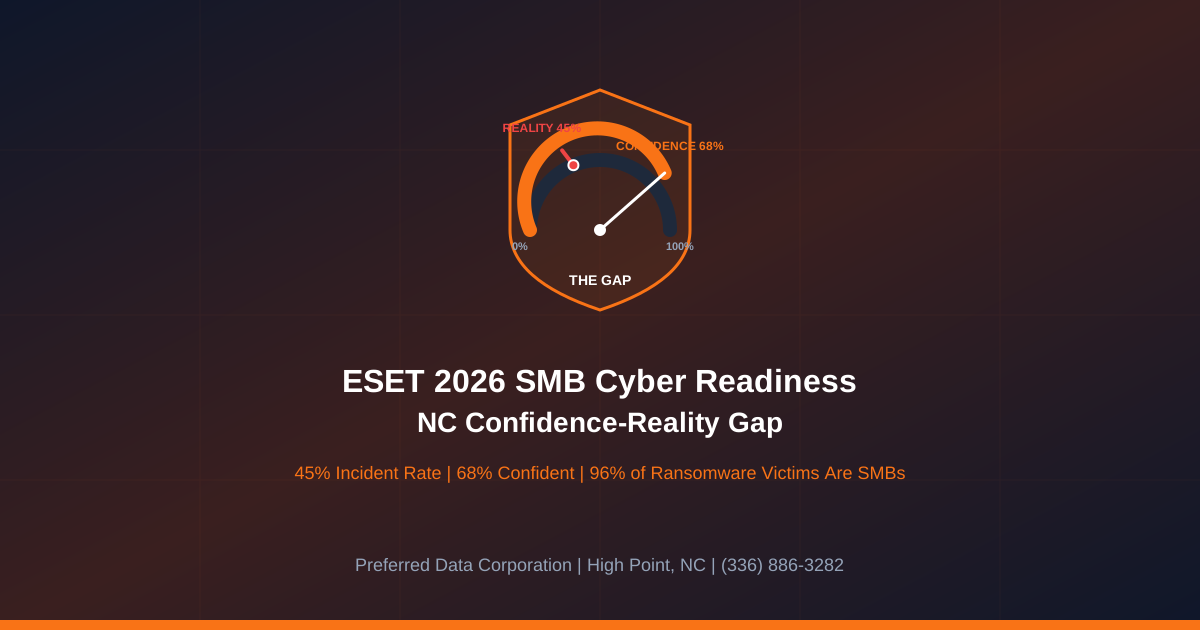
TL;DR: The ESET SMB Cyber Readiness Index 2026, released June 3, 2026, surveyed 4,400 SMB decision-makers across 13 countries at organizations with 25 to 1,000 endpoints. The headline finding is a wide confidence-reality gap: 45% of SMBs suffered a cybersecurity incident in the past 12 months and 14% suffered more than one, yet 68% still say they are confident in their ability to prevent attacks. Paired with the Verizon 2026 Data Breach Investigations Report, where SMBs account for roughly 96% of ransomware victims, and its 2025 edition, which found ransomware in 88% of SMB breaches versus 39% at larger organizations, the picture for North Carolina small businesses is unambiguous: confidence is not a control, and the gap between "we feel ready" and "we are ready" is exactly where attackers operate.
Key takeaway: 45% of SMBs were hit in the last year. 68% still feel confident. That 23-point gap is the attack surface.
Need an honest, NC-grounded cyber readiness assessment? Preferred Data Corporation has supported NC small businesses, manufacturers, and distributors for over 39 years. Call (336) 886-3282 or request a readiness assessment.
What did the ESET SMB Cyber Readiness Index 2026 reveal?
The ESET SMB Cyber Readiness Index 2026 is a 4,400-respondent global study covering 13 countries and SMBs in the 25 to 1,000 endpoint band, which closely matches the typical NC manufacturer, distributor, professional services firm, or contractor. The report's headline data points draw a sharp line between perception and outcome.
- 45% of SMBs suffered a cybersecurity incident in the past 12 months, per ESET via Review Central.
- 14% suffered more than one incident in the same window, indicating that for nearly one in seven SMBs, attacks are no longer a once-a-decade event.
- 68% of SMB decision-makers say they are confident in their ability to prevent attacks, the highest confidence reading ESET has recorded across recent index cycles.
- AI-powered malware is the single most-stated SMB concern in the 2026 index, displacing prior cycles' top concerns of ransomware and phishing as standalone categories.
The implication is not that SMB defenders are wrong to feel more capable. The implication is that capability has not kept pace with attacker velocity, and the 23-point gap between "45% hit" and "68% confident" is where most NC SMB incidents originate.
Why is the confidence-reality gap so dangerous for NC SMBs?
Because the gap drives under-investment in exactly the controls that move incident rates down. When leadership reports confidence, security budget requests get deferred, EDR rollouts get postponed for "next fiscal," and the incident response retainer is treated as a "nice to have." The math then breaks down predictably:
- Confidence-driven deferrals compound. A 6-month EDR delay at an NC manufacturer in High Point or Winston-Salem covers roughly one full ransomware dwell-cycle, per Verizon DBIR 2026 SMB analysis from the Cyber Readiness Institute.
- AI-powered tooling has lowered attacker cost. Per Help Net Security's coverage of the Verizon 2026 DBIR, ransomware-as-a-service ecosystems now target SMBs more frequently because the operational cost of attacking 100 SMBs is now lower than attacking one Fortune 500.
- Insurance is repricing the gap. Per the Cyber Readiness Institute's DBIR 2026 SMB brief, 2026 cyber insurance questionnaires now ask SMBs whether they have EDR, 24/7 monitoring, immutable backups, and an incident response retainer in place, and "confident but un-instrumented" is a fast path to denial.
For a Piedmont Triad SMB, the practical translation is that confidence built on legacy AV, a single backup, and "we have not been hit yet" is not a defensible position in 2026.
How does this match Verizon's 2026 DBIR data?
The Verizon 2026 DBIR data confirms the ESET picture from a different angle: SMBs are not a smaller, simpler version of enterprise targets, they are now the primary target. Three numbers anchor the alignment.
- SMBs account for approximately 96% of ransomware victims in 2026, per Cyber Readiness Institute's DBIR 2026 SMB analysis.
- Ransomware was present in 88% of SMB breaches versus 39% at larger organizations, per Verizon's 2025 DBIR executive summary. SMBs are not less likely to face ransomware, they are more than twice as likely on a per-breach basis.
- Credential abuse, phishing, and exploited vulnerabilities remain the top three initial access patterns for SMBs, per Help Net Security's DBIR 2026 summary. All three are addressable with mature MFA, identity monitoring, and patch SLA, none of which require enterprise budgets.
The cross-reference matters. When two independent 2026 studies, one from a global endpoint vendor (ESET) and one from a global telecom-led incident analysis (Verizon), report the same shape, the data is not a marketing artifact. It is the operating environment for every NC SMB in 2026.
What SMBs believe vs what the data shows
The clearest way to see the gap is a side-by-side. Every "data shows" cell below is anchored to a cited source.
| What SMBs believe | What the 2026 data shows |
|---|---|
| "We can prevent most attacks" (68% confident, per ESET 2026) | 45% were hit in the past 12 months; 14% were hit more than once, per ESET 2026 |
| "Ransomware is mostly an enterprise problem" | SMBs account for ~96% of ransomware victims, per Cyber Readiness Institute on DBIR 2026 |
| "Our backups will save us" | Ransomware present in 88% of SMB breaches per Verizon's 2025 DBIR |
| "AI-powered malware is years away from our segment" | AI-powered malware is the #1 stated SMB concern in 2026, per ESET 2026 |
| "Our legacy AV plus firewall is enough" | Credential abuse, phishing, and exploited vulns dominate SMB initial access; EDR, MFA, and patch SLA are the modern minimums, per Help Net Security on DBIR 2026 |
Which threats are NC SMBs most under-prepared for?
The ESET 2026 index and the Verizon 2026 DBIR jointly highlight three under-prepared categories. None require enterprise budget to address, but all require deliberate posture.
- AI-augmented phishing and business email compromise. Per ESET 2026 via Review Central, SMB respondents named AI-powered malware as the top concern. The practical face of "AI-powered malware" for an NC distributor is a pixel-perfect spear-phish from a spoofed vendor with a real invoice number and a real PO reference, scraped from a prior breach. Defenses: phish-resistant MFA, vendor invoice verification process, mailbox rule monitoring.
- Identity attacks and credential abuse. Per Help Net Security's DBIR 2026 summary, credential abuse is a top-three SMB initial access pattern. Defenses: MFA on every account including service and admin, conditional access in Entra ID, and SIEM or MDR detection of impossible-travel and consent-grant abuse.
- Ransomware via unpatched perimeter appliances. Per Cyber Readiness Institute on DBIR 2026, exploited edge devices (VPN, firewall, mail gateway) remain a primary ransomware entry path. Defenses: documented patch SLA, EDR on every endpoint including servers, immutable backups separated from the production identity layer.
What is a defensible cybersecurity baseline for an NC SMB in 2026?
A defensible 2026 baseline for an NC SMB in the 25 to 1,000 endpoint range looks like the following. None of it is enterprise-only, and all of it is what cyber insurers, customers, and prime contractors now expect.
- MFA everywhere, phish-resistant where possible. Every account, every cloud app, every VPN. Hardware keys or platform authenticators for admins.
- EDR or MDR on every endpoint, including servers and domain controllers. Legacy AV is no longer a defensible control per the Verizon 2026 DBIR data on attacker dwell time and ransomware velocity.
- 24/7 monitoring with documented response SLA. A 9-to-5 SOC misses the 2 AM weekend ransomware push. Coverage must be continuous.
- Immutable, off-network backups with quarterly restore tests. Backup that has never been restored is hope, not a control.
- Patch SLA with named owners. Critical CVEs patched within 72 hours of public exploitation evidence, including Tier 0 assets and perimeter appliances.
- Documented incident response runbook with a retainer. Calling for help during the incident is too late. Pre-negotiated IR retainer.
- Annual tabletop exercise and quarterly readiness review. What you do not rehearse, you will not execute under pressure.
For a typical 75-endpoint Piedmont Triad SMB, the full baseline is achievable inside a managed services budget that is materially smaller than the cost of a single ransomware incident.
Ready to map your current posture against the 2026 baseline? Call (336) 886-3282 or request a baseline gap assessment.
Is the cost of "doing nothing" really that high?
Yes, and the 2026 data narrows the variance. Three reference points frame the math for an NC SMB:
- 45% annual incident rate per ESET 2026 means the prior assumption of "we are unlikely to be hit this year" no longer holds. A 45% one-year probability is a near-coin-flip.
- 88% ransomware presence in SMB breaches per Verizon's 2025 DBIR means that when an SMB incident occurs, it most often involves encryption, extortion, and a recovery clock measured in days to weeks.
- 96% of ransomware victims are SMBs per Cyber Readiness Institute on DBIR 2026 means the historical comfort of "attackers chase bigger targets" no longer reflects the operating environment.
Translated to an NC manufacturer: a 7-to-14-day production halt, a 4-to-6-week receivables disruption, a regulator notification if PII is involved, and a customer-trust impact that often outlasts the technical recovery. The cost of a credible 2026 baseline, by contrast, is recurring, predictable, and a fraction of the all-in incident cost.
How does Preferred Data Corporation help close the gap?
PDC closes the confidence-reality gap with three things NC SMBs in High Point, Greensboro, Winston-Salem, Charlotte, and Raleigh consistently ask for:
- Managed cybersecurity with 24/7 monitoring, EDR/MDR on every endpoint and server, identity attack detection, phishing-resistant MFA rollout, and an incident response retainer. This is the layer that turns "we feel confident" into "we have evidence."
- Managed IT services with documented patch SLA, asset inventory, vulnerability management, and tier-aligned admin access. This is the layer that removes the unforced errors attackers exploit.
- Managed backup with immutable, off-network copies, quarterly restore tests, and documented recovery time objectives. This is the layer that converts a ransomware event from existential to recoverable.
PDC has supported NC small businesses, manufacturers, and distributors for over 39 years with on-site coverage within 200 miles of High Point. The combination of local context, manufacturing-floor experience, and modern security tooling is what closes the gap in months, not years.
Want a 60-minute readiness conversation, no obligation? Call (336) 886-3282 or book a readiness assessment.
Frequently Asked Questions
What is the ESET SMB Cyber Readiness Index 2026?
It is a 4,400-respondent global study, released June 3, 2026 and covered by Review Central, of SMB decision-makers across 13 countries at organizations with 25 to 1,000 endpoints. The 2026 cycle highlighted a confidence-reality gap: 45% suffered an incident in the past year while 68% reported confidence in their ability to prevent attacks.
What does "96% of ransomware victims are SMBs" actually mean?
Per the Cyber Readiness Institute's DBIR 2026 SMB analysis, of the ransomware incidents observed in the Verizon 2026 DBIR dataset, approximately 96% involved SMB victims. Combined with the 2025 DBIR finding that ransomware was present in 88% of SMB breaches versus 39% at larger organizations, the SMB segment is now the primary, not secondary, ransomware target.
Is AI-powered malware really a 2026 SMB threat or hype?
Per ESET 2026 via Review Central, AI-powered malware is the #1 stated SMB concern in the 2026 index. The practical SMB-facing version today is AI-augmented phishing, deepfake voice for finance-team social engineering, and faster malware variant generation that breaks signature-based AV. The defense is EDR/MDR with behavioral detection, phish-resistant MFA, and out-of-band verification for finance workflows.
How much does a defensible 2026 SMB cybersecurity baseline cost?
It varies by endpoint count and existing posture, but for a typical 50-to-100-endpoint NC SMB, the recurring managed services budget for MFA, EDR/MDR, 24/7 monitoring, immutable backup, patch SLA, and an incident response retainer is materially smaller than the all-in cost of a single ransomware event (production downtime, recovery labor, legal and notification costs, and customer-trust impact). PDC will scope a fixed-fee baseline against your environment on request.
What if we already have antivirus, a firewall, and Microsoft 365 with MFA, are we covered?
That is a strong starting posture but not a defensible 2026 baseline by itself. Per the Verizon 2026 DBIR data via Help Net Security, credential abuse, phishing, and exploited vulnerabilities dominate SMB initial access, and legacy AV plus basic MFA do not address dwell-time detection, lateral movement, or identity attacks against admin accounts. EDR/MDR, 24/7 monitoring, conditional access, immutable backup, and a patch SLA close the remaining gaps.
Where do we start if we want to close the confidence-reality gap?
Start with a 60-to-90-minute readiness assessment that maps your current controls against the 2026 baseline, identifies the top three exposures, and prices the closest gap closures. Call PDC at (336) 886-3282 or request an assessment. No commitment, and you walk away with a written gap report regardless of whether you engage PDC for the remediation.
Related Resources
- Managed Cybersecurity Services for NC Businesses - 24/7 monitoring, EDR/MDR, identity attack detection
- Managed IT Services for NC Businesses - Patch SLA, asset inventory, vulnerability management
- Managed Backup for NC Businesses - Immutable, off-network copies and tested restores
- Ransomware Targets Unexpected NC Businesses: Dealerships, Accounting, Healthcare - Sector-by-sector NC ransomware exposure
- Cyber Insurance Application Readiness: NC SMB 2026 Guide - Why "confident" is not what underwriters score
- Contact Preferred Data Corporation - Schedule a 2026 readiness assessment