
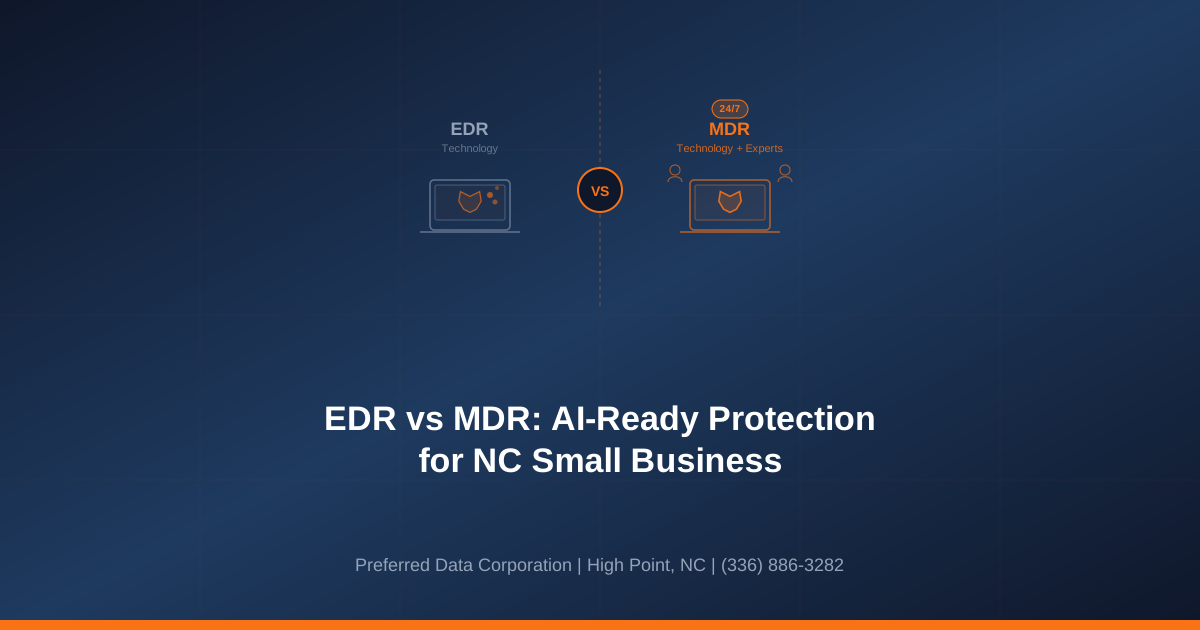
TL;DR: EDR (Endpoint Detection and Response) provides the technology to detect threats on devices, while MDR (Managed Detection and Response) combines that technology with 24/7 human expertise. For North Carolina small businesses facing AI-powered attacks that move from access to data theft in under 72 minutes, MDR delivers the response speed most SMBs need, while EDR alone requires in-house security staff to be effective. Understanding which approach fits your business could mean the difference between containing a breach and losing everything.
Key takeaway: With 87% of organizations experiencing AI-driven attacks in the past 12 months and the average AI breach costing SMBs $254,445, the EDR vs MDR decision is not about technology preference. It is about whether your business has the internal resources to monitor, investigate, and respond to threats around the clock, or whether you need a managed partner to handle that critical function.
Need help choosing between EDR and MDR? Contact Preferred Data Corporation at (336) 886-3282 for a personalized endpoint security assessment. Serving High Point, Greensboro, Charlotte, Raleigh, and all of North Carolina for over 37 years.
What Is EDR and How Does It Work for Small Businesses?
Endpoint Detection and Response (EDR) is security software that monitors every device, or endpoint, connected to your network. It tracks file changes, process executions, network connections, and user behaviors to detect suspicious activity. When a threat is identified, EDR can isolate the affected device, block the malicious process, and provide detailed forensic data about what happened.
For small businesses in High Point, Greensboro, and across the Piedmont Triad, EDR represents a significant upgrade from traditional antivirus. While antivirus relies on signature databases to identify known malware, EDR uses behavioral analysis and, increasingly, AI-driven detection to identify threats that have never been seen before. This distinction matters because AI-generated malware can create unique variants that bypass signature-based detection entirely.
EDR platforms typically provide:
- Real-time monitoring of all endpoint activity including file changes, registry modifications, and network connections
- Behavioral analysis that flags unusual patterns like a spreadsheet application suddenly encrypting files
- Automated response capabilities that can isolate a compromised device from the network within seconds
- Forensic investigation tools that provide detailed timelines of attack progression
- Threat hunting capabilities for proactively searching for hidden threats
The challenge for North Carolina small businesses is that EDR generates large volumes of alerts. Without trained security analysts to investigate those alerts, businesses face either alert fatigue, where critical warnings are ignored among thousands of notifications, or false positive overload, where teams waste time chasing benign events.
What Is MDR and Why Do NC Businesses Choose It?
Managed Detection and Response (MDR) combines EDR technology with a team of security analysts who monitor, investigate, and respond to threats on your behalf 24 hours a day, 7 days a week. For small businesses across North Carolina that lack dedicated security operations centers, MDR provides enterprise-grade protection without the cost of building an internal security team.
With 94% of SMBs using managed service providers in 2026, MDR represents the natural extension of the managed services model into advanced security operations. Instead of hiring three to five security analysts at $80,000 to $120,000 each per year, businesses in Charlotte, Raleigh, and Durham can access shared security expertise through their managed service provider.
MDR services from providers like Preferred Data Corporation include everything EDR offers plus:
- 24/7 human monitoring by trained security analysts who triage and investigate every alert
- Threat investigation that determines whether an alert represents a real attack or a false positive
- Active response where analysts take immediate action to contain threats, not just send notifications
- Proactive threat hunting where analysts search for threats that automated systems may miss
- Monthly reporting that provides actionable security insights tailored to your business
- Compliance support including documentation and evidence collection for CMMC, NIST, and other frameworks
For manufacturers in the Piedmont Triad, the 24/7 monitoring component is critical. Manufacturing operations often run around the clock, and attackers specifically target off-hours when they know security staffing is reduced. MDR eliminates that vulnerability.
How Do EDR and MDR Compare on Cost, Coverage, and Capability?
The total cost of ownership is where many North Carolina small businesses discover that MDR is more economical than EDR despite its higher per-endpoint price. EDR is cheaper on the surface, but the hidden costs of staffing, training, and managing the technology often exceed the cost of MDR.
| Comparison Factor | EDR Only | MDR |
|---|---|---|
| Monthly cost per endpoint | $5-15 | $15-40 |
| Required internal security staff | 1-3 FTEs ($240K-$360K/year) | None dedicated |
| 24/7 monitoring | Only if you staff it | Included |
| Average threat response time | Hours to days (without staff) | Minutes to hours |
| False positive investigation | Your team handles all | Provider triages all |
| Threat hunting | DIY or not done | Included |
| Compliance reporting | Manual effort required | Typically included |
| Setup and tuning | Your responsibility | Provider managed |
| Effective monthly cost (50 endpoints) | $250-750 + $20K+ staffing | $750-2,000 all-inclusive |
For a North Carolina business with 50 endpoints, EDR software alone might cost $500 per month. But to make that EDR effective, you need at least one security analyst reviewing alerts, which adds $80,000 or more per year. That brings the true cost to roughly $7,200 per month. MDR for the same 50 endpoints typically costs $1,000 to $2,000 per month, delivering better outcomes at a fraction of the real cost.
With the average AI breach costing SMBs $254,445 and 60% of breached small businesses closing within six months, the cost comparison should also factor in the risk reduction each approach provides. MDR consistently delivers faster detection and response, which directly reduces breach costs.
Which Is Right for Your NC Business: EDR or MDR?
The right choice depends on your internal capabilities, industry requirements, and risk tolerance. Here is a decision framework for businesses across High Point, Greensboro, Charlotte, and the broader North Carolina region:
Choose EDR if you have:
- A dedicated IT security team with at least one full-time security analyst
- The budget to staff 24/7 monitoring or accept the risk of delayed response during off-hours
- Existing SIEM infrastructure to aggregate and correlate EDR alerts with other security data
- Internal expertise to tune EDR policies, investigate alerts, and conduct threat hunting
Choose MDR if you:
- Have fewer than 3 dedicated IT security staff (or none)
- Need 24/7 monitoring but cannot justify the cost of a 24/7 internal team
- Face compliance requirements that mandate continuous monitoring and incident response documentation
- Want to focus your IT team on business operations rather than security alert investigation
- Are in manufacturing, construction, or another industry targeted by sophisticated attackers
For most North Carolina small businesses with 25-200 employees, MDR is the more practical and cost-effective choice. The managed IT services model that 94% of SMBs already rely on extends naturally to managed detection and response.
Key takeaway: EDR is a technology; MDR is a service. Most North Carolina SMBs need the service because they lack the staff to operationalize the technology on their own. Choosing EDR without the team to run it is like buying a fire alarm but having nobody to call the fire department.
How Does AI Change the EDR vs MDR Equation?
AI-powered threats have shifted the EDR vs MDR decision decisively toward MDR for most small businesses. The speed, sophistication, and volume of AI-driven attacks overwhelm the capabilities of EDR tools that rely on human operators who may not be watching at the critical moment.
AI phishing now achieves open rates of 54-78% compared to just 12% for traditional phishing, and it costs 95% less to execute. This means the volume of initial compromises is increasing dramatically. Each compromised endpoint generates EDR alerts that need investigation, and without dedicated staff, those alerts go uninvestigated.
When attackers move from initial access to data theft in under 72 minutes, response time is everything. MDR providers maintain response time SLAs measured in minutes, while businesses running EDR without dedicated security staff often measure response time in hours or days.
Organizations with AI-powered defenses detect threats 80 days faster and save $1.9 million per breach. MDR providers invest in AI-enhanced detection tools that most SMBs cannot afford individually, then deploy those tools across their entire client base. This gives small businesses in Winston-Salem, Durham, and Raleigh access to the same AI-powered defensive capabilities that large enterprises use.
With 83% of SMBs acknowledging that AI has increased their threat level but only 51% having AI security policies, the gap between threat awareness and actual protection continues to widen. MDR closes that gap by providing both the technology and the expertise.
What Should NC Businesses Look for in an MDR Provider?
Not all MDR providers are equal. For North Carolina businesses selecting an MDR partner, here are the critical evaluation criteria that separate effective protection from security theater:
Response time guarantees: Ask for specific SLAs. A quality MDR provider should guarantee response to critical alerts within 15-30 minutes, not hours. With attackers operating in under 72 minutes, an MDR provider with a 4-hour response SLA provides little real protection.
Local presence and understanding: A managed cybersecurity provider that understands North Carolina industries, from Piedmont Triad manufacturing to Charlotte financial services, delivers more relevant threat intelligence and faster on-site response when needed. Preferred Data Corporation provides on-site support within 200 miles of High Point.
True response capability: Some MDR providers only detect and notify; they do not actually respond. Ensure your provider can take containment actions, including isolating endpoints, blocking network connections, and disabling compromised accounts, without waiting for your approval on every action.
Integration with existing infrastructure: Your MDR provider should integrate with your existing network infrastructure, cloud services, and business applications to provide comprehensive visibility, not just endpoint monitoring.
Transparent reporting: Monthly reports should include metrics on alerts investigated, threats detected, response times achieved, and recommendations for improving your security posture. This data is essential for compliance documentation and for measuring the value of your investment.
Scalability: As your North Carolina business grows, your MDR service should scale seamlessly. Adding new endpoints, new locations, or new cloud services should not require a complete re-architecture of your security monitoring.
Ready to get the right endpoint protection for your business? Contact Preferred Data Corporation at (336) 886-3282 to discuss EDR vs MDR options tailored to your needs. Visit us at 1208 Eastchester Drive, Suite 131, High Point, NC 27265.
Frequently Asked Questions
Can I start with EDR and upgrade to MDR later?
Yes. Many North Carolina businesses start with EDR and upgrade to MDR when they realize the internal management burden is unsustainable. A good managed IT provider can layer MDR services on top of existing EDR deployments, often retaining the same endpoint agents.
Does MDR replace my existing antivirus?
In most cases, yes. MDR includes endpoint protection technology that supersedes traditional antivirus. The EDR component within MDR provides signature-based detection, behavioral analysis, and AI-driven threat detection, making standalone antivirus redundant.
How quickly can MDR detect ransomware?
Quality MDR providers detect ransomware indicators within minutes and can isolate affected endpoints before encryption spreads across the network. This speed is critical given that modern ransomware can encrypt an entire SMB network in under an hour.
Is MDR worth the cost for a business with only 20 employees?
Yes. A 20-employee business faces the same AI-powered threats as larger organizations, often with fewer defenses. MDR costs for 20-30 endpoints typically range from $500 to $1,200 per month, which is far less than the $254,445 average cost of an AI-related breach.
What is the difference between MDR and a managed SOC?
A managed SOC (Security Operations Center) is typically broader than MDR, monitoring network traffic, cloud services, and endpoints together. MDR focuses primarily on endpoint detection and response. Many providers, including Preferred Data Corporation, offer both capabilities as part of comprehensive managed security services.
Does MDR work with cloud environments like Microsoft 365?
Yes. Modern MDR services extend beyond traditional endpoints to cover cloud workloads, email platforms like Microsoft 365, and SaaS applications. This cloud coverage is essential as more North Carolina businesses migrate to cloud solutions.
How does MDR handle after-hours threats?
MDR operates 24/7 with trained analysts always on duty. This is one of its primary advantages over EDR-only deployments, where after-hours alerts may go uninvestigated until the next business day. For manufacturers in North Carolina running second and third shifts, this continuous coverage is essential.
Will switching to MDR disrupt my business operations?
No. MDR deployment typically takes 2-4 weeks and is designed to be non-disruptive. Agents are installed during maintenance windows, and the MDR provider tunes detection policies to minimize false positives before entering full monitoring mode.