
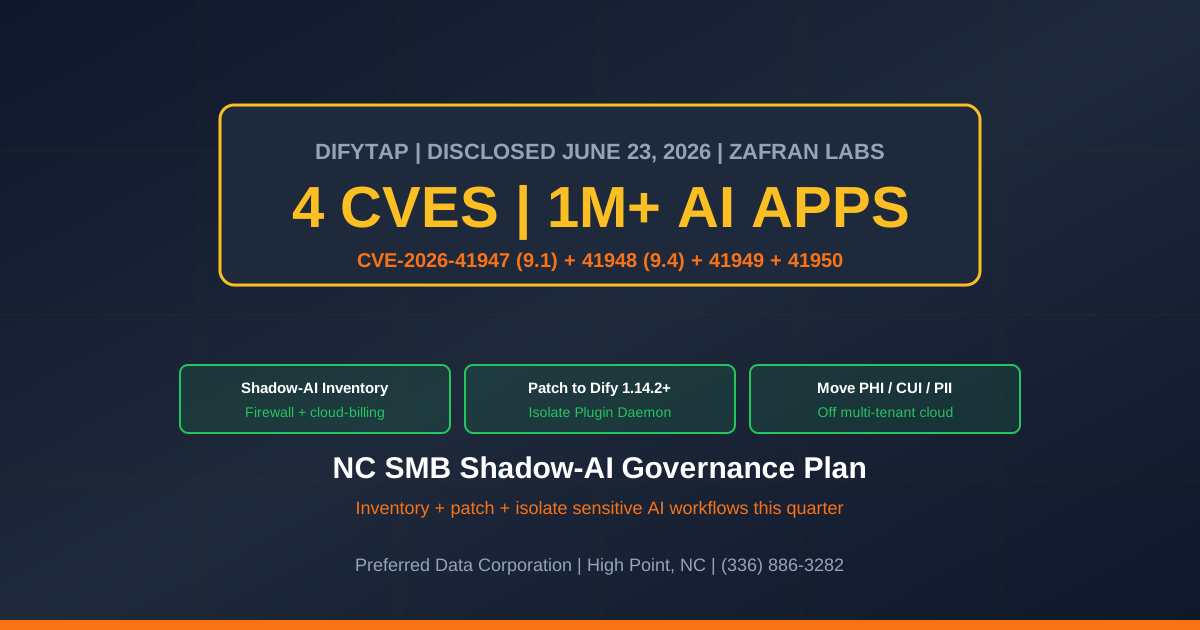
TL;DR: On June 23, 2026, Zafran Labs disclosed DifyTap - four vulnerabilities in Dify, the open-source AI agent platform that powers more than 1 million applications worldwide - per The Hacker News. Two are critical: CVE-2026-41947 (CVSS 9.1) lets any authenticated user reconfigure tracing for any application across tenants, and CVE-2026-41948 (CVSS 9.4) is a path-traversal that abuses the Plugin Daemon's internal REST API. Two more (CVE-2026-41949, CVE-2026-41950) leak files and previews across users on the same tenant. Per SecurityWeek, three of the four bugs allow one customer's AI data to be exposed to another customer on Dify's multi-tenant cloud. For NC SMBs running internal AI experiments on Dify, n8n, Flowise, or similar low-code AI platforms, the question is no longer "is my AI platform vulnerable" - it is "is my AI platform inventoried at all."
Key takeaway: Your shadow-AI risk is not an LLM jailbreak in a chat window. It is the open-source AI workflow platform a developer spun up four months ago, which has been quietly ingesting customer documents, never got an SSO mapping, and is now running CVE-2026-41948 on an unmonitored port.
Need a shadow-AI inventory and governance plan before the next AI-platform CVE drops? Preferred Data Corporation runs managed AI governance for NC SMBs. Call (336) 886-3282 or request an AI platform review.
What is Dify and why does DifyTap matter for NC SMBs?
Dify is one of the most-installed open-source AI orchestration platforms in the world. Per Cybernews, Dify has more than 10 million installs and serves as the orchestration layer for over 1 million AI applications, with 146,000+ stars on GitHub. NC SMBs use it (often unbudgeted, often unsanctioned) to wire together LLMs, internal documents, knowledge bases, and downstream automations into "AI assistants" for sales, customer service, marketing, and operations.
The DifyTap research, published June 23, 2026 by Zafran Labs, found four vulnerabilities that together turn the multi-tenant cloud version into an open data plane:
| CVE | CVSS | Class | NC SMB exposure |
|---|---|---|---|
| CVE-2026-41947 | 9.1 | Authorization bypass (tracing) | Authenticated user can enable tracing on any app across any tenant - capturing the full AI conversation data |
| CVE-2026-41948 | 9.4 | Path traversal via Plugin Daemon | Authenticated user can hit the internal REST API and traverse the file system |
| CVE-2026-41949 | High | File ID handling | Preview files uploaded by other tenants |
| CVE-2026-41950 | High | Access permission gap | Retrieve files uploaded by other users on the same tenant |
| CVE-2024-5846 (bundled PDFium) | 8.8 | Use-after-free | Crafted PDF → heap corruption → RCE potential |
Per Security Affairs, three of the four DifyTap bugs carry cross-tenant impact on Dify's multi-tenant cloud. Dify patched all but CVE-2026-41948 in version 1.14.2 - which means NC SMBs running self-hosted Dify older than 1.14.2 are exposed today, and the cross-tenant bugs hit anyone on the shared Dify cloud.
Quotable definition: Cross-tenant data exposure on a multi-tenant SaaS AI platform is the failure mode where the platform's tenant-isolation boundary breaks, allowing one customer's AI conversation data, prompts, uploaded documents, and outputs to be retrieved by another customer. For NC SMBs experimenting with low-code AI platforms, it converts "shadow AI" into "shadow breach."
Three facts an NC SMB owner should write down:
- The vulnerable platform is open-source and trivially deployable. Per Imperva's analysis, Dify is one of the fastest-growing low-code AI agent platforms. That means it sits inside NC SMB networks via a developer spin-up, an "innovation team" pilot, or a contractor's Docker container - rarely tracked by IT.
- The cross-tenant exposure is silent. Per Zafran's writeup, DifyTap allows an attacker to "wiretap" AI data across organizational boundaries with no sophisticated tooling. There is no login event in your tenant audit log to alert on.
- Patching closes part of the gap, not all of it. Dify shipped 1.14.2 with fixes for three of the four CVEs. CVE-2026-41948 remained pending at disclosure, per SecurityWeek. Self-hosted NC SMB instances need both the upgrade and an explicit network-isolation review of the Plugin Daemon endpoint.
Why does DifyTap matter to NC SMB AI strategy in 2026?
Because the structural problem is not Dify specifically - it is that NC SMBs are deploying production-grade AI workflows on platforms that ship with the security maturity of a one-year-old startup. Dify, Flowise, n8n's AI nodes, LangFlow, Big-AGI, and a dozen other low-code AI platforms are doing real work inside NC SMB networks right now. Each one is one CVE disclosure away from the same headline.
Three NC SMB exposure patterns we see in 2026:
- The High Point manufacturer running an "AI quoting assistant" on self-hosted Dify that ingests historical quotes, customer pricing, and BOM data. Per the DBIR 2026 finding that third-party breaches now factor into 48% of incidents, the manufacturer's competitive pricing now sits on a multi-tenant cloud whose isolation boundary just failed.
- The Charlotte professional-services firm running a Dify-orchestrated client-document summarizer that has read every contract in the firm's repository. The CVE-2026-41949 cross-tenant file-preview bug is not a hypothetical - it is "everything our paralegals uploaded, on the same shared cloud as everyone else's paralegals."
- The Greensboro distributor with an n8n + Dify pipeline generating customer outreach emails using a knowledge base. The shadow-IT spin-up was a $30/month cloud test that never went through IT review, has no SSO mapping, no MFA, no logging hookup, and no patch SLA.
Per Cybernews, the exposed surface includes one-click account takeover paths in addition to the cross-tenant data leak - which means a single phishing-compromised user account is enough to pivot into other organizations' data via the same platform.
Key takeaway: Dify's 1M+ application footprint is not a sign that the platform is mature. It is a sign that the AI gold rush has put NC SMB data into production AI plumbing that has not yet been hardened. DifyTap is the first wave of disclosures; treat it as the playbook for the next four.
How should an NC SMB respond to DifyTap and govern shadow AI?
Run a seven-step plan inside 30 days. The technique applies to every low-code AI agent platform in your environment, not only Dify.
- Inventory every AI agent platform inside your network (this week). Pull a list from the firewall (outbound traffic to known AI orchestration domains), from the cloud-billing aggregator (Docker, AWS, GCP, Azure containers running Dify / n8n / Flowise / LangFlow), and from the SaaS expense audit (Stripe / Brex / corporate-card subscriptions). Expect to find more than your IT team has documented.
- Patch self-hosted Dify to 1.14.2 or later (this week). Per Zafran, 1.14.2 closes three of the four DifyTap CVEs. Apply the upgrade, then re-test.
- Network-isolate the Plugin Daemon endpoint until CVE-2026-41948 is patched. Block external reachability to the daemon's internal REST API and require an internal-only authenticated proxy. Self-hosted operators bear full responsibility for the un-patched bug.
- Move sensitive AI workflows off shared multi-tenant clouds. For client PII, financial data, CMMC-scope CUI, HIPAA-scope PHI, and trade secrets - the multi-tenant Dify cloud is not the correct deployment surface. Move to dedicated, self-hosted, or single-tenant managed instances.
- Map every AI platform to SSO + MFA + logging. No AI orchestration platform should be reachable via a username/password without phishing-resistant MFA, no platform should be off the SIEM, and no platform should be operating without a documented owner inside the SMB.
- Write a shadow-AI policy (this month). Define which AI platforms are sanctioned, what data classes are allowed on each, and the request process for new AI tooling. The policy is the only durable answer to the "developer spun up a $30 Dify trial" problem.
- Tabletop a DifyTap-class incident. Walk the question: "If we learned today that our AI platform leaked our prompts and uploaded documents to other tenants, what do we tell clients, what do we tell counsel, and what do we tell our cyber insurance carrier?" The answer drives the controls in steps 1 - 6.
Key takeaway: DifyTap is not the last cross-tenant AI platform CVE NC SMBs will see in 2026. It is the disclosure that forces shadow-AI inventory and governance from a roadmap item into a Q3 priority.
How does Preferred Data Corporation help NC SMBs govern shadow AI and respond to DifyTap?
PDC runs managed AI governance, shadow-AI discovery, and AI vendor risk reviews for NC SMBs alongside our managed IT and cybersecurity services. We bring three things to the June 23, 2026 DifyTap disclosure:
- AI transformation services: AI platform selection, sanctioned-AI architecture (self-hosted vs single-tenant managed), AI workflow design with tenant-isolation review, prompt and data-handling policy, and OWASP LLM Top 10 control mapping.
- Managed cybersecurity services: Shadow-AI inventory (firewall + cloud-billing + SaaS expense triangulation), SSO + MFA + SIEM hookup for AI platforms, Plugin Daemon network isolation, and CVE monitoring for the AI orchestration stack.
- Custom software development: Where Dify's multi-tenant cloud is not the right surface, PDC builds single-tenant AI workflow systems on your infrastructure with audit-grade logging, SSO, and data-classification gates.
For NC manufacturers running AI quoting and BOM assistants in High Point and the Piedmont Triad, NC professional-services firms running AI document summarizers in Charlotte and Raleigh, and NC SMBs experimenting with AI agents across every sector - the DifyTap disclosure is the call to inventory, isolate, and govern.
Need help inventorying shadow AI and moving sensitive workloads off shared clouds? Call (336) 886-3282 or book an AI governance review.
Frequently Asked Questions
What is DifyTap?
DifyTap is the name Zafran Labs gave to a cluster of four vulnerabilities in the Dify open-source AI agent platform, disclosed June 23, 2026. CVE-2026-41947 (CVSS 9.1) is an authorization-bypass tracing flaw, CVE-2026-41948 (CVSS 9.4) is a path traversal in the Plugin Daemon, and CVE-2026-41949 / CVE-2026-41950 are file-handling gaps allowing cross-tenant and cross-user file access.
How many applications are affected by DifyTap?
Per Cybernews and SecurityWeek, Dify powers more than 1 million AI applications across self-hosted and managed cloud deployments, with over 10 million total installs and 146,000+ GitHub stars. Three of the four CVEs carry cross-tenant impact on the multi-tenant cloud version.
Is the multi-tenant Dify cloud safe for NC SMBs to use today?
For non-sensitive workloads (public marketing copy, internal automation that handles no regulated data), the patched cloud version is workable with proper governance. For client PII, CMMC-scope CUI, HIPAA-scope PHI, financial data, and trade secrets - move to dedicated self-hosted or single-tenant managed deployments. Multi-tenant cloud isolation has now demonstrably failed twice in the same disclosure cycle.
How does an NC SMB find shadow-AI deployments on its network?
Triangulate three data sources: outbound firewall traffic to AI orchestration domains, cloud-billing aggregator records for Docker / AWS / GCP / Azure containers, and SaaS expense audit on corporate cards. Most NC SMBs find more low-code AI platforms in production than IT is aware of - particularly inside marketing, sales-ops, and engineering teams.
What is the Plugin Daemon and why does CVE-2026-41948 matter?
The Dify Plugin Daemon is an internal REST API process used to load and run plugins for the AI platform. CVE-2026-41948 is a path-traversal vulnerability that allows an authenticated user to manipulate requests forwarded to the daemon, reaching files outside the intended scope on the host. Per Zafran, this CVE remained without a full patch at the time of disclosure, so self-hosted operators must network-isolate the daemon endpoint as a compensating control.
Does DifyTap apply to other low-code AI platforms?
The specific CVEs apply to Dify, but the pattern - authorization gaps, tenant-isolation failures, file-handling bugs, bundled vulnerable dependencies - is present across the entire low-code AI orchestration category. NC SMBs running Flowise, n8n with AI nodes, LangFlow, Big-AGI, or similar platforms should treat DifyTap as a leading indicator and run the same inventory + governance plan against every platform in the inventory.
Related Resources
- AI Transformation Services - Sanctioned-AI architecture and platform selection
- Managed Cybersecurity Services - Shadow-AI inventory and CVE monitoring
- Custom Software Development Services - Single-tenant AI workflow systems
- AI Agents Inside Perimeter: Shadow AI Governance - Companion shadow-AI playbook
- Agentic AI Browsers: Prompt Injection Governance - Companion AI governance angle
- Verizon DBIR 2026: 48% Third-Party Breaches - Companion vendor risk data
- Contact Preferred Data Corporation - Shadow-AI governance review