
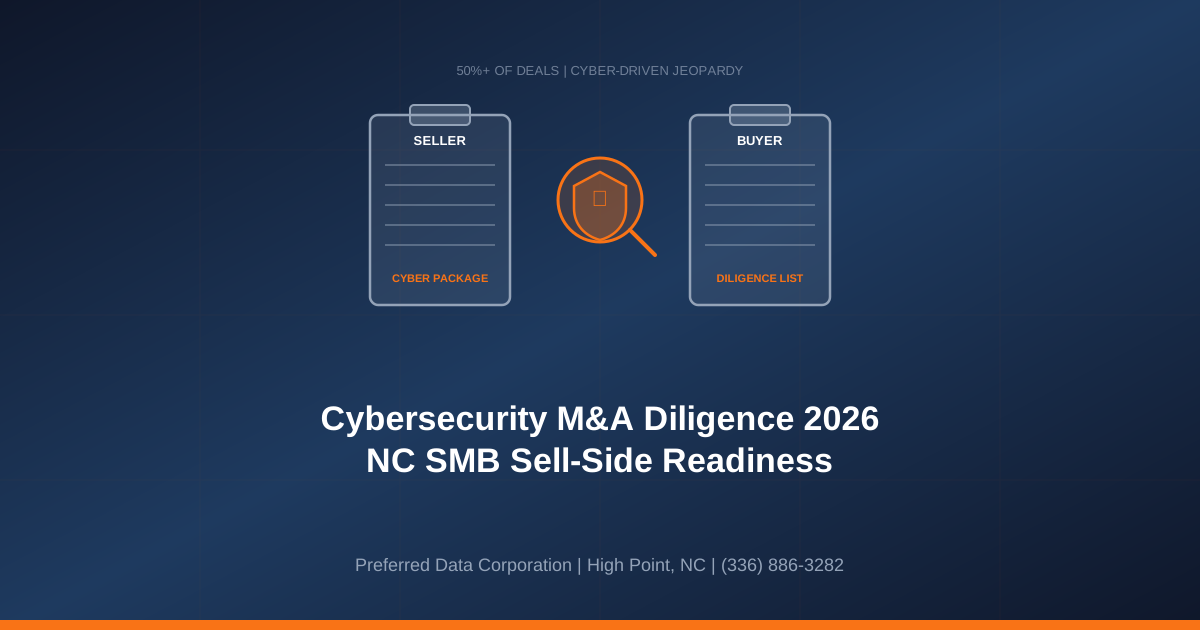
TL;DR: Cybersecurity findings now put over half of M&A deals in jeopardy according to Forescout, and buyers are aggressively pricing cyber risk into valuation, escrow, and reps-and-warranties insurance exclusions. For North Carolina small business owners planning to exit in the next 12-36 months, sell-side cyber readiness is no longer optional - it is the difference between a clean close and a stripped-down deal with retention holdbacks. Getting ready now, ahead of the letter of intent, is dramatically cheaper than remediating under deal timeline pressure.
Key takeaway: In 2026, buyers do cyber due diligence before they sign the LOI. If you wait until the LOI to discover you have unpatched systems, undocumented incidents, or shadow SaaS, the buyer either kills the deal or extracts the cost from your purchase price. The owners who exit at full valuation start cyber prep 12-24 months out.
Planning an exit in the next 3 years? Contact Preferred Data Corporation at (336) 886-3282 for a sell-side cybersecurity readiness assessment. Serving Piedmont Triad, Charlotte, Raleigh, and manufacturing owners across North Carolina since 1987.
Why Are Buyers Doing Cyber Due Diligence Before the LOI?
Cybersecurity findings put more than half of M&A deals in jeopardy according to Forescout research on 2026 M&A participants, and buyers have responded by moving cyber diligence earlier and earlier in the process. What used to be a Phase 3 confirmatory review after signed diligence access is now a Phase 1 pre-LOI screen that can quietly disqualify a target before the seller has even shared financials.
The reason is straightforward: buyers who inherited breaches learned the hard way that a discovered post-close incident can wipe out an entire deal thesis. Marriott inherited a Starwood breach that ultimately cost hundreds of millions in fines and remediation. Every mid-market PE firm since then has updated its playbook: screen for cyber risk before you commit to a price, price the risk explicitly into the LOI, and require the seller to remediate before close.
For a North Carolina small business owner planning to sell in the next 24 months, that shift changes what "prepare for exit" means. The traditional list - clean financials, key customer contracts, working leadership team - is still necessary. It is no longer sufficient. Buyers now ask about MFA coverage, patching cadence, incident history, shadow IT, and vendor breach exposure before they draft a letter of intent.
What Specific Cyber Findings Kill or Reprice Deals?
Six categories of finding show up in nearly every deal that gets repriced or killed for cyber reasons. Every owner planning an exit should assume the buyer's diligence team is looking for exactly these:
| Finding | How Buyers Reprice It | Typical Remediation Cost |
|---|---|---|
| Undisclosed prior breach or ransomware event | 5-25% purchase price reduction + expanded escrow | $10-100k for forensics narrative + response gaps |
| Weak MFA coverage on privileged systems | Retention holdback + closing condition | $5-25k to deploy + document |
| Missing SBOM / dependency inventory | Softer valuation, harder reps | $5-20k to build + monitor |
| Shadow SaaS with regulated data | Escrow for regulator exposure | $10-40k to inventory + remediate |
| Legacy Windows / server EOL | Cap-ex adjustment against purchase price | $20-200k depending on fleet size |
| Undocumented data locations / privacy exposure | Reps-and-warranties insurance cyber exclusion | $20-100k for data mapping |
For manufacturers in the Piedmont Triad, the two most common repricing triggers are legacy Windows exposure (still on Windows 10 heading into the October 2026 ESU Year 1 cliff) and undocumented OT/IT integration that leaves shop-floor systems reachable from the office network. Both can be found in the first hour of a cyber diligence review. Both are 100% fixable pre-LOI.
What Does Sell-Side Cyber Readiness Actually Look Like?
Sell-side cyber readiness is a documented package a broker can hand a buyer that says: "We know our environment, we run these controls, we have documented these incidents, and here is the plan for anything not yet remediated." Done right, it accelerates diligence and removes negotiating leverage from the buyer.
The eight elements every sell-side cyber package should contain:
1. Cybersecurity control narrative
A one-page executive summary of the security program: identity, endpoint, network, cloud, incident response. Reads like a control table with owners named.
2. Incident history log
Every incident, near-miss, and cyber insurance claim over the past 3-5 years, with root cause and remediation status. Hiding an incident is worse than disclosing it - buyers find out during forensics and the deal dies.
3. Data inventory and data flow map
Where does regulated data live? Where does it flow? Which SaaS holds what? A data map answers half the buyer's diligence questions in one document.
4. Vendor and supply chain register
The full list of third parties with access to your systems, with contract terms, SOC 2 status, and incident notification clauses. Third-party breaches now account for 48% of confirmed incidents per the Verizon 2026 DBIR - buyers will ask.
5. Patch and vulnerability posture
Current EDR, vulnerability scanner, and patch management outputs, sanitized. Aged high-severity findings on the report kill deals.
6. MFA and identity coverage report
Percentage of privileged accounts protected by MFA, break-glass account handling, third-party identity integrations. This is the single most-asked question.
7. Cyber insurance policy and claims history
Current policy, sublimits, prior claims, and renewal correspondence. A denied claim is a hard finding; a clean renewal is a green flag.
8. Compliance evidence pack
For federal contractors, CMMC status and SPRS record. For healthcare-adjacent businesses, HIPAA controls. For anyone with EU customers, GDPR posture. Match the pack to your industry.
Assembled well, these eight documents accelerate diligence by weeks and remove the buyer's ability to use "we need more information" as a repricing lever. Working with a managed IT provider means the pack exists as a byproduct of ongoing operations, not as a scramble in the final 60 days before a sale.
Key takeaway: Sell-side cyber readiness is an eight-document package (control narrative, incident log, data map, vendor register, patch posture, MFA coverage, insurance history, compliance evidence). The owners who assemble it 12-24 months pre-exit exit at valuation; the owners who scramble at LOI leave money on the table.
How Does Cyber Readiness Support Valuation?
Two mechanisms translate cyber readiness directly into valuation. The first is defensive: fewer findings means less price reduction, smaller escrow, and cleaner reps. The second is offensive: a demonstrably mature security program supports the acquirer's post-close plan, reduces integration cost, and can be highlighted as a differentiator in a competitive process.
For manufacturers with $10-50M in revenue exiting to strategic buyers or lower-middle-market PE, the difference between "well-prepared" and "unprepared" cyber posture routinely swings final proceeds by 5-15% of enterprise value. On a $25M deal, that is $1.25-3.75M. Sell-side cyber prep typically costs a small fraction of that.
The three most valuation-supportive artifacts:
- Documented, dated CMMC-aligned control set for federal contractors and manufacturers with defense-adjacent customers
- Clean cyber insurance renewal at market terms - not the "we could not renew last year" story
- Third-party attestation (SOC 2 Type 2, or an independent penetration test with clean rewrite) that supports the buyer's own diligence
Even a small business that never expected to sell benefits from these controls. The businesses that do end up selling get a materially better outcome.
How Do NC Small Business Owners Actually Start This?
Sell-side cyber readiness is a 12-24 month program, not a project. The right sequencing for a North Carolina small business planning an exit:
- Months 24-18 pre-exit: Cyber assessment. Understand baseline. Fix low-hanging fruit (MFA, EDR, backup).
- Months 18-12 pre-exit: Compliance alignment. Whichever framework fits your industry (CMMC, HIPAA, PCI, general NIST CSF), align controls and document evidence.
- Months 12-6 pre-exit: Assemble the eight-document package. Fill gaps identified during assembly.
- Months 6-0 pre-exit: Final tabletop, external validation (pen test or SOC 2), and refresh the package for staleness.
- During diligence: Provide the package in the data room. Respond to diligence requests with the pre-built artifacts.
For owners who did not start early, the compressed path is 6-9 months and costs meaningfully more, but is still dramatically better than showing up empty-handed. The worst path is discovering during LOI that a finding exists and having to remediate under 30-day pressure while trying to close.
Working with a provider that combines managed IT, cybersecurity, and M&A advisory gives NC small business owners a single accountable partner across the whole runway - one team that runs your day-to-day IT, hardens the environment for exit, and speaks the language of the diligence team the buyer will bring.
Planning an exit in the next 36 months? Contact Preferred Data Corporation at (336) 886-3282 for a sell-side cyber readiness assessment. Visit 1208 Eastchester Drive, Suite 131, High Point, NC 27265.
Frequently Asked Questions
We're not planning to sell - why should we care?
Cyber posture that supports a deal today is cyber posture that supports operations, insurance renewal, customer contracts, and compliance every day. Building for optionality means you are ready if a strategic opportunity emerges, and you get the operational benefits regardless.
How far in advance of an exit should we start?
Twenty-four months is ideal. Twelve to eighteen months is workable. Under six months is a scramble that leaves money on the table. Ownership transitions rarely follow the schedule you plan, so start earlier than you think.
Does a small business really face six-figure cyber remediation costs?
Yes, when discovered during diligence with a 60-day close pressure. The same fixes done proactively over 12-24 months cost dramatically less and can be operationalized into the normal IT budget. The difference is timing and negotiating leverage.
What if we have a prior incident we haven't disclosed?
Disclose it - to your advisor and, ultimately, to the buyer. Hidden incidents get discovered during forensics and typically end deals. Disclosed and remediated incidents are a data point buyers can price. The narrative around the incident (what happened, what you fixed, what evidence you have) matters more than the fact of the incident.
Do buyers actually run their own scans on us pre-LOI?
Increasingly, yes. Passive external attack surface scans are cheap and easy, and many buyers run them as a screen before spending time on a target. That means an exposed VPN portal, an expired certificate, or a leaked credential is potentially visible before you even know you are being evaluated.
How does CMMC compliance affect deal valuation for NC defense contractors?
Positively. A current SPRS score and documented CMMC alignment de-risk one of the largest categories of finding for federal contractors. With the Phase 2 suspension resolved in mid-2026, buyers are actively pricing CMMC readiness into acquisition offers.
Should we get SOC 2 before selling?
For most NC small businesses, SOC 2 is worth it if you sell to enterprise buyers or handle sensitive customer data. For manufacturers selling to industry buyers, a well-run cybersecurity program with documented controls is often sufficient. Ask your M&A advisor which framework the target buyer set values.
What is the biggest mistake sellers make?
Waiting until the LOI to start. By then the buyer has set price expectations and every finding is a negotiating chip. The businesses that exit clean do the work 12-24 months out and hand a completed package to the diligence team.