
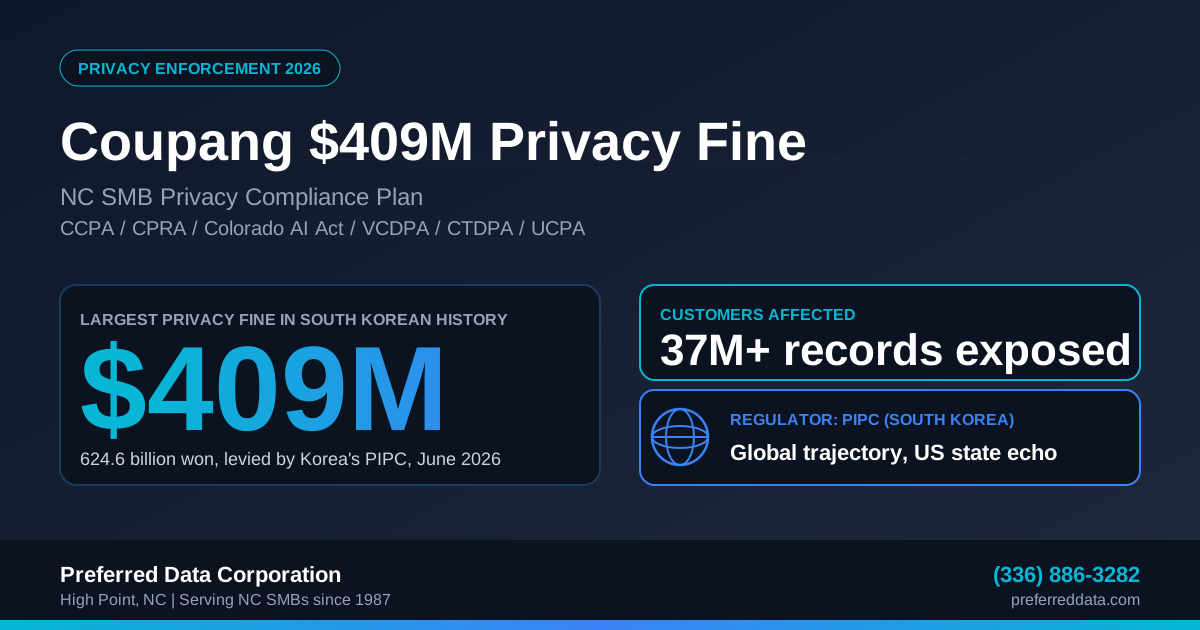
TL;DR: In early June 2026, South Korea's Personal Information Protection Commission (PIPC) fined e-commerce giant Coupang 624.6 billion won (roughly $409 million USD) after a data breach exposed records belonging to more than 37 million customers, per the Breachsense June 2026 roundup and the Privacy Guides breach digest. It is the largest privacy fine in South Korean history, and it lands in the same six-month window that the Colorado AI Act took effect on February 1, 2026 and US state lawmakers introduced more than 600 AI and privacy bills. For North Carolina SMBs in High Point, Charlotte, Raleigh, Greensboro, and Winston-Salem, the message is direct: nine-figure privacy fines are no longer a "big tech, big country" story.
Key takeaway: Privacy regulation is converging globally. An NC SMB does not have to sell into California, Colorado, or Korea to be in scope; it only needs to handle the data of someone who lives, works, or shops there. The defensible answer in 2026 is a written privacy program, a data inventory, vendor data processing addenda, and a tested breach response, not a "we are too small to matter" posture.
Need a defensible NC SMB privacy program built in 90 days? Preferred Data Corporation, founded in High Point in 1987, designs and operates privacy and cybersecurity programs for NC small businesses. Call (336) 886-3282 or request a privacy readiness review.
What happened with the Coupang $409 million fine?
Answer capsule: In June 2026, the PIPC issued a 624.6 billion won fine (about $409 million USD) against Coupang following a breach that exposed personal information for more than 37 million customers, per Breachsense and the Privacy Guides June 5-11 data breach roundup. The fine is the largest privacy enforcement action in South Korean history and continues a multi-year pattern of regulators escalating penalties to nine-figure ranges.
Three details from the public reporting that matter to SMB operators:
- Scale of exposure. With over 37 million customer records implicated, the breach touched a population roughly three and a half times the size of North Carolina.
- Regulator posture. PIPC's headline-setting fine signals that enforcement bodies outside the EU are now willing to impose GDPR-scale penalties on a single incident.
- Speed of escalation. A single incident moved from breach disclosure to nine-figure fine inside a compressed enforcement window, which is now the norm rather than the exception across jurisdictions.
PIPC and the new enforcement posture: "Privacy enforcement is no longer a slow administrative process; it is a fast, public, headline-driven exercise where regulators compete to signal that the era of cheap data breaches is over." The Coupang action is the clearest 2026 example of that shift, and US state attorneys general are reading the same playbook.
Why does a Korean privacy fine matter for an NC small business?
Answer capsule: A Korean privacy fine matters for an NC SMB because privacy regulation is converging on three principles every major regime now shares: lawful basis for collection, data subject rights (access, deletion, correction), and timely breach notification. Once an NC SMB handles data from a California resident, a Colorado employee, a Virginia customer, or a Korean vendor contact, it is sitting inside that converging framework, regardless of revenue size.
Three reasons NC SMB owners in Greensboro, Charlotte, and Raleigh should pay attention:
- Trajectory, not jurisdiction. The Coupang case demonstrates that regulators globally are normalizing nine-figure fines. The same trajectory shows up in US state attorney general actions under CCPA/CPRA and in EU GDPR enforcement.
- Cross-border data is the default. An NC SMB using Microsoft 365, Google Workspace, Shopify, HubSpot, or any major SaaS already has personal data crossing state and national lines through subprocessors.
- The "too small to notice" assumption is wrong. State AGs and class-action plaintiffs increasingly target mid-market and small businesses because they have weaker controls and are easier to settle against. The FBI IC3 2025 annual report documented $1.3 billion in personal data breach losses, much of it from SMB-scale incidents.
For an NC small business, the question is no longer "will privacy law apply to us?" It is "which laws apply, and can we prove compliance in 30 days if a regulator or insurer asks?"
What US state privacy laws should NC SMBs actually worry about?
Answer capsule: NC SMBs should track the five state regimes most likely to reach them in 2026: California (CCPA/CPRA), Colorado (Colorado Privacy Act and the new Colorado AI Act effective February 1, 2026), Virginia (VCDPA), Connecticut (CTDPA), and Utah (UCPA), plus the EU AI Act provisions that become fully applicable on August 2, 2026, per the Wilson Sonsini AI regulatory roundup.
The table below summarizes the regimes most likely to put an NC SMB in scope, with the trigger that pulls them in and the maximum penalty exposure.
| Jurisdiction | Law | Effective | NC SMB trigger | Maximum penalty (illustrative) |
|---|---|---|---|---|
| California | CCPA / CPRA | In force | Handles personal data of California residents above statutory thresholds | $2,500 per violation, $7,500 per intentional violation |
| Colorado | Colorado Privacy Act + Colorado AI Act | AI Act effective Feb 1, 2026 | Targets Colorado residents or deploys consequential AI decisioning | Up to $20,000 per violation under state consumer protection framework |
| Virginia | VCDPA | In force | Targets Virginia residents above statutory thresholds | Up to $7,500 per violation |
| Connecticut | CTDPA | In force | Targets Connecticut residents above statutory thresholds | Up to $5,000 per violation |
| Utah | UCPA | In force | Targets Utah residents above statutory thresholds | Up to $7,500 per violation |
| South Korea (illustrative) | PIPA / PIPC | In force | Processes Korean residents' data at scale | $409M precedent (Coupang) |
| EU | GDPR + EU AI Act | AI Act majority rules applicable Aug 2, 2026 | Offers goods/services to EU residents or processes EU personal data | Up to 4% global annual revenue under GDPR |
Penalty figures above are illustrative ceilings under each statute, not promises about any single case. State lawmakers introduced more than 600 AI and privacy bills in 2026 sessions, per the Wilson Sonsini summary, so this table will continue to expand.
How do NC SMBs end up in scope of state and international privacy laws?
Answer capsule: NC SMBs typically end up in scope of out-of-state and international privacy laws through five common patterns: a customer list that includes out-of-state residents, a remote employee in a regulated state, an e-commerce checkout that ships nationwide, a marketing list that contains EU contacts, or a vendor whose subprocessor sits in another jurisdiction. None of these are exotic for a Piedmont Triad SMB.
Five real-world triggers an NC SMB should audit this quarter:
- Customer addresses. A High Point manufacturer that ships to a California or Virginia customer is processing that customer's personal data.
- Remote employees. A Greensboro professional services firm with a remote employee in Colorado is processing Colorado-resident HR data, which puts CPA and Colorado AI Act considerations on the table for hiring and performance tooling.
- Marketing lists. A Charlotte SaaS firm running paid acquisition often ends up with EU and California contacts in its CRM long before legal reviews the list.
- Vendor subprocessors. Microsoft, Google, HubSpot, and most major SaaS run global infrastructures; data residency, subprocessor disclosures, and standard contractual clauses become the SMB's problem when a regulator asks.
- AI tools that touch customer or employee data. Any AI tool used for hiring, lending, pricing, or workforce decisions is now within the consequential-decision scope of the Colorado AI Act and similar emerging frameworks.
Want PDC to map your privacy exposure before California, Colorado, or your cyber insurer asks? Call (336) 886-3282 or request a privacy scoping engagement.
What does a defensible SMB privacy program look like?
Answer capsule: A defensible NC SMB privacy program in 2026 has six concrete artifacts: a written privacy policy aligned with the laws it triggers, a data inventory (what we collect, why, where it lives, how long), a data subject rights workflow, a vendor data processing addendum stack, a breach response plan, and a documented training program. The CISA small and medium business resource center frames similar fundamentals from the cybersecurity side.
The six components, in plain language for an NC owner-operator:
- Written privacy policy that names the categories of data collected, the purposes, the legal basis where required, retention periods, and how customers and employees exercise their rights.
- Data inventory that lists every system holding personal data, the categories of data, the data subjects (customers, employees, prospects, vendors), and the location.
- Data subject rights workflow to handle access, deletion, correction, and opt-out requests within the timelines required by CCPA, VCDPA, CTDPA, UCPA, and CPA (generally 45 days, extendable once).
- Vendor data processing addenda (DPAs) with every vendor that processes personal data on the firm's behalf, including breach notification timelines and subprocessor disclosure.
- Breach response plan that defines roles, escalation, forensic triage, customer and regulator notification timelines, and recordkeeping.
- Training and attestation so that every employee with access to personal data is documented as trained at hire and annually.
A program with these six artifacts, kept current, is the difference between a regulator asking questions and a regulator opening an enforcement action.
What is a 90-day NC SMB privacy hardening plan?
Answer capsule: A defensible 90-day NC SMB privacy hardening plan delivers a data inventory in the first 30 days, vendor DPAs and a privacy policy in the next 30 days, and a tested breach response plan plus training in the final 30 days. The plan is intentionally light enough for a 25 to 250-employee NC business in High Point, Greensboro, Charlotte, Raleigh, Winston-Salem, or Asheville to actually execute.
- Days 1-10: Scope and stakeholders. Identify the owner (typically the operations or compliance lead), enumerate states and countries represented in customer, employee, and vendor populations, and confirm which privacy regimes apply.
- Days 11-30: Data inventory. Document every system holding personal data, the data categories, retention, and access. Tag systems that touch California, Colorado, Virginia, Connecticut, Utah, or EU residents.
- Days 31-50: Privacy policy and rights workflow. Update the public privacy policy, build the data subject rights intake form, and assign a 45-day response SLA. Document the deletion and correction process for each system in the inventory.
- Days 51-70: Vendor data processing addenda. Pull the vendor list from the inventory, send DPAs to every vendor handling personal data, and track the signature status (signed, pending, declined-with-mitigation).
- Days 71-80: Breach response plan and tabletop exercise. Document the IR plan, run a one-hour tabletop with leadership simulating an NC SMB breach scenario, and log the gaps and remediation owners.
- Days 81-90: Training, attestation, and board readout. Deliver privacy training to every employee with access to personal data, capture attestations, and present the program status to the owner or board.
- Ongoing: Quarterly review. Re-run the data inventory delta, re-test the IR plan annually, and refresh vendor DPAs at renewal.
Done this way, the program is a defensible artifact binder rather than a slide deck.
How does Preferred Data Corporation help NC SMBs build a privacy program?
Answer capsule: Preferred Data Corporation has served NC small businesses from High Point since 1987, and we build SMB privacy programs as an integrated extension of our managed IT and cybersecurity practice. Our service area covers on-site work within 200 miles of High Point, including Charlotte, Raleigh, Greensboro, Winston-Salem, Asheville, and the broader Piedmont Triad.
PDC supports NC SMB privacy programs across four building blocks:
- Managed cybersecurity including vCISO-led privacy program design, data subject rights workflow build-out, vendor DPA rollout, tabletop exercises, and SOC-grade detection so that "we did not know" never becomes the firm's breach defense.
- Data protection services including immutable backups, encryption-in-transit and at-rest verification, retention policy enforcement, and the recordkeeping trail that regulators expect to see.
- Managed IT services with documented patch SLAs, MFA enforcement, centralized logging, and identity hygiene so that the privacy program rests on a credible technical foundation.
- Local NC accountability. Privacy programs fail when nobody owns them. PDC assigns a named local lead from High Point and reviews program status with your team on a documented cadence.
The Coupang fine is a headline today. In 12 months, the headlines will be US state AG actions against mid-market SMBs that ignored the trajectory. NC small businesses that move now will be the ones that hand a regulator, an insurer, or an acquirer a clean privacy binder when it counts.
Frequently Asked Questions
Does North Carolina have its own comprehensive privacy law?
As of mid-2026, North Carolina does not have a comprehensive consumer privacy statute equivalent to CCPA/CPRA, VCDPA, CTDPA, UCPA, or CPA. NC SMBs are still subject to sector-specific laws (HIPAA, GLBA, FERPA), the NC Identity Theft Protection Act for breach notification, and any out-of-state privacy law triggered by handling residents' data, per the California AG CCPA guidance and the Colorado AG privacy resources.
Why is the Coupang fine relevant if it was issued by a Korean regulator?
The Coupang fine matters because it confirms a global trend toward nine-figure privacy penalties, and because NC SMBs increasingly process data crossing the same borders. US state attorneys general, the FTC, and EU regulators are watching enforcement actions like this one and using them to calibrate their own penalty ranges, per the Privacy Guides roundup.
What is the Colorado AI Act and does it reach NC small businesses?
The Colorado AI Act took effect February 1, 2026, and applies a risk-based framework to "consequential decisions" made with AI, including hiring, lending, housing, and similar areas, per the Wilson Sonsini summary. An NC SMB that hires a Colorado-resident employee through an AI screening tool, or sells a consequential AI-powered service into Colorado, is within scope.
What is the practical first step for an NC SMB that has never run a privacy program?
The practical first step is a 30-day data inventory: list every system that holds personal data (CRM, ERP, accounting, HR, email marketing, helpdesk, document storage, backups), the categories of data, retention, and access. Everything else in a privacy program is downstream of that inventory, and the CISA SMB resources reinforce the same starting point.
How long does it take to stand up a defensible SMB privacy program?
A 25 to 250-employee NC SMB can stand up a defensible privacy program in roughly 90 days using the plan above. The program will not be perfect on day 90; it will be defensible, with named owners, documented artifacts, and a quarterly review cadence that improves it over time.
Do we need a CCPA-style "Do Not Sell or Share My Personal Information" link if we do not sell data?
If the firm meets the CCPA/CPRA thresholds and processes California-resident data, the answer depends on whether the firm "shares" personal data for cross-context behavioral advertising, which is broader than "selling." Many SMBs that believe they do not "sell" data still trigger the share definition through ad-tech integrations. The safe default is to scope it with counsel and treat the privacy policy and rights workflow as the controlling documents, per the California AG CCPA guidance.
Related Resources
- Managed Cybersecurity Services for NC Businesses - vCISO, IR plan, privacy program build, vendor risk
- Data Protection Services - Immutable backups, retention enforcement, recordkeeping
- Managed IT Services for NC Businesses - MFA, patch SLA, centralized logging, identity hygiene
- SEC Reg S-P June 2026 Deadline for NC RIAs and Broker-Dealers - Parallel financial services privacy regime
- AI Data Privacy Compliance for NC Businesses in 2026 - AI-specific privacy guardrails
- 73 Percent SMB Cyber Insurance Failure: NC Audit Defense - Overlapping cyber insurance posture
- Contact Preferred Data Corporation - Schedule a 90-day privacy readiness review