
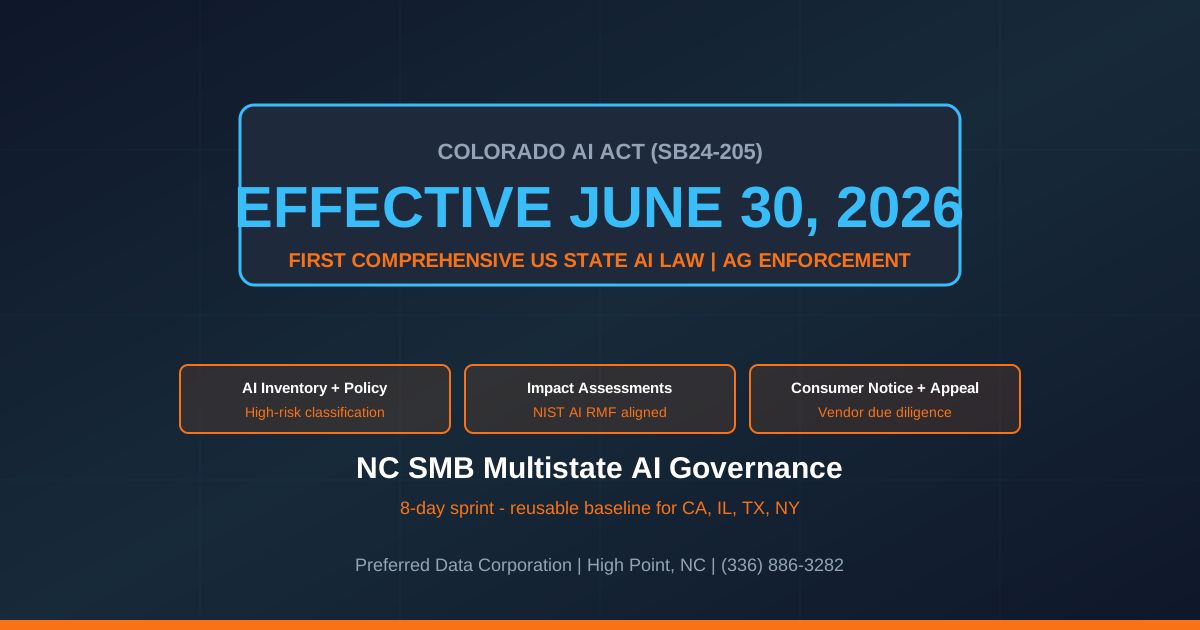
TL;DR: Colorado's Consumer Protections for Artificial Intelligence Act (SB24-205) takes effect on June 30, 2026, after Governor Polis signed SB25B-004 in August 2025 to push the original February 1, 2026 effective date forward. The law is the first comprehensive state AI consumer-protection statute in the US and imposes substantive obligations on developers and deployers of "high-risk AI systems" that influence consequential decisions in employment, housing, credit, healthcare, education, and insurance. For NC SMBs that have ever sold into Colorado - HR-tech SaaS sold to a Denver employer, a lender originating to a Colorado resident, a healthcare scheduling tool used by a Boulder practice, an insurance brokerage with Colorado policies - the small-business exemption is narrow and the AG enforcement authority is exclusive. The right time to design the AI governance program is now, with eight days of runway.
Key takeaway: "We are based in North Carolina" is not a defense. The Colorado AI Act applies to deployers and developers whose high-risk AI systems make or substantially influence consequential decisions about Colorado consumers. An NC SMB with no Colorado office can still be in scope. The defense is a documented AI inventory, an AI use policy, vendor due diligence, an impact assessment, and a consumer-notification template - all of which double as the multistate AI governance baseline.
Need an AI governance baseline before Colorado's June 30 effective date? Preferred Data Corporation runs AI Transformation services for NC small businesses since 1987 from High Point. Call (336) 886-3282 or book an AI governance review.
What does the Colorado AI Act actually require, and from whom?
Per the Colorado General Assembly bill text and the TrustArc compliance guide, the Act distinguishes between developers (who build high-risk AI systems) and deployers (who use them) and places different - but overlapping - duties on each. The Colorado Attorney General has exclusive enforcement authority; there is no private right of action.
Three facts an NC SMB owner should write down:
- The Act covers high-risk AI systems making or substantially influencing consequential decisions. Per the National Association of Attorneys General overview, "consequential" decisions cover employment, housing, credit, healthcare, education, insurance, legal services, essential government services, and similar categories. An AI-driven resume screen, a credit scoring model, a property-management AI tenant evaluator, or an insurance underwriting model is in scope by default.
- Deployers must implement risk management, impact assessments, and consumer notifications. Per TrustArc and the Akin Gump tracker, deployers must adopt and document a risk management policy and program, complete impact assessments for high-risk AI systems, notify consumers when a high-risk AI system makes or substantially influences a decision about them, and offer correction and appeal rights.
- Small-business exemption is narrow. Per the Akin Gump analysis and the Colorado AI Compliance annotated text, some deployer obligations (impact assessments and risk management formalities) are relaxed for deployers with fewer than 50 employees - but the exemption is lost if the SMB uses its own data to train or customize a high-risk AI system. The consumer-notification obligations apply regardless of size.
For an NC SMB that thought "this is an enterprise problem," the practical reality is: if you sell HR tech to any Colorado employer, originate loans to any Colorado resident, deploy AI in insurance, healthcare, education, housing, or credit anywhere your output reaches Colorado consumers, you are in scope.
Why does a Colorado law matter to an NC small business?
Because the geography of AI-driven decisions does not map to the geography of the SMB. Three concrete examples for NC SMBs.
- NC HR-tech SaaS sold to Colorado employers. A NC company offering resume-screen AI to employers nationally is a developer under the Act. Disclosures, documentation, and contractual flow-down to deployers in Colorado all apply.
- NC consumer-lending or BNPL platform. Per the National Association of Attorneys General analysis, credit decisions are "consequential." An NC lender originating loans to Colorado residents is in scope as a deployer.
- NC healthcare administration SaaS. Healthcare scheduling, eligibility determination, denial / prior-auth AI tools sold to Colorado providers put the NC SaaS vendor in scope as a developer.
Multistate exposure is the bigger picture. Per the Frascona analysis and LogicGate's overview, Colorado is the first major comprehensive state AI law, but California, Illinois, Texas, and New York have parallel measures in motion. The 2026-2027 AI compliance cost is multistate, not single-state. The work you do for Colorado is mostly reusable for the next state.
What does an in-scope NC SMB actually have to do by June 30, 2026?
A defensible Colorado AI Act program for an NC SMB has eight elements. Most are documentation; none requires a Fortune 500 budget.
| Program Element | What It Looks Like for an NC SMB | Reusable Outside Colorado |
|---|---|---|
| AI system inventory | Documented list of every AI / ML tool, vendor, purpose, data class | Yes - baseline for any AI policy |
| AI use policy | Written policy stating allowed and prohibited uses by team | Yes - baseline for any AI policy |
| High-risk AI classification | Per-system classification against the Act's consequential-decision list | Partially - aligns with EU AI Act categories |
| Risk management program | Documented controls covering bias, accuracy, security, transparency | Yes - NIST AI RMF aligned |
| Impact assessments | Per-high-risk-system documented assessment of bias and accuracy | Yes - aligns with NIST and EU AI Act |
| Vendor due diligence | Contractual flow-down, documentation requests, audit rights | Yes - applies to any AI procurement |
| Consumer notification template | Plain-language notice when a high-risk AI makes a decision | Yes - aligns with state notice trends |
| Correction / appeal process | Documented appeal pathway for consequential decisions | Yes - aligns with consumer-protection norms |
Two implications NC SMB owners should not skip:
- Most of the work is documentation, not engineering. Per the TrustArc compliance guide, the dominant cost is process design, vendor questionnaires, and policy authoring - not a software build. NC SMBs without an in-house compliance function can run this with a managed services partner.
- The work is multistate-reusable. Per the Clark Hill analysis, the Colorado framework borrows heavily from NIST AI RMF and aligns conceptually with the EU AI Act's risk categories. Investments in Colorado compliance pay forward to California, Illinois, Texas, and New York.
What is the eight-day Colorado AI Act sprint for NC SMBs?
If today is June 22, 2026, the runway to the June 30 effective date is eight days. Run this sequence. The result is a defensible Day-1 posture, not a five-year compliance program.
- Day 1 - assemble the team. Owner, IT lead, HR lead, head of customer-facing operations, counsel (in-house or fractional). One-hour kickoff to scope the AI inventory.
- Day 1-3 - inventory every AI system. Every internal AI tool, every vendor AI capability you have purchased, every AI feature embedded in a SaaS your team already uses (Microsoft 365 Copilot, ChatGPT Enterprise, HubSpot AI, M365 Copilot embedded in Word / Excel, sales-enablement AI, customer-service AI, HR-tech AI). For each: purpose, data class, vendor, whether output influences consequential decisions about Colorado consumers.
- Day 3-4 - classify high-risk. Apply the Act's consequential-decision categories: employment, housing, credit, healthcare, education, insurance, legal services, essential government services. Mark every AI system in the inventory as in-scope or out-of-scope. If in doubt, treat as in-scope and document why.
- Day 4-5 - publish an AI use policy. A two-to-four-page policy covering allowed uses, prohibited uses, vendor-approval workflow, data-classification rules, and the consumer-notification trigger. The policy is reviewed by counsel and signed by the owner.
- Day 5-6 - draft impact assessments for in-scope systems. A two-to-four-page impact assessment per in-scope system covering bias / accuracy testing, training-data documentation, output review process, and consumer impact.
- Day 6-7 - vendor due diligence and contractual flow-down. Send vendor questionnaires for every in-scope vendor; request documentation; identify contractual gaps; queue contract amendments for Q3 2026.
- Day 7-8 - consumer notification template + appeals workflow. Plain-language template stating that AI was used in a decision, what the decision was, and how the consumer can correct data, appeal, or request a human review.
- Day 8 onward - quarterly governance cadence. AI inventory review, vendor questionnaire refresh, impact-assessment updates, and policy alignment to new state laws. NC SMBs that build the cadence in 2026 are positioned for California, Illinois, Texas, and New York in 2027.
Key takeaway: Colorado is a first mover, not a one-off. The work an NC SMB does between June 22 and June 30 is the multistate AI governance baseline. The first state law is the hardest to design for; every subsequent law mostly maps onto the same documentation set.
Need an eight-day AI governance sprint scoped to your NC SMB? Call (336) 886-3282 or book an AI governance review.
What is the small-business exemption and how narrow is it?
Per the Akin Gump tracker and the NAAG analysis, deployers with fewer than 50 employees receive limited relief from some formalities (notably the impact assessment cadence for unmodified vendor AI systems), but:
- The relief is lost if the SMB uses its own data to train or customize a high-risk AI system. Most "we fine-tuned the vendor's model on our customer data" deployments lose the exemption.
- Consumer-notification obligations apply regardless of size. Every deployer that makes or substantially influences a consequential decision must notify the consumer.
- Anti-discrimination duties apply regardless of size. The substantive obligation to avoid algorithmic discrimination is not size-gated.
For NC SMBs, the practical read is: do not rely on the exemption. Build the program, document the exemption claim if it applies, and treat consumer notification as a hard requirement.
How does Preferred Data Corporation help NC SMBs build the AI governance baseline?
PDC has run technology services for NC small businesses since 1987 from High Point. Three concrete service lines align with the Colorado AI Act program.
- AI Transformation services: AI inventory, use policy authoring, high-risk classification, impact assessments, vendor due diligence questionnaires, consumer notification templates, and the quarterly governance cadence. NIST AI RMF and EU AI Act alignment built in.
- Software development services: For NC SMBs with custom-developed AI / ML features (or AI features in a custom application sold to Colorado customers), code-level documentation, model cards, training-data documentation, and appropriate audit-trail instrumentation for impact assessments.
- Managed IT services: M365 Copilot governance, Google Workspace AI governance, vendor SaaS inventory, data-loss prevention rules tied to the AI use policy, and the operational cadence to keep the inventory current as new AI features ship.
For NC SMBs selling HR tech, lending, healthcare administration, education tools, insurance, housing-adjacent services, or any AI capability whose output reaches Colorado consumers - June 30 is the effective date, but the work has to be in place before that. The procedural elements are the bulk of the cost; the engineering elements are smaller than most NC SMB owners expect.
Need a Colorado AI Act readiness review and multistate governance baseline scoped to your NC SMB? Call (336) 886-3282 or book an AI governance review.
Frequently Asked Questions
When does the Colorado AI Act take effect?
June 30, 2026. The original effective date was February 1, 2026, but Governor Polis signed SB25B-004 in August 2025 to push the effective date to June 30, 2026. There is no further delay scheduled as of June 22, 2026.
Does the Colorado AI Act apply to NC SMBs?
It applies to developers and deployers whose high-risk AI systems make or substantially influence consequential decisions about Colorado consumers, per the Colorado General Assembly text. Geography of the SMB is not the test; the geography of the consumer affected by the AI decision is. An NC SMB with no Colorado office can still be in scope.
What is a "high-risk AI system" under the Colorado AI Act?
Per the NAAG overview, a high-risk AI system is one that, when deployed, makes or is a substantial factor in making a consequential decision. Consequential decisions cover employment, housing, credit, healthcare, education, insurance, legal services, and essential government services. AI in resume screening, mortgage origination, insurance underwriting, healthcare prior authorization, education admissions / tracking, and similar use cases is in scope by default.
Is there a small-business exemption?
A limited one. Per the Akin Gump analysis and the annotated text, deployers with fewer than 50 employees get relief from some formalities (impact assessment cadence) for unmodified vendor AI systems - but lose that relief if they train or customize the AI on their own data. Consumer-notification and anti-discrimination duties apply regardless of size.
Who enforces the Colorado AI Act?
The Colorado Attorney General has exclusive enforcement authority. There is no private right of action - consumers cannot sue directly under the Act. Per LogicGate's analysis, the AG can pursue civil penalties for noncompliance, and good-faith implementation of risk management and impact assessments is a documented affirmative defense in many cases.
What should an NC SMB do between June 22 and June 30, 2026?
Run the eight-day sprint above: assemble the team, inventory AI systems, classify high-risk, publish an AI use policy, draft impact assessments for in-scope systems, send vendor due diligence questionnaires, publish a consumer-notification template, and stand up the quarterly governance cadence. The bulk of the work is documentation and process. The work is multistate-reusable for California, Illinois, Texas, and New York measures expected through 2027.
Related Resources
- AI Transformation Services - AI inventory, policy, impact assessments, governance
- Software Development Services - Custom AI / ML feature governance and documentation
- Managed IT Services - M365 / Google Workspace AI governance and vendor inventory
- AI for Main Street Act 65% SMB Regulation Concern - Companion AI regulation post for NC SMBs
- AI Governance Small Business Risk Management - Companion AI governance baseline post
- Contact Preferred Data Corporation - AI governance review for NC SMBs