
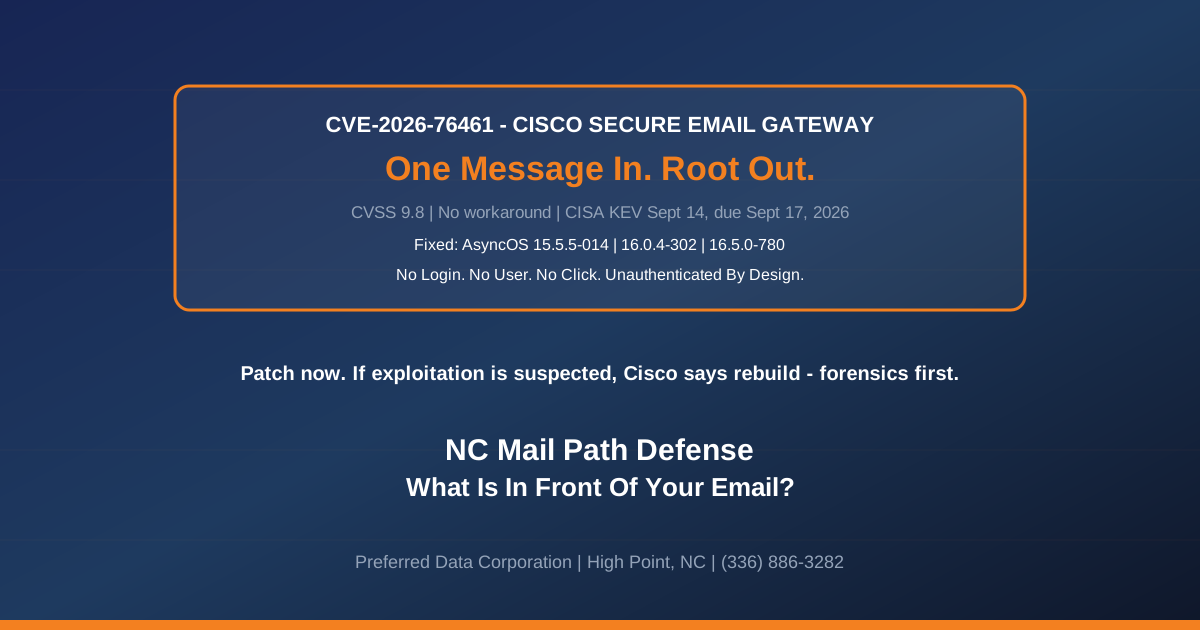
In short: Cisco disclosed CVE-2026-76461 on September 14, 2026, scored 9.8 out of 10: an unauthenticated sender gets root on a Cisco Secure Email Gateway by passing a crafted email through it. CISA listed it the same day, due September 17. No workaround, the Cisco-hosted service was in scope too, and where exploitation is suspected Cisco says rebuild rather than upgrade. Three questions below settle whether it is yours.
Your plant sends a lot of email that no person ever writes. Order acknowledgements. Advance ship notices. Invoices out of the ERP. Scanner output. Alerts off the floor. That traffic usually leaves through a relay or an appliance somebody configured years ago, separately from everybody's Outlook and separately from anyone's memory of it.
Last week one of those devices turned out to hand root access to whoever sent it a particular email. Nobody had to open it.
Key takeaway: Whatever sits in front of your mail belongs on the same list as your firewall. On most of the lists we inherit, it is not there at all.
What do I ask my IT provider, and how do I grade the answer?
Send three questions in writing, with a reply-by date. A week is generous for two of them. Question two is different: if the answer names a Cisco Secure Email Gateway in any form, stop waiting on the other two, because the federal due date for that one was September 17 and it has passed. You do not need to understand the answers technically to grade them, because a good answer has specifics in it and a brush-off does not.
- What sits in front of our email, inbound and outbound, and who patches it?
- Are any of those things a Cisco Secure Email Gateway, physical, virtual or the Cisco-hosted version, and if so what release are they on and on what date was it applied?
- If one of those devices was exposed, did anyone check whether it was already broken into, and what did they look at?
| What you asked | An answer that means something | An answer that means nothing |
|---|---|---|
| What is in front of our email | Names the products and says which direction each handles | "Everything goes through Microsoft" |
| Cisco, and what release | "No Cisco here", a release string with a date, or "it is the hosted service, Cisco moved it to 16.5.0-780, and here is what they told us about our instance" | "We are patched" |
| Did anyone check for a break-in | Names who looked, what logs, and what they found | "There is no indication of compromise" |
That right-hand column is not proof anybody did anything wrong; usually it means nobody has been asked in years. If the answer to question two is a flat "no Cisco anywhere," you are done here and the rest is background.
If you would rather hand the three questions to somebody who already knows what a good answer looks like, Preferred Data Corporation is in High Point at (336) 886-3282.
What is CVE-2026-76461 and how does it work?
Cisco's advisory of September 14, 2026 describes CVE-2026-76461: someone with no account and no password sends a crafted email carrying SQL statements through a Cisco Secure Email Gateway, and what they buried inside it ends up running as root on the appliance. Cisco puts the cause down to insufficient validation in the email parsing logic. It scores the flaw 9.8 out of 10, which is roughly where the scale stops, and states there are "no workarounds that address this vulnerability."
| AsyncOS branch | Fixed release |
|---|---|
| 15.5 and earlier | 15.5.5-014 |
| 16.0 | 16.0.4-302 |
| 16.5 | 16.5.0-780 |
Cisco states the flaw "affects Cisco Secure Email Gateway, both physical and virtual, regardless of device configuration," and confirms Secure Email and Web Manager and Secure Web Appliance are not affected. Read this next part carefully if you buy the hosted version, because it is easy to miss: Secure Email Cloud is built from Secure Email Gateway devices, Cisco has already upgraded those instances to 16.5.0-780, and it ran a threat-intelligence review across that fleet and contacted the customers where it found indicators of possible compromise. Being a cloud customer did not put you out of scope. It put the patching in Cisco's hands and left the question of whether anything happened on your instance in a phone call you may or may not have received.
Cisco adds that anyone running a release earlier than 16.5 should migrate to 16.5.0-780 rather than stop at the fix for their own branch. If the answer that comes back is 15.5.5-014, that is a patched appliance and also a conversation about why it did not go further.
There is no workaround. Cisco does publish Snort coverage as rules 67109 and 67110, numbers to forward to whoever runs your perimeter rather than anything you act on, plus hardening worth doing regardless: separate mail from management interfaces, keep the appliance behind a filtering device, and stop the management interface being reachable from the internet.
Does this reach us if we are on Microsoft 365?
Possibly, and nobody in the building can answer it from memory. That is the finding, rather than the CVE.
In environments we take over, a filtering appliance left behind by a Microsoft 365 migration is a recurring find, kept for a transition that was supposed to be temporary. It shows up on no invoice and in no rack, so nothing ever forced the conversation about switching it off. It stays out of the patch report because it was never in the inventory, and out of the inventory because the person who installed it left.
To see part of the answer without logging into anything, type your domain into any public MX lookup tool. Those records name the first thing on the internet that receives your mail, and if they point somewhere other than Microsoft that is a question for your provider. The outbound side carrying your ASNs and invoices will not appear there at all, which is why question one asks about both directions.
What does it actually cost me if nobody looks?
Two things, and neither of them is the appliance.
The first is silence. An attacker with root on the device that reads your mail sits in front of every invoice, quote and price list moving in or out. That position is what business email compromise is built on: the fraudulent banking-change email arriving inside a real thread. Nothing breaks, nothing alarms, and the loss turns up in accounts payable weeks later.
The second is the credentials, which the rebuild section deals with.
What this is unlikely to cost you is a stoppage. The flaw buys access, not downtime, so nobody calls you because the presses stopped. Which is exactly why it is worth an hour now instead of a fire drill later.
Want the mail path mapped and the logs read by somebody who has done it before? Call (336) 886-3282 or see Cybersecurity Services. Ask what it costs before you agree to it, here or anywhere else.
Why did the federal deadline say three days?
CISA added this CVE to its Known Exploited Vulnerabilities catalog on September 14, the same day Cisco disclosed it, due September 17. The alert CISA published that day lists that one CVE and nothing else, which is how a same-day entry reads: in use before anyone wrote about it.
CISA did not pick three days by feel. Binding Operational Directive 26-04, issued June 10, 2026 sorts vulnerabilities on four questions rather than on severity alone: is the asset publicly exposed, is the CVE on the KEV catalog, can an adversary automate every step, and does exploitation yield partial or total control. The fastest lane it defines is three days plus a forensic triage of the asset.
Which row this CVE landed on, we cannot show you. CISA publishes the criteria-to-timeline table only as an image, and its own alert for this CVE does not enumerate the factors it scored. Unauthenticated root execution makes three of the four look obvious, but "can an adversary automate every step" is a judgment CISA made and did not publish, so treat the September 17 due date as the fact and the reasoning as inference. The directive binds federal civilian agencies only, so it binds nobody in Kernersville.
Borrow the four questions anyway. Most companies we meet run one patch queue at one urgency, so a printer driver and an internet-facing appliance compete for the same Thursday evening. And note the top tier's wording: CISA did not say patch, it said patch and then find out whether somebody beat you to it.
If we were exposed, how would we know?
Cisco gives one concrete check and is careful about what it proves. Run grep -i "COPY.*TO PROGRAM" against mail_logs; Cisco says any entry in the output may indicate malicious activity. It also calls that a non-exhaustive example, says a clustered deployment means checking every node, and warns that an attacker with root may have removed the evidence.
The instruction that matters more than the grep is also Cisco's. The advisory strongly recommends cross-checking the network logs and the firewall logs held outside the impacted device, looking for unexpected uploads from the appliance to external addresses. BleepingComputer carried that forward on September 15. Rapid7 published Cisco's on-device indicators the same day without the off-device half, which is a fair illustration of how easily that half drops out of a write-up.
| Where you look | What it can tell you | What it cannot |
|---|---|---|
mail_logs on the appliance | Whether this one known pattern appears, which Cisco calls non-exhaustive | Whether an intruder with root edited them first |
| Firewall and network logs, held off the device | Outbound connections and transfers that should not exist | What happened inside the appliance |
| Every node in a cluster | That the compromised node is not the one you skipped | Anything, if only one node was checked |
One caveat for hosted customers, straight from Cisco: on Secure Email Cloud, administrators without command-line access may not be able to check these indicators themselves. Open a case and ask what Cisco's own review found on your instance rather than reading silence as an answer.
If the logs rotated before anybody looked, say so out loud. "We found nothing" and "we could not have found anything" get filed in the same place far too often, and only one is reassuring.
Should we patch the appliance or rebuild it?
Here is where we disagree with the week's coverage, ours included. Build numbers are the easy part to publish. Patch today. But if you find evidence this was used against your appliance, upgrading is the wrong finishing move, and it is the one everybody reaches for because it has a button.
Root means whoever was in there could do anything the appliance could do, including change what it reports about itself. Cisco says as much, and then says what to do about it, which is the part almost nobody is quoting.
Where exploitation is suspected on a virtual appliance, the advisory tells you to record forensic information first, then deploy a new virtual machine on a fixed release, rebuild the configuration, renew every credential and cryptographic key on the appliance, and keep watching it. The order is not optional, and Cisco says why: deploying a new instance destroys the configurations and logs. For a physical appliance it says contact Cisco TAC; for a hosted instance it contacted, renew credentials and cryptographic material. So the rebuild position is Cisco's rather than ours. What we add is the paperwork: somebody owns the trusted-or-rebuilt call in writing.
The September 17 revision added the sentence that costs the most. Cluster members authenticate to each other with SSH key pairs, those private keys can be read on a compromised appliance, and Cisco therefore recommends restoring every member of a cluster containing at least one compromised box. If you run a cluster, the unit of rebuild is the cluster.
Either way the credentials go. A gateway typically stores directory bind accounts, LDAP service credentials, SMTP authentication and administrative logins. Those log into your domain and your mail system, and installing 16.5.0-780 changes none of them.
Key takeaway: Patch on whatever clock you have. Then decide, in writing and with a name against it, whether that box is trusted or rebuilt. Leaving the decision unmade is the same as choosing trusted.
What should we actually do this week?
Send the three questions Monday with a reply-by date, and put a reminder on it so a silence becomes visible. If a rebuild is on the table, take the forensic copy first: a new instance destroys the logs. Then write down what is in your mail path, inbound and outbound, with a name against each line. That list still has value in December, when nobody remembers this CVE number.
Frequently Asked Questions
Why am I reading about a three-day deadline after it passed?
Because the deadline was the federal government's, not yours. Nothing about September 17 obliged a business in the Piedmont Triad to do anything, and nothing about the date closes the question for an appliance nobody has looked at. The inventory question underneath it has no deadline at all, which is the argument for handling it in a normal week rather than a bad one.
What if our IT company already dealt with this and never mentioned it?
That is normal and generally fine, as long as they can produce the release string and the date. Most providers patch quietly and do not narrate it, which is what you pay for. The answer that should bother you is not "we already did it." It is "we would have to look into it."
We do not run Cisco. Can we ignore this?
Ignore the patch. Keep the inventory question, because the answer is the same for every vendor: a device in the mail path reads content sent by strangers, with no authentication, by design. Cisco is this week's name. Next quarter it will be somebody else's.
Our email filtering is part of Microsoft 365. Are we safer?
Different. Whether it is safer depends on the parts you still own. You have handed the patching of the filter to Microsoft, which is a real gain. Identity, configuration, and everywhere your own systems send mail from are all still yours.
We are a defense subcontractor. Does this create a reporting obligation?
Possibly, depending on your contract flow-downs and what the device could reach. That belongs with your counsel and your contracting officer rather than your IT vendor. Preserve the logs now, before rotation settles it for you.
Where we are: Preferred Data Corporation has worked on North Carolina plant-floor and back-office systems out of High Point since 1987, and drives to sites inside 200 miles, Greensboro, Winston-Salem, Charlotte and Raleigh included. Call (336) 886-3282, email [email protected], or find us at 1208 Eastchester Drive, Suite 131, High Point, NC 27265.
Related Resources
- Cisco Security Advisory: Secure Email Gateway SQL Injection Vulnerability (CVE-2026-76461)
- CISA: CVE-2026-76461 added to the Known Exploited Vulnerabilities catalog, September 14, 2026
- CISA Binding Operational Directive 26-04: Prioritizing Security Updates Based on Risk
- Arctic Wolf: recommendations for CVE-2026-76461
- Help Net Security: Cisco patches actively exploited email gateway zero-day
- Preferred Data Cybersecurity Services
- Preferred Data Network Infrastructure
- Preferred Data Manufacturing IT
- The BOD 26-04 patch clock and what it means for NC small business
- On-premises Exchange, NTLM relay, and why the email server is the target
- Email security past the spam filter
- Network edge appliances keep landing on the KEV list