
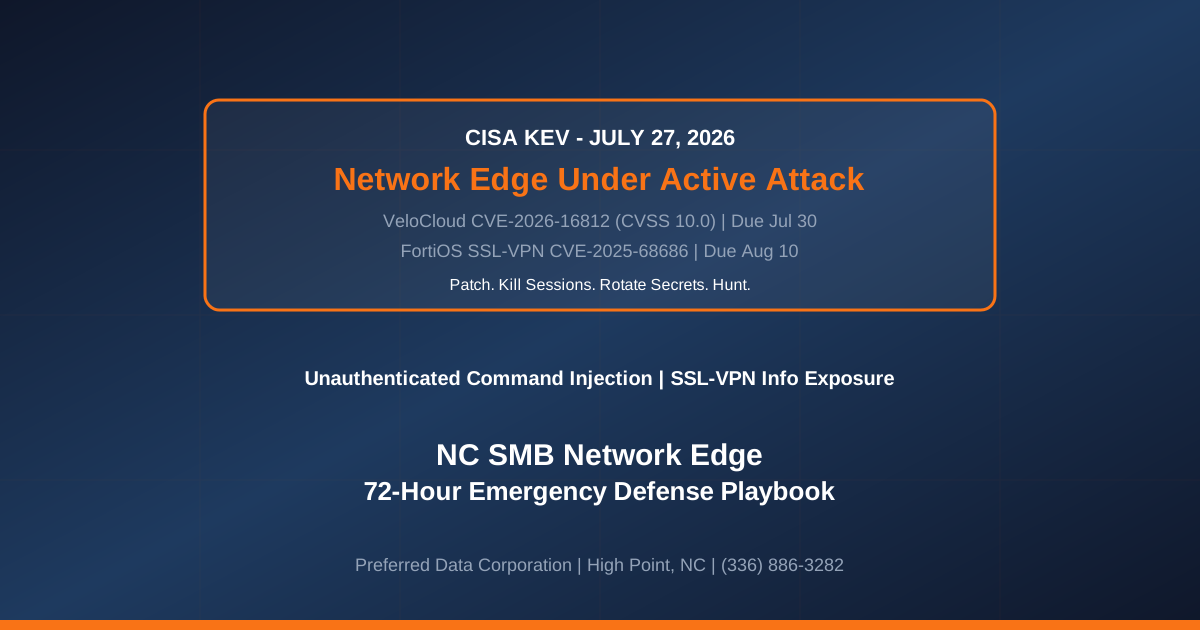
TL;DR: On July 27, 2026, CISA added two actively exploited network-edge vulnerabilities to its Known Exploited Vulnerabilities catalog: Arista VeloCloud Orchestrator On-Prem CVE-2026-16812 (CVSS 10.0, unauthenticated OS command injection, federal patch deadline July 30) and Fortinet FortiOS SSL-VPN CVE-2025-68686 (sensitive-information exposure via a symlink-persistence patch bypass, federal deadline August 10). Both sit on the internet-facing management plane that most North Carolina small businesses rely on for remote access and multi-site connectivity. NC SMBs running FortiGate SSL-VPN or a self-hosted VeloCloud SD-WAN orchestrator should treat this week as an emergency patch-and-hunt window, not a routine maintenance cycle.
Key takeaway: The VeloCloud flaw is a maximum-severity (CVSS 10.0) unauthenticated remote command injection that was exploited as a zero-day before a patch existed, and the FortiOS flaw specifically bypasses an earlier fix for a previously exploited bug. When attackers chain fresh edge-device access with credential and configuration theft, the appliance that protects your network becomes the beachhead into it. Patch on the CISA clock, terminate active sessions, rotate every secret the device touched, and hunt for the persistence attackers plant after the first foothold.
Need an emergency edge-device patch and compromise review this week? Contact Preferred Data Corporation at (336) 886-3282 for a rapid network-edge exposure assessment. BBB A+ rated, serving High Point, Greensboro, Winston-Salem, Charlotte, Raleigh, and the Piedmont Triad since 1987.
What did CISA add to the KEV catalog on July 27, 2026?
CISA added two vulnerabilities based on confirmed in-the-wild exploitation, and both target the network edge rather than an internal endpoint. The July 27 alert covers CVE-2026-16812 (Arista VeloCloud Orchestrator On-Prem OS command injection) and CVE-2025-68686 (Fortinet FortiOS exposure of sensitive information).
- CVE-2026-16812 (Arista VeloCloud Orchestrator On-Prem). SecurityWeek reports this is a CVSS 10.0 unauthenticated OS command injection exploited as a zero-day. VeloCloud Orchestrator is the self-hosted control plane enterprises use to centrally manage software-defined WAN, so a compromise reaches the confidentiality, integrity, and availability of every site the orchestrator manages. The Register notes CISA set an aggressive federal remediation deadline of July 30, 2026.
- CVE-2025-68686 (Fortinet FortiOS SSL-VPN). Security Affairs describes this as a sensitive-information exposure tied to a bypass of a patch that was meant to stop a symbolic-link persistence mechanism on previously exploited FortiGate devices. Affected releases include FortiOS 7.6.0-7.6.1 and 7.4.0-7.4.6 among earlier branches. The CISA KEV entry carries a remediation due date of August 10, 2026.
The unifying theme: both flaws live on the appliance that is supposed to be your first line of defense, and both are already being used against real organizations.
Why do edge appliances keep becoming the SMB attack of choice?
Internet-facing network appliances are the single most reliably exploited class of small-business technology in 2026 because they are exposed by design, slow to patch, and rich in credentials. Attackers who breach the edge inherit the keys to the interior.
- Exposed by design. A firewall, SSL-VPN portal, or SD-WAN orchestrator has to listen on the public internet to do its job. That makes it reachable by every automated scanner the moment a proof-of-concept circulates.
- Slow to patch. Edge appliances are treated as "set and forget" infrastructure. Firmware updates require a maintenance window, a reboot, and a rollback plan, so they routinely lag weeks or months behind disclosure while attackers move within 24 to 72 hours.
- Credential-rich. These devices terminate VPN sessions, hold cached credentials, store TLS private keys, and often trust the internal network implicitly. A read-only file-system foothold, exactly what the FortiOS flaw grants, is frequently enough to harvest what an attacker needs for the next stage.
This is not a one-off event. It is the same pattern that produced the CitrixBleed, SonicWall SMA1000, Palo Alto GlobalProtect, and Ivanti mass-exploitation waves across 2024 through 2026.
How does this compare to prior edge-appliance exploitation waves?
Edge-device mass exploitation has become a predictable annual cycle. The table below places the July 2026 KEV additions alongside recent large-scale edge campaigns so NC SMBs can see the recurring shape and plan defenses that outlast any single CVE.
| Campaign / CVE | Device class | Core weakness | Time to exploitation |
|---|---|---|---|
| CVE-2026-16812 (Jul 2026) | Arista VeloCloud SD-WAN Orchestrator | Unauthenticated command injection (CVSS 10.0) | Exploited as zero-day |
| CVE-2025-68686 (Jul 2026) | Fortinet FortiOS SSL-VPN | Info exposure via symlink patch bypass | Active exploitation |
| CVE-2026-8451 "CitrixBleed 3" (Jun 2026) | Citrix NetScaler | Pre-auth memory overread | Within 24 hours of patch |
| CVE-2026-15409/15410 (Jul 2026) | SonicWall SMA1000 | Unauth SSRF chained to code injection | Confirmed in the wild |
| CitrixBleed 1 (2023) | Citrix NetScaler | Session-token leak | Weeks, mass-scale |
The consistent lesson across five years: the specific vendor changes, but the exposure, the credential theft, and the fast follow-on intrusion do not. A defense built around one appliance model ages badly; a defense built around patch cadence, segmentation, and monitoring endures.
What should NC small businesses do in the next 72 hours?
Run a five-step edge-defense workflow scoped to the CISA deadlines, not your normal quarterly maintenance calendar. The federal July 30 (VeloCloud) and August 10 (FortiOS) dates are the right benchmark for private-sector SMBs too, because attackers do not distinguish between federal and commercial targets.
- Inventory and patch. Confirm whether any FortiGate is running an affected FortiOS branch and whether you operate a self-hosted VeloCloud Orchestrator. Apply the vendor fixes immediately; Arista's advisory and the vendor patch are the authoritative remediation.
- Terminate and rotate. Kill all active VPN and administrative sessions after patching, then rotate device admin credentials, local accounts, API keys, and any TLS certificates or private keys the appliance held. A patch does not evict an attacker who already captured a valid session or secret.
- Restrict the management plane. Limit the VeloCloud Orchestrator web interface and FortiGate admin access to a dedicated administrative network or allowlisted IPs. CISA's own guidance for the VeloCloud flaw is to restrict web-interface access and review recent administrator activity.
- Hunt for persistence. Review administrator activity logs for unusual changes, look for the symbolic-link persistence artifacts associated with the FortiOS flaw, and check for new local accounts, altered configs, or outbound connections to unfamiliar IPs.
- Plan the architectural fix. Segment the network so an edge compromise cannot pivot freely, and evaluate a move from broad SSL-VPN access to Zero Trust Network Access (ZTNA) that grants per-application, identity-verified access instead of full network reachability.
Not sure whether your edge devices are exposed? Call Preferred Data Corporation at (336) 886-3282 for a same-week network-edge exposure assessment across your FortiGate, SD-WAN, and remote-access footprint.
How does a managed network provider change the math on edge exploitation?
The gap that keeps hurting NC SMBs is not knowing that patches matter; it is having the staff, monitoring, and process to act inside a 72-hour window. A managed network and managed IT provider closes that gap in three concrete ways.
- KEV-cadence patching. PDC tracks the CISA KEV catalog continuously and treats KEV additions as emergency changes, so an edge patch lands in days, not the weeks an internally managed device typically takes.
- 24/7 monitoring and hunt. Continuous log review and proactive network monitoring catch the post-exploitation activity, new admin accounts, anomalous outbound traffic, that a patch alone never addresses.
- Architecture that limits blast radius. Network segmentation and Zero Trust design mean that even a successful edge compromise is contained rather than catastrophic, which matters enormously for NC manufacturers whose OT networks sit behind the same perimeter.
For a manufacturer or distributor running multiple sites on SD-WAN, the difference between a contained incident and a plant-floor shutdown is exactly this operational discipline.
Frequently Asked Questions
What is CVE-2026-16812 and how serious is it?
CVE-2026-16812 is an unauthenticated OS command injection vulnerability in Arista VeloCloud Orchestrator On-Prem with a maximum CVSS score of 10.0. It lets a remote attacker with no credentials run commands on the SD-WAN control plane, which can compromise every site the orchestrator manages. It was exploited as a zero-day, and CISA set a federal remediation deadline of July 30, 2026.
Is my FortiGate firewall affected by CVE-2025-68686?
If your FortiGate runs an affected FortiOS branch, including 7.6.0-7.6.1 or 7.4.0-7.4.6 among earlier releases, it may be exposed. The flaw is a sensitive-information exposure tied to a bypass of an earlier symlink-persistence patch, and CISA's remediation deadline is August 10, 2026. Confirm your firmware version, apply the Fortinet fix, and rotate credentials afterward.
We are a small business, not a federal agency. Do the CISA deadlines apply to us?
The CISA deadlines are legally binding only on federal civilian agencies, but attackers do not check whether a target is federal or commercial. The July 30 and August 10 dates are the best available benchmark for how fast every organization should move, because exploitation of these flaws is already happening in the wild.
What is the difference between patching and remediation here?
Patching installs the vendor fix so the vulnerability can no longer be exploited going forward. Remediation is the full response: patch, then terminate active sessions, rotate all credentials and keys the device touched, hunt for attacker persistence, and restrict management access. Because both flaws can lead to credential or session theft, patching alone can leave an attacker who already got in still inside.
Should we replace SSL-VPN with Zero Trust Network Access?
For most NC SMBs, yes, over time. Traditional SSL-VPN grants broad network access once a user connects, so an edge compromise or stolen session exposes the whole interior. ZTNA grants per-application, identity-verified access, which dramatically shrinks what an attacker can reach even if they breach the edge. It is a project, not an overnight change, but it is the durable architectural answer to recurring edge exploitation.
How quickly can Preferred Data help if we run FortiGate or VeloCloud?
PDC can begin a network-edge exposure assessment within the same week, prioritizing devices that fall under the July 27 KEV additions. The assessment covers firmware inventory, patch deployment, session and credential rotation, compromise hunting, and a segmentation and ZTNA roadmap. Call (336) 886-3282 to start.
Related Resources
- CISA Alert: Two Known Exploited Vulnerabilities Added July 27, 2026
- Critical Arista VeloCloud Orchestrator Vulnerability Exploited as Zero-Day - SecurityWeek
- Preferred Data Managed IT Services
- Preferred Data Network Infrastructure Services
- Preferred Data Cybersecurity Services
- Related: CitrixBleed CVE-2026-8451 NetScaler Defense Plan
- Related: SonicWall SMA1000 Zero-Days NC SMB Emergency Patch Plan