
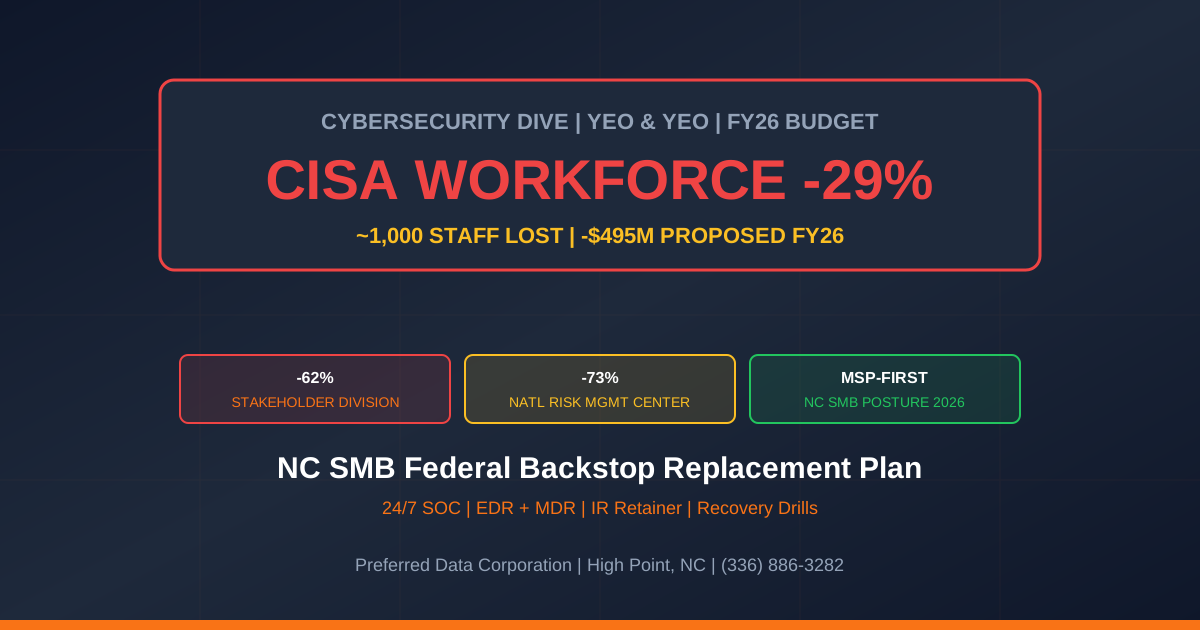
TL;DR: Per Cybersecurity Dive and Yeo & Yeo, CISA lost about one-third of its workforce in 2025 - 2026, falling from 3,732 to roughly 2,649 employees, with the Trump 2026 budget proposal cutting another $495 million and 30% of positions. The Stakeholder Engagement Division (SMB outreach) lost 62% of its funding; the National Risk Management Center lost 73%. NC small businesses that relied on CISA for free guidance, regional outreach, and incident-response help in 2024 - 2025 are now on their own. The 2026 SMB defense posture is MSP-first or no defense at all.
Key takeaway: The federal cyber backstop that NC SMBs assumed would be there during a ransomware event is no longer reliably staffed. The 2026 question is not "will CISA help if we get hit?" but "who picks up the phone at 2 a.m.?" A 24/7 managed cybersecurity provider with a documented incident-response retainer is the only durable answer for an NC small business.
Need to stand up an MSP-first cyber posture before the next federal cut? Preferred Data Corporation runs managed cybersecurity and 24/7 incident response for NC small businesses since 1987. Call (336) 886-3282 or request a posture review.
What changed at CISA in 2025 - 2026?
CISA's workforce shrank by approximately 1,000 staff between early 2025 and mid 2026, and the Trump administration's fiscal year 2026 budget proposal requests another $495 million in cuts plus a 30% headcount reduction. Per Cybersecurity Dive's coverage of the FY2026 budget and the Yeo & Yeo policy briefing, four numbers tell the story:
- Workforce: Down from 3,732 to about 2,649 (-29%). Roughly 1,000 staff left through buyouts, early retirements, layoffs, and reassignments.
- Stakeholder Engagement Division: -$62.2M (-62% of current funding). This is the division that ran SMB outreach, sector coordination, and regional partnerships.
- National Risk Management Center: -$97.4M (-73% reduction). This is the analytic arm that mapped sector-wide threat patterns for critical-infrastructure SMBs.
- Regional support: Per Nextgov / FCW reporting on Senator Warner's questions, CISA's ability to dispatch regional cybersecurity advisors to SMB incidents has been materially reduced.
Per Cybersecurity Dive's "7 Biggest Challenges" analysis, the agency's top 2026 challenge is supporting critical infrastructure companies and SLTT (state, local, tribal, territorial) governments with a depleted partnership workforce. Per Federal News Network's April 2026 reporting, several SMB-facing partnerships were described as being at a "standstill."
Why does this matter for an NC small business?
Because the free, federally funded cyber resources NC SMBs counted on in 2023 - 2024 are no longer reliably available in 2026. Three concrete losses for an NC manufacturer, distributor, or professional services firm:
- Regional cybersecurity advisor reach has shrunk. CISA's pre-cut model staffed Region 4 (which includes North Carolina) with regional advisors who would visit critical-infrastructure SMBs, run vulnerability assessments, and broker incident-response help. Per Cybersecurity Dive, the post-cut model has materially reduced that bandwidth.
- Free CISA SMB tooling and outreach is degraded. Per Cybersecurity Dive's challenges piece, the agency's ability to maintain free SMB programs (CISA Tabletop Exercise Packages, CISA Cyber Hygiene Services, CISA Stop Ransomware education) is constrained by the workforce reduction.
- Incident-response triage is slower. Per Federal News Network, federal cyber partnerships - including the ones that route SMB ransomware incidents to FBI and CISA help - are taking longer to engage. The 2-hour federal triage assumption from 2024 has stretched.
For an NC manufacturer in High Point or a distributor in Greensboro, the practical implication is that the cyber-event call tree must change. The first call in 2026 is no longer "report to CISA"; it is "engage MSP incident response."
What is the MSP-first cyber posture for an NC SMB in 2026?
The MSP-first posture replaces the assumed federal backstop with a contracted, 24/7 commercial provider. Per CISA's Cybersecurity Performance Goals 2.0 and NIST SP 800-171 benchmarks adapted for the 2026 NC SMB environment, the MSP-first stack has five required components:
| MSP-First Component | Purpose | 2026 NC SMB Standard |
|---|---|---|
| 24/7 SOC monitoring (EDR + MDR) | Detect intrusions in minutes, not weeks | Microsoft Defender for Business + partnered SOC |
| Documented incident response retainer | Phone-ringable IR team at 2 a.m. | 4-hour SLA, named contacts, signed runbook |
| Identity hardening (M365 / Entra ID) | Block credential theft attacks | FIDO2 / passkeys, conditional access |
| Immutable backups + recovery drills | Survive ransomware encryption | Veeam Hardened Repository + quarterly test |
| Patch SLAs to CISA KEV | Close known-exploited vulnerabilities | KEV 72 hours, Critical 7 days, all others 30 days |
Quotable definition: "MSP-first cyber posture" is the 2026 standard where the small business contracts with a managed cybersecurity provider for prevention, detection, and incident response - and treats federal resources (CISA, FBI, sector ISACs) as escalation, not foundation. The shift is not philosophical; it is operational. The federal backstop is no longer staffed to be the first call.
For NC manufacturers in CMMC scope, the MSP-first model also keeps SSP and POAM evidence current, which is the documentation auditors review during a Level 2 assessment.
What should an NC SMB do in the next 60 days?
Run a four-step plan to stand up the MSP-first posture before Q3 2026 renewal cycles begin.
- Map the current cyber call tree (week 1). Document who picks up the phone at 2 a.m. for an incident. If the answer is "CISA" or "we'd call the FBI," the call tree is broken in 2026. Replace with a contracted MSP IR retainer and a named CISO-as-a-Service contact.
- Stand up the 24/7 SOC layer (weeks 2 - 4). Deploy managed EDR with monitored response. Microsoft Defender for Business plus a partnered SOC is the entry tier; SentinelOne or CrowdStrike Falcon Go with managed SOC is the next tier.
- Lock down identity (weeks 3 - 6). FIDO2 / passkey rollout across M365 / Entra ID, conditional access policies, dormant-account purge, and OAuth integration audit. Per Verizon's 2026 DBIR, stolen credentials remain a top initial access vector.
- Document the incident runbook (weeks 5 - 8). A signed, dated runbook with named contacts, RTO / RPO targets, communication tree, and legal counsel notification. This is the document an underwriter and a Q3 board will both ask for.
Key takeaway: The MSP-first posture is not optional in 2026. NC SMBs that planned around the assumption of a federally funded cyber backstop now need to fund the equivalent commercially - which costs less than the median incident, but only if it is in place before the incident.
How does Preferred Data Corporation provide the MSP backstop for NC SMBs?
PDC has run managed IT and cybersecurity for NC small businesses since 1987 with 20+ year average client retention. We bring three things to the post-CISA-cut environment:
- Managed cybersecurity services: 24/7 SOC partnerships, managed Microsoft Defender for Business, identity hardening across M365 and Entra ID, KEV-rate patching, and named incident-response contacts for NC SMBs.
- Managed IT services: Documented incident runbooks, quarterly tabletop exercises tied to the NC SMB business context, RMM-driven patching, and CISO-as-a-Service guidance.
- Backup and recovery: Veeam Hardened Repository with immutable cloud tier, quarterly recovery drills, and documented evidence that survives a cyber-insurance audit and a CMMC Level 2 assessment alike.
For NC manufacturers in the Piedmont Triad, NC distributors in Greensboro and Winston-Salem, and NC professional services firms in Charlotte and Raleigh, the 2026 federal cyber posture is materially weaker than the 2023 - 2024 baseline. The work this quarter decides whether the next ransomware crew finds an MSP-defended target or an unprotected one waiting for help that no longer arrives in hours.
Need an MSP-first cyber posture documented in 60 days? Call (336) 886-3282 or request a cybersecurity posture review.
Frequently Asked Questions
How much has CISA's workforce shrunk in 2025 - 2026?
Approximately one-third. Per Cybersecurity Dive's 7 challenges analysis and Yeo & Yeo's policy briefing, CISA's workforce fell from 3,732 to roughly 2,649 between early 2025 and mid 2026 - about a 29% reduction. The Trump 2026 budget proposal requests another 30% reduction.
Will CISA still help an NC SMB during a ransomware attack?
Federally, the option still exists, but the response bandwidth is materially reduced. Per Cybersecurity Dive and Federal News Network, the Stakeholder Engagement Division (-62% funding) and regional advisor staff are stretched thin. The 2026 SMB posture should treat CISA help as escalation after a managed-cybersecurity provider engages, not as the first call.
What is an "MSP-first cyber posture" for an NC small business?
It is the 2026 model where a small business contracts a 24/7 managed cybersecurity provider for prevention, detection, and incident response - and treats federal resources (CISA, FBI, ISACs) as escalation, not foundation. The shift reflects the reduced federal capacity documented in Cybersecurity Dive's 2026 reporting and the practical reality that an NC SMB cannot afford to wait days for a federal advisor during a ransomware encryption event.
What did CISA's Stakeholder Engagement Division do for NC SMBs?
The Stakeholder Engagement Division ran sector outreach, partnership management, and SMB-facing programs including the CISA Tabletop Exercise Packages, regional advisor visits, and cyber hygiene services. Per Cybersecurity Dive's FY2026 budget analysis, the proposed 62% funding cut reduces the division's ability to maintain these SMB-facing programs at 2024 scale.
How fast can an NC SMB stand up an MSP-first posture?
60 days for the core stack. A typical NC SMB with 25 - 100 employees can deploy managed EDR with 24/7 SOC monitoring in 2 - 4 weeks, lock down identity in 3 - 6 weeks, and have a documented incident runbook signed within 8 weeks. The total cost typically runs $5,000 - $12,000 per month - well below the $254K median 2026 SMB breach cost.
Does the CISA cut affect CIRCIA reporting obligations?
No. The Cyber Incident Reporting for Critical Infrastructure Act (CIRCIA) reporting obligations remain in force regardless of CISA staffing. Per Fisher Phillips' CIRCIA FAQ, covered critical-infrastructure SMBs must still report substantial cyber incidents within 72 hours. What changes in 2026 is the SMB-side response support, not the reporting requirement.
Related Resources
- Managed Cybersecurity Services for NC Businesses - 24/7 SOC, EDR, and incident response
- Managed IT Services for NC Businesses - RMM, patching, asset inventory, runbooks
- Backup and Recovery Services - Immutable repositories and recovery drills
- CIRCIA 72-Hour Reporting Rule for NC Critical Infrastructure - Federal reporting requirements
- NC SMB Cyber Math 2026: 49% Hit, $254K Loss - Companion threat data
- Contact Preferred Data Corporation - MSP-first posture review for NC SMBs