
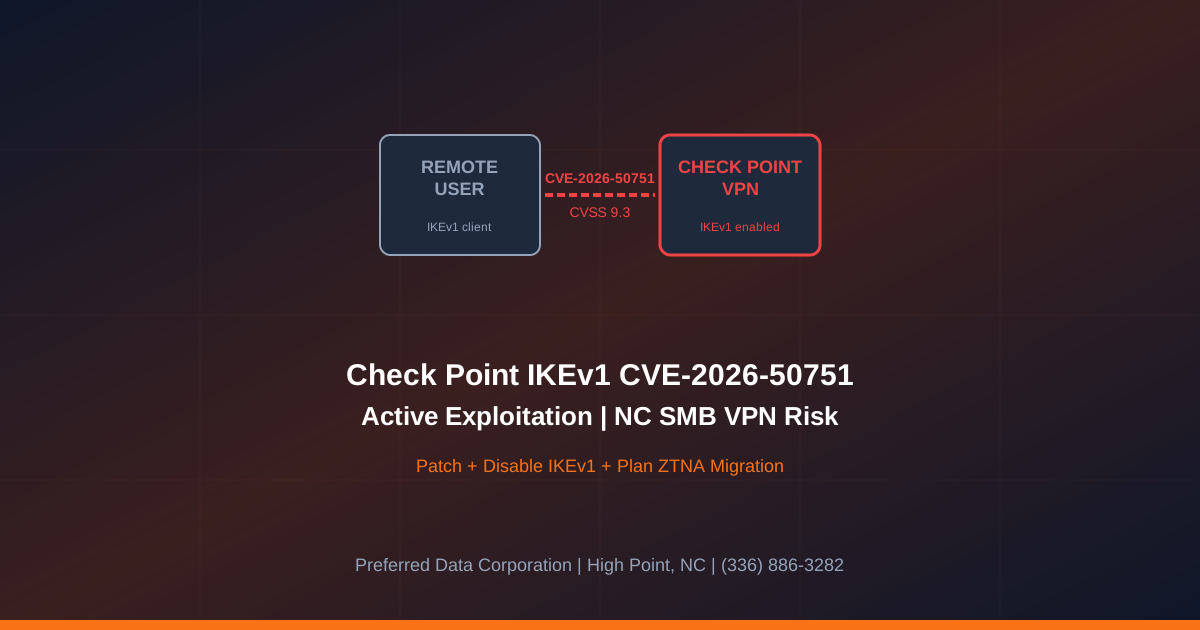
TL;DR: Check Point warned of active exploitation of CVE-2026-50751 (CVSS 9.3), a critical vulnerability in Remote Access VPN and Mobile Access deployments configured to use the deprecated IKEv1 key exchange protocol. For NC small businesses still running legacy VPN configurations, the practical impact is immediate: an unauthenticated attacker can target the appliance and potentially gain access to internal systems. The fix is fast: patch the affected build, disable IKEv1, force migration to IKEv2 or modern remote access (ZTNA/SASE), and document KEV closure for cyber insurance.
Key takeaway: Edge appliance vulnerabilities are now the #1 SMB breach vector. Every internet-exposed firewall, VPN, and gateway is a board-level risk in 2026. The SMBs that close CVE-2026-50751 inside the published KEV deadline are the ones whose insurance applications get approved this year.
Worried your Check Point VPN is still running IKEv1? Preferred Data Corporation runs managed firewall and remote access for NC small businesses. Call (336) 886-3282 or request an edge appliance review.
What is Check Point CVE-2026-50751 and why is it being exploited now?
It is a critical (CVSS 9.3) vulnerability in Check Point Remote Access VPN and Mobile Access deployments that have IKEv1 enabled. Per Check Point's own advisory and The Hacker News' coverage of recent KEV additions, the exposure exists because IKEv1 is a long-deprecated key exchange protocol that should have been retired across the industry years ago. Many SMBs and even mid-market firms left it enabled for backward compatibility with legacy clients.
Three reasons attackers are weaponizing this now:
- IKEv1 is a long-known weakness. The protocol has cryptographic and design issues that the IETF formally deprecated in RFC 8247 (2017). Public PoC research has existed for years. AI-assisted exploit dev compressed weaponization time per Help Net Security's 2026 DBIR analysis.
- Edge appliances are the #1 SMB breach vector. Per the Verizon 2026 DBIR, vulnerability exploitation overtook credential abuse as the top initial access vector at 31% of breaches. The 2026 KEV catalog includes critical, exploited CVEs in Fortinet, SonicWall, Palo Alto, Cisco ASA / ISE, Ivanti, Citrix, and now Check Point.
- Remote workforce makes VPN appliances strategic targets. Per Guardz's June 2026 MSP report, 90% of SMBs have at least one compromised user. A compromised VPN appliance is a single-pivot path to internal networks, file shares, ERP systems, and cloud token harvesting.
For NC small businesses with hybrid or remote workforces, an unpatched Check Point gateway with IKEv1 enabled is exactly the asset profile producing breaches in 2026.
Why is IKEv1 still a problem in 2026?
Because backward compatibility kept it alive in production long after it should have been retired. Three structural reasons:
- Legacy client compatibility. Older laptops, OT systems, manufacturing floor PLCs, and some MDM-controlled mobile clients still defaulted to IKEv1. Disabling it broke connectivity for a long tail of users.
- No clear ownership. In SMBs with a single in-house IT generalist, "modernize VPN config" is a project that rarely makes the quarterly plan against help-desk and project work.
- Insurance pressure is recent. Cyber insurers only started asking specifically about edge appliance configurations in the last 12-18 months. Without that pressure, "leave IKEv1 on" carried no obvious cost.
| Risk dimension | IKEv1 status quo | IKEv2 / modern stack |
|---|---|---|
| Cryptographic strength | Deprecated, vulnerable | Current, supported |
| Exploit availability | Public PoCs for years | None known |
| AI exploit dev impact | High | Low |
| Cyber insurance impact | Documented control gap | Compliant |
| CMMC review impact | Finding | Compliant |
| Remote workforce impact | Higher tail risk | Lower tail risk |
What does this mean for NC small businesses in practice?
If you run Check Point Remote Access VPN or Mobile Access and IKEv1 is enabled, you have an actively exploited critical CVE on your perimeter today. Per the Verizon 2026 DBIR, 96% of ransomware victims for which size was known were SMBs. Per the BlackFog 2026 State of Ransomware report, SMBs remain the dominant victim profile. A successful Check Point exploit typically chains as follows:
- Unauthenticated probe of the IKEv1 endpoint
- Exploit and authentication bypass / RCE
- Pivot into the internal network
- Credential harvesting from Active Directory or M365
- Lateral movement to file shares, ERP, finance systems
- Data exfiltration, then encryption / extortion
The blast radius covers downtime, ransom, data exposure, supplier contract penalties (especially for manufacturers in regulated supply chains), insurance claim impact, and customer churn. The 2026 Verizon DBIR and SecurityWeek's coverage both reach the same conclusion: edge appliance modernization is now a top-tier priority for SMBs.
Quotable definition: Check Point CVE-2026-50751 is a critical (CVSS 9.3) vulnerability affecting Check Point Remote Access VPN and Mobile Access gateways configured to use the deprecated IKEv1 key exchange protocol, currently under active exploitation in the wild, with public availability of indicators of compromise as of June 2026.
What should an NC small business do this week?
Treat CVE-2026-50751 as a KEV-rate emergency. The work splits into a 48-hour patch sprint and a 30-day modernization plan.
- Inventory every Check Point appliance. Build, version, services exposed (Remote Access VPN, Mobile Access, IPsec site-to-site), authentication methods, and which protocols are enabled.
- Patch immediately. Apply Check Point's vendor-recommended hotfix to every affected gateway. If you cannot patch the same day, disable IKEv1 as a workaround and add monitoring to the gateway.
- Disable IKEv1 permanently. Force IKEv2 only. Document the change in your change management log for cyber insurance.
- Audit client compatibility. Identify any legacy clients (laptops, OT, mobile) still using IKEv1, schedule client upgrades or replacements. Manufacturers should coordinate with OT engineers.
- Add managed monitoring. 24/7 SIEM / SOC ingestion of Check Point logs catches post-exploitation activity that patching delays let through. Per the 2026 Verizon DBIR, median patch time stretched to 43 days while exploitation precedes patches by ~50 days.
- Plan VPN replacement / modernization. Zero Trust Network Access (ZTNA) and Secure Access Service Edge (SASE) replace the perimeter-VPN model. For 25-500 person SMBs, the ZTNA / SASE shift is a 2026-2027 strategic move that should now be on the vCIO roadmap.
Need this assessed and remediated for your business? Call (336) 886-3282 or contact Preferred Data Corporation for an edge appliance review.
Why is this a managed-program problem, not a one-time patch?
Because the edge appliance category produces critical KEV entries every month, and the only economical defense for an SMB is a managed program that runs detection, patching, configuration audit, and migration on a continuous basis. Per the 2026 Verizon DBIR and Tenable's reading of the DBIR, the median number of KEV entries SMBs must close has grown from 11 in 2024 to 16 in 2025, with the 2026 trajectory steeper.
For a Piedmont Triad SMB, the right answer is a managed firewall, managed VPN, and managed remote access program from an MSP that runs KEV-rate cadence, evidences it for cyber insurance and CMMC, and bundles it with 24/7 SOC coverage. Preferred Data Corporation has delivered that managed protection to North Carolina small businesses since 1987, from our High Point headquarters and on-site across the Piedmont Triad, Charlotte, Greensboro, Raleigh, and Winston-Salem.
PDC supports this through managed cybersecurity, network and infrastructure, and managed IT services.
Frequently Asked Questions
What is CVE-2026-50751?
A critical (CVSS 9.3) vulnerability in Check Point Remote Access VPN and Mobile Access gateways configured to use the deprecated IKEv1 key exchange protocol. It is currently being actively exploited in the wild and is expected to land on the CISA Known Exploited Vulnerabilities (KEV) catalog with a published federal remediation deadline.
How do I tell if my Check Point gateway is exposed?
Check the gateway's IPsec VPN configuration. If IKEv1 is listed as enabled or auto-negotiation is enabled, you are exposed. Check Point's standard configuration interface (SmartConsole or the equivalent) exposes this setting. The Check Point security advisory associated with CVE-2026-50751 includes specific build versions affected.
Can we just disable IKEv1 instead of patching?
Disabling IKEv1 mitigates this specific CVE in most documented exploitation paths, and it is the recommended workaround if you cannot patch the same day. You should still apply the vendor hotfix as soon as practical. Document both the workaround and the eventual patch in your change management log; cyber insurers and CMMC assessors expect both.
Will disabling IKEv1 break our remote workers?
It depends on the client mix. Modern Check Point Endpoint Connect clients support IKEv2. Legacy laptops or OT clients that never moved from IKEv1 will lose connectivity. Test the change against a representative pilot group first, identify any legacy clients, and schedule client upgrades or replacements.
Should we still be using a traditional VPN in 2026?
For most NC SMBs, the strategic answer is no: Zero Trust Network Access (ZTNA) and Secure Access Service Edge (SASE) replace perimeter VPN with identity-aware, application-level access. For mature SMBs, a 2026-2027 ZTNA migration is the right vCIO move. For SMBs with legacy systems or manufacturing OT, a hybrid path (modern VPN now, ZTNA later) is realistic.
Related Resources
- Managed Cybersecurity Services for NC Businesses - KEV-rate patching, edge appliance hardening
- Network and Infrastructure Services - Managed firewall, VPN, and SASE
- Managed IT Services for NC Businesses - 24/7 monitoring and patching
- Palo Alto GlobalProtect CVE-2026-0257 NC SMB Defense Plan - Adjacent VPN vulnerability
- DBIR 2026 Remediation Paradox NC SMB 43-Day Patch Gap - Why managed patching is mandatory
- Contact Preferred Data Corporation - Edge appliance review for NC SMBs