
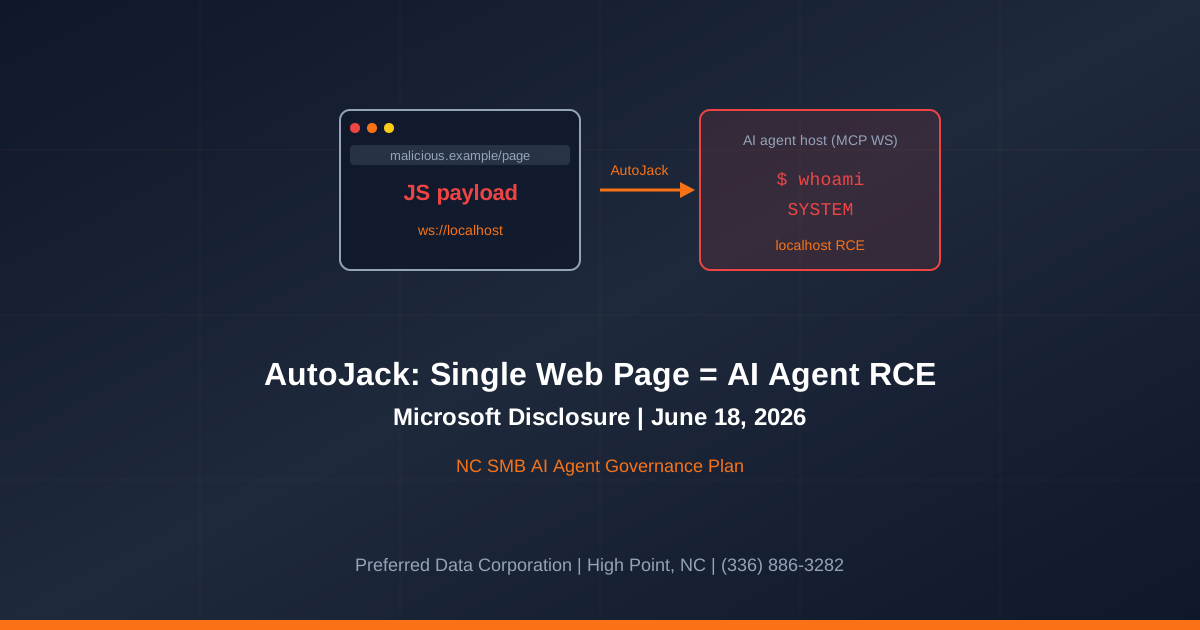
TL;DR: On June 18, 2026, Microsoft Security disclosed AutoJack, an attack technique where a single malicious web page can hijack an AI browsing agent and execute code on the host machine. The exploit chains three weaknesses in Microsoft's AutoGen Studio MCP WebSocket implementation, but Microsoft notes the same class of bug "could affect a broader class of agentic frameworks," per The Hacker News' coverage. For NC SMBs piloting agentic AI - browser agents, AutoGen, LangChain agents, MCP servers running on developer laptops - the lesson is blunt: the AI agent is a privileged local service on the workstation, and any web page it reads is a potential code-execution channel.
Key takeaway: AutoJack is not a single CVE. It is a class of agentic-AI flaw where the agent's "browse the web" capability and its "execute code locally" capability share the same trust boundary. Until that boundary is enforced, every browser-enabled AI agent on an SMB endpoint is a localhost RCE waiting for the wrong link.
Running AI agents on staff laptops? Get governance in place before the wrong tab loads. Preferred Data Corporation runs managed AI security and endpoint policy for NC SMBs, including agent inventory, MCP server hardening, and developer workstation EDR. Call (336) 886-3282 or request an AI agent risk review.
What is AutoJack and why is it different from previous prompt injection?
AutoJack is a host-level remote-code-execution exploit chain that abuses a web-browsing AI agent's local privileges. Per Microsoft's June 18, 2026 advisory and CSO Online's reporting, the attack works like this:
- The user runs an AI agent (early-development AutoGen Studio in the disclosed case) that exposes an MCP WebSocket on localhost.
- The agent is asked, or socially engineered via prompt injection, to open a single attacker-controlled web page.
- JavaScript on that page reaches the localhost MCP WebSocket through three chained weaknesses (insufficient origin checks, missing token validation, and an over-permissioned tool call).
- The web page spawns a process on the host with the same privileges as the agent. No sign-in, no further user interaction.
Previous prompt injection research has focused on the agent doing something it should not - leaking data, sending a message, calling an API. AutoJack is different. AutoJack uses prompt injection only to get the agent to load a URL. Everything that follows is browser-to-localhost code execution, the same class of bug that has plagued Electron apps and developer tooling for a decade. Per TechRadar's coverage, the agent's local trust is the breach surface, not the model.
How many NC SMBs are actually exposed to this?
More than the headline ("AutoGen Studio is a research project") suggests. Per the Microsoft Work Trend Index 2026 data summarized by Microsoft on shadow AI, 75% of workers already use AI at work and 78% bring their own tools. The exposed surface for an NC SMB therefore includes:
- Developers running AutoGen Studio, CrewAI, LangGraph, or LangChain agents locally.
- Sales and ops staff running Copilot Studio, Claude Desktop, ChatGPT Desktop, or browser-agent extensions (Anthropic's Computer Use, OpenAI Atlas).
- Any MCP server installed on a workstation - including the rapidly growing list of community MCP servers indexed by the Awesome MCP Servers list.
- Citizen-developer agent frameworks built into Notion, ClickUp, and Microsoft 365.
For a 25- to 100-person NC SMB, the realistic 2026 reality is: at least one workstation is running an MCP server today that the IT or security function does not know about.
What is the actual blast radius if one agent gets AutoJacked?
The same blast radius as any developer or power-user workstation compromise. Per the Awesome MCP Servers project documentation and the Microsoft Security Blog's broader May 2026 RCE analysis, an attacker who lands code execution as the agent's host process can:
| Stolen Resource | Why It Matters for an NC SMB |
|---|---|
| Cached SSO session tokens (M365, Google Workspace, Okta) | Mailbox impersonation, file exfil, finance impersonation |
| Local credential vaults (1Password CLI, Bitwarden CLI) | All saved business passwords in one harvest |
Cloud CLI tokens (~/.aws, ~/.azure, gcloud) | Direct production access without phishing the cloud admin |
| MCP server credentials (GitHub PAT, Slack, Linear, Notion) | Lateral movement across the SaaS stack |
| Local source code, customer data files | Direct exfil for extortion |
| Connected USB / mapped network drives | Pivot to file servers, plant-floor systems |
Per the Verizon 2026 DBIR, third-party involvement is now a factor in 48% of breaches - a typical NC SMB's agent stack is exactly that third-party surface.
Does AutoJack require a CVE patch or a policy change?
Both. Microsoft fixed the disclosed AutoGen Studio chain before it shipped to PyPI, per the Microsoft blog, but Microsoft is explicit that "AutoJack-class" issues will appear in other agent frameworks. The durable fix is a governance + endpoint policy that holds across whichever framework an employee installs next quarter.
Quotable definition: An AutoJack-class vulnerability is any agentic-AI framework flaw where (a) the agent exposes a privileged local interface (WebSocket, named pipe, localhost HTTP), (b) the agent reads attacker-controllable content (web pages, emails, documents), and (c) the local interface trusts requests originating from that content. The defense is to break the chain at any one of those three links.
What is the right 30-day rollout for an NC SMB?
A four-week sprint that lands inventory, endpoint controls, agent hardening, and policy in parallel. This is the same scope PDC runs inside the managed cybersecurity service:
| Week | Action | Outcome |
|---|---|---|
| 1 | Inventory every AI agent / MCP server installed on company endpoints (M365 audit, EDR process telemetry, developer self-attestation) | Shadow AI surface visible for the first time |
| 2 | Deploy EDR (or extend existing EDR) to every developer/Mac/Linux workstation; block localhost-to-WAN egress for agent ports where possible | AutoJack post-exploit behavior becomes detectable in minutes |
| 3 | Restrict AI agents to vetted frameworks via app allowlist / Intune Configuration Profile; require browser-agent extensions through a managed catalog | Unknown MCP servers stop appearing on endpoints |
| 4 | Publish an internal "Approved AI Agents" policy with sanctioned tools, prohibited patterns, and an incident-reporting channel | Shadow AI becomes governed AI, not banned AI |
Key takeaway: A 25-person NC SMB cannot stop employees from using AI agents - 78% already bring their own. What it can do is push agents to a known catalog, instrument every workstation with EDR, and assume that "the agent loaded a web page" is now an RCE primitive.
Should an NC SMB just ban browser-enabled AI agents until this shakes out?
No - that path loses the productivity dividend without fixing the actual risk. Per the Microsoft 2026 RSAC announcements on Agent 365, shadow AI grows in the absence of governance, not the presence of policy. The correct posture is:
- Sanction a small catalog of vetted browser-enabled agents (e.g., Copilot Studio, ChatGPT Desktop, Claude Desktop) so employees have a productive option.
- Restrict agent browsing to allowlisted domains where feasible (most enterprise agent frameworks support this in 2026).
- Treat the agent host as Tier-1 EDR coverage, identical to a developer workstation.
- Require workstation patching so AutoJack-class fixes from Microsoft, OpenAI, Anthropic, and others land within 7 days of release.
What is PDC's view on agent governance for a 25-person NC SMB?
For NC SMBs - including manufacturers piloting agentic copilots on the shop floor - PDC's recommended baseline is a three-layer stack:
- Endpoint - EDR on every device that runs an AI agent, including macOS and Linux developer laptops.
- Identity - Conditional Access that treats agent SSO logins as high-risk (require AAL2/MFA, deny on unmanaged devices).
- Catalog - A short, named list of approved agents with a published renewal/removal process every 90 days.
Per Microsoft's RSAC 2026 enterprise guidance, this is also what cyber-insurance carriers are starting to ask about at renewal in 2026.
How does Preferred Data Corporation help NC SMBs harden agent-enabled workstations?
PDC supports NC small businesses, manufacturers, and distributors with the three layers above as a single managed service:
- Managed cybersecurity with EDR coverage across Windows, macOS, and Linux workstations; SOC monitoring of identity and process events; and an incident-response retainer that treats agent-class compromise as a Tier 1 event.
- Managed IT services with MDM/Intune rollout, app catalog control, and patch management that gets vendor fixes installed inside the carrier-required window.
- AI transformation advisory that gives PDC's engineers the practical context to recommend which agent frameworks are safe to sanction, which to restrict to a sandboxed VM, and which to defer until the framework matures.
PDC has served NC small businesses for over 37 years with on-site coverage within 200 miles of High Point. The combination of local NC presence, 20+ year average client retention, and modern AI/MCP-aware endpoint controls is what gets agent governance deployed and verified in 30 days, not 30 weeks.
Want a one-page AI agent risk score for your NC SMB? Call (336) 886-3282 or request a 30-minute agent risk review.
Frequently Asked Questions
What is AutoJack in one sentence?
AutoJack is a Microsoft-disclosed exploit class where a single malicious web page hijacks an AI browsing agent and runs code on the user's machine by abusing the agent's localhost MCP WebSocket. Per Microsoft Security on June 18, 2026, the AutoGen Studio chain was fixed before public release, but the bug class affects a broader range of agent frameworks.
Was AutoJack actively exploited?
Microsoft reports the AutoGen Studio chain was disclosed via internal security research and was fixed before any public exploitation, per the Microsoft Security Blog. However, the underlying bug class - localhost agent service trusting attacker-controlled web content - has appeared in multiple frameworks in 2026 and should be treated as a generalized risk for any AI agent installed on staff workstations.
Do I need to patch anything if my staff uses only ChatGPT.com in a browser?
If staff use only the chat web app and no AI agent runs locally - no Claude Desktop, no ChatGPT Desktop, no AutoGen, no MCP server - the AutoJack chain does not apply to that user. But per Microsoft Work Trend Index data, 78% of users bring their own AI tools, so the practical answer for most SMBs is "you have agents running locally and do not know it - inventory first."
How is AutoJack different from the Agentjacking MCP attack reported in early June 2026?
Per The Hacker News' Agentjacking writeup, Agentjacking targets the agent's prompt and tool-selection logic to make the agent misuse its own tools. AutoJack uses prompt injection as a delivery mechanism but pivots to localhost RCE via the agent's MCP WebSocket - the agent does not need to be tricked into doing anything; the web page directly hijacks the agent's local interface.
How much does AI agent governance cost a 25-person NC SMB?
For a 25-person SMB with 5 developers and 20 knowledge workers, expect $40-$80 per endpoint per month for EDR + MDM bundles plus an initial $3K-$6K for an agent inventory and policy buildout. PDC bundles both inside the managed cybersecurity and managed IT services for predictable per-seat pricing.
Related Resources
- Managed Cybersecurity Services for NC Businesses - EDR, SOC monitoring, AI agent risk coverage
- Managed IT Services for NC Businesses - MDM, app catalog, patch management
- AI Transformation Advisory - Sanctioned agent catalog, governance baseline
- Agentjacking MCP Attack: NC SMB AI Coding Agent Defense - Companion AI agent risk post
- AI Agents Inside the Perimeter: Shadow AI Governance - Shadow AI rollout framework
- Contact Preferred Data Corporation - Schedule an AI agent risk review