
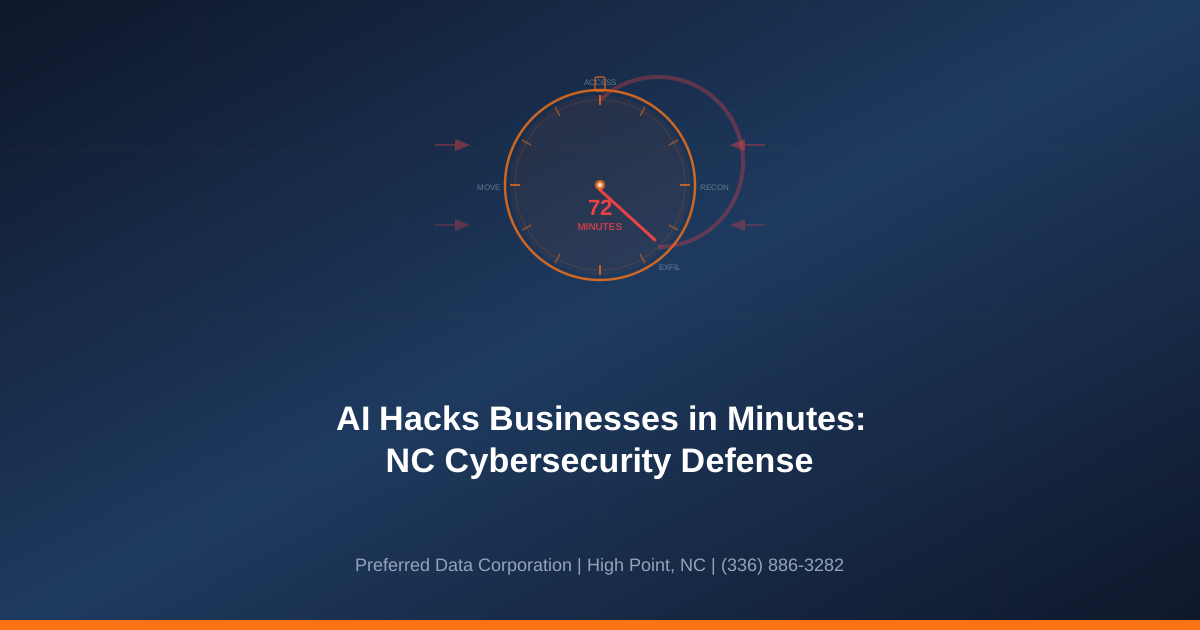
TL;DR: Modern cyberattacks powered by AI can move from initial access to complete data theft in under 72 minutes. With Claude Mythos scoring 83.1% on cybersecurity benchmarks and AI phishing achieving 54-78% open rates at 95% less cost, the speed of attacks has outpaced the ability of human-only security teams to respond. North Carolina businesses need automated, AI-powered detection and response systems that operate at machine speed.
Critical takeaway: The 72-minute attack timeline is not theoretical. Attackers are already using AI to accelerate every phase of a cyberattack, from initial phishing to data exfiltration. Organizations with AI-powered defenses detect threats 80 days faster and save $1.9 million per breach. For North Carolina SMBs, automated response is no longer a luxury, it is a necessity.
Can your business respond in 72 minutes? Contact Preferred Data Corporation at (336) 886-3282 for an emergency response readiness assessment. Serving High Point, Greensboro, Charlotte, Raleigh, and all of North Carolina since 1987.
How Fast Can AI-Powered Attacks Actually Strike?
Modern attackers using AI tools can move from initial access to data exfiltration in under 72 minutes. This timeline, documented by leading threat intelligence firms, represents a dramatic acceleration from the days and weeks that traditional attacks required. AI compresses every phase of the attack chain.
To understand the speed, consider the attack phases. Initial access through an AI-crafted phishing email takes seconds, with these messages achieving 54-78% open rates compared to just 12% for traditional phishing. Once an employee clicks, AI tools can automatically scan the compromised system, identify valuable data, escalate privileges, and begin extracting information, all without human attacker intervention.
Claude Mythos demonstrated that AI can discover thousands of zero-day vulnerabilities simultaneously, scoring 83.1% on the CyberGym benchmark. When attackers have access to similar AI capabilities for vulnerability exploitation, the time between "access gained" and "data stolen" collapses from hours to minutes.
For businesses in High Point, Greensboro, Charlotte, and across the Piedmont Triad, this speed fundamentally changes the security equation. A security team that checks alerts every few hours, or even every hour, cannot respond quickly enough. By the time a human analyst reviews the first alert, the attack may already be complete.
What Does a 72-Minute Attack Look Like?
Understanding the anatomy of a rapid AI-powered attack helps businesses appreciate why speed of defense matters as much as strength of defense. Here is what a typical 72-minute attack timeline looks like.
Minutes 0-5: Initial access. An AI-crafted phishing email, indistinguishable from a legitimate business communication, arrives in an employee's inbox at a manufacturing company in Winston-Salem. The employee clicks a link and unknowingly provides credentials. AI phishing emails cost 95% less to produce than traditional campaigns and achieve dramatically higher success rates.
Minutes 5-15: Reconnaissance. AI tools automatically scan the compromised account and connected systems. They identify the network topology, locate high-value targets such as financial databases and customer records, and map available pathways for lateral movement.
Minutes 15-35: Lateral movement and privilege escalation. The attack tools move through the network, compromising additional accounts and systems. AI identifies and exploits misconfigurations, weak credentials, and known vulnerabilities at machine speed, testing thousands of pathways simultaneously.
Minutes 35-55: Data identification and staging. Valuable data is identified, compressed, and prepared for exfiltration. Customer records, financial data, intellectual property, and proprietary manufacturing processes are all targeted.
Minutes 55-72: Exfiltration. Data is transmitted to attacker-controlled servers using encrypted channels that blend with normal business traffic. Simultaneously, the attack may deploy ransomware to lock systems and create an additional revenue stream.
| Attack Phase | Traditional Timeline | AI-Accelerated Timeline |
|---|---|---|
| Initial access (phishing) | Hours to days | Seconds to minutes |
| Reconnaissance | Days | 5-10 minutes |
| Lateral movement | Days to weeks | 10-20 minutes |
| Data identification | Hours to days | 10-15 minutes |
| Exfiltration | Hours | 10-20 minutes |
| Total elapsed time | Weeks to months | Under 72 minutes |
For manufacturing companies in the Piedmont Triad, construction firms in Charlotte, and professional services companies in Raleigh, this timeline means that the gap between "attack begins" and "damage done" has shrunk to barely over an hour.
Why Can't Human Security Teams Keep Up?
Human security teams, even excellent ones, operate at human speed. They need to see an alert, analyze its context, determine if it is a genuine threat, and then decide on and implement a response. Each of these steps takes minutes at minimum, often longer.
Consider the math. If a security analyst checks alerts every 30 minutes and takes 15 minutes to investigate a genuine threat, the minimum response time is 45 minutes. But that assumes the analyst catches the right alert immediately, has all the context needed, and knows exactly what to do. In reality, alert fatigue, false positives, and the complexity of modern IT environments stretch response times to hours or days.
The statistics reinforce this challenge. Organizations with AI-powered defenses detect threats 80 days faster than those relying on human-only approaches. That 80-day gap is the difference between catching an attacker during reconnaissance and discovering a breach months after data has been stolen.
For small businesses in High Point, Durham, and across North Carolina, staffing a security operations center with human analysts around the clock is cost-prohibitive. A single experienced security analyst can cost $80,000-$120,000 per year, and 24/7 coverage requires at least four full-time analysts. Most SMBs cannot justify that expense, which is precisely why 94% of SMBs use managed service providers in 2026.
What Technologies Enable Defense at Machine Speed?
Defending against 72-minute attacks requires security technologies that detect, analyze, and respond to threats automatically, without waiting for human intervention. Several technology categories are essential.
Endpoint Detection and Response (EDR): EDR solutions monitor every endpoint, from desktops to servers to mobile devices, for suspicious behavior. Unlike traditional antivirus that matches known signatures, EDR uses behavioral analysis to identify zero-day exploits and novel attack techniques. When Claude Mythos discovered thousands of zero-days, it reinforced why behavioral detection is essential.
Security Information and Event Management (SIEM): SIEM systems aggregate security data from across the entire IT environment, correlating events to identify attack patterns that individual systems would miss. Modern SIEM platforms use AI to reduce false positives and highlight genuine threats.
Security Orchestration, Automation, and Response (SOAR): SOAR platforms automate response actions. When a threat is detected, SOAR can automatically isolate compromised systems, block malicious IP addresses, disable compromised accounts, and begin forensic data collection, all within seconds.
Network Detection and Response (NDR): NDR monitors network traffic for anomalous patterns that indicate lateral movement, data staging, or exfiltration. For manufacturing companies in Greensboro and Winston-Salem, NDR is particularly important for detecting threats that cross from IT networks into OT environments.
These technologies work together to create a defense that operates at machine speed. When a phishing email leads to a compromised credential, EDR detects the anomalous behavior, SIEM correlates it with other events, and SOAR automatically contains the threat, all before a human analyst has finished their coffee.
What Does Effective Incident Response Look Like in 2026?
Effective incident response in the AI era combines automated machine-speed containment with human-led investigation and recovery. The goal is not to eliminate humans from the process but to automate the time-critical first response so that human expertise can be applied to strategic decisions.
Phase 1: Automated containment (0-5 minutes). When a threat is detected, automated systems immediately isolate the affected endpoint, block the attack's communication channels, and preserve forensic evidence. This containment happens before a human analyst is even notified.
Phase 2: Automated triage (5-15 minutes). AI analyzes the attack to determine its scope, identify all affected systems, and classify the severity. This analysis, which would take a human team hours, provides the foundation for informed decision-making.
Phase 3: Human-led investigation (15-60 minutes). Security professionals analyze the automated findings, determine the root cause, and develop a remediation strategy. Their expertise is applied to decision-making rather than data collection.
Phase 4: Recovery and hardening (hours to days). Systems are restored, vulnerabilities are patched, and defenses are strengthened to prevent similar attacks. Lessons learned are incorporated into automated detection rules.
For businesses across North Carolina, this model requires either building an in-house security operations center or partnering with a managed security provider that operates one on your behalf. Given the economics, partnering is the practical choice for virtually all SMBs. With 43% of cyberattacks targeting small businesses and the average breach costing $254,445, the investment in managed detection and response pays for itself many times over.
Does your business have a 72-minute response plan? Review our cybersecurity checklist or call Preferred Data at (336) 886-3282 to discuss your incident response readiness.
How Does MFA Slow Down AI-Powered Attacks?
Multi-factor authentication is the single most effective speed bump against AI-accelerated attacks. MFA blocks 99.9% of automated attacks according to Microsoft research. Even when AI-crafted phishing captures a password, MFA prevents that credential from being used without the second authentication factor.
This is critical because the 72-minute timeline assumes the attacker gains valid access. If MFA blocks that initial access, the entire attack chain collapses. The attacker must find an alternative entry point, which costs time and increases the chance of detection.
For businesses in Charlotte, Raleigh, Durham, and across North Carolina, MFA implementation should be the first priority. It protects email accounts, cloud services, VPN connections, and administrative interfaces. The technology is widely available, relatively inexpensive, and demonstrably effective.
However, MFA is not a complete solution. Sophisticated attacks can bypass some forms of MFA through real-time phishing proxies or social engineering. This is why MFA must be one layer in a comprehensive defense strategy that includes monitoring, automated response, and professional security management.
How Can Preferred Data Corporation Protect Your Business?
Preferred Data Corporation provides the machine-speed defense that North Carolina businesses need against 72-minute attacks. Our managed security services include 24/7 monitoring, automated threat detection and response, and expert human analysis, delivered by a team that has been protecting NC businesses since 1987.
Our cybersecurity services include endpoint detection and response, network monitoring, automated incident containment, and managed SIEM capabilities. When a threat is detected, our systems respond in seconds, not hours, containing the attack while our team investigates.
Our managed IT services ensure that your defenses are properly configured and maintained. Automated patch management closes vulnerabilities before attackers can exploit them. Our network infrastructure services implement segmentation and monitoring that limits lateral movement even if initial access is gained.
With over 37 years of experience, BBB A+ accreditation, and an average client retention of 20+ years, Preferred Data is the trusted security partner for businesses across the Piedmont Triad, Charlotte, Raleigh, Durham, Winston-Salem, and all of North Carolina. We provide on-site support within 200 miles of our High Point headquarters.
In a 72-minute attack, every second counts. Contact Preferred Data at (336) 886-3282 or visit our contact page to ensure your business can respond at the speed AI demands.
Frequently Asked Questions
Is the 72-minute attack timeline real or exaggerated?
The 72-minute timeline is based on documented threat intelligence. Some attacks complete even faster when targeting systems with weak credentials, missing patches, or no MFA. AI acceleration is compressing these timelines further as offensive tools become more capable.
What percentage of attacks on small businesses use AI?
Research shows 87% of organizations experienced AI-driven attacks in the past 12 months. With AI phishing achieving 54-78% open rates at 95% lower cost, it is more efficient for attackers to use AI tools, making AI-powered attacks the new baseline rather than the exception.
Can small businesses afford machine-speed security?
Yes, through managed security services. Building an in-house security operations center costs hundreds of thousands of dollars annually. Managed services from providers like Preferred Data deliver the same capabilities at a fraction of the cost, which is why 94% of SMBs use MSPs in 2026.
What is the most important defense against rapid attacks?
Multi-factor authentication is the single most impactful step, blocking 99.9% of automated attacks. Beyond MFA, endpoint detection and response with automated containment provides the machine-speed response needed to match AI attack velocity.
How quickly does Preferred Data respond to detected threats?
Our automated systems respond to detected threats in seconds, isolating compromised endpoints and blocking malicious activity before it can spread. Human analysts are alerted simultaneously and begin investigation within minutes, providing expert oversight of the automated response.
What happens if an attack occurs outside business hours?
With 24/7 monitoring and automated response, our systems protect your business around the clock. Attacks do not follow business hours, and neither does our defense. Automated containment operates identically at 3 AM as it does at 3 PM.
How does rapid attack speed affect cyber insurance?
Insurers increasingly require evidence of automated detection and response capabilities. Businesses with machine-speed defenses may qualify for better rates and coverage terms. Conversely, businesses relying on manual processes may face higher premiums or coverage limitations.
What should I do immediately to prepare for rapid attacks?
Enable MFA everywhere, ensure your endpoint protection includes behavioral detection, verify your incident response plan includes automated containment, and partner with a managed security provider. Call Preferred Data at (336) 886-3282 for an immediate assessment.