
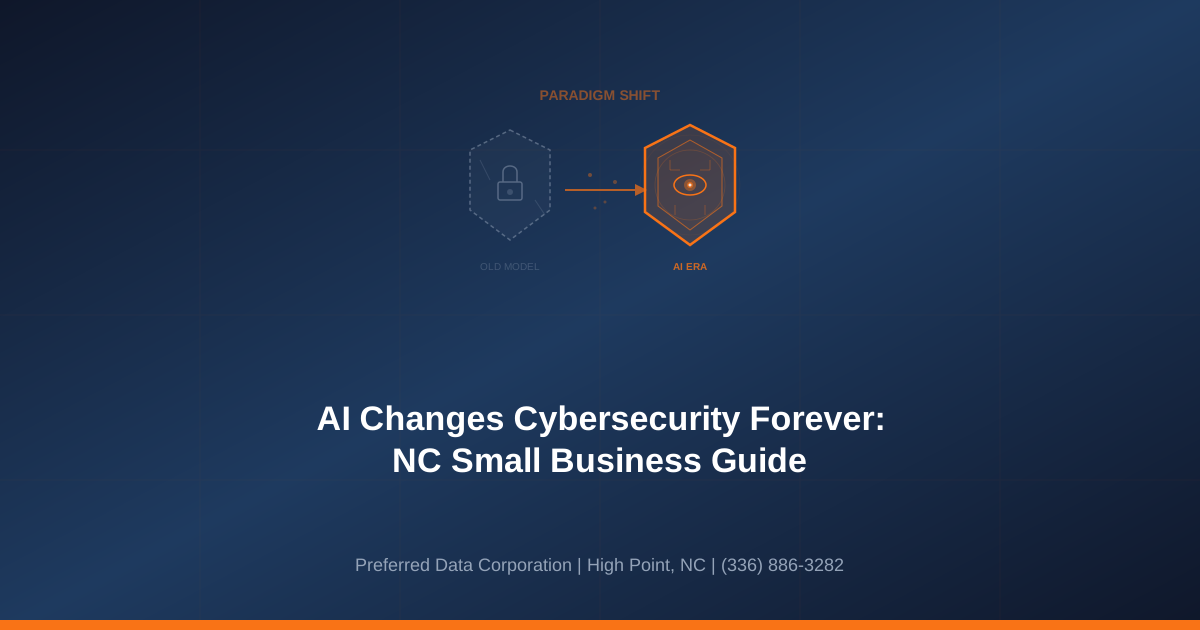
TL;DR: The cybersecurity landscape has undergone a permanent, fundamental shift. Claude Mythos's discovery of thousands of zero-day vulnerabilities, its 83.1% CyberGym score, and the launch of the $100 million Project Glasswing coalition signal that AI has permanently changed the offense-defense balance in cybersecurity. For North Carolina small businesses, the old rules no longer apply, and adopting AI-powered defenses is now a survival requirement.
Critical takeaway: We are witnessing the most significant change in cybersecurity since the invention of the firewall. Organizations with AI-powered defenses detect threats 80 days faster and save $1.9 million per breach. With 87% of organizations experiencing AI-driven attacks in the past 12 months, the shift is not coming, it is already here.
Is your cybersecurity strategy built for the AI era? Contact Preferred Data Corporation at (336) 886-3282 for a strategic security consultation. Protecting High Point, Greensboro, Charlotte, Raleigh, and all of North Carolina since 1987.
How Has AI Fundamentally Changed Cybersecurity?
AI has altered cybersecurity at its core by collapsing the time, cost, and expertise required to both attack and defend digital systems. Before Mythos, finding a single zero-day vulnerability might require a skilled researcher working for weeks. Mythos found thousands simultaneously. Before AI phishing tools, crafting convincing social engineering attacks required human creativity and effort. AI now produces phishing emails with 54-78% open rates at 95% lower cost.
This is not an incremental change. It is a paradigm shift comparable to the introduction of automatic weapons in warfare, where the fundamental assumptions about how conflicts are fought had to be rewritten. In cybersecurity, the assumptions that have guided defense strategies for two decades, that attackers need time, that obscurity provides some protection, that small businesses are not worth sophisticated attacks, are all now invalid.
The numbers quantify this shift. Claude Mythos scored 83.1% on the CyberGym benchmark versus 66.6% for its predecessor. In Firefox testing, exploit success jumped from 2 to 181 attempts. The AI achieved 93.9% on SWE-bench Verified. These are not improvements within an existing paradigm. They represent a new capability that did not exist before.
For businesses across North Carolina, from manufacturers in High Point to technology companies in Durham, this means the cybersecurity strategy that was adequate last year is no longer sufficient today.
What Did the Old Cybersecurity Model Look Like?
Understanding the paradigm shift requires understanding what it replaced. The traditional cybersecurity model for small businesses was built on several assumptions that held true for decades.
Assumption 1: Signature-based detection works. Antivirus software matched files against databases of known threats. This worked when new malware appeared at a manageable rate and reused recognizable code patterns. AI-generated malware invalidates this approach by creating novel variants faster than signature databases can be updated.
Assumption 2: Perimeter defense is primary. Firewalls and network boundaries were the first line of defense. While still important, the shift to cloud services, remote work, and interconnected supply chains has dissolved traditional perimeters. Businesses in Greensboro, Charlotte, and the Piedmont Triad need security that follows data wherever it goes.
Assumption 3: Humans set the pace. Both attack and defense operated at human speed. Security teams could analyze alerts, investigate incidents, and respond within hours or days. Attackers can now move from initial access to data theft in under 72 minutes, and AI accelerates this further.
Assumption 4: Small businesses are too small to target. When attacks required manual effort, targeting small businesses was often not worth the attacker's time. AI automation eliminates this barrier. Automated attacks can target thousands of small businesses simultaneously at negligible marginal cost, which is why 43% of cyberattacks now target small businesses.
| Old Cybersecurity Assumption | Status in 2026 | New Reality |
|---|---|---|
| Signature-based detection is sufficient | Obsolete | AI creates novel malware variants instantly |
| Perimeter defense is primary | Insufficient alone | Cloud and remote work dissolved perimeters |
| Human-speed response is adequate | Dangerously slow | AI attacks execute in under 72 minutes |
| Small businesses are not worth targeting | Completely false | 43% of attacks target small businesses |
| Obscurity provides some protection | Invalid | AI systematically scans all targets |
| Annual security audits are sufficient | Inadequate | Continuous monitoring is now mandatory |
What Does the New Cybersecurity Model Look Like?
The new cybersecurity paradigm is built on speed, automation, and intelligence. Instead of waiting for attacks and then responding, effective security now requires predicting, preventing, and responding to threats in real time, using AI-powered tools that operate at machine speed.
Continuous monitoring replaces periodic assessment. Annual or quarterly security audits are no longer sufficient when AI can discover thousands of vulnerabilities and attackers can exploit them within hours. Businesses in Winston-Salem, Raleigh, and across North Carolina need 24/7 security monitoring that detects anomalies the moment they occur.
AI-powered detection replaces signature matching. Modern endpoint detection and response (EDR) systems use behavioral analysis and machine learning to identify threats based on what they do, not what they look like. This catches zero-day exploits that have no known signature.
Zero-trust architecture replaces perimeter trust. Every user, device, and application must verify its identity and authorization for every access request. No entity is automatically trusted because it is inside the network perimeter.
Automated response supplements human analysis. When attackers move in under 72 minutes, waiting for a human to analyze and respond is not viable. Automated response systems can contain threats in seconds while human analysts investigate the root cause.
Organizations implementing these approaches detect threats 80 days faster and save $1.9 million per breach. For businesses across North Carolina, this is not just a security improvement, it is a competitive advantage.
Why Is the Offense-Defense Balance Shifting?
The balance between cyber offense and defense has historically favored attackers, and AI is amplifying this advantage in the short term. Understanding why is essential for businesses developing their security strategies.
Attackers benefit from AI in several ways. AI-powered phishing achieves 54-78% open rates versus 12% for traditional attempts. AI can discover zero-day vulnerabilities by the thousands, as Mythos demonstrated. AI can automate exploitation, moving from access to data exfiltration in under 72 minutes. And all of this costs 95% less than traditional attack methods.
Defenders face a different equation. They must protect every system, every application, and every user. Attackers only need to find one weakness. AI expands the number of known weaknesses dramatically while simultaneously making attacks faster and cheaper.
However, the defensive side is gaining powerful tools as well. Project Glasswing's $100 million investment in proactive vulnerability discovery, combined with AI-powered detection tools, is beginning to restore balance. The key differentiator is adoption speed. Businesses that implement AI-powered defenses now will be protected. Those that wait will face exponentially increasing risk.
For manufacturing companies in High Point, construction firms in Charlotte, and professional services companies in Durham, the message is clear: the window to upgrade defenses is closing. Every month without AI-powered security tools increases your exposure.
What Should NC Business Owners Understand About This Shift?
Business owners across North Carolina need to understand three fundamental truths about the new cybersecurity landscape.
First, cybersecurity is now a business survival issue, not an IT issue. With 60% of breached small businesses closing within six months and the average AI-related breach costing $254,445, cybersecurity failures directly threaten business continuity. Board members and business owners must treat security investment as essential as insurance.
Second, the cost of adequate defense has changed. Previous security spending focused on firewalls, antivirus, and occasional audits. The new model requires continuous monitoring, AI-powered detection, automated response, and professional management. While the absolute cost is higher, it is a fraction of the cost of a breach.
Third, doing nothing is the most expensive option. Ransomware costs are projected at $74 billion in 2026. With 75% of SMBs reporting they could not continue operating after a ransomware attack, and 87% of organizations experiencing AI-driven attacks in the past year, inaction carries the highest risk.
For businesses in Greensboro, Winston-Salem, the Piedmont Triad, and across North Carolina, these truths should inform every technology investment decision. The question is not whether your business can afford to upgrade its cybersecurity. The question is whether it can afford not to.
Ready to bring your security into the AI era? Take our free cybersecurity assessment or call Preferred Data at (336) 886-3282.
How Is Preferred Data Helping NC Businesses Navigate This Shift?
Preferred Data Corporation has been at the forefront of cybersecurity evolution since 1987. Over 37 years, we have helped North Carolina businesses navigate every major technology shift, from the emergence of network computing to the cloud migration era to the current AI revolution.
Our approach to the AI cybersecurity paradigm shift combines immediate protection with strategic transformation. Our cybersecurity services include AI-powered threat detection, endpoint protection, and 24/7 monitoring that matches the speed of modern threats. Our managed IT services ensure your infrastructure is hardened, patched, and properly configured to resist AI-powered attacks.
We recognize that North Carolina's manufacturing sector faces unique challenges. Our expertise with manufacturing environments includes OT/IT security convergence, legacy system protection, and compliance frameworks like CMMC. Our AI transformation services help businesses adopt defensive AI tools while managing the risks of AI adoption.
With BBB A+ accreditation, an average client retention of 20+ years, and on-site coverage within 200 miles of our High Point headquarters, Preferred Data is the cybersecurity partner NC businesses trust. We serve Charlotte, Raleigh, Durham, Greensboro, Winston-Salem, the Piedmont Triad, and communities across the state.
The cybersecurity paradigm has shifted. Your defense strategy must shift with it. Contact Preferred Data at (336) 886-3282 or visit our contact page to start the conversation. With 94% of SMBs using managed service providers in 2026, the question is not whether you need a cybersecurity partner, but whether you have chosen the right one.
Frequently Asked Questions
Is this really a permanent change or just hype?
This is a permanent, structural change in cybersecurity. Claude Mythos discovered thousands of zero-day vulnerabilities in a single pass, achieving 83.1% on the CyberGym benchmark. The $100 million Project Glasswing coalition, featuring Amazon, Apple, Google, and Microsoft, confirms the industry views this as a fundamental shift that requires systemic response.
How much should a small business spend on cybersecurity in the AI era?
Industry benchmarks suggest 7-15% of the IT budget for cybersecurity, though this varies by industry and risk profile. The critical calculation is comparing that investment against the $254,445 average cost of an AI-related breach and the 60% chance of closing within six months after a breach.
Can a small business in NC really defend against AI-powered attacks?
Yes, with the right tools and partners. Multi-factor authentication alone blocks 99.9% of automated attacks. Combined with managed security services, AI-powered detection, and automated patching, small businesses can achieve robust defense. Organizations with AI defenses detect threats 80 days faster and save $1.9 million per breach.
What is the biggest mistake businesses make during cybersecurity paradigm shifts?
Waiting to act. During every major shift in cybersecurity, the businesses that suffered most were those that assumed the old approach was still good enough. With 87% of organizations already experiencing AI-driven attacks, the shift is here now, not approaching.
How does this affect compliance requirements?
Regulatory frameworks are rapidly evolving to address AI threats. NIST, CMMC, and industry-specific standards are updating to require AI-aware security controls. Businesses that proactively adopt AI-era security practices will be ahead of compliance requirements rather than scrambling to catch up.
What role do employees play in the new cybersecurity model?
Employees remain critical. AI phishing achieves 54-78% open rates, making security awareness training more important than ever. However, the new model also reduces reliance on human judgment by implementing zero-trust controls and automated response systems that catch threats even when employees make mistakes.
Should I switch cybersecurity vendors because of AI threats?
Evaluate whether your current provider has AI-capable tools, 24/7 monitoring, and experience with the new threat landscape. If not, switching to a provider like Preferred Data Corporation that has invested in AI-era defenses could be the most important business decision you make in 2026.