
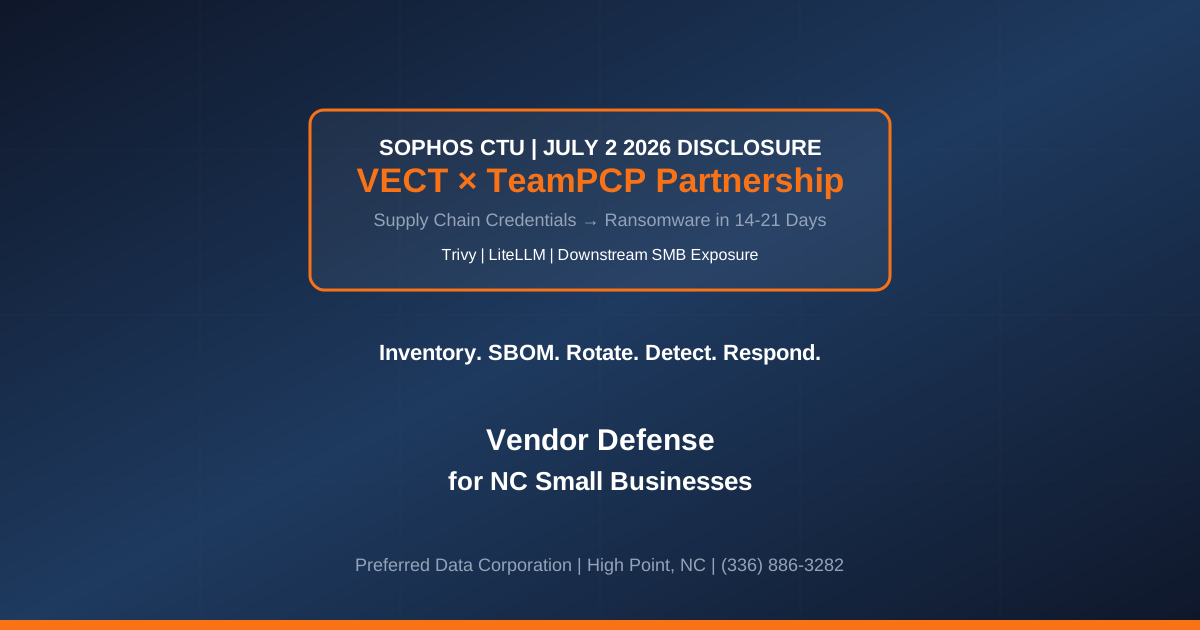
TL;DR: Sophos Counter Threat Unit's July 2, 2026 disclosure documents a formal March 2026 partnership between two threat actors — VECT (a ransomware-as-a-service operator) and TeamPCP (a supply-chain credential-theft operator). Under the arrangement, TeamPCP monetizes credentials harvested from the Trivy and LiteLLM open-source supply chain compromises by handing them to VECT for ransomware deployment. The result is that every downstream consumer of a compromised open-source component — including NC SMBs that consume software through their MSP, SaaS vendors, or in-house automation — is one broker hand-off away from ransomware. This is the operationalization of "supply chain risk is direct ransomware risk," and it demands a documented supply chain response playbook this quarter.
Key takeaway: The 2026 ransomware economy has an assembly line. Access brokers steal credentials at the supply chain layer, ransomware operators buy or partner for downstream deployment, and the SMB in the middle is the payload. Your defense must break the hand-off between broker and operator — with SBOM, credential rotation, and 24/7 detection — before it reaches your endpoints.
Do you know which of your MSP's tools, SaaS vendors, or open-source dependencies were touched by Trivy or LiteLLM in early 2026? Contact Preferred Data Corporation for a same-week supply chain audit. BBB A+ rated. On-site within 200 miles of High Point. Call (336) 886-3282.
What Is the VECT × TeamPCP Partnership?
Sophos Counter Threat Unit's July 2, 2026 threat intelligence disclosure documents a formal partnership announced in March 2026 between VECT and TeamPCP. The two groups previously operated separately — VECT as a ransomware-as-a-service (RaaS) operator and TeamPCP as a supply-chain credential-theft operator. Under the March 2026 arrangement, TeamPCP feeds credentials harvested from major open-source supply chain compromises directly to VECT for ransomware deployment.
Three defining characteristics of the partnership:
- Assembly-line specialization. TeamPCP focuses on high-yield supply chain intrusions and credential harvesting. VECT focuses on ransomware deployment, negotiation, and monetization. Neither group has to be excellent at both roles.
- Formal versus opportunistic. Prior access-broker relationships in the ransomware economy were transactional — one credential sold to one buyer for a fixed price. The March 2026 VECT × TeamPCP arrangement is standing and exclusive within specific supply chain campaigns.
- Downstream propagation. VECT commits to deploying ransomware across all organizations compromised in specific TeamPCP campaigns — currently the Trivy and LiteLLM supply chain attacks. This is not "one credential, one victim" — it is "one supply chain compromise, hundreds of downstream victims."
The partnership model is a mid-2020s evolution of the ransomware economy. Sophos, CrowdStrike, and Rapid7 have all documented similar consolidation trends. What makes the VECT × TeamPCP model distinctive is the direct pipeline from open-source component compromise to enterprise ransomware in the same operational tempo — often within weeks, not quarters.
Why Do Trivy and LiteLLM Matter for NC SMBs?
Trivy is one of the most widely-used open-source vulnerability scanners in the DevOps ecosystem. LiteLLM is an open-source LLM proxy that has become the default integration layer for organizations connecting internal apps to OpenAI, Anthropic, and other model providers. Both have massive downstream footprints in the software supply chain, and the 2026 compromises reached far into vendor stacks that NC SMBs indirectly consume.
Four channels through which Trivy or LiteLLM compromise reaches an NC SMB:
- Your MSP runs Trivy. MSPs routinely scan customer VMs, containers, and dependency trees with Trivy as part of vulnerability management. A compromised Trivy binary running in an MSP environment inherits every customer's credentials.
- Your SaaS vendors run Trivy or LiteLLM. Any SaaS vendor building an "AI feature" in 2025-2026 is likely running LiteLLM as the model-provider abstraction. Any SaaS vendor with a CI/CD security posture is likely running Trivy. Compromised vendors leak your account credentials and any data in scope of the vendor's access.
- Your in-house automation runs Trivy or LiteLLM. Custom quoting tools, AI chatbots, internal AI copilots, or DevOps automation scripts commonly pull LiteLLM as a dependency and Trivy in CI/CD. Compromised versions run with the privileges of the automation.
- Your customers or partners send you code. Consultants, contractors, and vendor integration teams routinely deliver scripts or containers with Trivy or LiteLLM dependencies.
Three 2026 regulatory realities make this direct SMB liability, not just vendor concern:
- FTC Safeguards Rule. SMBs subject to Safeguards must maintain a written information security program (WISP) with documented third-party service provider oversight. Supply chain compromise cascading through a vendor is explicitly in scope. The 2026 civil penalty adjustment is $51,744 per day per violation.
- CMMC 2.0 for defense contractors. NC manufacturers touching the defense industrial base must document their supply chain provenance and evidence third-party risk monitoring.
- Cyber insurance underwriting. 2026 renewal questionnaires from major carriers explicitly ask about SBOM, third-party risk continuous monitoring, and Trivy / LiteLLM exposure.
How Does the Supply-Chain-to-Ransomware Kill Chain Work?
The VECT × TeamPCP model compresses what used to be a multi-quarter kill chain into weeks. Understanding each stage helps size the risk to NC SMBs and identify where defense actually works.
Six-stage kill chain observed in Trivy and LiteLLM campaigns:
- Upstream open-source compromise. TeamPCP compromises a maintainer account or CI/CD pipeline for a popular open-source component. Malicious versions are published to public registries (npm, PyPI, GitHub Container Registry).
- Downstream propagation. Automated dependency updates (Dependabot, Renovate, Snyk auto-PR) or manual
npm update/pip install --upgradepulls the compromised version into downstream builds. - Credential harvesting on build. The compromised component runs during
npm installorpip installand exfiltrates credentials from the build environment — GitHub PATs, AWS keys, Azure service principal tokens, SaaS API keys. - Broker-to-operator hand-off. TeamPCP sorts harvested credentials by target attractiveness and hands the high-value credentials to VECT under the March 2026 partnership terms.
- VECT deployment. VECT uses the credentials to access the downstream victim's cloud environment, source-control systems, or on-prem infrastructure. Reconnaissance, lateral movement, and privilege escalation follow.
- Ransomware detonation. Data is exfiltrated, backup infrastructure is disrupted, and ransomware is deployed. The victim discovers the compromise on the ransom note, often 2-6 weeks after the initial supply chain intrusion.
The compression is what makes this dangerous. Historical access-broker economies had a multi-month lag between credential theft and ransomware deployment, giving detection tools time to catch up. The VECT × TeamPCP partnership compresses that to weeks. NC SMBs that "don't check GitHub audit logs monthly" have effectively no detection window.
Explore Preferred Data's cybersecurity services
How Should NC SMBs Break the Kill Chain?
Every stage of the kill chain has a defensive control. NC SMBs should implement at least one control per stage this quarter.
Stage 1 — Upstream (this month).
- SBOM for consumed software. Every SaaS vendor and MSP should be able to produce an SBOM on request. Any vendor that cannot is a supply chain risk in 2026 underwriting terms.
- Pin dependencies for in-house code. Move from floating semver ranges (
^1.2.3) to pinned versions (1.2.3) with lockfiles. Trivy and LiteLLM compromises would not have reached pinned consumers.
Stage 2 — Downstream propagation (next 30 days).
- Dependabot / Renovate with evaluation window. Do not merge dependency-update PRs the day they open. Wait 48-72 hours for community reports of malicious versions.
- Internal package registry. Artifactory, Nexus, or Verdaccio proxying npm and PyPI adds a controllable gate between the public registry and your CI.
Stage 3 — Credential harvest (next 30 days).
- Short-lived credentials. GitHub OIDC tokens, AWS IAM Roles Anywhere, and Azure workload identities eliminate long-lived PATs that survive credential theft.
- Secret scanning. GitHub Advanced Security, Gitleaks, or TruffleHog on every commit catches accidentally-committed credentials.
- Endpoint EDR on developer laptops. Developer laptops running
npm installare P0 endpoints and demand behavioral EDR.
Stage 4 — Broker-to-operator hand-off (ongoing).
- Threat intelligence subscription. MSSP threat feeds and CISA KEV alerts identify supply chain campaigns within days. Sophos, CrowdStrike, and Rapid7 all publish attribution against VECT-family and TeamPCP-family activity.
- PAT and OIDC token rotation. Every 90 days minimum. After any supply chain event impacting your dependency tree, immediately.
Stage 5 — Post-intrusion detection (ongoing).
- 24/7 managed detection and response (MDR). Human-in-the-loop MSSP SOC coverage is the only reliable defense against the weeks-fast kill chain. In-house SOC is not viable at NC SMB scale.
- Behavioral anomaly detection. Unusual GitHub PAT usage, unusual AWS API calls, unusual source-control activity outside business hours — the earliest signals that credentials are being used by VECT-family operators.
Stage 6 — Ransomware readiness (ongoing).
- Immutable backups. 3-2-1-1-0: three copies, two media, one offsite, one immutable, zero errors. Test restore quarterly.
- Documented incident response plan. Written runbook with roles, communication paths, escalation criteria, and 24/7 IR provider on retainer.
| Control | Kill chain stage | Effort |
|---|---|---|
| Vendor SBOM request | Upstream visibility | 1-2 weeks |
| Pinned deps + lockfile | Downstream propagation | 1 week |
| Internal npm registry | Downstream propagation | 4-6 weeks |
| Short-lived GitHub OIDC | Credential harvest | 2-3 weeks |
| Developer laptop EDR | Credential harvest | 1-2 weeks |
| MSSP threat feed | Broker hand-off | 1-2 weeks |
| PAT rotation policy | Broker hand-off | 1 week |
| 24/7 MDR | Post-intrusion | 2-4 weeks onboarding |
| Immutable backups | Ransomware readiness | 4-6 weeks |
| Documented IR runbook | Ransomware readiness | 1-2 weeks |
Read Preferred Data's vendor risk guide
What Are the Warning Signs You Are Downstream of Trivy or LiteLLM Compromise?
Post-compromise, the fingerprint is consistent. NC SMBs should hunt these signals through Q3 2026.
High-confidence indicators of downstream exposure:
- Trivy or LiteLLM in dependency tree.
npm ls,pip show,mvn dependency:tree, and container image scans should catalog these. If they appear, review versions against Sophos IoC reports. - New OAuth apps registered against your GitHub org since March 2026. Post-credential-theft, attackers register OAuth apps for persistence.
- Unfamiliar SSH keys on internal Git servers. Attackers add SSH keys for out-of-band re-entry.
- GitHub PAT usage from unfamiliar IPs. Review "Personal access tokens" audit logs. Any PAT used from a non-corporate IP after March 2026 is a rotation candidate.
- CI build durations anomalous.
npm installorpip installsteps taking 20-40% longer often correlate with credential-exfiltration payloads.
Lower-confidence but worth reviewing:
- Newly-created private repos with unusual names.
- Team members receiving GitHub or SaaS verification emails they did not initiate.
- Cloud spend anomalies — unexpected AWS Lambda, Azure Function, or GCP Cloud Run invocations.
If any of these are present, treat as active incident. Isolate CI runners, rotate all developer credentials, review OAuth apps and SSH keys, and escalate to a 24/7 incident response provider.
If you find supply chain IoCs, call Preferred Data at (336) 886-3282 for expedited incident response.
How Does This Connect to the Broader 2026 Ransomware Pattern?
The VECT × TeamPCP partnership fits a broader 2026 pattern of ransomware economy consolidation and vertical integration. Understanding the pattern helps NC SMBs prioritize investment.
Three connected 2026 ransomware economy trends:
- Access broker → ransomware operator formalization. VECT × TeamPCP is not unique. Sophos also documents 2026 partnerships in the Anubis, Qilin, and DragonForce families. RaaS operators are locking in reliable credential suppliers.
- Supply chain as the highest-yield access vector. One TeamPCP compromise of Trivy touches thousands of downstream consumers. Compared to phishing individual SMBs, supply chain is orders of magnitude more efficient for the operator economy.
- AI-assisted exploitation compression. The VECT × TeamPCP model uses AI in credential sorting, target prioritization, and post-intrusion reconnaissance. The kill chain that was 90 days in 2023 is 14-21 days in 2026.
For NC manufacturers, construction firms, healthcare providers, and professional-services offices, supply chain risk is now the leading edge of the ransomware economy — not the trailing edge.
How Does Preferred Data Deliver Supply Chain Defense?
Preferred Data Corporation delivers software supply chain audits, SBOM generation, MSP oversight for supply chain risk, GitHub configuration hardening, CI/CD isolation, short-lived credential migration, 24/7 managed detection and response, and expedited incident response for NC manufacturers, construction firms, healthcare providers, professional-services offices, and financial institutions.
With 37+ years of North Carolina IT expertise and an average client retention of 20+ years, our supply chain program integrates with your existing developer, MSP, and insurance controls.
Our VECT × TeamPCP response package includes a dependency audit across in-house and MSP-managed codebases with specific Trivy and LiteLLM version review, an SBOM aligned with FTC Safeguards and cyber insurance requirements, GitHub OAuth app and SSH key inventory, PAT and OIDC token rotation across your organization, and post-March-2026 supply chain incident review.
For businesses within 200 miles of High Point, we deliver on-site support when the situation demands hands-on-keyboard developer engagement.
Explore Preferred Data's managed IT services
Frequently Asked Questions
What is the VECT × TeamPCP partnership?
A formal March 2026 partnership documented in Sophos Counter Threat Unit's July 2, 2026 disclosure. VECT is a ransomware-as-a-service operator; TeamPCP is a supply-chain credential-theft operator. Under the partnership, TeamPCP feeds credentials harvested from Trivy and LiteLLM supply chain compromises to VECT for ransomware deployment.
Why do Trivy and LiteLLM matter to an NC SMB?
Trivy is one of the most widely used open-source vulnerability scanners; LiteLLM is a widely used LLM proxy. Both are in the dependency trees of MSPs, SaaS vendors, and in-house automation. NC SMBs that consume software from any of these channels are downstream of the compromises.
We do not have developers. Are we still exposed?
Yes. Your MSP, SaaS vendors, marketing tools, and any in-house automation almost certainly consume some open-source dependencies. Supply chain compromise cascades to consumers. FTC Safeguards, cyber insurance, and CMMC 2.0 all increasingly treat vendor supply chain oversight as required.
How fast is the kill chain from compromise to ransomware?
Historically 60-90 days. Under the VECT × TeamPCP model, Sophos documents 14-21 days from initial supply chain compromise to ransomware deployment on the downstream victim.
What is an SBOM and do we need one?
Software Bill of Materials — a machine-readable list of every component in a software artifact, with versions and provenance. Yes, in 2026 you need one for any in-house code and evidence of vendor SBOMs for consumed software. Cyber insurance renewals increasingly require both.
Should we run an internal package registry?
For SMBs with meaningful in-house development, yes. Artifactory, Nexus, or Verdaccio proxy public npm and PyPI and pin versions. This defends against zero-day upstream compromise where a malicious version reaches the public registry before takedown.
What is the fastest control we can deploy this month?
PAT rotation and MFA on every GitHub and SaaS admin account. It closes the highest-yield attack path for the broker-to-operator hand-off. Add developer-laptop EDR next.
Can Preferred Data audit our supply chain this month?
Yes. Our supply chain audit is a 5-10 day engagement for a typical NC SMB and delivers a dependency and SBOM inventory, a GitHub configuration review, a CI/CD hardening plan, and a prioritized remediation roadmap. Call (336) 886-3282 to start.