
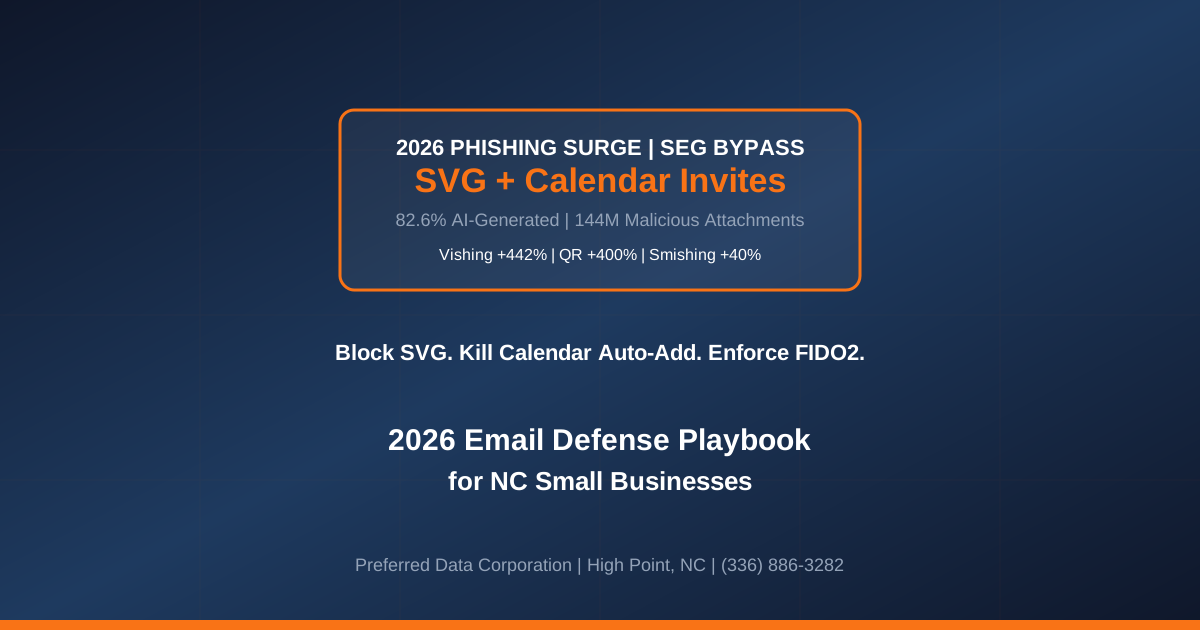
TL;DR: Multiple 2026 threat reports converge on the same conclusion: phishing has broken through the traditional secure email gateway (SEG). Hoxhunt's 2026 report finds AI-generated phishing now accounts for 82.6% of detected phishing emails, with 54% click rates matching human red-team experts. Google's June 2026 frauds and scams advisory documented fake renewal notices delivered as Google Calendar invites and scam apps abusing "invisible pages" in cloud documents to host malicious instructions. Individuals and corporate users encountered over 144 million malicious email attachments in 2025 (+15% YoY). Two attachment classes broke through in 2026 — SVG files carrying embedded JavaScript that most SEGs treat as image files, and ICS calendar invites that skip the primary inbox scan. Multi-channel attacks compound the risk: vishing surged 442%, QR phishing 400%, smishing 40%. For NC SMBs, this is a wholesale email defense refresh, not a SEG tuning exercise.
Key takeaway: In 2026, "we have Microsoft Defender / Google Workspace / Proofpoint / Mimecast, we're covered" is not defensible. Attackers have retooled around the SEG. Human-layer defense — training, ritualized verification, and phishing-resistant MFA — has to carry more weight than in 2024.
Is your email stack hardened for the 2026 phishing wave? Contact Preferred Data Corporation for a same-week email security assessment and phishing simulation. BBB A+ rated. On-site within 200 miles of High Point. Call (336) 886-3282.
Why Is Phishing Different in 2026 Than It Was in 2024?
Three fundamental shifts happened between 2024 and 2026 that render 2024-era email defenses insufficient. Hoxhunt's 2026 phishing trends report, StationX's 2026 phishing statistics, Cloudsek's top 11 trends, and Google's June 2026 fraud advisory all converge on the same shifts.
Shift 1 — LLM-generated content at scale. In 2024, phishing operators could produce hyper-personalized emails but only for high-value targets. In 2026, LLM-driven personalization at bulk-phishing cost has eliminated the boundary between spear-phishing and mass-phishing. Every email is unique. Template and hash-based SEG detection lost its effectiveness. Hoxhunt reports 82.6% of detected phishing is AI-generated with click rates matching human red-team experts (54%).
Shift 2 — Attachment innovation. Traditional Office macros are dead as an attack vector after Microsoft's 2022 default block. Attackers moved to alternatives: SVG files with embedded JavaScript (image-file loophole in most SEGs), HTML attachments with embedded phishing kits, OneNote files, ISO/IMG containers, and — critically for 2026 — ICS calendar invites that trigger a calendar-app scan instead of an email-attachment scan.
Shift 3 — Multi-channel and multi-stage. 2026 phishing rarely fits inside a single email. Vishing surged 442%, QR-code phishing surged 400%, smishing surged 40%. Attackers combine an initial email with a follow-up phone call, a QR code that pivots the target to a mobile browser (bypassing the corporate SEG entirely), or an SMS that references the initial email.
Key takeaway: SEGs were designed for a 2018 world of template-based, macro-delivered, single-channel phishing. Every one of those assumptions is invalid in 2026.
How Do SVG Attachments and Calendar Invites Bypass SEGs?
The two attachment innovations that dominate 2026 phishing telemetry work by exploiting product-category assumptions rather than product-specific bugs.
SVG attachments — the image-file loophole.
SVG (Scalable Vector Graphics) files are treated as images by most email clients and SEGs. But SVG is XML with embedded scripting support — <script> blocks execute when the SVG renders in a browser. Attackers use SVG attachments in three ways:
- Direct payload delivery. The SVG contains obfuscated JavaScript that runs when the recipient opens the attachment in a browser (default handler on many endpoints).
- Phishing kit delivery. The SVG renders as a login page inside the browser, harvesting credentials from within the local file context — no external site to block.
- Steganographic C2. The SVG appears benign but decodes commands from pixel data at runtime.
Most 2024-era SEGs bypass SVG attachment scanning because "images are safe." That assumption is wrong in 2026.
ICS calendar invites — the calendar-scan loophole.
Calendar invite attachments (.ics files) hit a different pipeline than email attachments. Microsoft Outlook, Google Calendar, and Apple Calendar auto-parse .ics files and often generate calendar entries automatically, sometimes with links or attachments embedded in the "notes" field. Attackers use ICS in three ways:
- Renewal-notice lures. Google's June 2026 advisory documented fake renewal notices arriving as Calendar invites. The user sees "Renew Subscription — 3 PM" on their calendar and clicks the meeting link, which routes to a phishing site.
- Direct calendar spam. Google Calendar's default "add invitations to calendar automatically" setting means an invite from a stranger can land on the user's calendar without any inbox interaction. The user sees the entry on their calendar, assumes it is legitimate, and follows the link.
- Embedded phishing URL. The ICS file description or location field carries the phishing URL, which many SEGs do not scan the same way they scan email body links.
Combined with LLM-generated personalization, both attachment classes produce emails that clear Microsoft Defender for Office 365, Proofpoint, Mimecast, Cisco IronPort, and Abnormal Security with click-through-worthy click rates.
What Compensating Controls Actually Work?
The industry pattern in 2026 is layered defense that assumes SEG failure at some rate. Every NC SMB should deploy each of the following.
Identity layer:
- Phishing-resistant MFA on every account. FIDO2 / passkeys defeat credential phishing outright. SMS OTP and push-notification MFA without number matching are 2026-inadequate.
- Conditional access on sign-in. Sign-in-frequency, session-lifetime, and device-compliance policies limit the value of a stolen session cookie or credential.
- OAuth application governance. Constrain which OAuth apps can be granted mail-read or mail-send permissions. Attackers use OAuth persistence to survive credential resets.
Email hardening:
- DMARC to
p=reject. Move fromp=noneorp=quarantinetop=reject. This prevents attackers from spoofing your own domain to your own employees. - Block SVG attachments at the SEG. Most legitimate business email does not carry SVG attachments. The rare exception can be allow-listed.
- Force ICS attachments through a scanning workflow. Configure Microsoft 365 or Google Workspace to treat ICS attachments the same as executable content.
- Disable Google Calendar auto-add for external invites. In Google Workspace, set "Add invitations to my calendar" to "Only if the sender is known."
- Enable Safe Links and Safe Attachments in Microsoft 365 (or the equivalent in Google Workspace, Proofpoint, Mimecast).
Human layer:
- Continuous phishing simulation. Quarterly at minimum, monthly for higher-risk industries. Coach repeat clickers 1:1.
- Awareness training modules that reflect 2026 attack surface. Cover SVG attachments, calendar invites, LLM-personalized emails, and multi-channel (vishing / QR / SMS) attacks explicitly.
- "Verify before you click" ritual. Any email requesting money movement, credential change, or urgent action must be verified through a known-good channel before action.
Network layer:
- DNS-layer filtering (Cloudflare Gateway, Cisco Umbrella, Zscaler) blocks known-malicious domains before the browser renders.
- Browser isolation for high-risk personas (executives, finance, IT) reduces blast radius when a phish lands.
| Control | Addresses | Priority |
|---|---|---|
| Phishing-resistant MFA (FIDO2) | Credential harvesting | P0 |
DMARC p=reject | Domain spoofing | P0 |
| SVG attachment block | Image-file loophole | P0 |
| Calendar auto-add disable | Calendar spam | P0 |
| Phishing simulation | Human-layer decay | P1 |
| DNS-layer filtering | Malicious landing pages | P1 |
| Browser isolation | High-risk personas | P2 |
| Continuous SBOM | Cyber insurance alignment | P2 |
Explore Preferred Data's cybersecurity services
What Are the New Multi-Channel Attack Patterns?
2026 phishing rarely lives in a single email. StationX's 2026 phishing statistics document 442% surge in vishing, 400% in QR phishing, and 40% in smishing. The common pattern is a two- or three-stage sequence.
Pattern 1 — Email plus vishing.
- Stage 1: Personalized email arrives, referencing a known vendor, order, or invoice.
- Stage 2: 10-30 minutes later, a phone call from a US-area-code (spoofed) number identifies as the vendor, references the email, and directs the target to click a link or provide MFA codes.
- Stage 3: The target, primed by the email and the call, complies.
Pattern 2 — Email plus QR code.
- Stage 1: Email arrives with a QR code (embedded PNG or SVG) rather than a hyperlink.
- Stage 2: The user scans with their personal phone, bypassing corporate SEG and DNS filtering.
- Stage 3: The mobile browser lands on the phishing site with none of the corporate security layers active.
Pattern 3 — Calendar invite plus follow-up email.
- Stage 1: Calendar invite auto-adds to the user's calendar.
- Stage 2: A follow-up email references the calendar entry ("as scheduled for 3 PM today, please…").
- Stage 3: The user believes the calendar entry validates the follow-up.
Pattern 4 — Cloud-document invisible page.
- Stage 1: Email invites the user to a Google Docs, Notion, or SharePoint document.
- Stage 2: The document contains a hidden or "invisible" page with the actual phishing content.
- Stage 3: Because the document is legitimate and the initial visible content is benign, SEGs and endpoint EDR both let it through.
Awareness training must specifically cover each pattern by name.
Learn about Preferred Data's managed IT services
What Are the Warning Signs of a 2026 Phishing Attempt?
Even a well-crafted 2026 phish leaves fingerprints. Train employees to look for these patterns before clicking anything.
High-confidence indicators:
- SVG attachment on a business email. Legitimate business email essentially never uses SVG attachments. Treat any SVG attachment as a phishing candidate unless you have specifically pre-arranged its receipt.
- Calendar invite from a stranger. Any invite from a sender not in the recipient's directory or previous conversations should be reviewed before adding to calendar.
- Reply-to mismatch. Sender appears to be a known vendor but reply-to routes to an external free-mail account.
- Urgency plus authority. "The CFO needs this by end of day" or "Final notice" language combined with an unusual request pattern.
- QR code in email body. Legitimate business email rarely uses QR codes as the primary interaction mechanism.
- Cross-channel follow-up. A phone call, SMS, or Teams message referencing an email is not automatic legitimacy — it can be Stage 2 of a multi-channel phish.
Lower-confidence but worth reviewing:
- New OAuth applications registered against tenant with mail permissions.
- Unusual login geographies against Microsoft 365 or Google Workspace.
- Newly-created forwarding rules on executive mailboxes.
- Employee reports of "weird email that felt off."
If any of these appear, treat as a live phishing incident: preserve headers, notify your MSP or SOC, and pull the message from other inboxes.
If a 2026-class phish lands, call Preferred Data at (336) 886-3282 for expedited investigation and containment.
How Does This Connect to the Broader 2026 Threat Pattern?
The 2026 phishing wave fits a consistent pattern: attackers commoditized personalization, retooled around SEGs, and shifted to multi-channel and multi-stage sequences that assume the initial email will get through. Google's June 2026 fraud advisory, Hoxhunt's 2026 trends, Cyble's Top 11 phishing trends, Cloudsek's analysis, and Kaspersky's 2026 SMB report all describe variations on the same theme.
Three connected 2026 trends every NC SMB should track:
- AI-generated phishing is the default. 82.6% of detected phishing is AI-generated. Template-based defense is obsolete.
- Multi-channel is the new normal. Vishing, smishing, and QR phishing surged 40-442% year over year. A single-channel defense misses more than half the attack surface.
- Attachment innovation continues. SVG, ICS, HTML, and cloud-doc invisible pages defeat mid-2020s attachment scanners. The next attachment loophole will emerge within 12 months.
For NC manufacturers, construction firms, healthcare providers, and professional-services offices in the Piedmont Triad, Charlotte, Raleigh, and Greensboro, email defense is a governance program with quarterly refresh, not a project you complete once.
Read Preferred Data's AI phishing guide
How Does Preferred Data Deliver Email Defense for NC SMBs?
Preferred Data Corporation delivers email security assessment, phishing simulation and awareness training, SEG tuning, DMARC/DKIM/SPF hardening, phishing-resistant MFA rollout, OAuth application governance, incident response for phished accounts, and 24/7 managed detection and response for NC manufacturers, construction firms, healthcare providers, professional-services offices, and financial institutions. With 37+ years of North Carolina IT expertise and an average client retention of 20+ years, our email defense program integrates the identity, mail, and human layers into a single continuous cycle.
Our 2026 phishing hardening package includes a fleet-wide email security assessment, SVG attachment blocking, calendar auto-add disable, DMARC enforcement to p=reject, phishing-resistant MFA on every account, a targeted phishing simulation with 2026-specific lures, and 24/7 SOC coverage.
For businesses within 200 miles of High Point, we deliver on-site workforce training when the situation calls for hands-on engagement.
Review our cybersecurity checklist
Frequently Asked Questions
How much of 2026 phishing is AI-generated?
Hoxhunt's 2026 phishing trends report finds AI-generated phishing accounts for 82.6% of detected phishing emails, with click-through rates of 54% matching human red-team experts. Template and hash-based SEG detection is largely defeated.
Why are SVG attachments a phishing vector?
SVG (Scalable Vector Graphics) files are XML with scripting support — they can contain JavaScript that executes when opened in a browser. Most 2024-era SEGs treat SVG as an image file and skip deep inspection. Attackers use SVG for direct payload delivery, phishing-kit delivery, and steganographic command-and-control.
Why are calendar invites a phishing vector?
Calendar (.ics) attachments hit calendar-parsing pipelines rather than email-attachment scanning pipelines. Google Calendar auto-adds invitations by default, so a phishing invite lands on the user's calendar without any inbox interaction. Google's June 2026 fraud advisory documented fake renewal notices arriving as calendar invites.
What does DMARC p=reject do?
DMARC (Domain-based Message Authentication, Reporting, and Conformance) p=reject tells receiving mail servers to reject any email claiming to be from your domain that fails SPF/DKIM authentication. This prevents attackers from spoofing your own domain to your own employees or partners.
Does phishing-resistant MFA stop 2026 phishing?
Yes, at the credential layer. Phishing-resistant MFA (FIDO2 / passkeys) defeats credential phishing outright. It does not stop the initial phish from landing, but it prevents the follow-on account takeover that turns a successful phish into a business email compromise.
What is a "verify before you click" ritual?
A documented policy that any email requesting money movement, credential change, wire transfer redirection, or urgent action must be verified through a known-good channel (a phone number from an internal directory, an in-person confirmation, an in-app message from a known account) before action. Even 30 seconds of verification defeats most 2026 phishing sequences.
How often should we run phishing simulations?
At minimum quarterly, monthly for higher-risk industries (financial services, healthcare, defense contractors). Simulations should reflect current 2026 lures — SVG attachments, calendar invites, LLM-personalized emails, and multi-channel sequences.
Can Preferred Data assess our email security this week?
Yes. Our email security assessment is a 3-5 day engagement for a typical NC SMB and delivers a SEG tuning review, DMARC/DKIM/SPF configuration audit, phishing simulation baseline, and a prioritized remediation roadmap. Call (336) 886-3282 to start the engagement.