
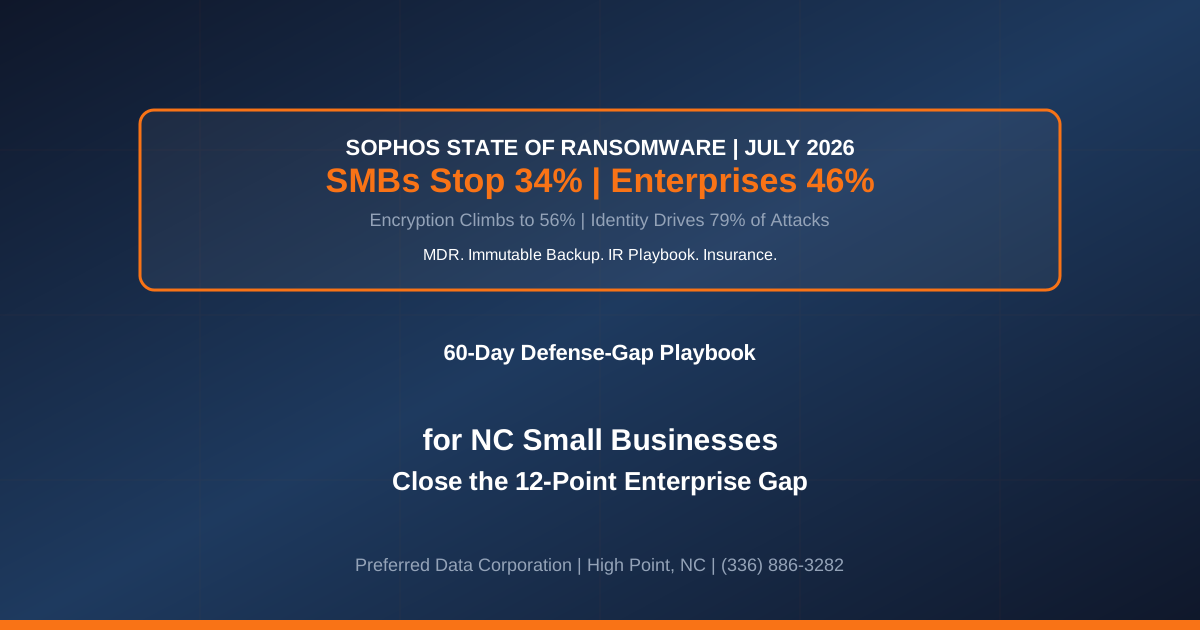
TL;DR: Sophos published the "State of Ransomware 2026" report in July 2026 - its seventh annual edition - based on a Vanson Bourne survey of 2,158 IT and cybersecurity leaders whose organizations were hit by ransomware in the previous 12 months, spanning 17 countries and organizations of 100-5,000 employees. The headline finding for NC SMBs is stark: organizations of 100-250 employees stopped only 34% of ransomware attacks before encryption or extortion, versus 46% at 3,001-5,000 employee organizations. That 12-point gap is a real, measurable defensive shortfall driven by 24/7 coverage, investigation capacity, and playbook maturity. Sophos also reports that data-encryption success rebounded to 56% in 2026 (up from 50% in 2025 but still below the 75% 2023 peak), payment rates continue to decline, and 79% of ransomware attacks now originate from compromised identities with 67% of incidents tied directly to the most significant identity attack. Malicious email (26%) and phishing (24%) together account for half of all incidents. The 34% number is not "small business is doomed." It is a specific gap that can be closed with 24/7 MDR (Managed Detection and Response), identity-first defense, tested immutable backup, an actual IR playbook, and pre-selected IR vendor retainers.
Key takeaway: The Sophos 2026 report says the gap between enterprise ransomware outcomes and SMB ransomware outcomes is not a size problem or a budget problem. It is a coverage problem. Enterprises stop more attacks because they have someone watching the console at 3 a.m. on Saturday. NC SMBs that add 24/7 MDR coverage - either through an MSP with an in-house SOC or through a managed EDR/XDR service - close most of the gap for a fixed monthly cost that is a fraction of the average NC SMB breach cost.
Is your NC SMB one of the 66% that would not have stopped a 2026 ransomware attack? Contact Preferred Data Corporation for a ransomware readiness assessment including EDR/MDR gap analysis, immutable backup verification, IR playbook review, and cyber-insurance evidence packet. BBB A+ rated, 24/7 SOC, 100+ NC clients. Call (336) 886-3282.
What Did Sophos Publish in July 2026 and Why Does It Matter for NC SMBs?
Sophos published the "State of Ransomware 2026" report in July 2026, based on a Vanson Bourne survey conducted January-March 2026 of 2,158 IT and cybersecurity leaders in organizations from 100 to 5,000 employees across 17 countries whose organizations had been hit by ransomware in the previous 12 months. The report is the seventh annual iteration of the Sophos ransomware benchmark and is a widely referenced dataset in cyber insurance underwriting, MSP planning, and corporate board reporting.
Three concrete facts every NC SMB should absorb:
- The 100-250 employee segment stopped 34% of attacks before encryption or extortion. The 3,001-5,000 employee segment stopped 46%. The gap is 12 percentage points and is consistent across geographies.
- Encryption success rebounded to 56% in 2026, up from 50% in 2025 but still below the 75% 2023 peak. The Sophos frame for 2026 is "Payments Drop as Encryption Climbs" - attackers are getting past defenders to encryption more often, even as more victims refuse to pay. Data-only extortion is a rising share of incidents but not yet the majority.
- 79% of ransomware attacks now originate from compromised identities, and 67% of ransomware incidents are directly tied to the victim organization's most significant identity attack. Malicious email (26%) and phishing (24%) together account for half of all incidents. Payment rates continue to decline year-over-year but time-to-recovery lengthens.
The 34%/46% gap is the number NC SMB executives should carry into their next board meeting. It is a measurable, specific, closable gap.
Why Is the SMB Stop Rate 12 Points Lower Than Enterprise?
The Sophos report attributes most of the gap to three structural factors that are common to NC SMB IT organizations.
Three concrete drivers of the SMB stop-rate gap:
- Coverage windows. Enterprise SOCs run 24/7 with tiered escalation and named on-call rotation. NC SMB IT typically runs 8x5 with best-effort after-hours coverage. Ransomware kill chains complete in 60-90 minutes; a Saturday-night detonation on 8x5 coverage is post-encryption before Monday.
- Investigation capacity. Enterprise SOCs have dedicated threat hunters and analysts who investigate alerts to root cause. NC SMB IT often triages by "restart the machine and see if the alert clears." Time-to-triage is the difference between stopping a ransomware kill chain at initial access versus at encryption.
- Playbook maturity. Enterprise IR playbooks are tested through tabletop exercises and updated annually. NC SMB IR playbooks often exist only as a document written years ago and never rehearsed. Under actual incident pressure, the untested playbook fails.
Three concrete facts about NC SMB coverage economics:
- A single security analyst FTE costs $85K-$140K in NC. Coverage 24/7/365 requires 4-5 FTE plus tooling. Total in-house cost is $500K-$800K/year for a coverage program a 40-100 person NC SMB will use maybe 20 hours a year in an incident.
- Managed Detection and Response (MDR) from a reputable provider costs $6-$25 per endpoint per month. For a typical NC SMB with 50-150 endpoints, MDR runs $300-$3,750/month all-in.
- The MDR-versus-in-house math is not close. A NC SMB gets enterprise-grade 24/7 SOC coverage for the cost of a mid-level IT contractor. The economic argument for in-house SMB security operations is thin.
How Is Ransomware Payload Behavior Changing in 2026?
Per the Sophos 2026 data, the frame is "payments drop as encryption climbs" - 56% of attacks now succeed at encrypting data (up from 50% in 2025 but below the 75% 2023 peak), even as victim payment rates continue to decline. Data-only extortion (theft with no encryption attempt) is a growing share of the mix but has not yet overtaken encryption-plus-theft as the dominant payload.
Three concrete facts about the 2026 ransomware payload pattern:
- Encryption is still the primary payload but not the primary leverage. Immutable backup posture is what lets victims refuse to pay for a decryptor. But even with clean restore capability, the stolen-data disclosure threat is a separate, harder-to-solve extortion vector.
- The negotiation lever is regulatory notification and reputational impact. Attackers threaten to publish stolen data on leak sites, notify affected customers directly, or notify regulators. For NC SMBs handling PII, PHI, or CUI, this is a serious lever independent of whether data was encrypted.
- Cyber-insurance coverage for extortion payments is uneven and increasingly restricted. Some 2026 policies exclude extortion payments entirely, some require pre-approved counsel and negotiation firms, and some cap payments at low ceilings.
Comparison: Ransomware payload evolution 2020-2026 and NC SMB defensive response.
| Era | Primary Payload | Primary Leverage | Primary Defense |
|---|---|---|---|
| 2020-2021 | Single-extortion encryption | Restoration cost | Backup + basic EDR |
| 2021-2022 | Double-extortion (encrypt + steal) | Restoration cost + disclosure threat | Backup + EDR + segmentation |
| 2022-2024 | Triple-extortion (encrypt + steal + DDoS/notify customers) | Restoration + disclosure + reputational | Backup + MDR + IR playbook |
| 2024-2026 | Encryption climbing (56%) plus growing data-only extortion share | Disclosure + regulatory notification + restoration | MDR + identity defense + data-theft detection + IR + counsel |
The 2024-2026 shift is the critical one. Defenders who invested in backup posture from 2020-2022 built a partial defense. The 2026 posture requires MDR-detected outbound data-exfiltration prevention plus identity-first defense (79% of attacks originate from compromised identities per Sophos 2026) as separate capabilities from backup.
Key takeaway: The 2026 ransomware defense is not "back up your data." It is "harden identities plus back up your data plus stop the theft in the first place plus have a rehearsed IR playbook plus have counsel and a negotiator on retainer." Every layer is a discrete investment. Every layer prevents a discrete failure mode. Skipping any layer means the extortion works.
What Should NC SMBs Do in the Next 60 Days?
The response is a five-workstream program that most NC SMBs can execute inside 60 days with an MSP partner. It is designed to close the 34%-to-46% stop-rate gap.
Track 1 - MDR coverage rollout (Weeks 1-4).
- Select an MDR service. Options include CrowdStrike Falcon Complete, SentinelOne Vigilance, Sophos MDR, Huntress, Arctic Wolf, or an MSP-provided MDR wrap (Preferred Data operates a 24/7 SOC that fills this role for NC SMB clients).
- Deploy the MDR agent to every endpoint and server. Windows, macOS, Linux, and cloud workloads all need coverage.
- Enable 24/7 SOC coverage with named escalation to a business owner or IT lead. Test the escalation with a simulated alert in the first 30 days.
- Extend MDR to identity (Microsoft 365, Google Workspace) and to network egress. Data-theft detection lives at the egress boundary.
Track 2 - Backup validation and restore testing (Weeks 1-6).
- Confirm immutable backup posture. Immutable backup means the backup cannot be deleted or modified by any credential that has access to the primary systems - typically achieved through cloud-vendor object lock, WORM storage, or air-gapped backup.
- Restore test every backup on a scheduled cadence. Untested backups are not backups. NC SMB best practice is quarterly full-restore testing.
- Document restore-time objectives (RTO) and recovery-point objectives (RPO) per system tier. Executive systems, financial systems, and customer-facing systems typically require RTO under 4 hours.
Track 3 - IR playbook rehearsal (Weeks 3-8).
- Write or update the IR playbook. Include named roles, communication protocols, decision authority for isolation and shutdown, and pre-approved external vendor list (IR firm, counsel, PR).
- Rehearse the playbook via tabletop exercise. Include the CEO, CFO, COO, IT lead, and a legal representative.
- Pre-select and retain an IR firm. Beazley Breach Response, Coalition Incident Response, Kroll, Arete, and Mandiant have SMB-scale offerings. A retainer is not always required; a pre-agreed engagement letter and playbook contact is enough.
Track 4 - Cyber insurance renewal (Weeks 4-8).
- Confirm 2026 policy language for encryptionless extortion, funds-transfer fraud, and business-interruption coverage.
- Assemble the attestation packet: MDR deployment, immutable backup, IR playbook, phishing-resistant MFA, endpoint patching cadence, and access-review cadence.
- Meet with the broker to walk through the attestation packet before renewal negotiations.
Track 5 - Board and executive alignment (Weeks 6-8).
- Brief the executive team and board on the 34%-to-46% gap and the specific investments closing it.
- Establish a monthly security KPI review: MDR coverage percentage, backup restore-test date, IR playbook version, unresolved-alert age.
- Include ransomware readiness in the annual audit-committee agenda.
How Does the NC SMB Ransomware Landscape Look in Mid-2026?
The macro landscape is important context for the Sophos data. Ransomware is not a static threat class; the 2026 landscape has specific characteristics.
Three concrete facts about the mid-2026 NC ransomware landscape:
- Manufacturing was the most attacked sector for the third consecutive year in H1 2026 per Sophos and adjacent data. NC's manufacturing concentration in furniture, textiles, automotive supply, and food processing places NC SMBs in the highest-attack-share category.
- Construction ransomware attacks grew 44% YoY in Q1 2026 per BlackFog. NC's active commercial and residential construction sector (including the specialty-trade subcontractor tier) is squarely in the attack path.
- Ransomware disclosure rates remain low at ~1 in 9 per BlackFog Q1 2026 data. Public leak-site listings are the tip of the iceberg; the actual attack rate is 5-10x higher than the visible rate. NC SMBs planning against "we haven't heard of many local incidents" are planning against a badly biased dataset.
The macro NC SMB posture should assume that a ransomware attempt against a similar-size NC business happens every business day within a 3-hour drive of Piedmont Triad. That is the base rate against which defensive investments should be sized.
How Does This Compare to Prior Year Sophos Reports?
The Sophos 2026 report continues themes from 2024 and 2025 but sharpens the SMB-defense-gap message.
Comparison: Sophos State of Ransomware headline shifts, 2025 vs 2026 report.
| Metric | 2025 Report | 2026 Report |
|---|---|---|
| SMB (100-250) attack stop rate before encryption/extortion | Sub-34% | 34% |
| Enterprise (3,001-5,000) attack stop rate | ~45% | 46% |
| SMB-vs-enterprise gap | ~13 points | 12 points |
| Encryption success rate on attacked orgs | 50% | 56% |
| Share of attacks originating from compromised identities | Not headlined | 79% |
| Share of ransomware incidents tied to a significant identity attack | Not headlined | 67% |
| Malicious email + phishing share of incident vectors | ~half | ~half (26% + 24%) |
| Payment rates | Declining | Continues to decline |
The SMB stop-rate gap has closed slightly year-over-year but persists. The macro shifts are the encryption rebound (from 50% to 56%) and the explicit identity-attack framing (79% / 67%) - which together push the required defensive stack from backup-centric to identity-plus-detection-centric.
Explore PDC's cybersecurity services - Managed IT services
How Does Preferred Data Handle Ransomware Readiness for NC SMBs?
Preferred Data Corporation has advised NC SMB clients on ransomware readiness continuously since the earliest Cryptolocker waves in 2013-2014. Our State-of-Ransomware-2026-response program is a four-layer deliverable designed to move NC SMB clients from the 34% stop-rate segment into the 46%+ segment.
PDC's four-layer NC SMB ransomware readiness program:
- MDR coverage. 24/7 SOC coverage via PDC's in-house MDR wrap on top of best-in-class EDR (CrowdStrike, SentinelOne, or Sophos depending on customer preference and existing stack). Named escalation to customer executives with tested response paths.
- Immutable backup and restore testing. Immutable backup posture using object lock or WORM storage, with quarterly restore testing documented in a customer-visible compliance packet.
- IR playbook and rehearsal. Written IR playbook customized to the customer's environment, annual tabletop exercise, and pre-established relationships with IR firms and cyber counsel.
- Cyber-insurance evidence packet. MDR deployment attestation, backup restore-test log, IR playbook version, MFA and patching cadence documentation for carrier renewal.
Cost for a typical 40-150 person NC SMB: $3,500-$14,000 for initial engagement plus $1,500-$6,500/month for ongoing MDR and managed security. The alternative is the median NC SMB ransomware event cost of $500K-$3M, including recovery costs, business interruption, breach notification, and cyber-insurance premium impact for the following 3-5 years.
Frequently Asked Questions
What is the Sophos State of Ransomware report?
The Sophos State of Ransomware report is an annual survey-based industry study of ransomware trends, now in its seventh edition. The 2026 edition was conducted by Vanson Bourne in January-March 2026 and surveyed 2,158 IT and cybersecurity leaders in organizations from 100 to 5,000 employees across 17 countries whose organizations had been hit by ransomware in the previous 12 months.
What is the 34%/46% gap?
Per the Sophos 2026 report, organizations of 100-250 employees stopped only 34% of ransomware attacks before encryption or extortion, versus 46% at 3,001-5,000 employee organizations. The 12-point gap is attributed to coverage windows, investigation capacity, and playbook maturity.
What is encryptionless extortion?
Encryptionless extortion is a ransomware attack pattern where the attacker steals data but does not encrypt the victim's systems. The extortion is against the stolen-data-disclosure threat, not against the locked-system restoration cost. It is a growing share of ransomware incidents in the Sophos 2026 report, though encryption itself remains the majority payload (56% encryption rate in 2026).
Does immutable backup solve the data-theft problem?
No. Immutable backup solves the encryption problem, but immutable backup does not solve the data-theft problem. The 2026 defense requires MDR-detected outbound data-exfiltration prevention plus identity-first defense (79% of attacks originate from compromised identities per Sophos 2026) as separate capabilities from backup.
What is MDR and how much does it cost?
MDR is Managed Detection and Response, a subscription service where a vendor operates a 24/7 SOC monitoring the customer's EDR alerts and taking response actions. Typical NC SMB pricing is $6-$25 per endpoint per month, or $300-$3,750/month for a 50-150 endpoint business. It closes the coverage-window and investigation-capacity components of the 34%-to-46% stop-rate gap.
Does cyber insurance cover encryptionless-extortion payments?
2026 coverage is uneven. Some policies exclude extortion payments entirely, some require pre-approved counsel and negotiation firms, and some cap payments at low ceilings. Confirm coverage during renewal with your broker; Preferred Data provides the attestation packet.
How fast can PDC close the 34%-to-46% gap for a NC SMB?
For existing PDC clients, MDR coverage plus immutable backup plus IR playbook plus cyber-insurance evidence packet completes inside 60-90 days. For new engagements, the initial ransomware readiness assessment completes inside 14-21 days and full program delivery completes inside 90-120 days depending on environment complexity.
Related Resources
- Cybersecurity Services for NC Small Businesses
- Managed IT Services for NC Small Businesses
- Contact PDC - request a ransomware readiness assessment