
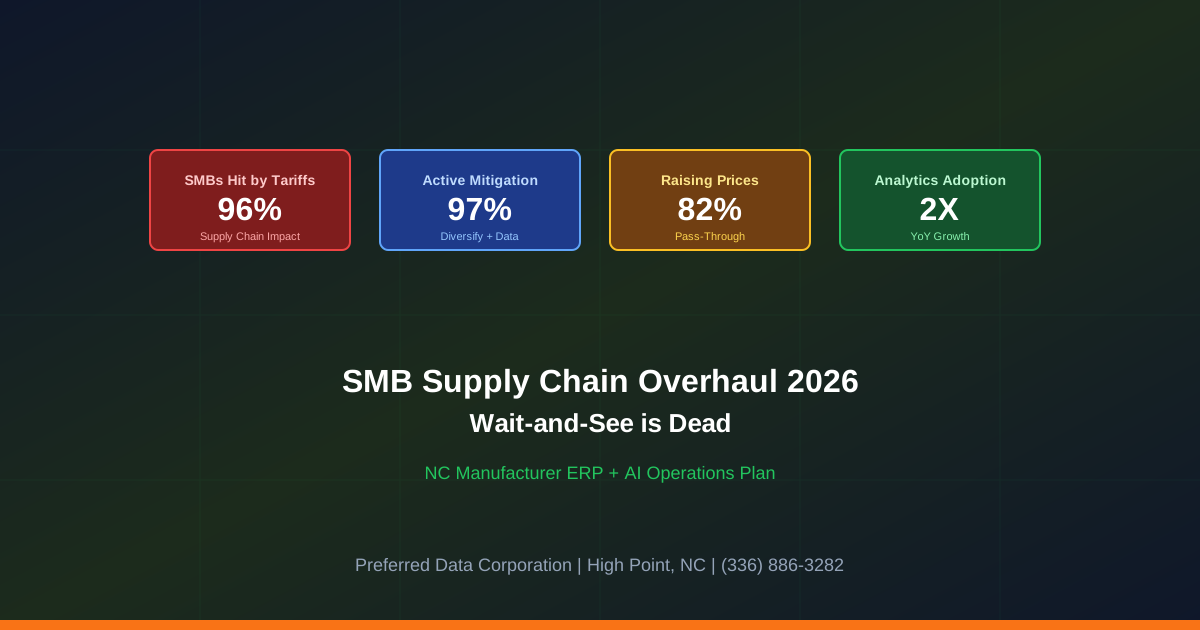
TL;DR: Per Digital Commerce 360's May 2026 report and FreightWaves coverage, 96% of surveyed small and mid-market businesses say tariffs have directly hurt their shipping, sourcing, or supply chains in the past year, 97% are now deploying at least one active mitigation strategy, 82% are raising prices (up sharply year over year), and AI-driven inventory and analytics tool adoption has more than doubled. For NC manufacturers, contractors, and distributors, "wait and see" is dead. The 2026 playbook is supplier diversification, ERP-driven landed-cost analytics, and AI-driven demand and inventory planning, and most SMBs cannot run that stack with their existing tooling.
Key takeaway: Tariff exposure is now an operations and IT problem, not just a procurement problem. The NC SMBs that protect margin in 2026-2027 are the ones that instrument landed-cost, alternate suppliers, and demand signals in a single ERP and analytics stack, not the ones that pass everything to spreadsheets.
Need to instrument tariff exposure across your suppliers, SKUs, and customers? Preferred Data Corporation has built ERP, analytics, and integration software for NC manufacturers since 1987. Call (336) 886-3282 or request a tariff-readiness review.
How big is the tariff hit on small businesses in 2026?
It is structural and broad. Per Digital Commerce 360, FreightWaves, and the NSBA 2026 Trade Impact Survey coverage, the headline numbers for 2026 are unambiguous:
- 96% of SMBs report tariffs directly hurt their shipping, sourcing, or supply chain in the prior 12 months.
- 96% also identify tariffs as their primary concern for 2026, with 31% expecting "significant to devastating" impact.
- 97% of SMBs are now deploying at least one active mitigation strategy (supplier diversification, longer planning horizons, more data tools).
- 82% are raising prices in response to tariffs, sharply up from the prior year.
- 62% report lost revenue or missed sales tied to supply-chain problems; 59% of those are stockpiling inventory as their primary coping strategy.
- Heavy use of analytics more than doubled year over year, and AI-driven inventory tool adoption continues to climb.
- 61% of small businesses reported a negative operational impact from 2026 tariffs per the NSBA Trade Impact Survey.
For an NC small business in furniture, textiles, manufacturing, construction, or distribution, that is not a hypothetical. North Carolina ranked among the top US states for manufactured exports in 2024-2025, and Piedmont Triad SMBs are disproportionately exposed via component imports, OEM equipment, and finished-goods customers.
Why does tariff mitigation depend on IT, not just procurement?
Because the math is dynamic, multi-supplier, multi-SKU, and multi-customer, and spreadsheets cannot keep up. Per Ivalua's procurement analysis and SupplyChain Strategy's 2026 outlook, the operational requirements split into four IT-heavy buckets:
- Landed-cost visibility per SKU per supplier per origin. Tariffs change quarterly. Re-pricing 500 SKUs by hand against changing duty rates is a full-time job that produces stale answers.
- Alternate supplier qualification at speed. Identifying, onboarding, and quoting against three suppliers per critical part requires CRM, document workflow, and analytics, not spreadsheets.
- Pass-through pricing analytics. Which customers absorb a 12% cost increase, which need re-negotiation, and which require contractual triggers. Without CRM + analytics, the business loses margin on the wrong accounts.
- Demand planning under volatility. Stockpiling is expensive working capital. AI-driven demand forecasting reduces overstock and stockout, but only with clean ERP data underneath.
| Old SMB tariff response (2023) | 2026 SMB tariff response | Why the shift |
|---|---|---|
| Wait and see | Active mitigation (97%) | Tariffs structural, not transient |
| Single-supplier sourcing | Multi-supplier qualification | Concentration risk too high |
| Pass-through to all customers | Targeted re-pricing | Margin protection per account |
| Spreadsheet landed cost | ERP + analytics dashboards | Volume and frequency beat manual |
| Manual stockpiling | AI demand planning | Working capital optimization |
The structural answer is not "absorb the hit." It is to instrument the operation so the SMB can re-cost, re-source, re-price, and re-plan inside the time horizon tariffs change.
What does this mean for NC small businesses in practice?
It means the operations tech stack is now a margin lever, not a back-office cost. For NC manufacturers, contractors, and distributors, three things are now table stakes:
- An ERP that tracks landed cost per SKU per origin and re-prices automatically when duty schedules change. PDC's PDC Software Suite is purpose-built for NC manufacturers in furniture, textile, industrial, and distribution.
- Supplier diversification supported by document and CRM workflows. Three qualified suppliers per critical part means three sets of contracts, qualifications, and audit trails to manage.
- Analytics on customer pass-through capacity. Margin per customer per SKU, with alerts when pricing falls below thresholds. Tableau, Power BI, or embedded analytics in the ERP.
Quotable definition: SMB tariff supply chain overhaul is the 2026 operational shift, documented across multiple industry surveys (Digital Commerce 360, FreightWaves, NSBA), in which small and mid-market businesses move from passive tariff absorption to active mitigation via supplier diversification (97% deploying at least one strategy), targeted pricing pass-through (82% raising prices), and ERP- and AI-driven supply-chain analytics (analytics adoption more than doubled year over year).
The 25-500 person NC manufacturer that runs landed cost in spreadsheets, sources from one supplier per part, and prices uniformly across customers will lose margin steadily through 2026-2027. The one that instruments it will not.
What should an NC small business do this quarter?
Treat the tariff response as an operational and IT project, not just a procurement memo. The sequence is straightforward.
- Run a landed-cost audit. Top 50 SKUs by revenue, every origin, every duty rate, every Incoterm. Identify where the actual margin sits after tariff pass-through.
- Identify single-supplier risks. Critical parts with one supplier in one country are the first to re-source. Begin alternate qualification now; it takes 90-180 days.
- Instrument supply-chain visibility in the ERP. If the existing ERP cannot track landed cost per origin, this is the year to upgrade or augment. PDC's custom software services build the integration layer when off-the-shelf does not fit.
- Add demand and inventory analytics. Even modest AI-driven demand planning reduces overstock and stockout meaningfully. Per the Federal Reserve's 2026 SMB AI monitoring, NC SMBs are actually leading large firms on AI operational adoption.
- Build a pricing pass-through framework. Customer-by-customer analysis of which accounts absorb increases, which need contractual triggers, and which require renegotiation.
- Document for the bank and the underwriter. Lenders and cyber/operational insurance carriers increasingly ask about supply-chain resilience evidence. Document the diversification and analytics work.
- Re-evaluate annually, not quarterly. Per FreightWaves, the majority of 2026 SMBs are extending planning horizons. Tariff schedules will keep moving; build the cadence to match.
Need this restructured for your business? Call (336) 886-3282 or contact Preferred Data Corporation for a tariff-readiness operational review.
Why is this an IT and software problem, not just a sourcing problem?
Because the size and frequency of the calculation overwhelms manual processes. Per the Federal Reserve's monitoring of AI adoption in the US economy and Digital Commerce 360's SMB report, SMBs that have adopted ERP-driven analytics and AI inventory planning are materially outperforming peers that have not, both in margin retention and stockout reduction. The defenders that hold up against tariff volatility all run the same operational stack: ERP with landed-cost intelligence + supplier qualification workflows + customer-level margin analytics + AI demand planning + a managed IT partner that keeps it all current.
For a Piedmont Triad small business, the answer is clear. Pick a partner that has built ERP and operations software for NC manufacturers for decades and can integrate analytics, AI, and document workflows into a single system. Preferred Data Corporation has done exactly that since 1987, from our High Point headquarters and on-site across the Piedmont Triad, Charlotte, Greensboro, Raleigh, and Winston-Salem.
PDC supports this through the PDC Software Suite, AI transformation, custom software development, and managed IT services for the manufacturing industry, furniture, and textile sectors.
Frequently Asked Questions
What does the Digital Commerce 360 May 2026 report actually say?
Per Digital Commerce 360's reporting, 96% of surveyed SMBs say tariffs have directly hurt their shipping, sourcing, or supply chains in the past year, 96% identify tariffs as their primary concern for 2026, 97% are deploying at least one active mitigation strategy, and 82% are raising prices in response. Heavy analytics use more than doubled year over year.
Are NC manufacturers more or less exposed than the average SMB?
More exposed. North Carolina ranks among the top US states for manufactured exports, with concentration in furniture, textile, machinery, and chemicals. Piedmont Triad SMBs in particular have significant component-import exposure (motors, electronics, hardware, fabric) and OEM equipment exposure. The 96% headline applies; many NC SMBs sit higher on the impact distribution.
How long does supplier diversification actually take?
For most components, 90-180 days from "begin search" to "first qualified shipment," depending on regulatory certification (UL, ASTM, REACH, RoHS, CMMC, etc.) and supplier responsiveness. For specialty or custom parts, 6-12 months is realistic. Starting now matters; starting in Q4 does not.
What software actually helps with tariff response?
A modern ERP with landed-cost tracking per SKU per origin, document/contract management for multi-supplier qualification, BI tools for margin-per-customer analytics, and AI demand-planning tools for inventory optimization. PDC's PDC Software Suite is purpose-built for NC manufacturers; for businesses with mature ERPs, custom integration layers and analytics extensions usually outperform full replacement.
Will AI tools really pay off for a small manufacturer?
In 2026, yes, on operational use cases (demand forecasting, inventory optimization, supplier discovery, document extraction). Per the Federal Reserve's monitoring of AI adoption, NC SMBs are outpacing large firms on operational AI adoption. The trap is buying tools without the underlying data discipline; AI on dirty ERP data produces confidently wrong answers.
Related Resources
- PDC Software Suite for NC Manufacturers - ERP, operations, landed cost, document workflows
- AI Transformation Services - Demand planning, inventory optimization, supplier discovery
- Custom Software Development - Integration, analytics, ERP extensions
- Managed IT Services for NC Businesses - Keep the operational stack current
- Manufacturing Industry Solutions - NC manufacturer playbook
- Contact Preferred Data Corporation - Tariff-readiness operational review for NC SMBs