
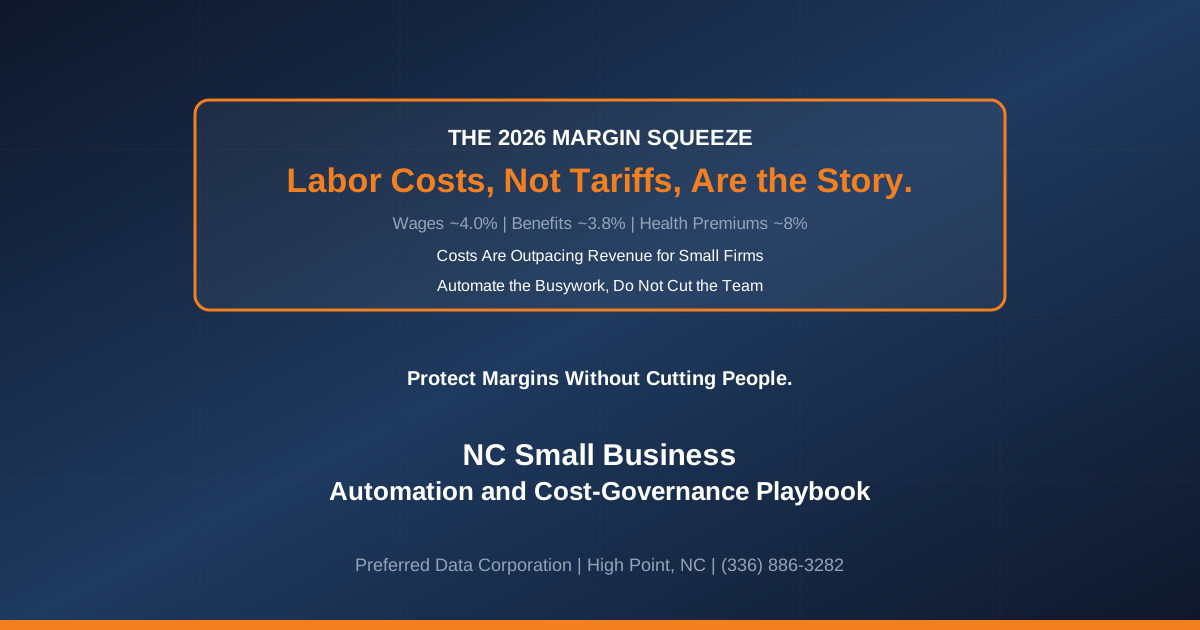
TL;DR: Heading through 2026, the margin story for many North Carolina small businesses is not tariffs, it is labor. Analyses project average wage increases near 4.0% and benefit cost growth around 3.8%, with health insurance premiums rising roughly 8%, per business-cost forecasts summarized by Old National Bank, while Bank of America account data shows small-business profitability under sustained pressure as costs outpace revenue, per the Bank of America Small Business Checkpoint. Cutting staff is the reflexive answer and often the wrong one. The durable lever is automating the repetitive administrative and operational work that eats hours, so you protect margins and capacity without gutting your team.
Key takeaway: You cannot control wages, benefits, or health premiums, but you can control how many hours of manual work your business pays for. Automating the repetitive tasks is how a small business absorbs rising labor costs without either raising prices past what customers will bear or cutting the people who serve them.
Watching rising costs eat your margins and unsure where to cut without cutting people? Contact Preferred Data Corporation at (336) 886-3282 for a technology and cost-governance review. BBB A+ rated, serving High Point, Greensboro, Winston-Salem, Charlotte, Raleigh, and the Piedmont Triad since 1987.
Why are small business margins under pressure in 2026?
Small business margins are under pressure in 2026 because core costs, especially labor and benefits, are rising faster than revenue. Per the Bank of America Small Business Checkpoint, profitability has been strained through the year as rising costs outpace solid consumer spending, with the smallest firms feeling the largest drag on margins.
The specific cost pressures a North Carolina owner is facing:
- Wages keep climbing. Analyses project average small-business wage increases near 4.0% for 2026, per business-cost forecasts, continuing a multi-year run of compensation growth.
- Benefits and health premiums rise faster than inflation. Total benefit compensation is projected up about 3.8%, with health insurance premiums rising roughly 8%, a line item that hits small employers hard.
- Tariffs still bite, but pass-through is limited. Around 80% of firms passed at least some higher input costs to customers while about 60% absorbed some, per the New York Fed's Liberty Street Economics, meaning price hikes alone cannot close the gap.
With hiring cooling into a "low-hire, low-fire" posture, the question is not how to grow headcount, it is how to get more done with the team you have.
Is cutting staff the right response to rising costs?
Usually not. Layoffs cut capacity along with cost, damage service and morale, and are expensive to reverse when demand returns, which is why forward-looking small businesses are turning to automation instead. The goal is to reduce the hours spent on low-value repetitive work, not to reduce the people who create value for customers.
Why automation beats headcount cuts as a margin strategy:
- It removes cost without removing capacity. Automating invoicing, data entry, scheduling, reporting, and routine communication reclaims hours you are already paying for, and redirects your team to revenue-generating work.
- It scales with rising volume. Automated processes handle more transactions without proportionally more labor, so growth does not immediately require another hire in an expensive labor market.
- It compounds. Every repetitive workflow you automate keeps paying back every month, unlike a one-time cost cut, and small businesses adopting AI and automation consistently report meaningful time savings.
Key takeaway: A layoff is a one-time cut that shrinks what your business can do. Automation is a durable change that lets the same team do more, which is the difference between surviving a cost squeeze and coming out of it stronger.
Want to know which of your manual processes are the best automation candidates? Call Preferred Data at (336) 886-3282 or explore our AI Transformation and Managed IT services.
Where can a small business cut costs without cutting people?
Start with the repetitive administrative and operational work that consumes hours but adds little unique value, and add IT cost governance to eliminate waste in what you already spend. Most small businesses carry a surprising amount of both manual busywork and unmanaged technology spend, and both are recoverable.
The highest-return targets for a North Carolina small business:
- Repetitive back-office work. Manual invoicing, data re-entry between systems, scheduling, quote and order processing, and recurring reports are prime automation candidates that free staff for higher-value work.
- Unmanaged technology spend. Duplicate SaaS subscriptions, over-provisioned cloud capacity, unused licenses, and auto-renewals quietly inflate costs, and a technology review routinely surfaces savings that drop straight to the bottom line.
- Costly downtime and rework. Unplanned outages and error-prone manual processes cost real money, so proactive managed IT and automated, validated workflows protect margins by preventing expensive interruptions.
Cutting staff versus automating and governing costs
| Factor | Cut staff | Automate and govern costs |
|---|---|---|
| Effect on capacity | Reduced | Preserved or increased |
| Effect on service quality | Often degraded | Maintained or improved |
| Durability of the savings | One-time | Recurring, compounding |
| Effect when demand returns | Must rehire, expensively | Scales without new hires |
| Team morale | Damaged | Focused on higher-value work |
| Hidden waste addressed | No | Yes, via cost governance |
Ready to protect your margins without cutting your team? Call (336) 886-3282 or learn about our AI Transformation Services.
What should an NC small business do to protect margins in 2026?
Map where your team's hours actually go, automate the repetitive work, and put governance on your technology spend so you are not paying for waste. This is a measured, high-return exercise because most of the savings come from work that adds no unique value and from spend no one is actively managing.
A practical sequence for a North Carolina small business:
- Measure where the hours go. Identify the repetitive administrative and operational tasks consuming the most staff time, because you cannot automate what you have not mapped.
- Automate the best candidates first. Start with high-volume, rules-based work like invoicing, data entry, scheduling, and reporting, where automation delivers fast, measurable time savings.
- Govern your technology spend. Audit SaaS subscriptions, cloud usage, licenses, and auto-renewals, and cut the duplication and over-provisioning that quietly erode margins.
- Harden against costly downtime. Use proactive managed IT and validated, automated workflows to prevent the outages and rework that turn into unplanned expense.
- Reinvest the reclaimed capacity. Redirect the hours and dollars you recover into sales, service, and growth, so cost discipline funds progress rather than just cushioning it.
Done well, this turns a difficult cost environment into a reason to modernize.
How does Preferred Data help NC businesses protect margins?
Preferred Data Corporation acts as the technology partner that helps small businesses do more with the team they have. Through our AI Transformation, Managed IT, and Cloud Solutions services, we map where your staff hours go, automate the repetitive administrative and operational work, govern your SaaS and cloud spend to cut waste, and harden your environment against the downtime and rework that eat margins. Serving North Carolina manufacturers and small businesses since 1987, and with proprietary software of our own, we bring practical automation, not theory.
Because we are local, on-site within 200 miles of High Point, we can sit with your team, find the work worth automating, and stay accountable for the results as costs and conditions shift.
Get a technology and cost-governance review. Contact Preferred Data Corporation at (336) 886-3282. We deliver AI Transformation, Managed IT, and Cloud Solutions for small businesses and manufacturers across the Piedmont Triad. Serving the region since 1987, BBB A+ rated.
Frequently Asked Questions
Why are small business margins shrinking in 2026?
Small business margins are shrinking because core costs are rising faster than revenue. Analyses project average wage increases near 4.0%, benefit cost growth around 3.8%, and health insurance premiums up roughly 8% for 2026, while Bank of America account data shows profitability under sustained pressure as costs outpace consumer spending, with the smallest firms hit hardest.
Should I lay off staff to deal with rising costs?
Usually not. Layoffs cut capacity and service along with cost, hurt morale, and are expensive to reverse when demand returns. A more durable response is to automate the repetitive administrative and operational work that consumes hours, so the same team can do more, which protects margins without gutting the people who serve your customers.
What kinds of work can a small business automate?
High-volume, rules-based tasks are the best candidates: manual invoicing, data entry between systems, scheduling, quote and order processing, and recurring reports. Automating these reclaims hours you already pay for and lets staff focus on revenue-generating work, and the savings recur every month rather than being a one-time cut.
How does IT cost governance help protect margins?
IT cost governance finds and eliminates waste in what you already spend, such as duplicate SaaS subscriptions, over-provisioned cloud capacity, unused licenses, and auto-renewals. Combined with proactive managed IT that prevents costly downtime, it recovers dollars that drop straight to the bottom line without affecting your team or your customers.
Can Preferred Data help us cut costs without cutting people?
Yes. We map where your staff hours go, automate the repetitive work, govern your SaaS and cloud spend to remove waste, and harden your environment against downtime and rework. We serve small businesses and manufacturers across High Point, Greensboro, Charlotte, Raleigh, and the greater Piedmont Triad.