
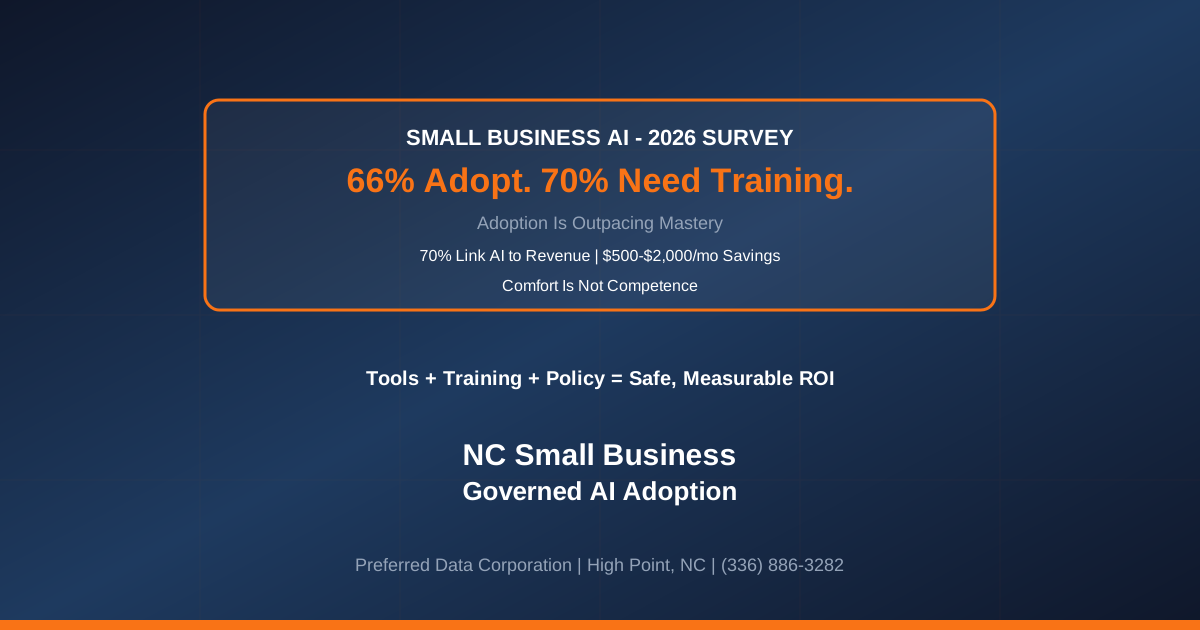
TL;DR: A Thryv survey of 561 U.S. small and mid-sized business owners released in July 2026 found AI adoption jumped to 66%, up from 55% a year earlier, yet 70% of those owners say they need more training to use AI effectively, even though 86% report being comfortable with it. The upside is real: 70% link AI to higher revenue, 55% cite cost reductions, and 61% estimate $500 to $2,000 in monthly savings. The gap is the story. Small businesses are adopting AI faster than they can master it, and ungoverned adoption creates data-leakage, accuracy, and compliance risks that erase the gains. For NC small businesses, the winners in 2026 are not the ones with the most AI tools; they are the ones with trained people and clear guardrails.
Key takeaway: The 2026 AI problem for small business is no longer "should we adopt?" It is "how do we adopt safely and get real ROI?" A 70% training gap and a comfort-versus-competence mismatch mean the value is being left on the table, and shadow AI is quietly creating risk. Governed adoption, training plus policy plus the right tools, is what turns AI from a novelty into a measurable advantage.
Adopting AI but not sure it is safe or paying off? Contact Preferred Data Corporation at (336) 886-3282 for an AI readiness and governance assessment. BBB A+ rated, serving High Point, Greensboro, Winston-Salem, Charlotte, Raleigh, and the Piedmont Triad since 1987.
How many small businesses actually use AI in 2026?
Roughly two-thirds of U.S. small businesses now use AI, and the trend line is steep. Thryv's July 2026 survey put adoption at 66%, up from 55% a year earlier, and other 2026 surveys land even higher depending on how "use" is defined.
- Thryv 2026: 66% of small businesses use AI, with one-third spending more on AI tools than they did 12 months ago.
- Intuit QuickBooks 2026 reporting has put regular AI use among U.S. small businesses at 68%, up sharply from 48% in mid-2024.
- Broader tallies such as the U.S. Chamber of Commerce Foundation confirm the same direction: AI has moved from experiment to everyday tool for most small firms.
Whichever number you take, the conclusion is identical: if your NC competitors are not using AI yet, they will be within a year, and doing it well is now a differentiator.
Why does a 70% training gap matter more than the adoption rate?
Because adoption without competence produces mistakes, wasted spend, and hidden risk, and the data shows a clear comfort-versus-competence gap. 70% of small-business owners say they need more training even though 86% say they are comfortable using AI, and a separate Goldman Sachs survey found 73% need additional training to fully leverage it. "Comfortable" is not "effective."
The gap shows up in three costly ways:
- Left-on-the-table ROI. Owners already report gains (70% tie AI to higher revenue and 61% estimate $500 to $2,000 in monthly savings), but under-trained teams capture a fraction of what disciplined users do.
- Accuracy and trust failures. Staff who do not understand model limitations ship AI output with errors, hallucinated facts, or off-brand tone into customer-facing work.
- Shadow AI. Employees paste customer data, contracts, and source code into free public tools with no policy, creating data-leakage and confidentiality exposure the business never approved.
Key takeaway: Comfort is not competence. The businesses getting real, safe value from AI in 2026 pair tools with training and clear rules, so people know both how to use AI well and where the guardrails are.
What is "governed AI adoption" and why do NC SMBs need it?
Governed AI adoption is the combination of the right tools, trained people, and clear policy, so a business captures AI's productivity gains without the data, accuracy, and compliance risks of a free-for-all. It is the difference between "everyone uses whatever chatbot they found" and "the team uses approved tools, on approved data, with training and oversight."
The contrast is stark:
| Dimension | Ungoverned (Shadow) AI | Governed AI Adoption |
|---|---|---|
| Tools | Whatever each person picks | Vetted, approved, often business-tier |
| Data handling | Sensitive data pasted into public tools | Rules on what data can go where |
| Training | None, learn-by-guessing | Role-based training, documented |
| Accuracy control | None | Human review, use-case boundaries |
| Compliance | Unmanaged exposure | Policy aligned to HIPAA, CMMC, privacy law |
| ROI | Inconsistent, hard to measure | Tracked against real use cases |
For NC manufacturers, professional-services firms, and healthcare-adjacent practices, governance is not bureaucracy; it is what keeps AI use from creating a reportable data incident or a compliance finding. Our AI Transformation service and AI Integration solution are built around exactly this balance.
Want AI adoption that is both productive and safe? Call Preferred Data Corporation at (336) 886-3282 to scope a governed rollout for your NC business.
How can an NC small business close the AI training and governance gap?
Follow a five-step path that pairs enablement with guardrails, and start with the use cases that already show ROI rather than boiling the ocean.
- Inventory current AI use, including shadow AI. Find out which tools staff already use and what data they feed them. You cannot govern what you cannot see.
- Write a plain-English AI acceptable-use policy. Define approved tools, what data may and may not be entered, required human review, and disclosure rules. Keep it short enough that people actually read it.
- Standardize on vetted, business-tier tools. Consolidate onto tools with proper data-handling terms (for example, business-tier assistants that do not train on your data) instead of a sprawl of free consumer apps.
- Deliver role-based training. Train by job function on effective prompting, verifying output, and recognizing limitations, so the 70% who want training actually get it.
- Measure against real use cases. Track time and cost savings on specific workflows (quoting, drafting, support triage) so you can double down on what works and cut what does not.
This is the practical bridge from "we use AI" to "AI reliably makes us money," and it is repeatable across manufacturing, professional services, and other NC sectors.
What are the risks of getting AI adoption wrong?
The main risks are data leakage, inaccurate output reaching customers, and compliance violations, all of which can cost far more than the productivity AI adds. Ungoverned adoption is not free; it is deferred risk.
- Data-leakage and confidentiality. Sensitive data entered into unapproved tools can be exposed, and for regulated NC firms that can trigger N.C.G.S. Section 75-65 breach-notification or HIPAA obligations.
- Accuracy liability. AI output shipped without review can contain errors or fabricated facts that damage customer trust or create legal exposure, especially in contracts, financials, and healthcare communications.
- Wasted spend. With one-third of small businesses already increasing AI spend, buying tools without training and consolidation just multiplies subscriptions without multiplying results.
Getting the foundation right, tools plus training plus policy, is how NC small businesses turn the 66% adoption wave into durable advantage instead of new liability. Pair it with strong cybersecurity and sound managed IT and AI becomes a controlled, compounding asset.
Ready to turn AI adoption into measurable, safe ROI? Contact Preferred Data Corporation at (336) 886-3282. Serving the Piedmont Triad since 1987, BBB A+ rated.
Frequently Asked Questions
How many small businesses use AI in 2026?
About two-thirds. The Thryv July 2026 survey found 66% of U.S. small businesses use AI, up from 55% a year earlier, and other 2026 surveys report figures in the high 60s to high 80s depending on methodology. Adoption is now mainstream and still climbing.
If adoption is so high, why do owners say they need more training?
Because comfort is not competence. In the Thryv survey, 70% of owners said they need more training even though 86% feel comfortable with AI, and a Goldman Sachs survey put the training need at 73%. Many teams adopted AI faster than they learned to use it well, so they capture only part of the available value and take on avoidable risk.
What is shadow AI and why is it a problem?
Shadow AI is employees using unapproved AI tools, often free consumer apps, without company oversight, frequently pasting sensitive customer data, contracts, or code into them. It creates data-leakage, accuracy, and compliance exposure the business never approved. A clear acceptable-use policy and vetted tools bring it under control.
Does AI actually save small businesses money?
Yes, when used well. In the Thryv 2026 survey, 70% of owners linked AI to higher revenue, 55% cited cost reductions, and 61% estimated $500 to $2,000 in monthly savings. The businesses realizing the most are those that pair tools with training and focus AI on specific, measurable workflows.
What should an AI acceptable-use policy cover?
At minimum: which AI tools are approved, what data may and may not be entered into them, when human review is required, disclosure rules for AI-assisted work, and how to handle regulated data (PII, PHI, CUI). Keep it plain-English and short so employees actually follow it.
Can Preferred Data help us adopt AI safely?
Yes. Our AI Transformation service and AI Integration solution cover the full governed-adoption path: assessing current use and shadow AI, writing acceptable-use policy, standardizing vetted tools, delivering role-based training, and measuring ROI, for small businesses across High Point, Greensboro, Charlotte, Raleigh, and the Piedmont Triad.
Related Resources
- Thryv: AI adoption rises to 66% - Sahm Capital
- AI adoption rises but 70% need more training - CPA Practice Advisor
- SMB AI training gap and revenue impact - Yahoo Finance
- Preferred Data AI Transformation
- Preferred Data AI Integration Solution
- Preferred Data Managed IT Services
- Preferred Data Cybersecurity Services