
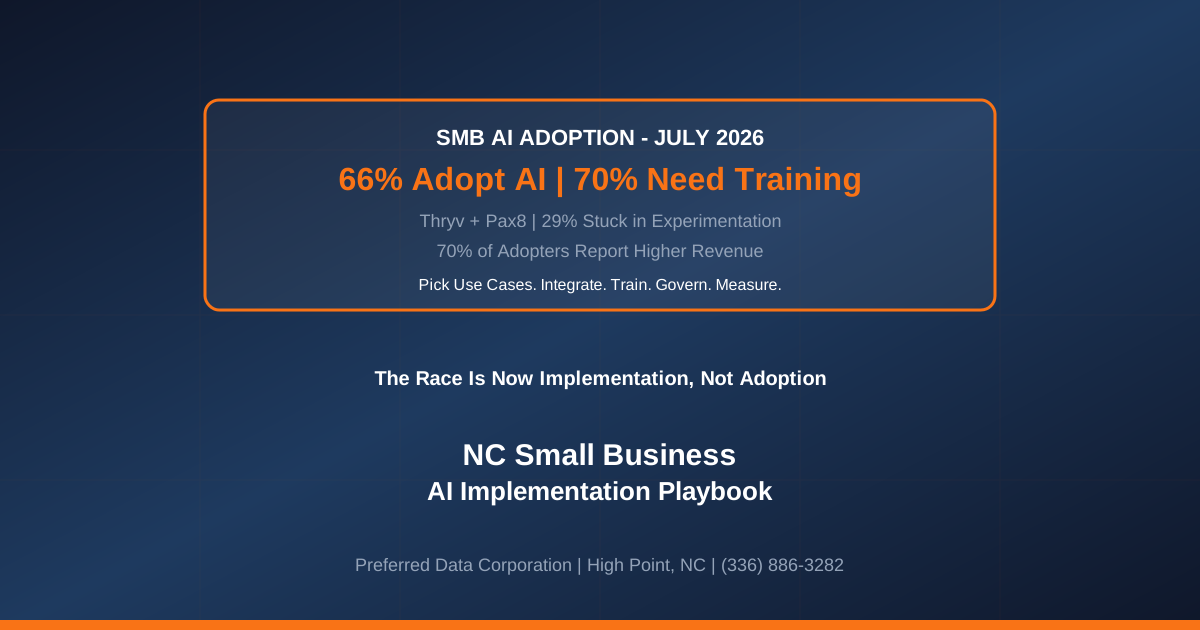
TL;DR: Two July 2026 surveys agree on the shape of the small-business AI moment: adoption is high but competence is not. Thryv's 2026 AI and Small Business survey found adoption rose to 66% from 55% a year earlier, yet 70% of owners admit they need more training to use AI effectively. Pax8's Q2 2026 SMB AI research found 61% actively using AI and another 29% still experimenting, with a large share stuck in experimentation, unable to move from testing to deployment. For North Carolina small businesses, the competitive gap in 2026 is no longer "do you use AI?" It is "can you get AI into production and measure the return?"
Key takeaway: The AI adoption race has already been won, roughly two-thirds of SMBs are in. The next race, and the one that determines who actually gains ground, is the implementation-and-competence race. The businesses that pull ahead are not the ones with the most AI tools; they are the ones that pick two or three high-value use cases, deploy them securely into daily operations, train their people, and govern the data. The 70% training gap and the "stuck in experimentation" cohort are not signs that AI failed; they are the exact opening where a guided implementation partner turns pilots into profit.
Stuck in AI pilots with no measurable return? Contact Preferred Data Corporation at (336) 886-3282 for an AI readiness and implementation assessment for your NC business. BBB A+ rated, serving High Point, Greensboro, Winston-Salem, Charlotte, Raleigh, and the Piedmont Triad since 1987.
How many small businesses actually use AI in 2026?
Roughly two-thirds of US small businesses now use AI, but a large majority still feel under-skilled to use it well. Thryv's 2026 survey puts adoption at 66%, up from 55% a year earlier, with 70% of owners saying they need more training and about one-third spending more on AI tools than they were 12 months ago.
The returns, where businesses get past experimentation, are real:
- Revenue impact. Per Thryv's findings, 70% of adopters said AI increased their revenue over the past year, and 55% said it helped reduce costs.
- Competitive separation. Pax8's Q2 2026 research found two-thirds of AI-using SMBs look fundamentally different in confidence, competitive posture, and approach to growth than non-users.
- The stall point. Pax8 also found 61% actively using AI and 29% still experimenting, with nearly one in three unable to advance from testing to deployment.
The story is not scarcity of adoption. It is a gap between adopting a tool and operationalizing it, and that gap is where value is won or lost.
Why do so many small businesses get stuck in AI experimentation?
Businesses stall in AI experimentation because they treat AI as a tool to buy rather than a capability to build, and the missing pieces, skills, data readiness, integration, and governance, are exactly the pieces a subscription does not include. Three failure modes recur.
- The skills gap. The 70% who want more training are telling you the truth: buying a license does not create the internal competence to design prompts, validate outputs, redesign a workflow around the tool, and change how people work. Without that, the pilot never leaves the sandbox.
- The integration gap. AI delivers value when it plugs into the systems where work actually happens, the ERP, the CRM, the ticketing system, the document store. A standalone chatbot nobody has connected to real data stays a demo.
- The trust and governance gap. Owners rightly hesitate to push AI into customer-facing or financial workflows without controls for accuracy, data privacy, and oversight. Absent a governance framework, caution freezes the pilot in place.
None of these is solved by adding another AI product. They are solved by an implementation discipline, which is precisely what most lean SMB teams do not have spare capacity to build alone.
What separates the SMBs that profit from AI from the ones that don't?
The businesses that get returns follow a use-case-first, production-oriented path, while the stuck cohort chases tools. The contrast is stark enough to plan against.
| Dimension | Stuck in experimentation | Getting measurable ROI |
|---|---|---|
| Starting point | "Which AI tool should we buy?" | "Which two workflows cost us the most time?" |
| Scope | Many tools, shallow use | Few use cases, deep deployment |
| Integration | Standalone, disconnected | Wired into ERP, CRM, and daily systems |
| People | Left to self-teach | Trained and supported through the change |
| Governance | Ad hoc, so caution stalls it | Framework for accuracy, privacy, oversight |
| Measurement | No baseline, no metric | Baselined hours or cost, tracked outcome |
The right-hand column is not more expensive; it is more disciplined. It trades tool sprawl for focused execution, which is why it produces the revenue and cost results the surveys attribute to AI adopters.
How should an NC small business move AI from pilot to production?
Follow a five-step implementation sequence that prioritizes value and control over tool count. This is the backbone of PDC's AI Transformation engagements.
- Find the two highest-cost workflows. Start from where time and money actually leak, quoting, document processing, customer response, scheduling, reporting, not from a tool catalog. Operational-efficiency analysis surfaces the candidates with the best return.
- Deploy narrow and deep. Implement AI into those specific workflows, integrated with the real systems that run them, rather than rolling out a general-purpose assistant nobody adopts.
- Train the people who use it. Close the 70% training gap directly with hands-on enablement so staff trust the output, know the limits, and change how they work. Adoption is a people project as much as a technology one.
- Govern the data and the outputs. Put a framework around accuracy checks, data privacy, and human oversight so AI can safely touch customer and financial workflows, which is where the biggest returns live.
- Measure against a baseline. Capture the pre-AI hours or cost, then track the delta. Measurable ROI is what turns a pilot into a funded, expanding program.
Want a use-case-first AI roadmap for your business? Call Preferred Data Corporation at (336) 886-3282 for an AI readiness assessment that names your two best starting workflows.
Why use a local implementation partner instead of going it alone?
The surveys make the case: 70% of owners say they lack the training to use AI well, and a third of adopters are stuck. A local AI implementation partner supplies the exact capability that gap represents, use-case selection, systems integration, staff training, and governance, without the SMB having to hire a data-science team it cannot justify. PDC brings that alongside deep manufacturing and industrial context and 39-plus years of local operating experience, so the AI you deploy fits how your business actually runs. The businesses winning the 2026 AI race are not the ones with the most tools; they are the ones with a partner who gets AI into production and proves the return.
Frequently Asked Questions
What percentage of small businesses use AI in 2026?
About 66% of US small businesses use AI in 2026, up from 55% a year earlier, according to Thryv's 2026 AI and Small Business survey. Pax8's Q2 2026 research similarly found 61% actively using AI with another 29% experimenting. Adoption is high, but the same surveys show most owners feel they lack the skills to use it effectively.
Does AI actually increase revenue for small businesses?
For businesses that move past experimentation, yes. Thryv's survey found 70% of AI-adopting small businesses said AI increased their revenue over the past year, and 55% said it reduced costs. The returns concentrate among businesses that deploy AI into real workflows and train their people, not among those that stall in pilots.
Why is my AI pilot not producing results?
The most common reasons are a skills gap, a lack of integration, and missing governance. If staff were left to self-teach, if the tool is not connected to your real systems, or if you have no framework for accuracy and data privacy, the pilot cannot scale into daily operations. Fixing those three is usually what turns a stalled pilot into measurable ROI, and none of them is solved by buying another tool.
How many AI tools should a small business use?
Fewer than most think. The businesses getting returns typically pick two or three high-value workflows and deploy AI deeply into them, rather than spreading across many shallow tools. Tool sprawl is a symptom of the "stuck in experimentation" pattern; focused, integrated deployment is the pattern that produces revenue and cost results.
What is the first step to a real AI strategy?
Start with your two highest-cost or most time-consuming workflows, not with a tool. Identify where time and money leak, then apply AI to those specific processes with integration, training, and governance. PDC's AI readiness assessment is built to name those starting workflows and lay out a production path.
Can Preferred Data help if we have no AI expertise in-house?
Yes, that is the core use case. Most NC small businesses do not have and cannot justify an internal data-science team. PDC provides the implementation discipline the surveys show is missing, use-case selection, systems integration, staff training, and governance, so you get AI into production and measure the return. Call (336) 886-3282 to start.
Related Resources
- AI Adoption Continues to Rise, but 70% Say They Need More Training - Yahoo/Thryv
- Pax8 Research: Small Businesses All-in on AI - GlobeNewswire
- Preferred Data AI Transformation Services
- Preferred Data AI Integration Solutions
- Preferred Data Operational Efficiency Solutions
- Related: AI Agent ROI Reality Check for Small Business
- Related: The AI Integrator Shift and SMB Outcomes