
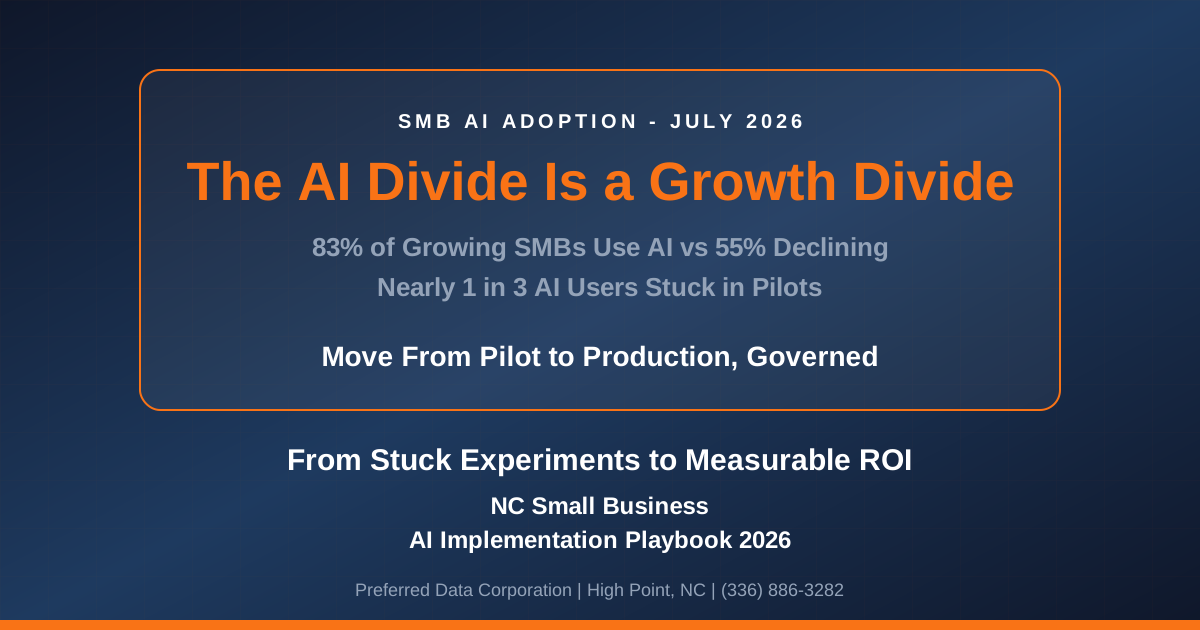
TL;DR: Mid-2026 data shows AI adoption now tracks with business growth: 83% of growing SMBs have adopted AI versus just 55% of declining ones. But adoption alone is not the payoff. Nearly 1 in 3 AI-using small businesses are stuck in experimentation and 70% say they need more training. Preferred Data Corporation helps North Carolina small businesses move from stalled pilots to governed, measurable production AI.
Key takeaway: The gap between AI adopters and non-adopters has become a growth gap. Winning is not launching a pilot. It is moving a narrow, high-value workflow into governed production, training your people, securing your data, and measuring results against a real baseline.
The story of small business AI in 2026 is no longer "should we try it." It is "why are so many of us stuck." Two out of three SMBs are actively using AI, yet a third of them cannot get past testing. The businesses pulling ahead are the ones that treat AI as an operations discipline, not a science experiment.
Ready to turn AI experiments into results that show up on your P&L? Contact Preferred Data Corporation at (336) 886-3282. BBB A+ rated, serving High Point, Greensboro, Winston-Salem, Charlotte, Raleigh, and the Piedmont Triad since 1987.
Is AI adoption really linked to business growth in 2026?
Yes, and the correlation is now hard to ignore. According to business.com's 2026 SMB AI usage study, 83% of growing small businesses have adopted AI compared to only 55% of declining ones. Growing firms are also leaning in harder, with 78% planning to increase AI investment.
That 28-point spread between growing and declining businesses is the clearest signal yet that AI has moved from novelty to competitive infrastructure. It does not prove AI causes growth on its own, but it does show that the companies gaining ground are far more likely to have operational AI in place. For a small manufacturer in the Piedmont Triad or a professional services firm in Charlotte, sitting out is increasingly a decision to compete against better-equipped rivals.
The practical read for North Carolina owners is simple. If your competitors are automating quoting, customer follow-up, and back-office work while you are not, the productivity gap compounds quarter over quarter. PDC's AI Transformation service exists to close that gap deliberately rather than through scattered tool trials.
Why are so many small businesses stuck in AI pilots?
The bottleneck is not curiosity, it is execution. The Pax8 Q2 2026 SMB AI Pulse Report, published July 13, 2026, found that 61% of SMBs are actively using AI and 29% are still experimenting, with nearly 1 in 3 AI-using SMBs unable to move from testing to real deployment.
Most stalls trace back to three gaps: messy or ungoverned data that makes outputs unreliable, no clear owner or success metric for the pilot, and staff who were handed a tool without training. A demo that impresses in a sandbox falls apart when it meets real customer records, compliance requirements, and daily workflow. Without governance and a measurement baseline, "it seems to work" never becomes "we depend on it."
This is where a partner earns its keep. Getting unstuck usually means narrowing scope, not expanding it: pick one expensive, repetitive workflow, wire it to clean data, put a human review step in place, and measure it against last quarter's numbers. PDC pairs managed IT services with AI implementation so the data plumbing and the automation are handled together, not in silos.
What is the difference between stuck-in-pilot and production-grade AI?
Production-grade AI differs from a stalled pilot on five measurable dimensions: data governance, training, security, measurement, and demonstrated ROI. The table below shows why so many pilots stall and what "done right" actually looks like for a North Carolina SMB.
| Dimension | Stuck-in-Pilot AI | Production-Grade AI |
|---|---|---|
| Data governance | Ad hoc spreadsheets, no ownership, inconsistent inputs | Cleaned, access-controlled data with a clear owner |
| Training | Tool handed over with no onboarding; 70% say they need more | Role-based training so staff trust and use the output |
| Security | Sensitive data pasted into public tools, no policy | Governed access, audit trail, and data-loss controls |
| Measurement | "It feels faster," no baseline | Tracked against a pre-AI baseline with defined KPIs |
| ROI | Unproven, hard to justify renewal | Documented revenue lift or cost reduction |
The Thryv 2026 AI and Small Business survey reinforces why the right column matters. Among adopters, 70% said AI increased their revenue over the past year and 55% said it reduced costs. Those results do not come from experimentation. They come from AI that is embedded, governed, and measured. Our operational efficiency solutions are built to get you into that right-hand column.
See where your AI efforts are stalling. Call PDC at (336) 886-3282 for a practical assessment of your highest-value automation opportunities.
How do North Carolina SMBs move from experimentation to deployment?
The reliable path is narrow and deep, not broad and shallow. PDC uses a pilot-to-production method: find your highest-cost repetitive workflows, deploy AI narrow and deep on one of them, train the people who use it, govern the data and security around it, and measure results against a real baseline before scaling.
Start where the money already leaks. The Thryv research found that more than half of SMBs have implemented AI in product development and innovation, employee training and documentation, and operations and supply-chain management, with the top focus areas being automating administrative tasks, customer communication, and marketing automation. Those are exactly the workflows where a small NC business can see returns in weeks, not quarters.
Data readiness comes before the model, every time. If your customer records, inventory data, or job histories are inconsistent, no AI tool will save you. PDC's AI integration solutions sequence the work correctly: clean and connect the data, apply security and governance controls, then automate. For manufacturers, our manufacturing industry practice applies the same method to shop-floor and ERP workflows where the ROI is often largest.
Why does AI training matter more than the tool itself?
Because untrained users abandon good tools. The Thryv 2026 survey found that 70% of AI adopters said they need more training, and roughly one-third are spending more on AI tools than they were 12 months ago. Spending on tools while underinvesting in people is the fastest way to end up in the stuck third.
Training does two things at once. It builds the trust that makes staff actually use AI outputs instead of quietly reverting to old habits, and it teaches the judgment to catch when the AI is wrong. An AI that drafts customer emails is only valuable if your team knows how to review and send them confidently. PDC bundles enablement into every deployment so adoption sticks after the consultant leaves.
The businesses seeing revenue lift are not the ones with the fanciest tools. They are the ones whose people were brought along. That is the difference between a line item and a competitive advantage, and it is why our business growth solutions treat training as core, not optional.
How do you keep AI secure and compliant while adopting it fast?
Security cannot be an afterthought bolted on after go-live. The moment staff start feeding customer data, financials, or proprietary designs into AI tools, you have a data-governance and compliance problem whether you have addressed it or not. Governed access, audit trails, and clear policies on what data may touch which tools are the guardrails that let you move fast without exposure.
This is especially acute for North Carolina manufacturers and firms handling regulated data. Shadow AI, where employees quietly paste sensitive information into public chatbots, is now one of the most common and least managed risks in small business. PDC's cybersecurity services put governance around AI use so productivity gains do not become breach headlines.
The right sequence protects you and speeds you up. When data access, monitoring, and policy are in place first, teams can adopt aggressively because the rails are already there. Governance is not the brake on AI, it is what makes confident deployment possible.
Do not let a preventable data mistake undo your AI gains. Talk to Preferred Data Corporation at (336) 886-3282 about governed, secure AI adoption for your High Point or Piedmont Triad business.
Frequently Asked Questions
What percentage of small businesses are using AI in 2026?
According to the Pax8 Q2 2026 SMB AI Pulse Report, 61% of SMBs are actively using AI and another 29% are still experimenting. Separately, business.com data shows 83% of growing SMBs have adopted AI versus 55% of declining ones.
Why are so many businesses stuck in AI experimentation?
Nearly 1 in 3 AI-using SMBs cannot move from testing to deployment, per Pax8. The usual causes are ungoverned data, no defined owner or success metric for the pilot, and staff who received a tool without training. Narrowing scope to one high-value workflow and measuring against a baseline is the most reliable way to get unstuck.
Does AI actually increase revenue for small businesses?
Among adopters, 70% said AI increased their revenue over the past year and 55% said it reduced costs, according to the Thryv 2026 AI and Small Business survey. Those results come from embedded, governed AI rather than one-off experiments.
How much training do employees need to use AI effectively?
The Thryv 2026 survey found 70% of AI adopters say they need more training. Training matters more than the tool itself because untrained staff abandon good tools and cannot catch AI errors. Role-based enablement is what turns a purchased tool into a durable productivity gain.
Where should a North Carolina small business start with AI?
Start with your highest-cost, most repetitive workflows. Research shows the top focus areas are automating administrative tasks, customer communication, and marketing automation, where returns often appear within weeks. Ensure the underlying data is clean and governed before deploying any tool.
How does PDC help businesses move from AI pilots to production?
PDC uses a practical pilot-to-production method: identify your highest-cost workflows, deploy AI narrow and deep on one of them, train your people, govern the data and security, and measure against a real baseline before scaling. Call (336) 886-3282 to start with an assessment.