
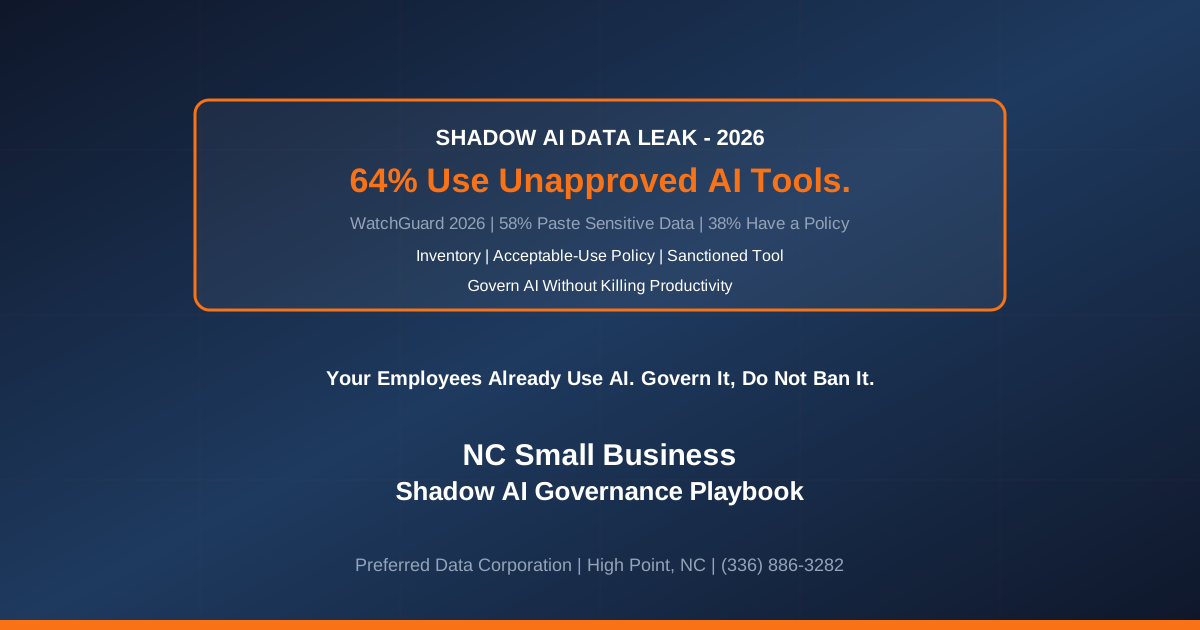
TL;DR: Your employees are already using AI tools you never approved, and many are pasting sensitive company data into them. A July 2026 WatchGuard survey of organizations with 50 to 500 employees found 64% of workers admit to using unauthorized AI tools for work, while only 38% of organizations have a comprehensive AI policy and 25% have none at all. For a North Carolina small business, "shadow AI" is not a future problem, it is a live data-leak and compliance exposure that a short policy, a sanctioned tool, and basic monitoring can close this quarter.
Key takeaway: Banning AI does not stop shadow AI, it just hides it. The businesses that win in 2026 give employees a safe, approved way to use AI and put simple guardrails around the data, rather than pretending the tools are not already in the building.
Worried about what your team is pasting into AI? Contact Preferred Data Corporation at (336) 886-3282 for a shadow AI and data-governance assessment. BBB A+ rated, serving High Point, Greensboro, Winston-Salem, Charlotte, Raleigh, and the Piedmont Triad since 1987.
What is shadow AI and why should a small business care?
Shadow AI is any AI tool your employees use for work without approval, oversight, or a data agreement, most often free public chatbots and browser assistants. It matters because those tools can absorb whatever an employee types or pastes, and most small businesses have no idea it is happening. In the July 2026 WatchGuard 2026 Cybersecurity Hygiene Report, fewer than 30% of respondents believed their organization keeps an accurate inventory of the software in use, and nearly 40% said their company has no full visibility into the applications employees run.
The reason this spreads so fast is simple: AI genuinely helps people work faster, so they adopt it whether or not the company has a plan. Adoption is real and growing, with 57% of US small businesses now investing in AI, up from 36% in 2023. The gap is not adoption, it is governance. When a tool is unmanaged, the business carries all of the risk and captures none of the control.
For a High Point manufacturer or a Greensboro professional-services firm, the exposure is concrete: quotes, drawings, customer lists, financials, and employee records can leave your control the moment they are pasted into a consumer AI account you do not administer.
Are employees really putting sensitive company data into AI tools?
Yes, and at a rate that should alarm any owner. Recent research from security-training firm Anagram found that 58% of employees admit to pasting sensitive data, including client records, financial data, and internal documents, into large language models. The same research found 45% have used AI tools their employer banned, and 40% said they would knowingly break a policy to finish a task faster.
That last number is the one that changes your strategy. A written ban, by itself, is not a control when nearly half of employees will route around it under deadline pressure. The behavior is not malicious, it is convenience, which means the fix has to make the safe path the easy path.
Three data points that frame the exposure for a small business:
- 64% of employees at 50-to-500-person organizations use unauthorized AI tools for work, per WatchGuard, July 2026.
- 58% admit pasting sensitive data into AI models, per Anagram.
- 90% of organizations believe their employees are using AI, yet only 38% have a comprehensive policy, per ISACA's 2026 AI Pulse Poll.
Key takeaway: Once proprietary data is pasted into a consumer AI account, you cannot reliably get it back or prove where it went. Prevention at the point of entry is the only control that works, which is why an approved tool plus a clear "never paste" list beats a blanket ban.
Want a clear line drawn between safe and unsafe AI use? Call Preferred Data at (336) 886-3282 or explore our AI Transformation and Cybersecurity Services.
How much does a shadow AI data leak actually cost a small business?
The direct cost is the loss of control over regulated or contractually protected data, which can trigger breach-notification, compliance, and liability consequences well beyond the convenience the tool provided. If your business handles protected health information, cardholder data, or Controlled Unclassified Information, pasting it into an unapproved public model can breach HIPAA, PCI, or CMMC obligations and your customer contracts.
For North Carolina businesses, exposure of personal information about customers or employees can also invoke N.C.G.S. Section 75-65 breach-notification duties. And the governance gap is not just a data problem, it is a trust problem: 45% of small-business workers worry that adopting too much AI could damage their company's reputation, which tells you employees themselves want clearer guardrails.
The unmanaged-versus-governed contrast is stark:
| Factor | Ungoverned (shadow AI) | Governed (sanctioned AI) |
|---|---|---|
| Data control | Company data may train a vendor's public model | Enterprise tier, prompts not used for training |
| Visibility | Fewer than 30% of orgs know what tools run | Known, approved tool list |
| Compliance | HIPAA, PCI, CMMC, and NDA exposure | Data classes mapped to obligations |
| Employee behavior | 40% will break a ban to work faster | Safe default that is also the fast path |
| Cost model | Hidden risk, no oversight | Predictable, monitored, measurable |
How does a North Carolina small business govern AI without killing productivity?
You do not ban AI, you channel it: inventory what is already in use, publish a one-page acceptable-use policy, provide a sanctioned business-tier tool, and add light monitoring. This closes the leak while keeping the productivity your team already relies on. Because only 25% to 38% of organizations have a real AI policy today, even a short, well-communicated program puts you ahead of most peers.
A practical eight-step program a small business can run in weeks, not months:
- Inventory the AI already in use. Ask each team what tools they use before assuming the answer is none. Most organizations cannot see their own software, so discovery comes first.
- Write a one-page acceptable-use policy. Name approved tools, prohibited data types (customer records, financials, PII, PHI, credentials, source code, CUI), and who to ask when unsure.
- Provide a sanctioned, safer option. Give staff a business-tier or enterprise AI tool so they do not default to a free consumer model.
- Turn off training on your inputs. Prefer paid or enterprise tiers where your prompts are not used to train the vendor's models.
- Classify what may never be pasted into public AI. Tie the list to your existing compliance obligations under HIPAA, CMMC, or PCI.
- Train once, briefly, and repeat. A 30-minute "what is safe to paste" session directly addresses the pasting-sensitive-data behavior.
- Add basic visibility. Know which AI domains your network reaches, and pair it with the hygiene basics WatchGuard flags, where 76% of employees reuse passwords and 50% access corporate resources without a VPN.
- Review quarterly. AI tools change monthly, so revisit the approved list and policy on a set cadence.
This mirrors recognized guidance such as the NIST AI Risk Management Framework and the OWASP Top 10 for LLM Applications, scaled down to what a small business can actually operate.
Ready to turn shadow AI into governed AI? Contact Preferred Data Corporation at (336) 886-3282. We combine AI Transformation, Managed IT, and AI Integration to make AI safe and productive for Piedmont Triad businesses. Serving the region since 1987, BBB A+ rated.
Frequently Asked Questions
What is shadow AI?
Shadow AI is the use of AI tools for work without company approval, oversight, or a data agreement, most commonly free public chatbots and browser AI assistants. A July 2026 WatchGuard survey found 64% of employees at 50-to-500-person organizations admit to using unauthorized AI tools for work.
Is it safe to put company data into ChatGPT or other public AI tools?
Not without controls. On consumer tiers, prompts can be used to improve the vendor's models, and 58% of employees admit pasting sensitive data such as client records and financials into large language models. Use a business or enterprise tier that excludes your inputs from training, and never paste regulated data like PHI, cardholder data, or CUI.
Should we just ban AI tools at our small business?
A blanket ban usually fails, because 40% of employees say they would break a policy to finish a task faster. A better approach is to provide a sanctioned business-tier AI tool, publish a short acceptable-use policy, and add basic monitoring so the safe path is also the fast path.
What should an AI acceptable use policy include?
At minimum: the list of approved tools, the data types that may never be entered into any AI tool, the tiers or settings required (such as training turned off), who to contact for exceptions, and a review cadence. Keep it to one page so people actually read and follow it.
How does shadow AI create compliance risk?
Pasting regulated data into an unapproved public model can breach HIPAA, PCI, CMMC, and customer NDAs, and exposure of North Carolina residents' personal information can trigger breach-notification duties under N.C.G.S. Section 75-65. Governance maps each data class to its obligation so employees know what is off-limits.
Can Preferred Data help us govern AI use?
Yes. We inventory the AI already in use, help you write and roll out an acceptable-use policy, stand up a sanctioned business-tier tool with the right data controls, and add monitoring and training, for businesses across High Point, Greensboro, Charlotte, Raleigh, and the greater Piedmont Triad.
Related Resources
- WatchGuard 2026 Cybersecurity Hygiene Report - Shadow AI and Unsafe Work Habits
- ISACA 2026 AI Pulse Poll - AI Use Accelerates While Governance and ROI Lag
- NIST AI Risk Management Framework
- Preferred Data AI Transformation Services
- Preferred Data Cybersecurity Services
- AI Tool Sprawl: The Hidden Cost for NC Small Businesses