
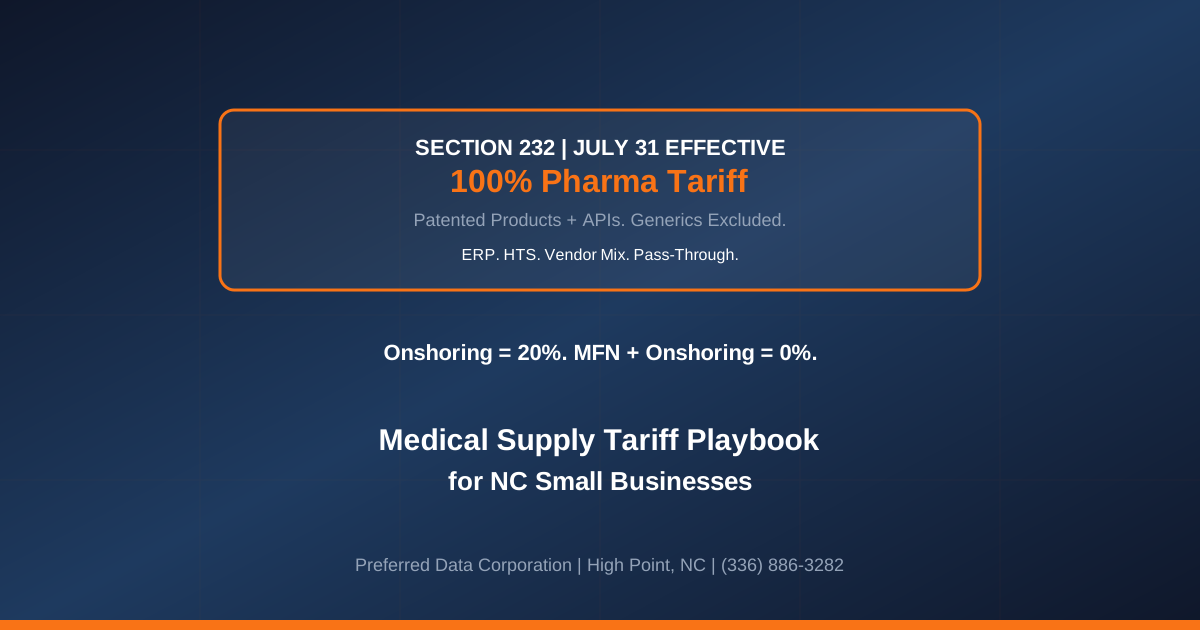
TL;DR: The Trump Administration's Section 232 tariff on patented pharmaceutical products and their active pharmaceutical ingredients (APIs) takes effect at a 100% ad valorem rate on July 31, 2026 for large companies and September 29, 2026 for small manufacturers and importers. Generics, biosimilars, and their ingredients are excluded at this time. Companies with an approved onshoring plan face a reduced 20% rate through April 2030; companies with both an onshoring plan and an MFN (Most Favored Nation) pricing agreement face 0% through January 2029. NC small medical supply distributors, independent pharmacies, veterinary clinics, hormone-replacement-therapy (HRT) and wellness clinics, dental supply firms, and every downstream buyer that touches patented pharmaceutical products needs to model exposure now, adjust ERP landed-cost logic before July 31, and structure vendor conversations around HTS classification and onshoring status.
Key takeaway: Section 232 pharma tariffs are structured to protect large manufacturers with onshoring capital while pushing the cost onto downstream buyers. NC small clinics and distributors do not qualify for onshoring agreements themselves. Their leverage comes from ERP landed-cost transparency, HTS reclassification review, and vendor selection between tariff-in and tariff-out suppliers.
Does your NC medical practice, veterinary clinic, wellness clinic, or supply distributor import patented pharmaceutical products or APIs? Contact Preferred Data Corporation for a same-month ERP landed-cost audit, HTS classification review, and vendor-mix stress test. BBB A+ rated. On-site within 200 miles of High Point. Call (336) 886-3282.
What Actually Changes for NC SMBs on July 31 and September 29, 2026?
President Trump's Section 232 investigation of pharmaceutical imports (initiated April 2, 2026 under Executive Order 14257) concluded that patented pharmaceutical imports pose a national-security risk based on foreign concentration of manufacturing capacity. The remedy is a two-track tariff schedule.
Three concrete facts every NC medical or pharma-adjacent SMB should treat as confirmed:
- 100% ad valorem tariff on patented pharmaceutical products and APIs. Applies to patented (branded) drugs and their active ingredients imported into the United States. Generic pharmaceuticals, biosimilars, and their associated ingredients are expressly excluded from Section 232 tariffs at this time. NC SMBs that dispense or resell branded HRT products, branded oncology drugs, branded biologics, and branded specialty pharmaceuticals are in the direct-exposure zone.
- Split effective dates: July 31 for large companies, September 29 for small manufacturers. The Small companies effective date (September 29, 2026) applies to the manufacturer, not to the downstream buyer. A NC clinic or distributor buying from a large manufacturer sees the 100% tariff embedded in the landed cost from July 31 forward, regardless of the clinic's own size.
- Two reduction pathways for manufacturers: onshoring plan (20%) and onshoring + MFN pricing (0%). Manufacturers with approved onshoring plans face 20% from September 29, 2026 through April 2, 2030. Manufacturers with both onshoring plans and MFN pricing agreements face 0% from July 31, 2026 through January 20, 2029. Downstream buyers cannot access these paths directly, but they can favor suppliers who did - the difference in landed cost between a 0% supplier and a 100% supplier is often the entire margin on the branded product.
The downstream implication is straightforward. Any NC SMB whose ERP or POS system still calculates landed cost using a pre-July 2026 tariff schedule is undercharging customers, undercollecting margin, and unknowingly absorbing tariff cost that should have been passed through or renegotiated.
Key takeaway: The tariff mechanic is not "did your business get charged." It is "did your ERP and pricing engine know about the tariff on the day the invoice was cut." A three-week lag between a July 31 tariff effective date and a pricing update is a documented margin loss on every branded pharmaceutical unit that moved through the door.
Who in NC Is Actually Exposed?
The Section 232 pharmaceutical tariff hits harder in NC than in most states because NC's medical, veterinary, and specialty-pharmacy footprint disproportionately relies on branded pharmaceutical products imported from Europe, Ireland, Singapore, Switzerland, and India.
Three concrete NC exposure patterns every SMB should evaluate:
- NC independent pharmacies and small pharmacy chains. North Carolina has approximately 900 independent pharmacies and dozens of small regional chains (per NC Board of Pharmacy registration data). Every branded prescription - Ozempic, Wegovy, Mounjaro, Humira, Eliquis, Trulicity, most oncology biologics - is in scope. Downstream cost pressure hits reimbursement rates, PBM negotiations, and patient co-pays.
- NC HRT, wellness, and specialty compounding clinics. The Piedmont Triad, Charlotte, and Raleigh markets have seen substantial growth in HRT and wellness clinics that dispense branded pharmaceuticals. Every branded testosterone product, estrogen product, thyroid product, and specialty compounded formulation using a branded API is in the exposure zone. Cash-pay clinics feel this immediately at the pricing update.
- NC veterinary clinics and animal-health distributors. Veterinary medicine relies heavily on branded pharmaceuticals for oncology, dermatology, and specialty care. NC has 2,400+ licensed veterinarians (per NC Veterinary Medical Board registration data), and a substantial fraction of large-animal and specialty small-animal veterinary practice depends on imported branded drugs. Feed additives, hormone treatments, and specialty biologics are in scope for the animal-health line.
- NC dental supply distributors and dental practice groups. Branded dental anesthetics, branded fluoride products, and branded oral surgery pharmaceuticals move through NC dental supply distributors and into NC dental practices. Smaller share of TCO than pharmacy or veterinary but still a documented landed-cost impact.
- NC medical spa and aesthetic practices. Branded botulinum toxin products (Botox, Dysport, Xeomin), branded dermal fillers, and branded laser topicals often carry patented status. NC med-spa growth in Charlotte, Raleigh, and the Triad has been substantial in the last five years, and cash-pay margin is highly tariff-sensitive.
The generics-excluded footnote matters. NC SMBs whose product mix is heavily generic (traditional independent pharmacies, most primary-care practices, most veterinary teaching clinics) have less direct exposure. NC SMBs whose product mix skews branded/specialty (HRT clinics, med-spas, specialty oncology, wellness clinics) have direct exposure to the full 100% rate.
What Should NC SMBs Do in the Next 30-60 Days?
The response is a coordinated four-track program that puts every branded pharmaceutical line item into a documented ERP-visible category before the July 31 effective date.
Track 1: ERP landed-cost visibility (Weeks 1-2).
- Audit every ERP or POS system for landed-cost logic on pharmaceutical SKUs. Is the current tariff rate coded in a table, a stored procedure, or a hardcoded field? Where does it live?
- Confirm the pathway for updating rates on July 31. A manual daily-rate update is high-risk. An automated feed from a customs broker or ERP tariff module is preferred.
- Enumerate every SKU by HTS classification and country of origin. HTS 3004 (medicaments) is the primary landing zone. Country of origin drives whether the tariff applies (imports vs domestic-manufacture).
- Reconcile against last 12 months of invoices. A pattern of imports from Ireland, Switzerland, Germany, India, Singapore, or Puerto Rico is the exposure signature. Domestic-manufactured (US-labeled with true US COO) is not exposed.
Track 2: HTS reclassification review (Weeks 2-4).
- Verify HTS classifications with a licensed customs broker. Every branded pharmaceutical SKU should carry a defensible HTS classification supported by product literature and manufacturer attestation. Misclassification is a compliance risk and a missed-mitigation opportunity.
- Identify any generic equivalent that could substitute. For pharmacies and clinics with dispensing discretion, a generic equivalent may be therapeutically appropriate and outside the tariff.
- Document any manufacturer that received an onshoring or MFN reduction. Manufacturer-published onshoring status is a public procurement signal. Prefer 0% and 20% suppliers over 100% suppliers when clinically equivalent.
Track 3: Vendor mix and pricing pass-through (Weeks 4-6).
- Rank suppliers by their tariff status. 0% MFN + onshoring, 20% onshoring, 100% no agreement.
- Restructure primary vendor relationships for high-volume SKUs. Where clinical equivalence permits, shift volume toward 0% and 20% suppliers.
- Update customer or patient pricing. Cash-pay clinics can update prices on July 31 with 60 days of notice. Reimbursed clinics (Medicare, Medicaid, private insurance) need to work with PBMs and payers on rate updates.
- Document every pass-through decision. Insurance reimbursement adjustments and PBM negotiations require documented cost-basis evidence.
Track 4: Refund and duty-drawback preparation (Weeks 4-8).
- Preserve every entry summary and CBP Form 7501 from July 31 forward. If the tariff is later reduced, refunded, or subject to a court challenge, the entry summary is the refund basis.
- Establish a duty-drawback filing capability. Duty drawback recovers 99% of duties paid on imports that are later exported or destroyed. For distributors that ship out-of-state, this can be material.
- Watch the CAPE portal (Consumer Automated Portal for Entry) for refund filing procedures. The 2025-2026 tariff refund infrastructure will likely be used for any Section 232 rate adjustments in 2027 and beyond.
Comparison: NC SMB Response Options After Section 232 Pharma Tariff
| Response | Effort | Cost | Margin Recovery | Risk |
|---|---|---|---|---|
| Pass tariff through 100% to cash-pay customers with 60-day notice | Low | $0 | 100% | Customer attrition risk on price-sensitive branded lines |
| Substitute generic where clinically equivalent | Medium | Low | 60-90% (via generic margin) | Requires provider signoff and patient conversation |
| Restructure vendor mix toward 0% MFN/onshored suppliers | High | Medium | 80-100% | Requires 60-day sourcing runway; may reduce vendor rebates |
| Renegotiate PBM/payer reimbursement rates on branded lines | High | Medium | 30-70% | Timing depends on carrier fiscal year; multi-quarter effort |
| Absorb the tariff cost and reduce net margin | Low | 100% of tariff | 0% | Documented margin loss; unsustainable on high-volume branded lines |
| Duty drawback on re-exported product (distributors) | Medium | Low | Up to 99% of duties paid | Requires customs broker and documentation discipline |
For most NC SMBs, the highest-value response is a mixed strategy: vendor mix optimization on the top 20% of branded SKUs by volume, generic substitution where clinically appropriate, and a documented pass-through decision on the remainder.
Explore Preferred Data's managed IT services
Need an ERP landed-cost audit before July 31? Call (336) 886-3282.
How Does Preferred Data Handle Tariff-Driven ERP and Pricing Updates?
Preferred Data has served NC medical practices, veterinary clinics, dental groups, pharmacies, and medical distributors as their IT partner since 1987. Our Section 232 pharma tariff response is a four-layer deliverable.
PDC's Section 232 pharma tariff response package:
- ERP landed-cost audit and update. Review current ERP tariff calculation, identify SKUs by HTS and country of origin, model tariff exposure per line item, and deploy an updated landed-cost pipeline before July 31.
- HTS classification review with customs-broker partnership. Coordinate with a licensed NC customs broker (or bring a preferred broker into the loop) to verify HTS classifications and identify reclassification opportunities.
- Vendor mix and pricing pass-through analytics. Rank suppliers by tariff status, model margin impact per SKU per supplier, deliver a vendor-shift recommendation with 60-day and 180-day horizons.
- Refund and duty-drawback preparation. Establish entry summary preservation, coordinate with customs broker on drawback filing, monitor CAPE portal for any rate adjustments.
Cost for a typical NC SMB program (mid-size pharmacy, HRT clinic, veterinary clinic, or small distributor with 100-500 branded SKUs): $6,000-$14,000 for the audit and update. The alternative, running July 31 through Q4 with pre-tariff landed cost logic, is a documented margin loss estimated at $50,000-$300,000+ per quarter depending on branded SKU volume.
Frequently Asked Questions
Does the 100% tariff apply to generic drugs my pharmacy dispenses?
No. Generic pharmaceuticals, biosimilars, and their associated ingredients are expressly excluded from Section 232 tariffs at this time. Only patented (branded) pharmaceutical products and their active pharmaceutical ingredients are in scope. A pharmacy whose product mix skews heavily generic sees limited direct exposure; a pharmacy that dispenses substantial branded specialty and biologic volume sees direct exposure to the full 100% rate.
When exactly does the tariff hit my landed cost as a NC small pharmacy?
The 100% rate applies to imports arriving at US ports of entry on or after July 31, 2026 (for large manufacturers) and September 29, 2026 (for small manufacturers). Your landed cost reflects the tariff on the day the product cleared customs, not the day you received it in inventory. A shipment cleared July 30 is at pre-tariff rate; a shipment cleared August 1 is at 100%. Your ERP should reflect that on a per-lot basis, not a per-SKU average.
Can a NC small pharmacy or clinic get its own onshoring agreement?
No. Onshoring agreements are negotiated between the pharmaceutical manufacturer and the US Government. Downstream buyers cannot apply directly. What you can do is prefer manufacturers who received onshoring agreements (0% MFN + onshoring, or 20% onshoring alone) over manufacturers who did not (100% rate). Manufacturer onshoring status will be publicly available through the Department of Commerce, and clinical equivalents from onshored manufacturers should be preferred where therapeutically appropriate.
Does the tariff affect Medicare, Medicaid, or Tricare reimbursement rates?
Not directly at the point of dispensing. Federal reimbursement rates are set through their own statutory processes and lag actual cost changes by 6-18 months. Pharmacies and clinics dispensing to federally-reimbursed patients absorb the near-term cost impact and recover through subsequent rate adjustments. Cash-pay pricing is under direct pharmacy or clinic control and can be adjusted with 60 days notice on July 31.
What about PBM (Pharmacy Benefit Manager) contracts?
PBM contracts typically include cost-of-goods-sold reset provisions that trigger on documented tariff or regulatory changes. Every NC pharmacy should review its PBM contracts for the reset language and document the tariff-driven cost basis before the July 31 date. A well-documented cost basis is the leverage in the PBM conversation.
Are compounded medications affected?
Depends on the API. A compounded medication using a patented, imported API is exposed to the tariff on that ingredient. A compounded medication using a generic or off-patent API is not. NC compounding pharmacies and HRT clinics should audit their formulations at the ingredient level, not the finished product level.
How does this interact with the CAPE portal and tariff refunds?
The Consumer Automated Portal for Entry (CAPE) is the CBP infrastructure for tariff refunds. If the Section 232 pharmaceutical tariff is later reduced (via a court ruling, an executive action, or a trade deal), refunds will likely flow through CAPE against preserved entry summaries. Every NC SMB should preserve entry summaries and coordinate with a customs broker on drawback preparation.
Related Resources
- Managed IT Services for NC Small Businesses
- PDC Software Suite
- Cybersecurity Services
- Contact PDC - request a same-month ERP landed-cost audit and Section 232 pharma tariff impact modeling