
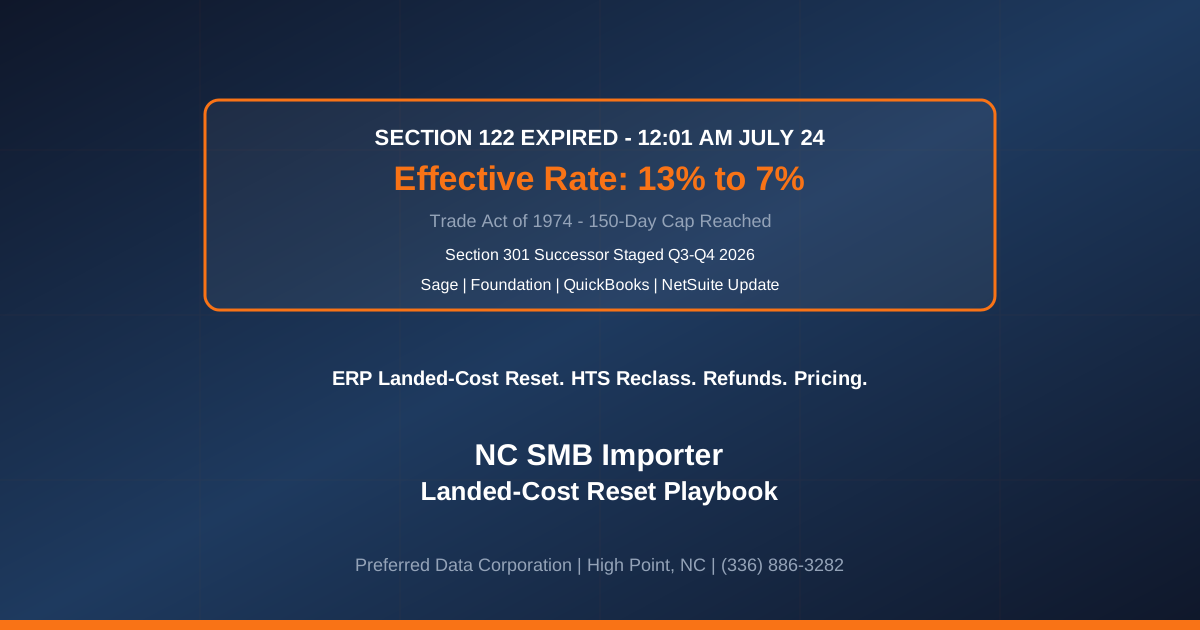
TL;DR: At 12:01 AM EDT on July 24, 2026 the Section 122 tariff — a 10% (later 15%) global import surcharge in effect since February 24 — statutorily expired under the Trade Act of 1974's 150-day cap. No extension legislation passed. Multiple analyses forecast the average US effective tariff rate falling from ~13% to ~7% overnight, according to Statt.com's expiration analysis and Center for American Progress. A Section 301 successor is being staged with proposed 10-12.5% duties across dozens of trading partners, but nothing has taken effect on Day 1. For North Carolina small-business importers — furniture manufacturers in the Triad, textile mills, medical-device distributors, food-service equipment resellers, electronics importers — July 25, 2026 is Day 2 of a landed-cost reset that most ERPs are not currently configured to reflect.
Key takeaway: Section 122 expiration is not a free-lunch tariff reduction; it is a compliance and cost-accounting reset event. NC SMBs need to (a) update ERP landed-cost logic today, (b) verify HTS codes remain correctly classified, (c) evaluate refund opportunities on tariff-affected inventory in transit, (d) prepare for a Section 301 or Section 232 successor, and (e) revisit customer pricing that priced in the surcharge.
Need help resetting Sage / Foundation / QuickBooks landed-cost logic before your next pay period? Contact Preferred Data Corporation at (336) 886-3282. BBB A+ rated, serving High Point, Greensboro, Winston-Salem, Charlotte, Raleigh, and the Piedmont Triad since 1987.
What Exactly Expired at 12:01 AM on July 24, 2026?
Section 122 of the Trade Act of 1974 authorizes the President to impose global tariffs — up to 15% and up to 150 days — in response to a balance-of-payments emergency. Statt.com's tariff analysis walks through the calendar: the tariffs took effect February 24, 2026 and expired at 12:01 AM EDT July 24, 2026, precisely 150 days later. No extension legislation cleared Congress, so the statute took over.
Three specific effects flowed from the expiration on Day 1.
- The 10% (mid-cycle raised to 15%) surcharge on most imports lapsed, dropping the applicable general tariff to the pre-February-24 baseline for the affected HTS categories.
- Section 232 products remain unchanged. Steel, aluminum, autos, and semiconductors were separately treated under Section 232 and were never inside Section 122 scope, per Freshfields' post-IEEPA tariff analysis.
- Section 301 investigations are staged as a successor. Thomson Reuters' post-IEEPA analysis notes that the US Trade Representative issued a Section 301 determination on June 2, 2026 proposing additional duties of 10-12.5% on dozens of trading partners. Section 301 has no statutory rate cap and no fixed expiration.
The average US effective tariff rate is projected to fall from ~13% to ~7% overnight, but the trajectory over the next 90 days is expected to reverse partially as Section 301 or new Section 232 actions phase in. That two-step — down today, partially back up over Q3-Q4 — is the operational reality NC importers need to plan around.
Who in North Carolina Is Actually Affected?
NC has a disproportionate exposure to imports across five sectors that concentrate in the Triad, Triangle, Charlotte, and Wilmington metros.
- Furniture and home-furnishings manufacturers and importers in High Point, Thomasville, Lexington, Hickory, and the broader Piedmont Triad. High Point alone is the historic furniture-market capital of the US, and many local firms import components from Asia, Vietnam, and Mexico.
- Textiles, apparel, and technical textile manufacturers in Charlotte, Gastonia, and the Piedmont region importing yarn, dye chemistry, and finished components.
- Medical-device and biotech firms in RTP, Wilmington, and Winston-Salem importing components, subassemblies, and finished devices.
- Food-service and hospitality equipment distributors across NC importing cookware, refrigeration, and specialty equipment.
- Electronics resellers and industrial-controls integrators importing PCB assemblies, sensors, and control modules for use in NC manufacturing and construction customers.
For every one of these, the July 24 expiration is a real cost-and-price event. Center for American Progress' pre-expiration analysis documented a 67% increase in small-business bankruptcies in Q1 2026 year-over-year, attributed in part to the tariff-driven cost pressure. Not all of that pressure reverses on Day 2, but the trajectory shifts.
What Are the Five Actions NC SMBs Should Take This Week?
A 7-day post-expiration action plan concentrates on the five items most likely to catch a small importer flat-footed.
- Day 1-2: Update ERP landed-cost logic. Sage 300 CRE, Foundation Software, QuickBooks Enterprise, NetSuite, and vertical-specific ERPs typically hardcode a tariff percentage into landed-cost calculations. Verify with your ERP admin or PDC's custom-software team that the 10-15% surcharge line item is removed for entries dated July 24 or later. Do not simply zero the number if you plan to price in a Section 301 successor; use a parameterized field.
- Day 2-3: Verify HTS classifications. Section 122's expiration does not affect Section 301 or Section 232 duties on the same HTS codes. If you have re-classified any product to minimize Section 122 exposure in the past six months, revisit the classification against the US Harmonized Tariff Schedule to confirm you are still filing correctly under the new baseline. A misclassification that saved money under Section 122 may now be an overpayment.
- Day 3-4: Evaluate refund opportunities. Duties paid on inventory that was in transit on July 24 may be eligible for reconsideration depending on the specific tariff line and the timing of liquidation. The Freshfields refund analysis frames the refund question. Coordinate with your customs broker.
- Day 4-5: Revisit customer pricing. If you added a "tariff surcharge" line item to invoices, quotes, or contracts during the Section 122 period, decide whether to (a) remove it, (b) rename it, or (c) hold it against the Section 301 successor. Customer-facing consistency matters here; changing pricing twice in six months erodes trust.
- Day 5-7: Prepare for the Section 301 successor. Thomson Reuters frames the Section 301 process as staged over Q3-Q4 2026 with proposed 10-12.5% duties. Build a scenario model with three tariff bands (0%, 10%, 12.5%) so pricing decisions during Q4 procurement cycles are informed.
Executed together, the five actions convert a compliance event into a modest margin recovery and a competitive pricing advantage over slower-moving competitors.
What ERP and Cost-Accounting Systems Actually Need Updating?
NC SMB importers run a heterogeneous ERP landscape. Five system categories need attention.
| System | Landed-Cost Config Location | Typical Update Effort | NC SMB Vendors of Note |
|---|---|---|---|
| Sage 300 CRE / Sage 100 / Sage Intacct | Inventory item cost tiers, purchase-order landed-cost setup | 2-4 hours | Contractor + wholesale distributor use |
| Foundation Software | Job cost / item master landed-cost table | 2-4 hours | Commercial construction + trades |
| QuickBooks Enterprise / QuickBooks Online | Item cost + custom-field landed cost + third-party landed-cost app | 3-6 hours | Very common in NC 5-50 employee importers |
| NetSuite | Item Landed Cost setup + Item Definition | 4-8 hours | Mid-market NC importers |
| PDC Software Suite (proprietary) | Vendor-cost table + rules engine | 1-3 hours | NC customers on custom PDC ERP |
| Custom-built spreadsheets, Access DBs, ad-hoc | Depends on the spreadsheet | 4-16 hours | Endemic in small NC importers |
The single most common problem PDC sees in NC importers is landed-cost calculations happening inside a hand-maintained Excel spreadsheet outside the ERP. Every tariff change is a chance for that spreadsheet to fall out of sync with reality, which produces pricing decisions on stale data. The 30-day post-expiration cleanup opportunity is to migrate spreadsheet landed-cost logic into the ERP or into a parameterized custom application.
How Does the Post-July-24 Landscape Compare to Section 301 and IEEPA?
Three separate tariff authorities matter for NC importers post-July-24, and only Section 301 is currently in staged deployment.
| Authority | Status Post-July-24, 2026 | Cap / Duration Limits | NC SMB Implication |
|---|---|---|---|
| Section 122 (Trade Act of 1974) | Expired | 15% cap / 150 days | Baseline restored for affected HTS codes |
| Section 301 (Trade Act of 1974) | Staged, 10-12.5% proposed | No statutory cap or expiration | Reintroduces trading-partner-specific duties Q3-Q4 |
| Section 232 (Trade Expansion Act of 1962) | Active — steel, aluminum, autos, semis | No statutory cap or expiration | Continues to affect NC steel + aluminum-based products |
| IEEPA (International Emergency Economic Powers Act) | Post-2026 status litigated | Broad presidential authority | Freshfields refund pathway analysis relevant |
The takeaway is that "tariff pressure" as an overall condition is not going away, even though Section 122 specifically expired. NC importers should treat July 24 as a reset opportunity, not a permanent cost reduction.
Ready to reset your landed-cost model and prepare for the Section 301 successor? Contact Preferred Data Corporation at (336) 886-3282 or visit 1208 Eastchester Drive, Suite 131, High Point, NC 27265. PDC custom-software and AI transformation can build the parameterized landed-cost model and scenario dashboards NC SMBs need for Q4 planning.
How Should NC SMBs Think About China-Plus-One, Reshoring, and Supplier Diversification Now?
The February-July Section 122 window drove real supplier-diversification conversations across NC importers. The July 24 expiration does not reverse those decisions; it recalibrates the payback math. Four practical implications.
- Vietnam, Mexico, and India diversification remains rational. Even if Section 122 is gone, Section 301 successor + Section 232 sectoral actions + IEEPA litigation together produce enough sustained pressure that single-source China concentration is more expensive over three years than diversified alternatives.
- Nearshoring to Mexico is more competitive than pre-tariff models suggested. USMCA-covered imports face lower duty than most alternatives even under the expired Section 122, and logistics cost + lead time from Mexico is often materially better than trans-Pacific.
- Reshoring to NC has moved from "aspirational" to "case-by-case competitive" for higher-value products. NC's manufacturing base, workforce, and infrastructure make reshoring viable for a growing subset of NC SMBs' import lines.
- Supplier-diversification data needs an ERP home. The lessons of Feb-July 2026 should be captured in a supplier-scoring model inside the ERP, not in a founder's head. This is a natural custom-software build for NC importers.
How Does the Tariff Reset Intersect With Cybersecurity, Cyber Insurance, and Data Governance?
Tariff and cybersecurity are more connected than they look. Three intersections worth noting.
- ERP admin access hardening. Every change to landed-cost logic is a change to ERP configuration. Ensure phishing-resistant MFA on ERP admin accounts and audit logging on config changes. A tariff-driven ERP config change is exactly the sort of event a Sage / Foundation / NetSuite compromise would hide behind.
- Vendor-payment fraud risk during transition. Post-expiration invoice reconciliation is a period of higher-than-normal invoice volume and unusual vendor communication, exactly the environment where business email compromise (BEC) succeeds. Enforce dual-authorization for wire transfers over policy thresholds.
- Supplier-diversification data as competitive intelligence. The list of alternate suppliers you evaluated in Feb-July is competitive intelligence that adversaries would pay for. Treat the supplier-diversification workbook as sensitive data, restrict access, and audit exfiltration.
For a Triad furniture manufacturer, a Wilmington medical-device importer, or a Charlotte industrial-controls integrator, the cybersecurity discipline that protected your Feb-July tariff planning is the same discipline that protects your Q3-Q4 Section 301 planning.
Frequently Asked Questions
Do we get an automatic refund on Section 122 duties we already paid?
Not automatically. Refund pathways depend on the specific HTS code, the entry-liquidation timing, and whether litigation (IEEPA-related or otherwise) creates a refund basis. Freshfields' post-IEEPA analysis is the current best public reference. Consult your customs broker.
Will the Section 301 successor start on Day 1?
No. The Section 301 process requires public comment, USTR determination, and (typically) a delayed implementation date. Realistic Section 301 successor tariffs are staged over Q3-Q4 2026. Section 232 sectoral actions may hit sooner for specific product categories.
Should we lower prices to customers now that tariff is gone?
Depends on your pricing structure. If you added a discrete "tariff surcharge" line item, remove or hold it explicitly. If you built the tariff into a general price increase, evaluate whether competitors will lower prices; being the first mover on a price reduction can lock in market share but erode margin. Model both scenarios before deciding.
Our ERP is QuickBooks Enterprise. How do we update landed cost?
QuickBooks Enterprise supports landed cost through a paid feature or through third-party apps. Update the tariff line item in your landed-cost calculation, or if you use a third-party app (SOS Inventory, QuickBooks Advanced Inventory landed cost), update the parameter in the app. Test with a sample transaction before running a period-end.
Does Section 122 expiration affect USMCA-covered imports from Mexico or Canada?
Section 122 already applied only to non-USMCA-covered imports; USMCA imports were largely unaffected. The July 24 expiration therefore does not materially change USMCA imports either way.
How do we tell if our HTS classifications are still correct?
Compare your current filed HTS codes against the US HTS descriptions and consult with your customs broker. If any classification was optimized specifically for Section 122 exposure, revisit it under the new baseline. Section 232 and Section 301 coverage of the same HTS codes may make prior optimizations obsolete.
What is the Trade Act of 1974's 150-day cap and can it be extended?
Section 122 imposes a 15% maximum tariff rate and a 150-day maximum duration, per the statute. Extension requires Congressional legislation, which did not clear before July 24. A future Section 122 imposition would restart the 150-day clock.
What are the top three ERP mistakes NC SMBs are making in the transition?
(1) Zeroing the tariff line item without documenting why, so post-Section-301 restoration is undocumented and error-prone. (2) Updating landed cost in inventory but not in cost of goods sold, producing mismatched financial statements. (3) Failing to reconcile against customs broker records for entries pending liquidation across the July 24 boundary.